The year was 1817, and London was slick with a persistent, weeping sort of rain. It was not a cleansing storm, full of thunder and theatricality, but a quiet, miserable drizzle that had begun in the morning and showed no sign of ceasing. It clung to the gray stone of the great townhouses in Mayfair, tracing dark lines down their facades like tears. It gathered in the hollows of the cobblestones, reflecting the gaslight and shivering distorted pools of gold. The air smelled of wet wool, damp earth from the parks, and the ever-present hint of coal smoke, a smell that was the very breath of the city.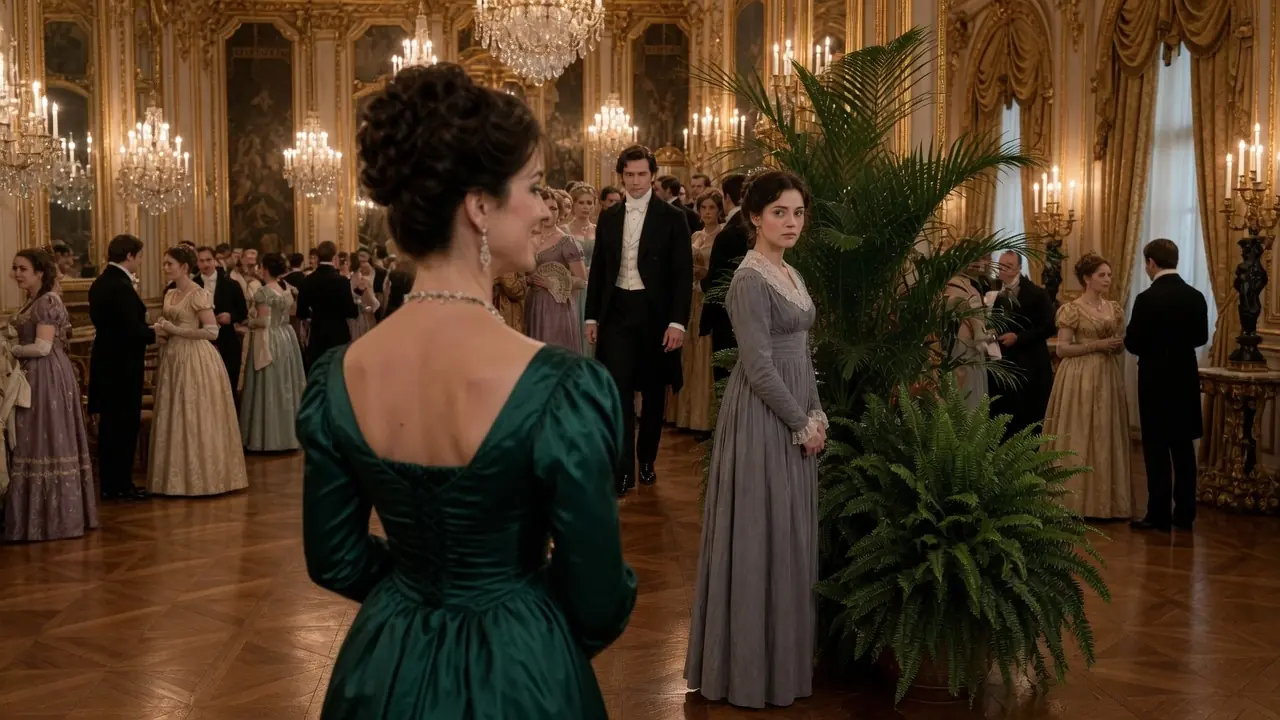
Inside the Chandford townhouse on a respectable, but not fashionable, square, the air was thick with a different kind of dampness. There was a silence that felt heavy and cold, broken only by the tick of a grand clock in the hall, counting out the seconds of a life that felt perpetually on hold. This was the world Helena Chandford had inhabited for the two years since her father's death. A world of muted colors, lowered voices, and the constant, oppressive presence of her stepmother, Lady Roxana Chandford. Tonight, however, the silence was supposed to break.
It was the night of the Duchess of Ambermere's annual ball, the glittering pinnacle of the early season, and the house was stirring with the rustle of preparation. Or part of the house was. From her own small room at the back of the second floor, Helena could hear the sounds from her stepmother's chambers. The light, quick footsteps of her ladies' maid, the murmur of satisfied comments, the soft swish of silk being laid out upon a bed. Helena sat on the edge of her own narrow mattress, her hands folded in her lap.
She was already wearing her chemise and stockings, waiting. She had learned to wait. It was the primary occupation of her life. Waiting for a summons, waiting for a pronouncement, waiting for the other shoe to inevitably drop. She was 23 years old, and in the two years since her father, Lord Chandford, had passed, her world had shrunk to the dimensions of this house and the rigid schedule her stepmother imposed.
Her father had been a man of finance, respected and admired. And his sudden death had left a void that Roxana had filled with an unnerving speed and totality. She had assumed control of the household, the finances, and Helena herself, all under the guise of grieving widowhood and protective stewardship. But Helena knew better. She knew the chill in her stepmother's smile, the brittle edge to her voice when she offered what sounded like a kindness.
And she knew the secret that gave Roxana her power. A secret held in a lacquered box in Lord Chandford's old study. A secret Roxana had revealed to Helena one dreadful afternoon, a month after the funeral. "Your father was not the man you thought he was, my dear. " Roxana had said, her voice smooth as cream.
She had laid out a small collection of papers. "He was on the brink of ruin, disgrace. " "These papers, they prove it. I have spent every waking moment since his passing protecting his name, your name, and you will help me. " The help required was simple, absolute obedience.
Helena was to live quietly, make no demands, and present a placid, untroubled face to the world, a testament to Roxana's devoted care. In return, the lacquered box would remain closed. Her name would remain untarnished. For Helena, who had worshipped her father, it was no choice at all. It was a sentence, and she had been serving it ever since.
A sharp rap on the door broke her reverie. "Miss Helena, Her Ladyship is ready for you. " It was Sarah, Roxana's maid. Helena stood, smoothing the front of her simple chemise. She did not bother to look in the mirror.
She knew the face that would look back at her. Pale, with serious gray-green eyes, and dark brown hair pulled back severely. It was a face she scarcely recognized as her own anymore. She walked down the corridor to Roxana's suite. The rooms were a world away from her own, decorated in shades of rose and gold, filled with French furniture, and the scent of expensive perfume.
Roxana was standing before a full-length cheval glass, a vision in shimmering emerald silk. The gown was the latest mode, its neckline daring, its fabric catching the candlelight with every slight movement. Diamonds glittered at her throat, and in her dark, upswept hair, she was a beautiful woman, and she knew it. She turned as Helena entered, her eyes a startling, vivid blue, sweeping over Helena's simple undergarments with a flicker of something that might have been disdain, or perhaps satisfaction. "Ah, Helena, there you are," she said, her voice bright and brittle.
"We must make haste. The carriage will be here within the hour. " She gestured to Sarah, "Bring it in. " Sarah disappeared for a moment and returned carrying a dress. She held it up and for a long moment, the only sound in the room was the ticking of the mantel clock.
The dress was gray, not a fashionable silver or a soft, dove gray, but a flat, lifeless, utilitarian gray. The fabric was a cheap, heavy muslin, the kind a lady's maid might wear for her morning duties. The cut was hopelessly out of date with a high, clumsy neckline and long sleeves devoid of any trim or adornment. It was a dress designed to make its wearer disappear. It was a shroud for a living girl.
Helena stared at it. She felt the blood drain from her face, a cold sickness rising in her stomach. This was a new level of cruelty. Before, it had been refitted gowns from years past, dresses chosen to be modest and unassuming. But this, this was a statement, a costume for a paid companion or a poor relation.
To wear this to the Ambermere Ball was not just to be overlooked. It was to be actively shamed. "It is serviceable," Roxana said, watching Helena's face with keen interest. "One cannot be seen to be extravagant in our delicate position. It speaks of good sense and economy.
You understand, of course? " Helena did not look at her stepmother. She looked at the dress, she understood perfectly. Roxana was tired of Helena's quiet dignity. She wanted to break it.
She wanted to see her weep, to beg. She wanted a public spectacle of Helena's diminished status, a confirmation of her own supreme authority. She did not cry. She had learned a long time ago that tears were exactly what Roxana wanted. She lifted her chin, her gaze still fixed on the drab fabric.
"Where did you find it, Stepmother? " The question was quiet, devoid of the anger and humiliation that was choking her. Roxana's smile tightened infinitesimally. "A very clever little seamstress, inexpensive, but thorough, it will do. " She waved a dismissive hand, "Now get dressed.
Helena would be the drab shadow that made her jewel-toned brilliance shine all the brighter. Helena took the dress from Sarah, whose eyes were full of a pity Helena could not afford to acknowledge. The fabric was coarse under her fingers. She turned without another word and walked back to her own room. She closed the door behind her and leaned against it, the terrible dress clutched in her hand.
For a moment, she allowed the mask to slip. The pain was a physical thing, a crushing weight on her chest, "Why? " Why this unending inventive cruelty? What had she ever done to inspire such hatred? But she knew the answer, she existed.
Her father had loved her more. That was her crime. And she was still being punished for it. She thought of the lacquered box, of her father's kind face, the way he would call her his sensible girl. He had believed in honor, in a good name.
She could not let that be destroyed, no matter the cost to her own pride. Pride was a luxury she did not have. Taking a slow, steady breath, she pushed away from the door. She would wear the dress. She would go to the ball.
She would stand in the corner and be invisible, she would endure. It was what she did. It was all she could do. The carriage ride was silent. Roxana was a study in composed anticipation, while Helena felt as though she were being transported to her own execution.
The gray dress felt like lead weights on her limbs. It chafed at her neck and wrists. She had done her own hair, pulling it into a simple knot at the nape of her neck, the way she always did. She wore no jewelry. She had none to wear.
Ambermere House was ablaze with light. A river of carriages disgorged the cream of London society onto a carpet laid across the damp pavement. The sound of music and a hundred conversations spilled out into the night. As they stepped out of their carriage, Helena instinctively shrank back, but Roxana's hand on her arm was like a vise, pulling her forward. The ballroom was a sea of color, light, and noise.
Chandeliers dripped with a thousand crystals, casting a brilliant, unforgiving light on the assembly. Jewels flashed, silks rustled, and the air was heavy with the scent of perfume and wax. Men in stark black and white stood in formal groups, while women in gowns of every conceivable pastel and jewel tone laughed and flirted behind their fans. And into this glittering ocean stepped Helena in her dress of dull, lifeless gray. The change was immediate.
It was not a sudden gasp or a pointing of fingers. It was more subtle and far more cruel. A series of small, sharp glances. A whispered comment behind a fan. The way conversations seemed to pause as she and Roxana passed, then resume with a new, avid energy.
She was not just being ignored. She was being noticed and judged, a curiosity, a scandal in muslin. Roxana, of course, was in her element. She moved through the room with a serene smile, greeting acquaintances. Her emerald gown was a beacon.
Helena trailed in her wake like a captured ship, her head held high, her eyes fixed on a point somewhere over the heads of the crowd. She would not look at them. She would not give them the satisfaction of seeing her flinch. They found a spot near a set of potted ferns, and there Roxana left her. "Do try to look pleasant, Helena.
You look like you're attending a funeral. " And with a final, satisfied glance, she swept away to join a group of chattering matrons. Helena stood by the ferns, feeling the fronds brush against the back of her dreadful dress. She felt like a specimen pinned to a board. The music swelled, the dancers swirled, and she was an island of gray in a sea of color.
People gave her a wide berth. A few younger ladies giggled as they passed, their eyes flicking over her with open scorn. Each glance was a tiny paper cut. Each whisper was a drop of acid. She focused on the orchestra, on the precise movements of the conductor's baton.
She cataloged the details of the room, the pattern of the plasterwork on the ceiling, the number of candles in the nearest sconce, the way the light fractured through the duchess's diamonds across the room. She retreated into her mind, the place Roxana could not touch. She did not know how long she had been standing there. 10 minutes, an hour, an eternity. The clock in the hall at home had a steadier, kinder rhythm than the frantic beating of her own heart.
She was just a ghost. She had to remember that. Ghosts could not be hurt. Then, she felt a change in the room. A subtle shift in the currents of conversation, a turning of heads.
The whispers did not die down, but their subject seemed to change. A path was clearing through the center of the ballroom floor. Down that path walked a man. He was tall, dressed in immaculate, severe black. His white cravat, a slash of starkness against the dark fabric.
His hair was the color of a raven's wing, and his face was all sharp angles and aristocratic planes. A face that gave away nothing. It was Barnaby, the Duke of Whitchurch. A man known for his immense fortune, his ancient title, and his formidable, icy reserve. He was the host's most prized guest, and he looked as though he would rather be anywhere else on Earth.
He rarely attended such functions, and when he did, he never danced. He would stand at the edge of the room, his expression unreadable, and leave at the earliest decent opportunity. The mothers of debutantes watched him with a mixture of awe and frustration. He was the greatest prize of the season, and he was utterly unattainable. Helena watched him, as everyone else did.
He moved with a quiet, deliberate grace, his sea-gray eyes scanning the room with a look of profound boredom. His gaze swept past her, then stopped, it returned. For one, two, three heart-stopping seconds, the Duke of Whitchurch looked directly at her. Helena's breath caught in her throat. She was certain he was looking at someone behind her, it was impossible.
He was looking at the drab gray mouse in the corner, but he was not looking at someone else. His eyes were on hers. There was no pity in them, no scorn, there was nothing. An unnerving, assessing stillness. And then he began to walk.
He did not walk towards the Duchess or towards any of the glittering belles who were now preening and positioning themselves in his line of sight. He walked across the vast, polished expanse of the ballroom floor. He walked directly towards the potted ferns. He walked directly towards her. A hush fell over the room, the whispers died.
The music seemed to falter. Every eye was on the Duke and on the strange, drab girl he was approaching. Helena felt a hundred pairs of eyes on her back, her skin burned. She wanted the floor to open up and swallow her whole. What was he doing?
Was this some new, elaborate form of humiliation? He stopped before her. He was even taller up close. A formidable presence that seemed to suck all the air from her immediate vicinity. She could smell the clean scent of starch and something faintly of the outdoors, of rain and cold air.
She forced herself to meet his gaze. His eyes were the color of the North Sea on a winter's day, flecked with darker gray, they saw everything. In the ringing silence of the ballroom, the Duke of Whitchurch bowed. It was not a cursory nod, but a formal, correct, deliberate bow. And then he spoke.
His voice was low, resonant, and carried easily in the quiet. "I find myself in need of a partner for the next waltz," He said, his eyes never leaving hers. "If you are not already engaged, Miss Chandford. " He knew her name. Helena's mind went utterly blank.
The room, the people, the music, it all receded to a distant hum. There was only this man, his impossibly calm, gray eyes, and his outstretched hand. This was not happening. It could not be happening. It was a dream, a feverish hallucination brought on by shame and despair.
But the hand was still there, waiting. She could feel Roxana's stare, like a physical blow, from across the room. She could feel the collective baffled outrage of every ambitious mother and daughter in London. To refuse was impossible. To accept was terrifying.
Her own hand, when she raised it, was trembling. She placed it in his. His fingers closed around hers, his grip firm and cool. "I am not engaged, Your Grace," she managed to whisper, the words feeling foreign in her own mouth, "Good," he said. And the Duke of Whitchurch, the man who never danced, led the girl in the servant's gray dress onto the floor.
The orchestra, as if waking from a trance, struck up the opening bars of a waltz. The Duke placed a hand on her waist, and the world began to spin. He was an excellent dancer, precise, controlled, leading her with an effortless strength that made it impossible to put a foot wrong. Helena felt weightless, a strange and forgotten sensation. She kept her eyes down, fixed on the knot of his cravat, unable to bear the hundreds of stares that she knew were dissecting them.
They did not speak. The silence between them was as profound as the silence that had fallen over the room. Helena was intensely aware of the warmth of his hand on her back. The cool strength of his fingers holding hers. She could feel the steady rhythm of his breathing.
One minute, two minutes. The waltz seemed to stretch into infinity. She ought to say something, thank you. Or ask him why. But the words would not form.
She was afraid that if she spoke, the spell would break. And she would find herself back by the ferns. The object of ridicule once more. Finally, she dared to lift her eyes to his. He was looking down at her.
His expression as unreadable as ever. Something moved at the corner of his mouth. Not quite a smile. It was the almost. "You are a better dancer than you believe yourself to be, Miss Chandford," he said.
His voice a low murmur meant only for her. "You are a better dancer than rumor would have it, Your Grace," she replied. The words surprising her with their boldness. The almost smile flickered again. "Rumor is often a poor substitute for fact.
" The final notes of the waltz hung in the air. The duke led her from the floor, not back to the ignominy of the potted ferns. But towards the grand terrace doors. He did not release her hand. He stopped just short of the doors and turned to her, he bowed again.
A final formal gesture of dismissal. "Thank you for the dance, Miss Chandford. " And then he was gone, melting back into the crowd as quietly as he had appeared. Helena stood frozen, her hand still tingling where he had held it. The room slowly came back to life around her.
But the quality of the sound had changed. The whispers were still there, but now they were not scornful. They were baffled, speculative, awed. She had been invisible. Now she was the most visible person in the room.
The Duke of Whitchurch had crossed a crowded ballroom to single her out. He had danced with her. He had spoken to her. In the space of a single waltz, he had taken her stepmother's carefully constructed humiliation and shattered it into a thousand pieces. She turned, and her eyes met Roxana's across the room.
The look on her stepmother's face was not one she would soon forget. It was a mask of pure, unadulterated fury, barely concealed by a brittle social smile. For the first time in two years, Helena felt something other than fear or resignation. It was a small, fragile seedling of a feeling, but it was there. It felt like hope.
The following morning, a footman delivered a card on a silver salver. It was thick, creamy white, and engraved with a severe, elegant crest. Helena, who was taking her solitary breakfast of toast and weak tea in the morning room, recognized it at once. The crest of the Duke of Whitchurch. Roxana, who had been pointedly ignoring her since their silent carriage ride home, snatched the card from the tray.
Her lips thinned as she read it. "The Dowager Duchess of Whitchurch requests the pleasure of your company for tea this afternoon, " "At 3:00. " She read aloud, her voice dripping with ice. She looked at Helena. Her blue eyes narrowed.
"What did you do? " "I danced with him, Stepmother, that is all. " "Do not play the simpleton with me, Helena. What did you say to him? " "He commented on my dancing.
I commented on his. " That was the extent of our conversation. Roxana stared at her searching for some sign of duplicity, of triumph. But Helena kept her expression perfectly neutral. She would not give her that satisfaction.
Inside, her heart was hammering against her ribs. The Dowager Duchess, the Duke's grandmother, a woman known to be as formidable and sharp as a shard of ice. Why would she want to see Helena? Was it to deliver a reprimand? To warn her away from her grandson?
"You will go, of course," Roxana said, her mind clearly working. "You will be polite. You will be modest. And you will report every word of the conversation back to me. " "Do you understand?
" "Perfectly," Helena said. Roxana tossed the card onto the table, "Wear the gray. It is suitable for a quiet afternoon call. " Helena knew it was a test. A reminder of who was in control, she simply nodded.
That afternoon, as the hall clock struck a quarter to three, Helena descended the stairs. She was wearing the gray dress. She had brushed it carefully and pressed the worst of the creases out with a cool iron herself. But it was still what it was. A badge of her lowly status.
Roxana was waiting in the hall, a satisfied smile on her face. The smile faltered slightly when she saw Helena. For Helena had done something unexpected. She had found, in the bottom of a trunk of her mother's things, a small, simple lace collar and matching cuffs. They were old, but exquisitely made.
She had spent the morning carefully tacking them onto the drab dress. The effect was transformative. The stark white of the lace against the flat gray relieved its severity, framing her face and slender wrists. It did not make the dress beautiful, but it gave it, and her, a quiet, deliberate dignity. It was a small act of defiance, too subtle for Roxana to forbid, but a statement nonetheless.
Roxana's eyes narrowed, but she said nothing. She simply waved her out of the door to the waiting hired carriage. Whitchurch House was on a grander square than their own. A vast, imposing edifice of Portland stone that seemed to look down its nose at its neighbors. The door was opened by a butler who looked as ancient and solid as the house itself.
He led her without a word through a cavernous, echoing hall filled with marble busts and portraits of stern-faced ancestors up a sweeping staircase and into a drawing room on the first floor. The room was surprisingly light and comfortable filled with books and comfortable-looking furniture rather than the stiff formality she had expected. A fire crackled in the grate and by it, in a high-backed wing chair sat a small, elderly woman. Hephzibah, the Dowager Duchess of Whitchurch, was tiny, with a cloud of snow-white hair and eyes as bright and black as a bird's. She was dressed in dark purple silk and a formidable collection of jet jewelry adorned her neck and wrists.
She watched Helena approach her head tilted to one side. "Miss Chandford," she said, her voice a dry rasp, "You came. " "I confess I was not entirely certain you would, " Helena curtsied, "Your Grace. You were kind enough to invite me. " "Kindness had nothing to do with it," the Dowager said briskly, "Curiosity, sit down, child.
" "The tea is about to arrive. " Helena sat on the edge of a brocade sofa her back straight, her hands folded in her lap. The Dowager's sharp eyes took in every detail of her appearance from the simple hairstyle to the mended lace at her collar. "That is a truly hideous dress," the Dowager remarked without preamble, helena blinked, "Yes, Your Grace. " "And yet you wear it well.
Or rather, you refuse to let it wear you. " "There is a difference. " A maid entered with the tea service and the Dowager fell silent until the girl had departed. She poured the tea herself, her movements precise and economical. "My grandson, as you may have noticed, is a man of few words and even fewer impulses," she began, handing Helena a cup.
"For him to cross a ballroom, to ask a young woman to dance, is the social equivalent of a volcano erupting in the middle of Hyde Park. The entire city is talking about it this morning. " "I am sorry if it has caused you or the duke any embarrassment," Helena said quietly, "Embarrassment? " The Dowager let out a short, sharp laugh. "My dear girl, it is the most interesting thing that has happened all season.
" "I have not been so entertained in years. I wish to meet the young woman who could provoke such a singular action. " She took a sip of her tea, her black eyes studying Helena over the rim of the cup. "Your stepmother is Lady Roxana Chandford, is she not? " "Yes, Your Grace.
" "I knew her mother, a fool of a woman who thought a title was a substitute for a character. " It seems the apple did not fall far from the tree. That emerald gown she was wearing last night cost more than a farmer earns in five years. And yet her stepdaughter is dressed in sackcloth. "Explain this to me.
" It was a direct command, not a polite inquiry. Helena felt her familiar knot of fear tighten in her stomach. To speak ill of Roxana was dangerous. But to lie to this woman seemed equally perilous and far more foolish. She chose her words carefully.
"My stepmother believes in economy, Your Grace. " "My father's estate was left in a more complicated state than was first believed. " "She feels it is important that we present a modest front, " "Modest? " The Dowager snorted. "There is modesty and there is public mortification.
" "That dress was not an act of economy. It was an act of war. " "And you, my dear, are the battlefield. " Helena said nothing. She looked down into her teacup.
The Dowager had seen straight through the pretense with terrifying clarity. "And you do not fight back," the Dowager continued more to herself than to Helena. You stand your ground. You hold your head up. You put on your mother's lace and you face the enemy, "Why?
" This was the heart of it. The question she could not answer. The secret she had to protect. "I loved my father, Your Grace. I wish to protect his memory.
" The Dowager was silent for a long moment. She set her cup down. "A good answer," she said at last, "Loyalty. " "It is a rare enough commodity and a dangerous one. " She leaned forward slightly.
"Let me be plain with you, Miss Chandford. " I am an old woman. I have no time for social niceties. My grandson is the head of this family and it is his duty to marry and produce an heir. For the past three seasons, I have watched every simpering ambitious chit in London throw herself at his head.
They see his title and his fortune. They do not see him. They do not want to, "You. " She paused, her eyes sharp. "You did not look at him with avarice.
" You did not look at him at all until you were forced to, "This interests me. " She stood up and walked to a small writing desk. She came back with a small sealed envelope. This is the card of a modiste, a Madame Dubois. She is discreet and her taste is impeccable.
She is expecting you tomorrow morning. You will be properly attired for the rest of the season. The bills will be sent to me. Helena stared at the envelope speechless. "Do not look so shocked, child.
It is not an act of charity. " "It is an investment. " "I am investing in a more interesting season. " The Dowager sat back down. "I am also hosting a small dinner party on Friday evening.
" "My grandson will be there. I expect you to attend. " A formal invitation will be sent, "Your Grace, i, my stepmother. " "Your stepmother will not dare to refuse an invitation from me," the Dowager said with absolute certainty. "And you will not arrive in that gray monstrosity, is that understood?
" "Yes, Your Grace," Helena whispered, "Good. " The Dowager gave a brisk nod, a signal that the audience was over. "I find I am suddenly very tired. You may see yourself out. " Helena walked out of Whitchurch House in a daze.
The world looked different. The rain had stopped and a pale watery sunlight was breaking through the clouds. In her hand she clutched the Dowager's envelope like a holy relic, an alliance, an ally. She had an ally. The visit to Madame Dubois was a revelation.
The modiste was a tiny, energetic French woman who looked at Helena's gray dress with a look of profound horror, clucking her tongue, "Mon Dieu, c'est un crime. " Then, under the Dowager's instructions, she began to work her magic. She did not try to turn Helena into a diamond of the first water. Instead, her choices were subtle, elegant, and perfectly suited to Helena's quiet beauty. A walking dress of deep blue merino, a simple afternoon gown of printed muslin in shades of lavender, and for the Dowager's dinner party, a gown of pale, luminous green silk that made Helena's eyes seem more green than gray.
When Helena returned home that evening, Roxana was waiting. The formal invitation from the Dowager Duchess had indeed arrived. Roxana could not refuse it, but her fury was palpable, "A new dress? " she hissed, her eyes taking in the box from the modiste that a footman carried. "How did you manage that?
" "The Dowager Duchess insisted," Helena said, her voice calm. "She felt my current wardrobe was insufficient for her dinner party. " She did not mention the other gowns. She did not mention the account the Dowager had opened. She held her secrets close, just as Roxana held hers.
The dinner party was an intimate affair, only 12 guests. The duke was there, of course. He greeted her with a cool, formal nod. His expression giving nothing away. But, Helena saw the way his eyes lingered for a fraction of a second on her green gown.
She was seated not next to him, but across the table. She spent most of the dinner speaking with a kindly old baronet on her left. But, she was aware of the Duke's presence in every fiber of her being. She felt his gaze on her from time to time. A quiet, assessing weight.
After dinner, the ladies retired to the drawing room. The Dowager drew Helena to a seat beside her, effectively shielding her from the curious glances of the other women. When the gentlemen rejoined them, the Duke did not immediately approach. He stood by the fireplace, speaking with another guest. But, later, as Helena was looking at a collection of miniatures on a side table, he appeared at her elbow.
"My grandmother seems to have taken a liking to you, Miss Chandford. " He said, his voice a low rumble. "She has been very kind. " Helena replied, not looking at him. She was focused on a tiny portrait of a woman with sad eyes.
"Kindness is not a word I generally associate with my grandmother, " "Strategic, perhaps, perceptive, never kind. " "Then, I am honored by the exception. " "The green suits you. " He said, changing the subject. "Thank you, Your Grace.
" "It was the Dowager's choice, " "Was it? " He was silent for a moment. "I have a library at my estate in the north, old Town. " "It is filled with books bound in precisely this shade of green. " My great-grandfather had a fondness for it.
It was an odd, personal detail to share. Helena finally turned to look at him. "Old Town, that is a stark name for an estate. " A shadow passed through his eyes. "It is a stark place, or it has become so.
" My family has neglected it for a generation. "I am attempting to bring it back to life. " There was a depth of feeling in his voice that surprised her. She saw not the cold duke, but a man burdened by duty and private grief. "It is a worthy endeavor, Your Grace, to build something that lasts.
" He looked at her then, a long, searching look. "Yes," he said slowly, "it is. " From that night on, Helena's life changed. Under the Dowager's formidable wing, she was included in the right parties, the right concerts, the right excursions to the country. Dressed in her new, elegant wardrobe, she was no longer the gray mouse.
She was Miss Chandford, the Dowager Duchess of Whitchurch's mysterious protege. The whispers followed her still, but now they were of a different sort, who was she? Where had she come from? What did the duke see in her? She ignored them all.
Her interactions with the duke remained brief and frustratingly public. A shared glance across a crowded room, a formal bow, a few stilted words about the weather or the music. Yet, with each encounter, she felt the connection between them deepen. It was a silent conversation, a recognition that passed between two people who did not belong in the glittering frivolous world they inhabited. She learned to read the subtle shifts in his guarded expression.
The slight tightening of his jaw when a particularly foolish fop spoke to him. The way his eyes would soften almost imperceptibly when he looked at his grandmother. The almost smile that appeared only when he spoke to Helena. One afternoon she found him alone in the Dowager's library. He was not reading but staring into the fire.
His face etched with a profound weariness. He looked up as she entered and for a moment he did not mask his expression. She saw a loneliness in him that mirrored her own. "Miss Chandford," he said, his voice rough. He seemed to recover himself, "Forgive me.
I was lost in thought. " "I can come back later," she said, hesitating at the door, "No. Stay. " She walked further into the room. The scent of old paper and leather a comforting blanket. She did not ask what was wrong.
She simply stood by the fire sharing the silence with him. After a long moment he spoke his voice low. "I received word this morning from Old Town. " "The west wing roof has collapsed after the winter storms. " He shook his head a gesture of deep frustration.
"Another piece of the past crumbling into dust. " "You can rebuild it," she said softly, "Can I? " He looked at her his sea-gray eyes dark with doubt. "It takes more than money and stone, Miss Chandford. " "It takes hope, a belief in the future.
" Something my family has been sorely lacking. "Then you must be the one to find it again," she said. He held her gaze. And in that moment, the distance between them of rank, of wealth, of society's expectations seemed to vanish. There were only two people in a quiet room sharing a glimpse of the truth of their lives.
"Perhaps," he said, his voice barely a whisper. "Perhaps you are right. " The moment was broken by the sound of the Dowager entering the room. Her cane tapping a sharp rhythm on the floorboards. But the connection had been made.
A fragile thread spun in silence and shared vulnerability. Roxana watched all of this with a simmering rage. Her plan had backfired spectacularly. The girl she had tried to humiliate was now the talk of the town poised to make the match of the century. Roxana's own social standing which she had thought secured was now tied to the stepdaughter she despised.
She could not harm Helena publicly without harming herself. So she turned to the weapon she still held. One evening, after Helena returned from a concert Roxana was waiting for her in her room. The lacquered box was open on the dressing table. "You are becoming quite the celebrity, my dear," Roxana said.
Her voice deceptively sweet. "But do not forget on what foundation your new life is built, on my silence. " She picked up one of the letters. "Your father's good name. It is so very fragile.
" "A word from me to the right person. A whisper to a gossip columnist. " And the great Duke of Whitchurch might find his interest waning when he learns he is courting the daughter of a charlatan and a thief. The cold fear was back, gripping Helena's heart, "You would not. " "Oh, I would," Roxana said, her smile turning vicious.
"Do not for one second imagine that I would not. " "You are enjoying your little moment of triumph. Enjoy it while it lasts. " "But remember who allows it. Remember who can take it all away with a single word.
" She closed the box with a sharp snap. "Have a pleasant night's sleep, Helena. " Helena stood frozen in the center of the room long after Roxana had gone. The joy she had begun to feel, the fragile hope that had taken root in her heart, shriveled under the frost of her stepmother's threat. She could not bring this shame to the Duke, to his name, to his family.
He, who was so dedicated to restoring his own family's honor, could not be tied to the disgrace of hers. The budding romance was not a fairy tale. It was a time bomb. And Roxana held the detonator. Helena knew then that she had to end it.
She had to push him away for his own good. The thought was a shard of ice in her chest. She had just begun to feel alive. And now she had to choose to go back to the gray, silent world she had inhabited before. It was the only honorable thing to do.
It was the only choice she had. For a week, Helena practiced the art of avoidance. She developed a sudden headache when the Dowager's carriage was announced. She was busy with a seamstress when an invitation to ride in the park arrived. At a large route, she caught the duke's eye across the room.
And instead of thefering a small, shared smile, she turned away. Her heart hammering with the pain of the rejection she was inflicting. She saw the confusion in his gaze, then the cooling of it. The return of the icy mask he wore so well. He did not pursue her.
He was too proud a man for that. He simply withdrew, leaving a cold, empty space where his quiet presence had been. The Dowager summoned her. "What is the meaning of this foolishness, girl? " She demanded, her black eyes snapping.
"Are you a child to play these games of push and pull? " "I am not worthy of the duke's attention, Your Grace," Helena said, her voice low, her eyes on the carpet. It was the truth, just not the one the Dowager suspected, "Not worthy? " The old woman scoffed. "You are the only woman in this godforsaken city who is.
" You have more sense and steel in your little finger than the rest of them have in their entire empty heads. "Do not insult my intelligence or my grandson's by pretending otherwise. " "What is it? What has she done? " She knew, of course.
She knew it had to be Roxana. "It is a private family matter, Your Grace, i cannot. " "Cannot or will not? " The Dowager cut in sharply. She sighed, a sound of deep frustration.
"Loyalty is a virtue, Helena, but loyalty to a memory at the expense of your own life is a fool's errand. " Your father would not want this for you. But what would he want? For his name to be dragged through the mud? For the world to believe he was a fraud?
The thought was unbearable. Roxana, sensing victory, became bolder. She began making comments in public, veiled references to the unfortunate circumstances of Lord Chandford's finances, the brave face Helena was putting on. She was laying the groundwork for the reveal, salting the earth so that nothing could grow for Helena again. The breaking point came in the form of a small folded note slipped under Helena's door.
It was not from the duke or the Dowager. It was from Sarah, Roxana's maid. "Her Ladyship met with Mr. Finch from the Morning Post today in the study. " "She showed him papers from the box, " "Be careful. " Helena's blood ran cold.
Finch, a notorious gossip columnist, a man who traded in ruin and scandal for coin, it was happening. Roxana was making her move, panic seized her. She paced her small room, her hands clenched. She could let it happen. She could retreat into the shadows and let the scandal break, destroying her, but saving the duke from any association.
Or or she could fight. Not for herself, but for the truth. The Dowager's words came back to her. Loyalty to a memory at the expense of your own life is a fool's errand. What if her memory was wrong?
What if the story Roxana had told her was the lie? Not her father's life. She had never truly looked at the letters. She had accepted Roxana's version of them, blinded by grief and fear. She had to see them.
She had to know. That night, she waited until the house was deep in sleep. The clock in the hall struck two. Barefoot, holding a single candle, she crept down the stairs. The house was a place of shadows, full of creaks and groans she had never noticed before.
The study door was unlocked. Roxana had grown careless in her confidence. The room was just as her father had left it, except for Roxana's perfume, which hung faintly in the air. The lacquered box was on the corner of the desk. Her hand trembled as she reached for it.
It was not locked. She lifted the lid. The letters were there, tied in a faded ribbon. With shaking fingers, she untied it. She sat in her father's chair, the chair he had sat in every night, and began to read.
The candle flame flickered, casting long, dancing shadows on the walls. She read through letters from her father's man of business, account ledgers, and drafts of his own correspondence. At first, it was as Roxana had said, talk of debts, of overextended credit, of accounts in disarray. Despair washed over her. It was true, but she kept reading.
She would know the whole truth, no matter how ugly. And then she saw it. A name mentioned once, then again. A Mr. Alister Finchley, no, not Finch, alister Finchleyley, a business partner. The letters began to change in tone.
Her father was not confessing to fraud. He was investigating it. "I fear Finchley has entangled our accounts in a scheme of remarkable audacity. " "I cannot yet prove it. " "But I believe he is using our firm's credit to finance his own speculative ventures, leaving us liable for the losses.
" "I must move carefully, " Another letter. A draft to his solicitor. "I have the proof. Finchley's own ledger, which I secured last night. " "It details the entire deception.
" "He has ruined a dozen men. " "I intend to present this to the authorities on Monday. " The letter was dated the Friday before his death. He had died on Sunday of a sudden heart seizure. He had never made it to Monday.
It was not her father's disgrace. It was his last unfinished act of honor. He had died trying to stop a criminal, and Roxana, helena's mind raced, roxana knew Finchley. He had been a frequent visitor in the months after her father's death. He was the source of her new extravagant income, they were partners.
Roxana had not been protecting her father's name. She had been protecting his business partner. The man who had caused his death and had used the twisted truth to imprison Helena. The rage that filled her was a clean, pure fire. It burned away the fear, the grief, the years of submission.
She was not the daughter of a thief. She was the daughter of a hero. She knew what she had to do. She could not do this alone, she needed help, she needed him. Taking the most crucial letters, she left the box and crept back upstairs.
She did not sleep. She dressed, not in gray or green, but in the practical dark blue traveling dress Madame Dubois had made her. At dawn, before the city was truly awake, she slipped out of the house. She did not take a carriage, she walked. The streets were quiet, washed clean by the night's rain.
She walked with a purpose she had not felt in years. She walked to Whitchurch House. The ancient butler who opened the door looked at her in astonishment. A young lady, alone, unchaperoned at this hour. "I must see the Duke," she said, her voice clear and steady.
"It is a matter of the utmost urgency. " She would not be denied. The butler, seeing the look in her eye, seemed to understand this. He led her not to a formal receiving room, but to a small private study at the back of the house. The Duke was there, already dressed.
He was standing by the window, a cup of coffee in his hand. He turned as she entered, and his face was a mask of cold surprise. "Miss Chandford, this is unexpected. " "Forgive me, Your Grace," she said, her voice shaking slightly now that she was here. "I know this is a terrible breach of propriety, but I had nowhere else to turn.
" She walked to the desk and laid the letters down. "My whole life for the past two years has been a lie. " "I need you to help me find the truth. " He looked from the letters to her face, his eyes searching hers. The coldness in them began to melt, replaced by a dawning concern.
He put his coffee cup down. "Tell me everything," he said. And so she did. She told him about her father, about Roxana's cruelty, about the lacquered box and the threat that had hung over her. She told him of her discovery in the night.
Her voice was low and steady as she recounted the facts. But when she spoke of her father's honor, it broke with a pain she could no longer contain. She did not weep, but a single tear traced a path down her cheek. He listened without interruption, his gaze never leaving her face. His expression was unreadable, but he did not move, did not speak until she was finished.
The silence in the room was absolute. "She told me I was not worthy of you," Helena finished, her voice a whisper. And I believed her. I believed I would bring shame to your name. I came here tonight to give you a chance to to step away before the scandal breaks.
Mr. Finch of the Morning Post will publish the story any day now. The one Roxana gave him. She had laid her soul bare. She had given him her family's ruin, her own humiliation. She expected him to be cautious, to be distant, to thank her for the warning and show her to the door.
He did not look guilty. That was what she noticed the most sharply, he looked angry. A cold, controlled fury that was more terrifying than any shouting. He walked around the desk and he picked up the letters. His long fingers were deft as he sorted through them.
His eyes scanning the pages with a speed and comprehension that spoke of a lifetime of dealing with such documents. "This is not a scandal, Miss Chandford," he said, his voice hard as iron, "This is evidence. " He looked up at her and the full force of his gaze held her. "Your father was an honorable man, a brave one. " "And you are his daughter.
" He walked to the bell pull. "You will not be stepping away. And neither will I. " We will face this together. When the butler appeared, the Duke gave a series of quiet, rapid orders.
His man of business was to be summoned, his solicitor. A message was to be sent to the Dowager. And breakfast was to be brought for Miss Chandford, who would be staying, helena watched him. A sense of unreality washing over her. He was not casting her aside.
He was marshaling his forces. He was taking her side. "But what about Finch, the newspaper? " she asked, fear still a knot inside her. A grim, dangerous smile touched the Duke's lips.
It was the first real smile she had ever seen from him. "Mr. Finch is about to receive a much more interesting story to print," he said. "And Mr. Finchley is about to have a very, very bad day. " The final ball of the season was held at the home of the Marquess of Fleet. It was the most sought-after invitation, the glittering culmination of months of social maneuvering.
Helena had never expected to attend, but she arrived on the arm of the Duke of Whitchurch. She wore a gown of the deepest sapphire blue, a color chosen by the Duke himself. "It matches the ink your father used in his ledgers," he had told her. A strange, poetic compliment that had made her heart ache. The color of truth.
As they entered the ballroom, a wave of whispers followed them, a testament to the rumors that had been flying all week. The Duke's open courtship of the mysterious Miss Chandford had been the talk of the town, but the story Roxana had planted was also beginning to circulate, a poisonous undercurrent. Helena held her head high. The fear was gone. Standing beside Barnaby, she felt a strength she had never known.
They saw Roxana across the room. She was with a group of her cronies and with a portly, florid man Helena recognized from a portrait as Alister Finchleyley. Roxana's face, when she saw Helena with the Duke, was a picture of disbelief, which quickly curdled into malevolent confidence. She believed her trap was about to spring. She began to walk towards them, a predatory smile on her face.
"Your Grace," Roxana said, her voice dripping with false sympathy as she reached them. "And Helena, my dear, how brave of you to show your face. " "Why should she not, Lady Chandford? " The Duke's voice was dangerously quiet, roxana's smile widened. "Oh, I think we all know.
" "The sad truths about my late husband are bound to come out. " "It is a terrible shame. But one cannot hide from one's past. " She looked pointedly at a man standing near them who Helena now recognized as the gossip columnist, Mr. Finch. But before Finch could speak, another man stepped forward.
He was elderly with a tired, dignified face. The Duke inclined his head. "Lord Ashworth, thank you for coming. " "Finchley," Lord Ashworth said, his voice shaking with an old anger. He ignored everyone else and stared at Roxana's companion.
"I thought I would never see you again, you villain. " Finchley's face went pale. "I don't know what you mean. " "You know precisely what I mean. " Lord Ashworth said, his voice rising, "You ruined me.
You and your schemes. " And Lord Chandford, he knew. He was going to expose you. He told me so himself the day before he died. A collective gasp went through the onlookers.
The Duke stepped forward, his presence commanding silence. "Lord Chandford was indeed on the verge of exposing a massive fraud perpetrated by Mr. Finchley," he said, his clear voice carrying through the room. A fraud that ruined Lord Ashworth and several others. Lord Chandford's death prevented him from delivering his evidence to the authorities. Evidence which has, fortunately, now come to light.
He produced a single sheet of paper. It was a copy of the ledger page, authenticated by his solicitor. He did not show it to the crowd. He showed it to Mr. Finch. The columnist's eyes widened as he read it.
He looked from the paper to the pale, sweating face of Finchley, to the triumphant face of Roxana, which was now a mask of horror. He was a jackal, but he was a journalist. He knew a real story when he saw one. Roxana had been undone. Her lies were exposed.
Her source of income about to be arrested. Her social standing in ruins. She looked at Helena. Her eyes filled with a pure, unadulterated hatred that was terrible to behold. And in that hatred, for the first time, Helena saw not a monster, but a pathetic, frightened woman who had built her life on lies, and now had nothing left.
The antagonist's defeat was not just satisfying. It was also deeply, profoundly sad. Without a word, Roxana turned and fled. The duke did not watch her go. He turned to Helena, his sea-gray eyes soft.
In the middle of the crowded ballroom, with the entire world watching, he took her hand. "Helena," he said, using her given name for the first time. It sounded like a prayer on his lips. "I believe I asked you a question once before, on a night not unlike this one. " He went down on one knee, the crowd gasped.
"That night, I asked for a dance. " "Tonight, I ask for your life, for your heart, for the right to stand beside you, always. " "Helena Chandford, will you do me the profound honor of becoming my wife? " Tears streamed down Helena's face. But these were not the tears of sorrow Roxana had so longed to see.
They were tears of joy, of release, of a love she had never thought possible, "Yes," she whispered, "Barnaby, " "Yes, " Epilogue, one year later. The air at Old Town was crisp and clean, smelling of damp earth, pine, and the distant sea. The estate was no longer stark. The west wing roof was repaired, its new slate gleaming in the autumn sun. The gardens, long overgrown, were being patiently reclaimed, and the first late roses were blooming against a south-facing wall.
The house felt different, as though it had been holding its breath for a very long time, and had finally been allowed to exhale. Helena, Duchess of Whitchurch, stood in the newly restored library. The room was filled with afternoon light, which fell across the shelves of books bound in that particular shade of green. She ran her hand along a worn leather spine, a quiet smile on her face. The door opened, and Barnaby came in.
He was not the cold Duke of London society. Here, at Old Town, in his country clothes, with his hair slightly ruffled by the wind, he was simply her husband. He came and stood behind her, wrapping his arms around her waist, his chin resting on her shoulder. "What are you thinking about? " he murmured against her hair.
"About how a hideous gray dress can lead to all of this," she said, leaning back against him. He was silent for a moment. "That dress," he said, his voice soft. "When I saw you in it, everyone else saw a victim. " "I saw a queen in disguise.
" "I saw your strength, your defiance, i saw you. " "I had been waiting my whole life to see you. " She turned in his arms to face him. The almost smile she had once treasured was now a full, real smile, one that reached his sea-gray eyes and transformed his face. It was a smile he saved only for her.
"And I saw a man who needed someone to help him rebuild his roof," she teased gently. "And so you have," he said, his expression turning serious. He placed a hand over her heart. "You have rebuilt all of it, Helena.
You have brought it all back to life. " He lowered his head and kissed her. A slow, deep kiss full of the quiet promises of a lifetime. The past was not forgotten.
The scars remained, a reminder of the cost of cruelty and the long work of healing. But here, in the quiet of the library, surrounded by the evidence of a future they were building together, there was only peace. They had reclaimed their names, their honor, and themselves. They had found a love that was not a prize to be won or a transaction to be made, but a quiet, chosen act, an act of seeing and of being truly seen, and it had made all the difference.