The worst kind of cruelty isn't a slap across the face. It's a joke played at your expense, meticulously orchestrated to ruin what little dignity you have left. 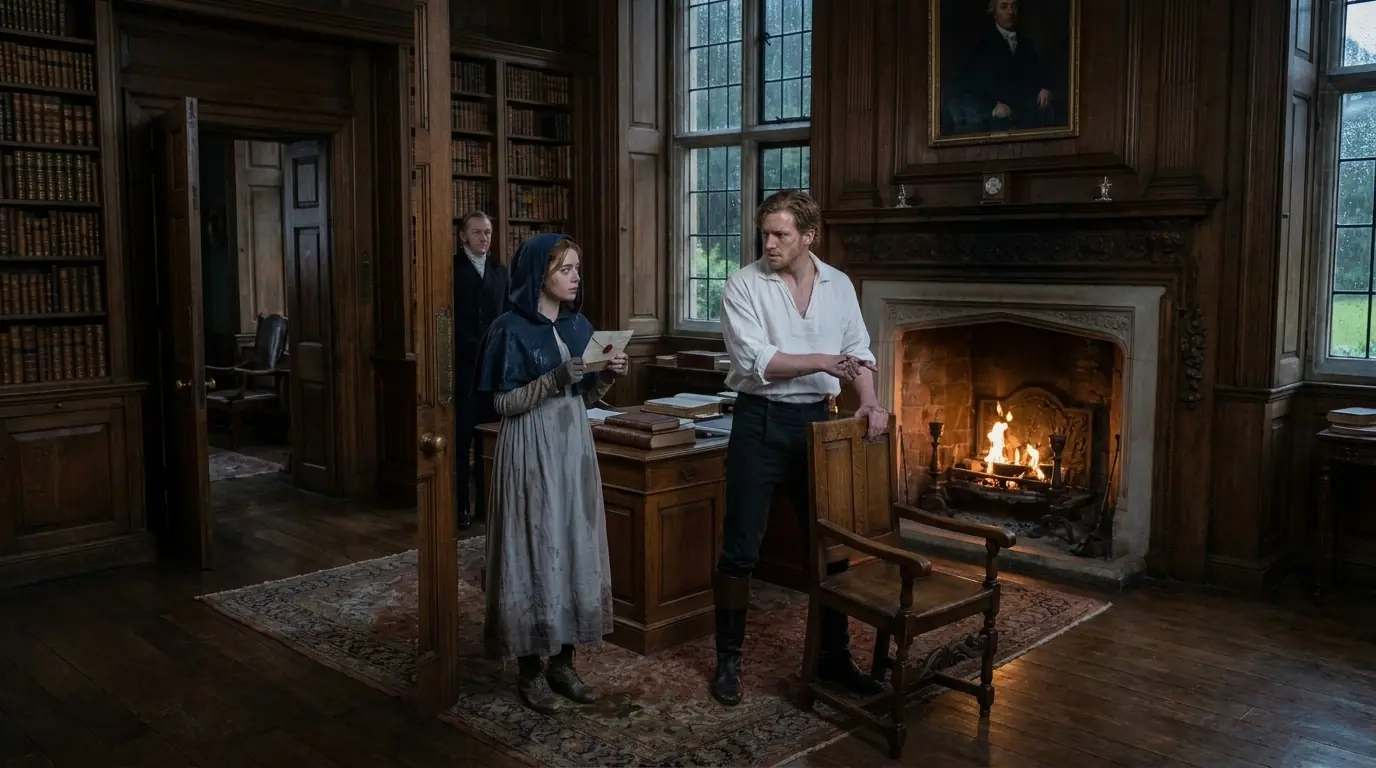
When her stepmother shoved her into a carriage bound for the notoriously ruthless Duke of Westland, it was supposed to be the punchline of the season. She was meant to be laughed out of his estate and ruined in the papers. Instead, she walked into his study, drenched and shivering, and he did the one thing she never expected. He pulled out a chair.
Rain lashed against the thin glass of the hired hack, bleeding the vibrant greens of the countryside into a muddy, bruised purple. Norah Hawthorne sat stiffly on the cracked leather seat, her hands folded in her lap. She was twenty-four years old, though her eyes—slate gray and deeply tired—belonged to a woman twice that age. Her cloak was wool, dark navy, and inadequate. The damp had seeped through the shoulders hours ago. Beneath it, her gown was a faded gray muslin, mended three times at the hem. It was not the gown of a woman calling upon a duke. It was the gown of a governess, a spinster aunt, a ghost haunting the edges of a family that didn't want her.
Tucked into her reticule was a letter sealed with the heavy crimson wax of her stepmother, Lady Agatha. Norah replayed the morning in her mind: the clinking of silver spoons against porcelain in the breakfast room, the smell of hot buttered scones that she was not invited to eat. Agatha, draped in rose-colored silk, holding out the parchment with a smile that barely stretched past her teeth.
"The Duke of Westland has written, Norah," Agatha had lied, her voice dripping with artificial sweetness. "He seeks a bride of quiet disposition. I have replied on your behalf. You are to go to Rookwood at once. Do not dally. A duke does not wait."
Behind Agatha, her two daughters, Clara and Jane, had pressed their napkins to their mouths to muffle their giggles.
Norah was not a fool. She knew Alistair Radcliffe, the Duke of Westland, was not seeking a bride. He was a recluse, a man who had returned from the Peninsula with a severe limp, a terrible temper, and a profound disgust for polite society. He spent his days managing his vast tenant farms and breeding hounds. He was known to turn away viscounts at his gates. He certainly had not written to Agatha Hawthorne asking for the hand of her penniless stepdaughter.
It was a trap, a meticulously designed humiliation. Agatha had likely written a letter so absurdly presumptuous, so dripping with misplaced desperation, that the Duke would explode in a rage. He would throw Norah out into the mud, and by tomorrow, Agatha would ensure the gossip columns in London knew all about it. The desperate Hawthorne spinster, turned away at the gates of Rookwood after throwing herself at a duke. It would finalize Norah's social death. It would ensure she could never leave Agatha's house, condemning her to a lifetime of unpaid servitude—managing the ledgers and mending the linens while the legitimate daughters danced at Almack's.
The hack hit a rut, jolting Norah's teeth together. She swallowed the metallic taste of blood where she had bitten her tongue. She could have run. She could have asked the driver to turn around or to take her to a coaching inn. But she had exactly four shillings to her name. Running required capital. Surviving required endurance. She had survived Agatha for ten years since her father's passing. She could survive one angry aristocrat.
The carriage slowed, the wheels crunching over a thick gravel drive. Norah wiped the condensation from the glass. Rookwood loomed out of the storm. It was not the pristine, manicured palace one expected of a dukedom. It was a sprawling, ancient beast of dark stone, heavy with ivy and shadowed by massive, twisted oak trees. It looked exactly like a place where a man might retreat to hate the world in peace.
The carriage jerked to a halt. The driver, a miserable-looking man with a soaked hat, didn't bother to open the door. Norah opened it herself, stepping down into an inch of freezing mud. The cold bit through her thin leather boots instantly. She paid the driver his fare—three of her four shillings—and watched the hack turn and rattle away back down the long drive, leaving her entirely alone in the pouring rain.
There was no turning back.
Norah climbed the wide stone steps. They were slick with moss at the edges. She lifted the heavy iron knocker, shaped like a hound's head, and let it fall. It landed with a dull, resounding thud that echoed through the heavy oak door. For a long moment, nothing happened. Only the sound of the rain drumming against her hood.
Then, the locks turned. The heavy door groaned inward, revealing a cavernous entry hall lit by flickering sconces. A butler stood in the doorway. He was tall, thin, and impeccably dressed in black, though his face carried the same weathered, exhausted look as the estate itself. He looked at Norah, at her dripping cloak, at her muddy boots. He did not look impressed, nor did he look surprised. He simply looked waiting.
"I have a letter," Norah said, her voice rough from disuse. She did not try to sound grand. She did not try to smile. She reached into her reticule, pulled out the heavy, crimson-sealed parchment, and held it out. "From Lady Agatha Hawthorne, for His Grace, the Duke of Westland."
The butler's eyes flicked to the seal. A subtle tightening around his mouth was the only sign of his displeasure. He did not take the letter.
"His Grace is not receiving callers."
"I am aware," Norah said evenly. A drop of freezing water slid off her nose and landed on the parchment. "I am not a caller. I am a delivery. If you turn me away, I will simply stand on your steps until I freeze, at which point you will have to move my body, and I assure you, I am heavier than I look."
The butler blinked. It was a slow, deliberate blink. Then, he stepped aside.
"Wait here."
He turned and walked down the long, shadowed corridor, his footsteps swallowed by the worn Persian runner. Norah did not move. She stood precisely where she was, letting the water pool around her feet on the cold marble floor. She braced herself. The explosion would come soon. She mentally cataloged her remaining layers of defense: stoicism, silence, and the sheer numb apathy of a woman who had nothing left to lose.
Ten minutes passed. The chill of the entryway seeped into Norah's bones, causing a fine tremor in her hands. She clasped them tightly together to hide the shaking. When the butler returned, he carried no silver tray, no polite regrets. He simply gestured for her to follow.
Norah walked behind him, her wet boots squeaking faintly against the floors. The interior of Rookwood was dim. The air smelled of old paper, beeswax, and damp earth. There were no gilded mirrors, no fragile French chairs. The furniture was dark, heavy mahogany, built to withstand centuries. It matched the man she was about to face.
The butler stopped before a set of double doors. He opened one and announced, "Miss Norah Hawthorne, Your Grace."
Norah stepped inside. The study was massive, lined floor-to-ceiling with books that looked entirely too read. A fire roared in the massive hearth, fighting a losing battle against the damp chill of the room.
Behind a sprawling oak desk sat Alistair Radcliffe. He did not look up immediately. He was bent over a large ledger, a quill scratching furiously across the thick paper. He was not wearing a jacket. His linen shirt was unbuttoned at the throat, the sleeves rolled up to the elbows, revealing forearms corded with muscle and smeared with black ink. His dark hair was overly long and ruffled, as if he had run his hands through it a dozen times. He looked less like a duke and more like a dock worker managing accounts.
"Leave the letter on the desk, Bates," Alistair said, his voice a low, gravelly baritone that vibrated in Norah's chest. He still didn't look up. "And have someone bring more wood."
The scratching of the quill stopped. Alistair slowly raised his head. His eyes were a startling pale amber, striking against the harsh angles of his face. There was a thin, jagged scar that ran from his left temple down into the stubble on his jaw. He looked at Norah. He saw the water dripping from her hood. He saw the puddle forming on the priceless antique rug beneath her. He saw the pinched, bloodless line of her lips and the rigid set of her shoulders.
Norah stared back. She held the letter out, her hand trembling just slightly despite her best efforts. *Read it,* she thought. *Read it, laugh, scream, and throw me out. Let's get this over with.*
Alistair set his quill down carefully. He stood up. He was a tall man, broad-shouldered, and when he walked around the edge of the desk, Norah noticed the pronounced drag of his right leg. He didn't take the letter. Instead, he walked past her.
Norah stiffened, expecting him to open the door and order her out. But he walked to the fireplace. He grasped the heavy, leather-upholstered wingback chair sitting near the hearth and dragged it closer to the fire. It scraped loudly against the stone hearth. He turned back to her. He pointed a long, ink-stained finger at the chair.
"Sit."
Norah blinked. The command was sharp, but not cruel. It was the tone of a man addressing a stray dog shivering in his barn.
"Your Grace, the letter will still be unread in five minutes."
"You are dripping on my floor, Miss Hawthorne. Sit down before you catch pneumonia in my study. I loathe paperwork, and a coroner's inquest would ruin my week."
Norah stared at him. No one had offered her a chair in ten years. In Agatha's house, Norah stood. She stood behind Agatha's chair at dinners. She stood while the dressmakers fitted her stepsisters. She stood waiting for orders. Her legs, heavy and aching from the cold, betrayed her pride. She moved toward the fire.
She didn't take off her cloak. She couldn't bring herself to expose the threadbare gown beneath, but she sank into the leather chair. The heat from the flames hit her like a physical blow, making her shiver violently.
Alistair watched her for a moment, his amber eyes unreadable. Then he picked up the heavy iron poker and stabbed at the logs, sending a shower of sparks up the chimney.
"Give it here, then," he said, holding out his hand without looking at her.
Norah pulled the damp parchment from her reticule and placed it in his palm. His hand was warm. The brief brush of his calloused fingers against hers was jarring. Alistair broke the heavy wax seal with his thumb. He leaned against the mantelpiece, the firelight casting long dancing shadows across his scarred face, and began to read.
Norah held her breath. She watched his face for the shift—the moment his brow would furrow, the moment his lip would curl in disgust. He read the first page. He flipped to the second. His expression did not change. It remained a mask of bored exhaustion. When he finished, he didn't crumple it. He didn't throw it into the fire. He carefully folded it back along its original creases and tapped it against his thigh.
"Your stepmother," Alistair said slowly, "is a remarkably imaginative woman."
Norah's fingers dug into the armrests of the chair. "She is a cruel woman, Your Grace. The imagination is merely a byproduct."
Alistair looked at her. Truly looked at her this time. He didn't see a blushing maiden caught in a misunderstanding. He saw the defensive posture, the cynical tilt of her chin, the way she met his gaze without a hint of tears.
"She writes here," Alistair said, his voice flat, "that you harbor a deep, consuming passion for me. That you have wept over my portrait, and that she, as a dutiful mother, could no longer bear to see you pine. She begs me to take you in as a bride or a mistress. She seems entirely indifferent to which, so long as she is rid of you."
Norah closed her eyes for a brief second. The humiliation was a hot coal in her stomach, but she forced her eyes open. She kept her voice steady.
"A portrait of you does not exist in her house, Your Grace. If it did, I am quite sure she would have used it to frighten the maids."
A harsh, sudden sound barked out of Alistair's chest. It took Norah a moment to realize it was a laugh. It was rusty, as if he hadn't used it in years.
"So," Alistair murmured, looking down at the letter. "A joke?"
"Yes."
"A performance?"
"Yes. She expected me to read this, fly into a rage, and turn you out into the storm. She expected you to walk back to town in the mud, ruined and humiliated."
Norah swallowed hard. "She expected you to provide the punchline, Your Grace. I am merely the prop."
The silence in the room stretched. The clock on the mantle ticked loudly. The fire popped. Alistair pushed himself off the mantelpiece. He walked back to his desk, tossed the letter onto the polished wood, and leaned forward on his knuckles, staring across the room at her.
"And what did you expect, Miss Hawthorne?"
"I expected you to be a man of your reputation," Norah said bluntly. "I expected shouting. I did not expect a chair."
Alistair's jaw tightened. He looked at the wet hem of her cloak, at the mud on her cheap boots. He looked at the dark circles under her eyes.
"I am a man of my reputation," he said softly. "But I do not suffer fools, and I do not perform on command for petty women looking to entertain their tea circles." He reached over and pulled the heavy velvet bell cord hanging near his desk.
"What are you doing?" Norah asked, her heart kicking up a frightened rhythm.
"I am ringing for tea," Alistair said, sitting back down in his heavy desk chair. "And then, Miss Hawthorne, we are going to write a letter of our own."
When Bates returned, he showed no surprise at the request for a heavy tea service for two. He simply nodded and disappeared, returning minutes later with a massive silver tray laden with steaming pots, sliced roast beef, thick crusty bread, and sharp cheese. Alistair gestured to a small table near the fire.
"Eat."
Norah stared at the food. Her stomach cramped violently at the smell of the roasted meat. She hadn't eaten since a meager bowl of watery porridge the day before. Pride demanded she refuse. Survival demanded she eat. She stood up, walked to the table, and poured the tea. She made a plate, keeping her portions small, polite.
"Don't be tedious," Alistair said from his desk, not looking up from a new ledger he had opened. "Eat until you are full. The hounds get the scraps anyway, and they are entirely too fat as it is."
Norah looked at him. She picked up a thick slice of beef, folded it onto a piece of bread, and took a bite. It was the best thing she had ever tasted. She ate mechanically at first, then with focused intent, consuming the calories her body desperately needed. Alistair worked in silence for twenty minutes, giving her the dignity of ignoring her hunger. Only when she set her cup down did he close his ledger and lean back.
"Tell me about Lady Agatha," he commanded.
Norah wiped her mouth with a linen napkin. The warmth of the room and the food in her belly had settled the violent shaking in her limbs, leaving a clear, sharp exhaustion in its wake.
"There is nothing unique about her, Your Grace," Norah said, her voice stronger now. "She married my father for his estate. He died before he could secure my portion. She kept me on because a servant you do not have to pay is economically advantageous. I keep the accounts. I manage the household. She hates me because I look like my mother and because I do not cry when she insults me. And the letter... I am twenty-four. My stepsisters are nearing their debuts. A spinster half-sister in the house is an eyesore. But to throw me out unprovoked would look bad to her society friends. She needed a scandal. She needed me to be the architect of my own ruin. Thus, the letter."
Norah looked at the fire. "By tomorrow morning, all of London will secretly know that I suffered a delusion of grandeur, traveled to Rookwood uninvited, and threw myself at the Duke of Westland. I will be mad, pathetic, and utterly unemployable. She will be the martyred stepmother who tried to help me."
Alistair listened, his face expressionless. He picked up Agatha's letter again, turning it over in his hands. "It is a clumsy strategy," he noted dryly. "She relies entirely on my supposed lack of control. If I do not throw you out into the rain, her entire narrative collapses."
"You are famously uncooperative, Your Grace."
Alistair's mouth twitched. It wasn't quite a smile, but it wasn't a scowl either. "I am selectively cooperative, Miss Hawthorne. I merely reserve my cooperation for things that do not bore me to tears. Society bores me. Petty cruelty bores me."
He stood up and walked toward the fire, pulling up a second chair opposite hers. He sat down heavily, stretching his ruined right leg out toward the hearth with a grimace he quickly hid.
"You said you keep the accounts for your father's estate."
"I do."
"Are you competent?"
Norah looked him in the eye. "I am precise. I caught three errors the estate manager made last quarter that would have cost us £200. Agatha fired him and made me take over his duties without his salary."
"Naturally." Alistair rested his elbows on his knees, leaning toward her. The firelight caught the amber in his eyes, making them look like struck flints. "My estate manager resigned three days ago. He was stealing from me. I caught him, broke his nose, and threw him off the property. The ledgers on that desk are a disaster, spanning three counties."
Norah blinked. She looked from him to the towering stacks of paper on the oak desk. "Are you offering me a position, Your Grace?"
"I am offering you a countermove," Alistair corrected, his voice dropping to a low, intense murmur. "Lady Agatha expects me to return you in disgrace. What if instead, I do not return you at all?"
Norah's breath hitched. "I do not understand."
"Your stepmother sent you here claiming you are to be my bride. If I send you back, she wins. But if you stay at Rookwood—if I hire you as my estate manager, a position you will execute behind closed doors—she cannot claim you were rejected."
"She will claim I am your mistress," Norah said bluntly. "The scandal will be worse."
"Let her," Alistair said dismissively. "What do you care for the opinions of a society that has done nothing but watch you starve in the corner? Here you will have a salary, £50 a quarter. You will have a dry room, three meals a day, and the absolute solitude of my library. You will fix my ledgers. I will give you a sanctuary." He paused, his eyes narrowing slightly as he watched her process the information. "And as for Lady Agatha," Alistair continued, a dark, dangerous edge entering his tone, "I will write her a letter. I will thank her profusely for her generous gift. I will tell her that I found you entirely satisfactory and that you have decided to stay at Rookwood indefinitely. I will leave the exact nature of your stay entirely up to her fevered imagination. Let her try to explain that to her tea circle."
Norah stared at the Duke. He was not a prince charming. He was a cynical, injured, irritable man who needed an accountant. And yet, sitting in his dim, woodsmoke-scented study, offering her the tools to dismantle her stepmother's trap from the inside out, he was the most beautiful thing she had ever seen.
"£50 a quarter," Norah repeated slowly.
"And you must not touch my hounds. They bite strangers."
"I don't like dogs anyway."
Alistair looked at her. A genuine, reluctant smile broke across his scarred face, transforming him entirely. The harsh lines vanished, revealing the ghost of the handsome, vital man he had been before the war.
"I think, Miss Hawthorne," Alistair said softly, "that Lady Agatha has made a terrible miscalculation."
Norah looked at the fire, feeling the warmth finally seep into her very bones. She thought of Agatha waiting in her silk gowns for the carriage to return with a weeping stepdaughter. She thought of the £50. She thought of the silence of the library.
"Do you have a pen, Your Grace?" Norah asked, meeting his gaze with a cold, bright spark in her gray eyes. "I believe we have a letter to write."
***
The room they gave her was situated in the east wing, overlooking the sprawling, unkempt maze of the kitchen gardens. It was not a grand guest chamber. It was a housekeeper's suite, long abandoned, smelling faintly of dried lavender and old dust. But when Norah awoke the next morning, the heavy wool blankets pulled to her chin, she experienced a sensation so foreign it took her several minutes to identify it: safety.
No one was shouting. No bells were ringing, demanding her immediate presence to lace a corset or heat a curling iron. There was only the muted, rhythmic chopping of wood from the yard below, and the distant cawing of rooks.
Norah dressed in her same faded gray gown. Mrs. Gable, the grim-faced housekeeper with a posture like an iron rod, had taken her wet cloak the night before. It was returned to her chair this morning, brushed clean of mud and thoroughly dried. A silent, efficient courtesy that spoke volumes of how Rookwood operated. You did your job, and you survived.
She found her way down the labyrinthine corridors to the study. The door was ajar. Alistair was already there. He sat in the same chair as last night, though he wore a clean shirt of heavy, unbleached linen. A massive, brindle-coated Irish wolfhound lay across his boots. The beast lifted its head as Norah entered, letting out a low, vibrating rumble that sounded like grinding stones.
"Quiet, Hector," Alistair murmured, not looking up from his paper. "She's the new ledger keeper. Eat her and I'll make you do the math."
Hector rested his massive ugly head back on the leather boots with a heavy sigh. Norah walked to the smaller desk Alistair had ordered Bates to set up in the corner. It was bare, save for three towering stacks of leather-bound account books, a fresh block of ink, and a dozen newly sharpened quills.
"Where would you like me to begin, Your Grace?" Norah asked, taking her seat.
"The 1812 tenant records," Alistair replied, turning a page of his newspaper. "I suspect the late Mr. Higgins was pocketing the grain surplus and marking it as rot. Prove it or don't. Just make the numbers match reality, Miss Hawthorne. I despise fiction in my accounts."
Norah opened the first book. The handwriting was atrocious—a frantic, spidery scroll that practically radiated guilt. She picked up a quill, dipped it, and went to work.
The silence of the room was entirely different from the oppressive, hostile quiet of Agatha's house. There, silence meant someone was listening at a door. Here, it was simply the byproduct of two people engaged in their respective tasks. Hours bled away. The only sounds were the scratching of nibs, the crackle of the fire, and the occasional heavy thud of Hector shifting his weight.
By one o'clock, Norah had found the first discrepancy.
"Three hundred bushels of wheat," she said aloud. Her voice sounded raspy, breaking the long quiet.
Alistair glanced up. "Pardon?"
"Harvest of 1812. He logged three hundred bushels lost to blight in the lower valley." Norah tapped the page with the feather of her quill. "But in the supply manifest for the hounds, he logged purchasing an extra eighty bushels of grain from the neighboring county due to a poor local yield. The lower valley yields oats, not wheat. The wheat fields are on the eastern ridge. There was no blight on the ridge in 1812. It was a drought year. You don't lose wheat to rot in a drought."
Alistair stared at her. He set his newspaper down slowly.
"He sold the three hundred bushels," Norah continued, her eyes scanning the columns rapidly, the numbers slotting into place in her mind like pieces of a clockwork mechanism. "He pocketed the profit, then used estate funds to buy back the necessary grain for the kennels at a premium from a supplier. I guarantee you the supplier is a relative of his."
Alistair leaned back in his chair. He didn't look angry. He looked profoundly, quietly satisfied. "His brother-in-law owns the mill in the next county over," Alistair said softly.
"There you have it," Norah said, turning the page. "You are owed approximately £400 for that year alone, Your Grace. Shall I draft a letter to your solicitor, or do you prefer to break his nose a second time?"
Alistair let out a sharp, genuine bark of laughter. Hector flinched, looking up at his master in betrayal. "Draft the letter, Miss Hawthorne. The nose-breaking was deeply satisfying, but unfortunately, it does not replenish the coffers."
Norah dipped her quill again. "As you wish."
They worked through the afternoon. Bates brought in tea and cold meats at three, placing them silently between the desks. They ate without speaking. Norah realized with a sudden pang of clarity that she was not treated as a lady of the house, nor was she treated as a servant. She was treated as an equal, a colleague. It was the most intoxicating respect she had ever been given.
At dusk, Alistair stood up. His leg was stiff from sitting. He leaned heavily on the desk for a moment before forcing himself upright. "Enough for today," he commanded. "The numbers will still be corrupt tomorrow. Leave them."
Norah wiped her pen clean. "I have found another £200 missing from the forestry yields."
"Miss Hawthorne," Alistair said, limping toward the door. "If you do not stop working, I will assume you enjoy the company of my ledgers more than is strictly healthy. Go to your room. Dinner is at seven. You will eat in the dining room."
Norah paused. "With you?"
Alistair stopped in the doorway. He looked back over his shoulder, the dim light throwing the scar on his face into sharp relief. "I employ an estate manager. I do not ask my estate manager to eat in the kitchens. Seven o'clock. Do not be late."
He walked out, the heavy, uneven sound of his footsteps echoing down the hall.
***
Three weeks passed. The letter to Agatha had been dispatched on Norah's second day. It was a masterpiece of aristocratic brevity penned in Alistair's aggressive hand.
*Lady Agatha,*
*I accept your offering. Miss Hawthorne is quite suitable for my needs and will remain at Rookwood. Your concern for her future is no longer required.*
*Westland*
It was ambiguous. It was scandalous. It was exactly the sort of match to throw onto the dry kindling of the London season. They received the morning post every Wednesday. Alistair usually used it to line the bottoms of the whelping boxes in the kennels, but today he brought it into the dining room and tossed it onto the table beside Norah's plate of eggs.
"Page four," he said, pouring himself a cup of black coffee.
Norah picked up the paper. Her hands were steady. She turned the crisp, ink-smelling pages. There, tucked between a review of a terrible opera and an advertisement for Macassar oil, was the society column.
*The rumors swirl fiercely around a certain northern duke, long absent from the ton, who has reportedly taken in a stray. The spinster stepdaughter of a desperate local widow was sent to his estate on an errand and mysteriously failed to return. The widow claims a secret betrothal. The Duke's complete silence suggests an arrangement of a far less holy nature. One shudders to think of the poor girl's reputation, though at her advanced age, perhaps any roof is better than none.*
Norah read it twice. She carefully folded the paper and set it down next to her teacup. "Well," she said neutrally. "I am ruined."
"Utterly," Alistair agreed, tearing a piece of toast in half. "Does it bother you?"
Norah looked out the tall dining room windows. The sky was the color of bruised iron. Rain was threatening again. She thought of Clara and Jane, likely parading through Hyde Park, whispering behind their fans, basking in the glow of their stepsister's spectacular downfall.
"A reputation is a currency," Norah said finally, looking back at Alistair. "It only matters if you intend to buy something with it. I am not shopping for a husband in London. I am auditing your timber accounts. The trees do not seem to care that I am a fallen woman."
Alistair's eyes gleamed with dark amusement. "Pragmatic to the bone."
"It is how I survived."
A sudden, sharp knocking at the main entrance shattered the morning quiet. It was not the heavy, measured knock of a local tenant. It was frantic, entitled, and loud. Alistair frowned. He pushed his chair back.
"Stay here if it is someone from my stepmother. They are here for me," Norah said, standing up. "I do not hide, Your Grace."
Alistair looked at her, his jaw tightening. He didn't argue. He gave a single sharp nod, and they walked to the entrance hall together.
Bates had just opened the heavy oak door. Standing on the top step, looking thoroughly miserable in the damp wind, was Lord Harrington. He was Agatha's cousin—a thin, greedy man who dressed entirely too young for his age and lived on Agatha's financial scraps. He was wearing a violently green riding coat that was currently speckled with Rookwood's infamous mud.
Harrington barged past Bates, spotting Norah immediately. "Norah!" he gasped, striking a theatrical pose of relief. "Thank God. I am here to rescue you from this madness. Agatha is beside herself. The scandal! Get your cloak at once. I have a carriage waiting."
He didn't even look at the Duke. He reached out to grab Norah's wrist. Before his fingers could graze her sleeve, a large, deeply scarred hand clamped down on Harrington's shoulder. The force of the grip made the smaller man's knees buckle slightly.
"Lord Harrington, I presume," Alistair said. His voice was a low, terrifying purr. "You are tracking mud onto my floors."
Harrington spun around, his face paling as he finally registered the massive, imposing figure of the Duke of Westland. Alistair was a head taller, twice as broad, and possessed the eyes of a man who had killed Frenchmen for significantly less than a ruined carpet.
"Your Grace," Harrington squeaked. He tried to puff out his chest. "I am here on behalf of Lady Agatha Hawthorne. This situation is untenable. You have held this poor girl hostage, ruining her virtue to spite her family."
"Hostage," Alistair repeated. He let go of Harrington's shoulder and took a half-step back, folding his arms. He looked at Norah. "Miss Hawthorne, are you a hostage?"
Norah stepped forward. She did not look at the mud on Harrington's boots. She looked him dead in the eye.
"Tell Agatha," Norah said, her voice ringing clear and cold in the cavernous hall, "that I am employed here. I am the estate manager of Rookwood. I am paid £50 a quarter, which is exactly £50 more than she ever gave me. I am not leaving."
Harrington gaped. "Estate manager? Don't be absurd, Norah. Women do not manage estates. You are a spinster. You are a... a concubine."
The word hung in the air, ugly and sharp. Alistair did not shout. He did not blink. He merely uncrossed his arms.
"Bates," Alistair said softly.
"Yes, Your Grace." The butler materialized from the shadows.
"Lord Harrington is leaving. If he is not off my property in three minutes, release the hounds."
Harrington's eyes widened in sheer terror. He looked at Norah, then at the Duke's scarred, merciless face. He didn't say another word. He turned on his heel, practically sprinting out the door and down the stone steps toward his waiting carriage. Bates calmly shut the door, turning the heavy iron lock with a satisfying clack.
Silence returned to the hall. Norah stood very still. The adrenaline was ebbing, leaving her feeling hollowed out. She had just formally, undeniably severed the only family tie she had ever known. She was entirely untethered. Alistair watched her. He saw the slight tremor in her hands before she hid them in the folds of her skirt.
"He is a fool," Alistair said gruffly.
"He is," Norah agreed, staring at the closed door. "But he is right about one thing. I am a spinster, and society will only ever see me as a concubine now."
Alistair stepped closer to her. He didn't touch her. He didn't offer empty platitudes. "Society," Alistair said, his voice dropping to a gravelly murmur, "is composed entirely of hypocrites who would drown their own mothers for a better seat at the opera. You are Norah Hawthorne. You untangled five years of embezzlement in three weeks. You stared down a duke in a rainstorm. Do not let a man in a green coat tell you what you are."
Norah looked up at him. His pale amber eyes were fierce, locking onto hers with an intensity that made the breath catch in her throat. For the first time, she didn't see an employer. She saw a shield.
"Back to the ledgers, Miss Hawthorne," he said softly.
"Yes, Your Grace."
***
Winter hit Yorkshire not with a gentle flurry, but with a brutal, damp assault. The cold seeped through the thick stone walls of Rookwood, turning the air inside sharp and unforgiving. For Norah, it meant working closer to the hearth in the study, a thick wool shawl wrapped tightly around her shoulders. For Alistair, it meant a terrifying, silent agony.
She noticed the shift in early December. The temperature dropped significantly overnight. When Alistair entered the study the next morning, his face was ashen. His limp, usually a heavy but manageable drag, was pronounced, forcing him to lean heavily on the doorframe before making his way to his desk. He didn't speak. He sat down, opened a ledger, and stared at it blindly for three hours.
Norah watched him from the corner of her eye. The tension radiating from him was palpable. It filled the room like smoke. By noon, she could hear his ragged, shallow breathing.
"Your Grace," she said softly.
"Do not," Alistair snapped, his voice a jagged edge. "Do not speak to me right now."
Norah closed her mouth. She recognized the tone. It wasn't anger directed at her. It was the fury of a trapped animal. She returned to her numbers, but her focus was entirely broken.
When Bates brought the afternoon tea, Alistair didn't touch it. He tried to stand, perhaps to move to the fire, but his right leg buckled instantly. He caught himself on the edge of the heavy oak desk with a suppressed, violent hiss of pain, knocking his inkwell to the floor. The black ink shattered against the wood, splashing across the rug. Alistair cursed—a vicious, guttural string of filth he had likely learned in the barracks of Spain. He sank back into his chair, gripping his right thigh with white-knuckled intensity. His head bowed.
Norah stood up. She didn't hesitate. She didn't ring for Bates. She walked to the hearth. She grabbed the heavy iron tongs and selected a smooth, flat brick from the side of the fireplace, moving it directly onto the glowing coals. Then she walked to the sideboard where Alistair kept a decanter of cheap, dark brandy. She poured three fingers into a glass.
She walked to his desk. She bypassed the shattered inkwell. She set the brandy down next to his clenched fist.
"Drink," she commanded. "It was not a request."
Alistair looked up at her through the tangled mess of his dark hair. His amber eyes were clouded with pain, his jaw tight with humiliation. He hated being seen like this. He hated the weakness.
"Leave me alone, Norah," he gritted out. It was the first time he had used her Christian name.
"No." Norah crossed her arms. "You are useless to me in this state, and I have questions about the blacksmith's quarterly bill. Drink the brandy."
He glared at her. She stared back, completely unfazed by his temper. She was a woman who had lived under Agatha's roof. She was immune to men throwing tantrums. Slowly, his hand uncurled from his thigh. He picked up the glass and downed the brandy in one brutal swallow. He coughed, the harsh liquor burning a path down his throat.
Norah walked back to the hearth. Using the thick leather gloves kept by the woodbox, she pulled the hot brick from the coals. She wrapped it swiftly and tightly in a thick piece of flannel she found draped over the wood basket. She walked back to him. She knelt beside his chair.
Alistair stiffened violently. "What are you doing?"
"I am treating you like a faulty ledger, Your Grace. I am fixing the problem."
Without asking permission, Norah placed the flannel-wrapped brick gently but firmly against the outside of his ruined knee. Alistair sucked in a sharp breath. The dry, searing heat penetrated his trousers, meeting the deep, bone-deep ache of the old musket wound. It didn't cure it, but the heat forcibly relaxed the seizing muscles that were tearing him apart. He slumped back into his chair, his head hitting the leather headrest, his eyes closing. The fight drained out of him, leaving only exhaustion.
Norah stayed kneeling beside him. She didn't touch him other than holding the brick in place. She didn't offer pity. Pity was corrosive. It was what destroyed pride. She just offered a quiet, solid presence. For ten minutes, the only sound was the crackle of the fire and the slow evening of Alistair's breathing.
"Shrapnel," Alistair said suddenly, his voice thick and low. He didn't open his eyes. "Vitoria. They dug out what they could, but the bone shattered. The dampness makes it feel like it's breaking all over again."
"My father had gout," Norah said quietly, looking at the pattern on the ruined rug. "He would scream if the bed sheets touched his foot. We used hot bricks. It tricks the nerves."
"I am not screaming."
"You were considering it."
Alistair finally opened his eyes and looked down at her. She was kneeling on the floor, the hem of her gray dress soaking up the spilled black ink. She looked entirely ordinary. She looked entirely magnificent.
"You ruined your dress," he pointed out softly.
Norah glanced at the ink stain creeping up her skirt. "It was an ugly dress."
"I have another," he offered. "You should have run back to London with Harrington," Alistair murmured, the pain medicine of the brandy making him unguarded. "You are sitting in a freezing room, pressing hot rocks to a crippled man's leg, ruining your clothes."
Norah shifted the brick slightly to ensure the heat remained even. She looked up, meeting his pale amber eyes. The cynical armor she wore so tightly cracked just a fraction, revealing the deep, bruised heart beneath.
"In London, I was a prop in a joke," Norah said, her voice fiercely quiet. "Here I am necessary. Do not insult me by telling me I should have chosen the former."
Alistair held her gaze. The air in the study changed. The heavy, oppressive tension of his pain vanished, replaced by something entirely different—a sudden, sharp gravity that pulled the space between them taut. He slowly reached down. His large, calloused hand bypassed the brick. He rested his fingers just for a second against the side of her ink-stained cheek. His thumb brushed along her jawline. The touch was incredibly gentle, a stark contrast to the violence of his scars and his temper.
"No," Alistair said, his voice a rough whisper. "You are not a joke, Norah. Not here."
Norah's breath caught. She didn't pull away. She leaned just a millimeter into the warmth of his palm. The transaction was over. The charade they had played to trick high society was cracking. In the dim, ink-stained reality of Rookwood, they had accidentally built something real.
***
January arrived with teeth. The moors surrounding Rookwood froze into a jagged, iron-hard landscape, white with frost and deadly to an unwary horse. Inside the manor, the rhythm had settled into an unbreakable cadence: breakfast at seven, ledgers at eight, the quiet, profound companionship of two people who had found the exact shape of their own brokenness in another.
They did not speak of the evening Norah had knelt by his chair. They didn't need to. The shift was in the architecture of their days. Alistair no longer barked when she corrected his math; he merely grunted and pushed the inkwell toward her. Norah stopped wearing her heavy shawl, fully trusting that Bates would keep the study fire roaring, precisely because Alistair had threatened the man's life if Miss Hawthorne was ever allowed to shiver.
Then, on a Tuesday, the illusion of their isolated sanctuary shattered. Norah was adding a column of figures from the sheep shearers when the heavy knocker on the front door echoed through the hall. It was not a tenant. Tenants used the back entrance. Alistair looked up from his correspondence, his pale eyes narrowed.
"Bates will handle it."
But Bates did not handle it. Footsteps clipped sharply down the corridor—the unmistakable, authoritative staccato of expensive leather heels demanding attention. The study doors were thrown open without a knock.
Lady Agatha Hawthorne stood in the doorway. She looked magnificent and utterly out of place. She wore a traveling pelisse of deep burgundy velvet lined with Russian sable. Her face was powdered, her lips pinched into a tight, furious line. Behind her, Clara and Jane huddled like brightly colored, frightened birds, staring wide-eyed at the shadowed, imposing interior of Rookwood.
Norah slowly set her quill down. The silence in the study was absolute. Agatha's eyes swept the room. They bypassed the towering bookshelves, the roaring fire, and locked onto Norah. She took in the simple, neat gray dress, the ink on Norah's fingertips, and the small desk positioned carefully near the Duke's.
"So," Agatha hissed, her voice dripping with venom. "It is exactly as they say. You have turned my respectable home into a laughingstock, and you sit here, playing the quiet mouse in the mud."
Alistair did not stand. He leaned back in his heavy oak chair, steepled his fingers, and stared at Agatha. He looked at her the way he looked at a diseased fox in his woods.
"Lady Agatha," Alistair drawled. His voice was dangerously soft. "You are trespassing, and you are tracking snow onto my floor."
Agatha flinched at his tone, but desperation fueled her bravado. She marched further into the room, her daughters trailing behind her. "I am here for justice, Your Grace," Agatha demanded, her chest heaving. "You took my ward. You ruined her reputation, and by extension, you have ruined the prospects of my legitimate daughters. Clara was refused a dance by Lord Mosley last week because the stench of Norah's scandal clings to our name."
"A tragedy," Alistair said flatly. "Mosley is an idiot with the chin of a trout. Clara had a lucky escape. Now get out."
Agatha's face mottled with rage. "You will not dismiss me. I know the law. Norah is unmarried. She is legally bound to my household. I am taking her back to London today. And if you attempt to stop me, I will go to the magistrate. I will tell the courts that the Duke of Westland kidnapped a gentlewoman and holds her against her will."
Norah stood up. Her legs felt hollow, the old familiar dread clawing at her throat. "Agatha, stop. You are making a fool of yourself."
"Shut your mouth," Agatha snapped, pointing a gloved finger at her. "You ungrateful wretch! You have cost me everything. The dressmakers are demanding payment. The butcher refuses my credit. Society has cut us dead because they think I sold you to a monster."
Norah blinked. The pieces slotted together in her analytical mind. It wasn't about morality. It wasn't about reputation. It was about money. Agatha's trap had failed. By not returning Norah in disgrace, Alistair had left Agatha's narrative hanging in the wind. Society didn't pity Agatha. They suspected her of brokering a cheap, scandalous deal.
Agatha turned back to the Duke. She lifted her chin. "There is, of course, a way to avoid the magistrates, Your Grace. A settlement for the damage done to my family's name. £10,000. A pittance for you. You pay me, I leave her here to rot, and I publicly declare she is dead to me."
The extortion hung in the air, ugly and bare. Alistair stared at her. The ticking of the mantel clock seemed abnormally loud. He slowly lowered his hands. He pushed his chair back and stood up. He did not favor his bad leg. He drew himself up to his full, terrifying height.
"£10,000," Alistair repeated.
"For the loss of her virtue," Agatha confirmed, her eyes gleaming with greed.
Alistair walked around his desk. He walked past Agatha, entirely ignoring her, and stopped in front of Norah. He looked down at her. His amber eyes were unreadable, stripped of all the warmth she had grown accustomed to.
"Miss Hawthorne," he said quietly. "Open the bottom drawer of my desk."
Norah frowned, but she obeyed. She walked behind his desk, pulled the heavy iron handle of the bottom drawer, and found a thick stack of vellum documents tied with a black ribbon.
"Bring them here."
Norah carried the heavy stack to him. Alistair took it. He turned to Agatha and tossed the bundle onto the small table between them. It landed with a heavy, final thud.
"What is this?" Agatha sneered.
"My London solicitor is a very thorough man," Alistair said, his voice dropping to a gravelly register that made Clara whimper softly by the door. "When a woman attempts to play games with my name, I investigate her. It took my man three days to discover your accounts. You are bankrupt, Lady Agatha. Your late husband's estate was mortgaged to the hilt to pay for your silk gowns and your gambling debts."
Agatha's face lost all its color. The powder stood out in stark relief against her suddenly gray skin. Alistair untied the black ribbon.
"These are your promissory notes. The ones held by the butcher, the dressmaker, the carriage maker, and the three separate moneylenders in Cheapside who were threatening to repossess your furniture. I bought them all."
"You... you what?" Agatha whispered.
"I bought your debts," Alistair said coldly. "Every last shilling. Which means, Lady Agatha, you do not dictate terms to me. You owe me." He picked up the top note and held it over the fire. "If you ever speak the name Norah Hawthorne again," Alistair said, dropping the paper into the flames and watching it curl into black ash, "if you ever show your face in Yorkshire again, if you ever so much as breathe in a way that displeases me, I will call in these debts. I will have you and your daughters thrown into the Fleet Prison for debtors before the sun sets."
Agatha stared at the fire, her mouth opening and closing soundlessly. The arrogance was gone, replaced by a hollow, breathless terror.
"Now," Alistair roared, the sudden violence in his voice shaking the glass in the windowpanes. "Get out of my house!"
Agatha didn't argue. She turned, grabbed her daughters by their arms, and practically dragged them out of the study. The heavy front door slammed shut a moment later. The sound of the carriage wheels churning the frozen gravel faded into the distance.
The silence they left behind was suffocating. Norah stood by the desk. Her hands were shaking. She pressed them flat against the cold wood to steady them. She had spent ten years terrified of Agatha. Ten years watching her father's legacy be bled dry. And in three minutes, Alistair had dismantled the woman entirely.
Alistair stood by the fire. He was breathing heavily, the adrenaline making his broad shoulders rise and fall beneath his linen shirt. He ran a hand over his face, suddenly looking incredibly tired.
"I didn't ask you to do that," Norah said. Her voice was raspy, stripped of its usual calm logic.
Alistair turned his head. "I know."
"You bought her debts. You bought her." Norah's throat felt tight, a bitter taste rising on her tongue. "Which means, by proxy, you bought me. I am no longer a hostage to her cruelty. I am a hostage to your generosity."
Alistair's jaw tightened. The scar on his cheek stood out, stark and white. He walked toward her, his limp pronounced now that the fury had drained from him. He stopped inches away, invading her space, forcing her to look up at him.
"Do not insult me," Alistair said, his voice a low, rough rasp. "And do not insult yourself. I did not buy you. You earned your place here the moment you found Higgins's embezzlement. You earn it every day you sit at that desk and force my estate back to life."
"Then why?" Norah demanded, a single furious tear finally breaking free and spilling hot down her cheek. "Why spend a fortune buying the debts of a woman you despise?"
Alistair reached out. His calloused thumb caught the tear before it reached her chin. He didn't pull away. He let his hand cup her face, the heat of his palm a shocking contrast to the chill of the room.
"Because," he said softly, "she looked at you like you were nothing. And I am entirely tired of the world being too stupid to realize what you are."
Norah's breath hitched. "What am I, Your Grace?"
"You are the only quiet I have found in five years," he murmured, stepping closer until the wool of her dress brushed the coarse linen of his shirt. "You are the woman who brought me a hot brick instead of pity. You are the only person who looks at me and does not see a broken duke. You just see me."
He dropped his hand, taking a half-step back, though his eyes never left hers. He looked suddenly unsure, a vulnerability crashing through his imposing armor.
"The scandal will not die, Norah," Alistair said, his tone turning pragmatic, though his eyes burned. "Agatha is gone. But the ton will always view you as a fallen woman because of me. You cannot leave Rookwood. The world out there has already decided what you are."
"I have no desire to leave Rookwood," Norah replied fiercely. "I have my ledgers. I have a salary."
Alistair shook his head slowly. "A salary is easily revoked. An employment contract can be broken. That is not security. I will not have you live the rest of your life looking over your shoulder, wondering if the mood of an irritable, crippled man will leave you homeless."
Norah froze. The logic was sound, brutally so, but hearing him say it sent a cold spike of panic through her chest. "Are you dismissing me?"
"I am proposing to you."
The words dropped into the space between them like lead weights. Heavy, unmovable, real. Norah stared at him. "You hate society. You swore never to marry."
"I hate society," Alistair agreed. "But society respects a title. They can whisper about a concubine until they are hoarse. But they cannot ignore the Duchess of Westland. They will have to bow to you. They will have to step aside in the street. Agatha will have to call you 'Your Grace' if she ever dares to write to you."
He stepped forward again. He didn't drop to one knee. They both knew his leg wouldn't allow it, and neither of them wanted the theatricality anyway. He simply took both of her ink-stained hands in his large, scarred ones.
"It is a transaction," Alistair said, though his thumb stroked the backs of her knuckles with an aching tenderness. "I give you the absolute ironclad protection of my name. I give you half of everything I own. I give you a home where you never have to stand unless you wish to."
"And what do I give you?" Norah whispered, her heart hammering against her ribs like a trapped bird.
Alistair looked down at her. The cynicism that had defined him for years fractured completely, leaving a profound, quiet sincerity.
"You give me a reason to sit by the fire," he said. "You fix my accounts. You keep the hounds off the furniture, and you stay. Just stay, Norah."
***
They were married three weeks later, not in a grand London cathedral, but in the small, drafty stone church at the edge of the Rookwood estate. Norah did not wear white. She wore a gown of deep, rich forest-green velvet that Alistair had ordered directly from Paris. It was not a gown of a spinster. It was a gown that commanded a room.
There were no aristocratic guests. Bates stood as a witness, weeping quietly into a pristine linen handkerchief, and Mrs. Gable held Norah's gloves. When the vicar pronounced them man and wife, Alistair did not offer a polite, chaste peck. He pulled Norah flush against his chest, right there in the freezing chapel, and kissed her with a desperate, crushing intensity that tasted of winter air and absolute possession. Norah kissed him back, wrapping her arms around his neck, anchoring herself to the only solid thing in her world.
The news hit London three days later. It was not a scandal. It was an earthquake. The gossip columns did not know how to frame it. The ruined spinster had not been ruined at all. She had walked into the lion's den, bypassed the debutantes, the heiresses, and the scheming mothers, and walked out wearing one of the oldest ducal coronets in England. Lady Agatha Hawthorne was reportedly bedridden with nerves for a month, though everyone in society noted that she quietly moved to a much smaller house in Bath.
Shortly after, spring finally came to Yorkshire. The frost thawed, turning the moors into a brilliant, vivid patchwork of green and purple heather.
Norah sat at the large oak desk in the study. Alistair's desk. He had moved to the smaller one in the corner, claiming she needed the space for her rapidly expanding filing system. She was reviewing the quarterly profits. They were up twelve percent. Higgins's mess had been entirely eradicated.
The study door opened. Alistair walked in. He had been out riding the boundary lines. His boots were muddy, his hair windblown, and the harsh lines of pain around his mouth had softened remarkably over the last few months. Hector trotted at his heels, immediately collapsing near the hearth with a heavy sigh.
Alistair walked over to the large oak desk. He leaned his hip against the edge, ignoring the mud he was transferring to the wood, and looked down at his wife.
"Are you auditing me again, Your Grace?" he asked, a familiar teasing gravel in his voice.
Norah looked up, a slow smile spreading across her face. It was a beautiful smile, completely free of the defensive shadows that had once haunted her.
"Someone must," Norah replied, tapping her quill against the ledger. "You spent an exorbitant amount on the new kennels."
"The hounds were cold."
"The hounds have thicker coats than the sheep, Alistair."
He laughed—a deep, resonant sound that filled the room. He reached out, plucking the quill from her fingers and tossing it onto the blotter. He caught her hand, pulling her up from the heavy leather chair.
"The numbers can wait," Alistair said, pulling her into his arms. The smell of cold air, horse, and leather clung to him.
"It is three o'clock in the afternoon," Norah murmured, though she was already leaning into his chest.
"I am a duke," Alistair said against her hair, his arms wrapping tightly around her waist. "I can be irresponsible at three o'clock in the afternoon if I wish."
Norah rested her head over his heart, listening to the steady, strong beat. She thought of the carriage ride in the rain, the threadbare cloak, the four shillings in her pocket. She thought of the joke her stepmother had played, designed to destroy her. It had been a cruel joke. But as Alistair's lips pressed into her forehead, warm and fiercely protective, Norah decided she quite liked the punchline.