They said a woman's hair was her crown, so her stepmother took scissors to it at midnight and smiled. Elena Voss stood in front of the narrow mirror in her bedroom, candle in hand, staring at what remained. Uneven edges, bare neck, the cold draft from the window finding skin that had never been exposed before. She did not cry. She had learned a long time ago that tears were exactly what Marion wanted. Downstairs, the house was quiet. The ball was in 14 hours.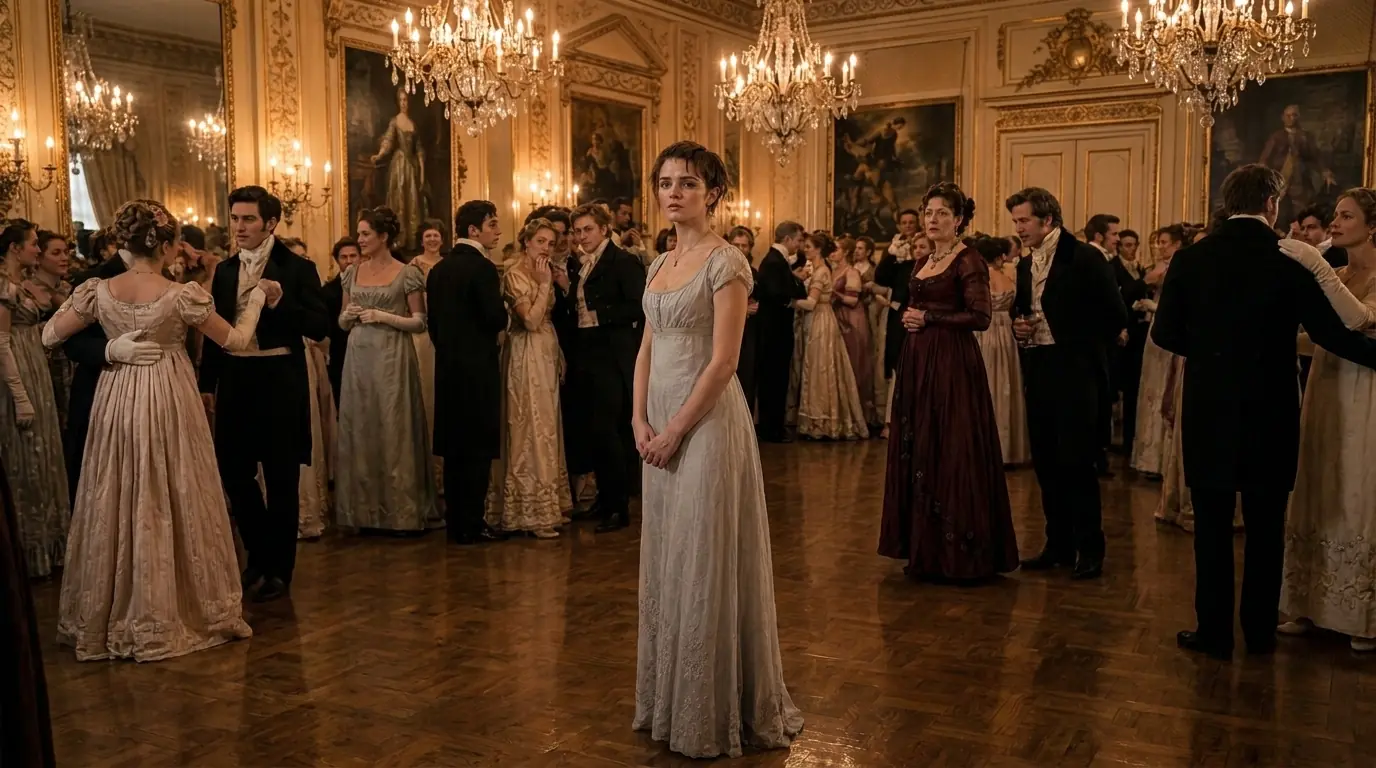
Cecily's gown, ivory silk, freshly pressed, hung on the door of the best bedroom. Elena's gown, if one could call it that, lay folded on the chair by the window, pale gray, four seasons old. A dress that had belonged to a woman who was no longer alive, her mother's dress. Elena set the candle down, ran her fingers along the uneven line of her hair one more time. She went anyway. The night had begun simply enough. Elena had been asleep or close to it when she heard the door open.
Not a creek, not a hesitation. Marion never hesitated. That was the thing about her stepmother that Elena had come to understand over eight years. The woman did not act out of anger. She acted out of calculation. Anger made mistakes. Marion did not make mistakes.
Sit up. Marion had said. Elena had obeyed. Not out of fear. She had moved past fear somewhere around her 15th year, but because resistance with Marion always cost more than compliance. That too she had learned. The candle Marion carried cast long shadows across the room.
In her other hand, the sewing scissors, silver-handled, ordinarily kept in the downstairs parlor. Elena looked at the scissors, then at her stepmother's face. Marion was smiling. Your hair has been unmanageable for weeks, she said, moving behind Elena with the ease of someone performing a perfectly routine task. I've been meaning to tidy it. Tomorrow is not the right day to look unkempt. Tomorrow, Elena said carefully, is the Ashworth ball.
Exactly. Marion gathered Elena's hair in one hand, dark, thick, falling past her shoulder blades. First impressions matter enormously. The scissors opened. Elena stared straight ahead at the wall. She did not flinch when she heard the first cut. Did not make a sound through the second or the third.
She focused on the wallpaper, a faded pattern of climbing roses that she had memorized over years of sitting exactly here, being told exactly what she was and was not. The roses had once been pink. Now they were the color of old dust. When Marion finished, she stepped back and tilted her head, studying her work with the mild satisfaction of someone who had trimmed a hedge. "Much better," she said, more manageable. She left without taking the candle. Elena sat for a long moment in the flickering light, feeling the draft on her neck.
Then she reached up slowly and touched the ends of her hair, uneven, jagged in places. The longest section fell just below her jaw, the shortest above her ear. She stood and walked to the mirror. She looked and she understood perfectly. This was not about tidiness. This was not about manageability. This was about the Ashworth ball and Lord Ashworth, the Duke, newly returned to society after 2 years abroad.
And the fact that Marion had a daughter she intended to place directly in his line of sight. Cecily was beautiful. Cecily was polished. And Elena standing beside her was meant to be a contrast, a shadow, a reminder to anyone watching that the Voss family had one daughter worth looking at, and it was not the quiet one with the old dress. Marion was not cruel out of spite. She was cruel out of strategy. Which in many ways was worse.
Elena came down to breakfast the next morning as though nothing had happened. Cecily noticed immediately. Her eyes went straight to Elena's hair and something flickered across her face. Not guilt. Cecily never carried guilt for her mother's actions, but something close to discomfort quickly smoothed over. "Your hair," she said. Yes, Elena said and reached for the bread.
Marion poured her tea serenely. I think it suits her. There's something almost modern about it. No one responded to that. Their father, Baron Voss, a man who had made an art form of being present in body while absent in every other sense, read his newspaper and said nothing. He had said nothing for eight years. Elena no longer expected him to start.
She ate her breakfast. She listened to Cecily chatter about the ball, the music, the gowns, the question of whether Lord Ashworth would dance at all, given his reputation for coldness. She folded her napkin when she was finished and excused herself and went upstairs to her room. She took her mother's gray dress out of the chair and shook it gently, held it up to the light. There was a small mend near the left seam that she had made herself. Two winters ago.
Invisible unless you knew where to look. She laid the dress on the bed. She looked at herself in the mirror again, the short, uneven hair, the plain face, the bare neck. Then she sat down and began to pin what remained of her hair with the same quiet methodical attention she gave to everything. Marion had wanted her to stay home, had wanted her, if she came at all, to stand at the edge of the room and disappear. Elena had been disappearing her entire life.
She was rather tired of it. The carriage was cold. Cecily talked the entire way. Marion sat with her hands folded and her eyes on the passing dark, already somewhere inside the ballroom, already moving pieces across a board only she could see. Elena watched the window. The Ashworth estate appeared first as lights, dozens of them, blazing from every window, turning the November fog gold. Then gates, then a long drive, then the sound of the horses slowing and the carriage door opening, and the cold air coming in sharp and clean.
She stepped out last. She straightened her mother's gray dress. She walked through the door. She came anyway. The Ashworth Ballroom was everything Elena had expected, and nothing she had prepared for. She had attended balls before, smaller ones, quieter ones, the kind where the chandeliers were half-lit to save on candles, and the music stopped at 10. This was not that.
This was 300 candles burning at full height, throwing light across marble floors and ivory walls, and the kind of crowd that filled a room not just with bodies, but with noise and perfume, and the particular energy of people who believed themselves to be exactly where they were supposed to be. Elena stood just inside the entrance and took it in. Cecily had already moved ahead, drawn forward by instinct the way a compass needle finds north. Marion followed at a measured pace, gloved hand resting on the air beside her daughter's arm, guiding without appearing to guide.
They were good at this, the two of them, moving through a room like they own the floor beneath their feet. Elena followed at a distance. She was used to that, too. The receiving line moved quickly. A butler announced names in a voice trained to carry without shouting. Around her, women in silks of every pale color turned to greet acquaintances, assess rivals, calculate the room. Elena kept her eyes forward and her chin level, and tried not to think about her hair.
She was not entirely successful. She felt it the exact moment the nearest group of women noticed. A pause in conversation, then a resumption slightly lower in pitch with a particular quality that meant the conversation had changed subject and the new subject was standing within earshot. She caught one phrase clearly, cut it herself, perhaps, and then she was past them, and she fixed her gaze on the far end of the room and kept walking. What she did not do was reach up and touch her hair.
She had promised herself that in the carriage, whatever happened tonight, she would not reach up and touch her hair. The Duke was not where she expected him to be. She had assumed, from everything she had heard, that Lord Sebastian Ashworth would be stationed near the front of the room, doing the social work expected of a host, performing the rituals of welcome with the mechanical competence of a man raised to them. Instead, she found him, after several minutes of careful observation, standing near the far window at the edge of the room.
Not hiding, Ashworths did not hide in their own ballrooms, but apart, watching the room with an expression Elena could not quite read from this distance. Not boredom, not hostility, something more like patience, the patience of a man waiting for the evening to be over. He was taller than she had imagined, dark-coated as most of the men were, but he wore it differently, less like a costume, more like armor he had forgotten to take off. His face was sharper than the portrait in the society papers, which had softened him.
The Duke smiled. It was a polite smile, the smile of a man who had been smiling politely at things for 30 years and had grown very efficient at it. He did not ask her to dance. Cecily's smile did not waver. She was too well trained for that. But Elena, who had been watching Cecily's smiles for eight years, saw the microscopic adjustment, the slight recalibration. The smile stayed, but the certainty behind it shifted.
Marion watching from across the room saw it too. Her eyes moved a quick sharp sweep and found Elena at the refreshment table. Elaner picked up a glass and looked elsewhere. It was 20 minutes later when she felt it. Not a sound, not a touch, simply the particular sensation of being watched steadily, deliberately, without any attempt at concealment. Elena had spent enough of her life being looked at sideways in quick glances in the peripheral way people looked at someone they were discussing that she had developed a precise sensitivity to it.
This was different. This was direct. She turned. The Duke was looking at her from across the room. Not a glance, not an assessment. He was simply looking with the same patient attention he had given the room earlier. Except now the room had narrowed to one point and that point was her and he did not look away when she caught him.
Elena held his gaze for two seconds, three, then turned back to the refreshment table and set her glass down with great care. Her heart was doing something unreasonable. She ignored it. She heard the conversation stop before she understood why. It moved in a wave, the way sound moved in large rooms when something shifted. A ripple of reduced noise spreading outward from a single point. Elena looked up.
The Duke was crossing the room, not towards Cecily, who stood 20 feet to Elena's left and had clearly reached the same conclusion as every other person watching, because Cecily's chin had lifted slightly in preparation for the approach toward Elaner. The ripple of quiet reached the women nearest her. One of them, she did not know her name, only her expression looked from the Duke to Elena and back again with the rapid calculation of someone updating a ledger in real time. Elena did not move.
He stopped in front of her. Up close, he was more tired looking than she had expected, not unwell, but carrying something. The way men looked when they had been competent in difficult circumstances for a very long time. He bowed correctly, precisely, with none of the exaggeration that younger men sometimes used to perform their own charm. "Miss Voss," he said, she curtsied, "your grace." A beat of silence around them. The room had resumed its noise, but at a lower register, and with considerably more attention directed at this corner of it.
"I believe the next dance is a waltz," the Duke said. It was not a question, but it was not quite a statement either. There was something in the pause after it that left space genuinely for a refusal. Elena noticed that. She filed it away. I believe it is, she said. “Would you do me the honor?”
Elena looked at him for a moment. She was aware of Marion at the edge of her peripheral vision. She was aware of Cecily, who had gone very still. She was aware of approximately forty people in the immediate vicinity who were no longer pretending not to watch. “Yes,” she said. “Thank you.” He offered his arm.
She took it. The music began. Elena had danced with perhaps a dozen men in her life at the smaller, quieter balls with the half-lit chandeliers. She knew the steps. What she was not prepared for was the simple physical fact of being led by someone who danced as though he had opinions about it. Not showy opinions, not performative ones, but a kind of quiet authority. A slight pressure at the right moment, an adjustment so small she almost didn't notice it until she realized she was moving exactly as she should be.
For the first 30 seconds, she said nothing. He said nothing. Then why are you doing this? She had not planned to ask it. She asked it because the question had been sitting in her chest since he crossed the room and it was either ask it or spend the entire dance pretending it wasn't there. He looked down at her. Something shifted in his expression.
Not surprise exactly, more like recognition. “Because you came anyway,” he said. Elena said nothing. The chandeliers moved above them, or they moved beneath the chandeliers. She could not quite tell, and around the edge of the floor, she was aware of faces watching, of fans raised in front of mouths, of Marion standing very still with an expression Elena had never seen on her before. Uncertainty. The dance ended.
The Duke did not release her arm. The next he said, "If you're willing." In 1814, a second consecutive dance was not a small thing. It was a declaration made in full view of 300 people. It was the kind of thing that appeared in letters the next morning and conversations for weeks afterward. Both of them knew this. Elena looked at him.
“I’m willing,” she said. The room understood before Elena did. The second dance was a slower one. That made it worse or better depending on where you were standing. For the watchers at the edge of the floor, it was better, more to observe, more time to observe it. For Marion, standing precisely where Elena had last seen her, it was considerably worse. Elena kept her eyes forward.
She had made a decision somewhere during the first dance, a quiet internal decision of the kind she made often, without ceremony, without announcement. She would not spend this dance looking for Marion's face. She would not spend it calculating consequences or constructing explanations or preparing the careful neutrality she would need to wear on the carriage ride home. There would be time for all of that. There was only so much time for this. You're not what I expected, the Duke said. His voice was low, not conspiratorial, simply calibrated to the distance between them rather than the room around them.
Elena found she appreciated that. "What did you expect?" She asked. He considered it. She noticed that about him, he did not answer quickly. He answered when he had something to say. "I'm not sure exactly.
Something easier to read, perhaps. I've been told I'm difficult to read. By whom? People who preferred I was easier. Something moved at the corner of his mouth. Not quite a smile. The suggestion of one like a word almost said.
"And what did you expect?" He asked. "Of tonight." Elena thought about the gray dress laid out on the bed, about the scissors, about Marion's serene face in the candle light. “Less,” she said simply. He looked at her. Less, he repeated.
“I came expecting less. I find that useful.” “Useful?” “When things turn out to be more than expected,” she said, “it helps to have started with less. The surprise is cleaner." He was quiet for a moment. The music moved around them unhurried.
That is either very wise, he said, or very sad. “It can be both,” Elena said. Most useful things are. At the edge of the ballroom, Marion was recalculating. She was good at it, recalculating. It was in many ways her primary skill. The world presented itself to Marion as a series of arrangements, and when one arrangement failed to hold, she did not panic.
She revised. What she was seeing now required significant revision. The Duke had asked Elena, Elena in the gray dress with the ruined hair for a second dance. Had asked, not been asked, had crossed the room with a purposefulness that half the room had witnessed, and the other half would hear about before the evening was out. The second dance was still in progress, and already Marion had caught three separate women watching Elena with a particular attention reserved for people who had unexpectedly become interesting.
She had meant to make Elena forgettable tonight. She appeared to have achieved the opposite. Marion's eyes moved to Cecily, standing with a small group near the far wall. Cecily was smiling and talking and giving every appearance of being entirely unbothered, which meant she was bothered enormously. Cecily had her mother's talent for surfaces. Marion looked back at the dance floor. The Duke was saying something.
Elena was listening. That specific quality of listening she had very still, very focused that Marion had always found quietly irritating, like being read by someone who never shared their conclusions. It's one night Marion told herself, "Two dances. Men did inexplicable things at balls. It meant nothing." She smoothed her gloves. She smiled at the woman beside her, who had just made a remark about the weather.
She revised her plan for the morning. The second dance ended. Elena stepped back and curtsied. The Duke bowed the same precise unexaggerated bow as before them. The room resumed its ordinary patterns. Couples moving off the floor, new ones forming, the orchestra shifting its pages, the ordinary machinery of a ball reasserting itself over the small disruption of the last 20 minutes, except that people were still looking. Elena was aware of it in the way she was aware of most things, quietly, peripherally, without allowing the awareness to show on her face.
A woman near the refreshment table, who had laughed at her hair an hour ago, was now watching her with a different expression entirely. Two men she didn't recognize were talking behind their programs. Near the entrance, she saw a young woman lean to her companion and say something behind her fan. She had come in as a curiosity. She was leaving as something else. She was not entirely sure how she felt about that. Miss Voss.
She turned. The Duke had not moved far. May I bring you something from the refreshment table. It was such an ordinary thing to say, so deliberately ordinary after the extraordinary public fact of what had just happened that Elena almost smiled. Thank you, she said. Yes. He went.
She stood where she was and breathed and allowed herself just for a moment to feel the strangeness of the evening. The cold draft on her neck, the gray dress, the chandeliers, the way he had said because you came anyway as though it were the most logical answer in the world, and she had not known what to do with it and still didn't. She reached up, she touched her hair, she caught herself and lowered her hand. He returned with two glasses and stood beside her.
Beside, not in front of, which again she noticed, which again she filed away. Most men positioned themselves opposite, facing you, the better to be looked at. He stood at an angle, both of them facing the room. You don't enjoy these, she said. It wasn't a question. A slight pause. What makes you say that?
You were standing at the window when I arrived. You're standing at the edge now. You attend, but you find a wall. He looked at her sidelong. Most people assume I'm surveying the room. You were, but that's not why you were at the wall. He was quiet for a moment.
No, he said it isn't. Obligation, she said. Yes. To the estate, the title, the expectation that you host and are seen hosting and perform the She paused, searching for the word. Performance, he said. Yes. He looked at his glass.
You do that very quickly. Do what? See things? Elena said nothing. Downstairs in the carriage in approximately 2 hours, Marion would be waiting. The gray dress would smell of candle wax. The scissors would be back in the parlor, silver-handled, innocent.
I've had practice, she said. Something crossed his face, a flicker of something more than polite interest. He opened his mouth. Your grace. They both turned. Lady Hargrove, the Duke's aunt. Elena recognized her from the society pages, had appeared at his elbow with the smooth inevitability of a woman accustomed to appearing exactly where she chose to be.
I believe Lord Fairfax is looking for you," she said to her nephew. Then her eyes moved to Elena with an attention so precise it felt like being measured. "And you must be the Voss girl." "Elena, Voss," Elena said. Yes. Lady Hargrove looked at her for a long moment, not unkindly, but thoroughly. The way someone looked at a document they were deciding whether to keep.
"I knew your mother," she said. The room continued around them. The music started again. Somewhere across the floor, Cecily laughed at something and the laugh carried. Elaner held very still. "Did you?" She said carefully.
Quite well, in fact. Lady Hargrove's expression gave nothing away. We must talk. Not tonight. Tonight is not the right place. She glanced at her nephew. Fairfax, don't keep him waiting.
The Duke looked at Elena. Something in his expression said he was not pleased about being redirected, but he was too well-mannered or too experienced with his aunt to argue it. Miss Voss, he said, "Your grace," she said. And he left. Lady Hargrove watched him go. Then she turned back to Elena with an expression that had shifted, still careful, but with something underneath it now. Something that looked, Elena thought, almost like relief.
Your hair, she said. Elena's chin lifted slightly. Yes. It wasn't your choice. It was not a question. Elena looked at her, this small, sharp-eyed woman who said she had known her mother and made a decision. No, she said it wasn't.
Lady Hargrove nodded once slowly, as though this confirmed something she had already suspected. Come and call on me Thursday, she said. 11: 00, she pressed a small card into Elena's gloved hand. Don't mention it to your stepmother. Then she too moved away into the crowd. Elena stood alone for a moment, the card in her hand, the music rising around her. The room understood before Elena did, but Lady Hargrove, it seemed, had understood longest of all.
The carriage ride home was quiet. That was the most dangerous kind of quiet with Marion. The loud kind, the sharp remarks, the pointed observations, the criticism dressed as concern. Elena had learned to navigate years ago. It had edges she could see and step around. This quiet was different. This was the quiet of someone who was thinking and thinking carefully and had not yet decided what they had decided.
Cecily stared out the window. Elena kept her hands folded in her lap and watched the dark passing outside and waited. "She did not wait long." "He'll lose interest," Marion said, not to Elena specifically, more to the air in the carriage the way she sometimes spoke, as though narrating something that had already been determined. Men like Ashworth are drawn to novelty. You were unexpected tonight. That's all it was.
Elena said nothing. Cecily made an excellent impression, Marion continued. Lady Forsythe commented on it personally. These things take time. One ball is not a campaign. “Of course,” Cecily said from the window. Elena looked at the dark outside and thought about a small card pressed into her gloved hand.
11: 00 Thursday. She had tucked it into the inside of her left glove, and she could feel it still, a slight stiffness against her palm. She said nothing about that either. Sleep did not come easily. Elena lay in the dark and stared at the ceiling and listened to the house settle into its night sounds, the creek of the upper corridor, the distant close of a door, the eventual silence that meant Marion had stopped moving. She thought about what Lady Hargrove had said.
I knew your mother. Her mother had been dead for eleven years. Elena had been eight when it happened, old enough to remember, young enough that the memories had the particular quality of things seen through water. A voice, a particular way of laughing, hands that smelled of rose water. Her father had put the portrait away within the year and married Marion within two, and the house had reorganized itself around the new arrangement, with the efficiency of a body healing over a wound, smoothly, completely, leaving only the faint raised line to show anything had ever been there at all.
No one spoke of her mother. No one in eleven years had said I knew her with that particular weight. As though knowing her meant something specific. As though there was something to be known. Don't mention it to your stepmother. Elena closed her eyes. She thought about the Duke.
The way he'd said because you came anyway. The way he'd stood beside her rather than opposite. The slight movement at the corner of his mouth that wasn't quite a smile. She allowed herself 30 seconds of that and then she put it away firmly in the same place she put other things she couldn't afford to think about too carefully. Then she thought about Marion who was recalculating who was always recalculating who would not Elena knew with absolute certainty simply wait and see.
She was right. Marion began the next morning over breakfast with the lightness of someone making pleasant conversation. "I spoke with Mrs. Alderton last night," she said, pouring tea with great serenity. "She sits on the committee with the Duchess of Ashworth, the Duke's mother, you know, formidable woman, very particular about the family name." Elena buttered her bread. Apparently, the duchess has strong views about suitability, Marion continued. Given the Duke's position, the estate, the title, one understands, of course, these old families must be careful.
Of course, their father said from behind his newspaper. Elena ate her bread and said nothing. She mentioned Mrs. Alderton. I mean that the duchess has been making inquiries about various young women in the county. Marion set down the teapot naturally with a son who will need to marry well. He danced with Elena. Cecily said a brief silence.
It was the first time Cecily had mentioned it directly. Marion smiled. The particular smile that meant the ground was very solid beneath her feet and she was not concerned in the slightest. He danced with several women. She said Elena simply had the advantage of being unexpected. Men find novelty briefly interesting. She looked at Elena with an expression of such perfectly constructed gentleness that a stranger would have found it difficult to locate the blade inside it.
I wouldn't read too much into it, darling. I'd hate for you to be disappointed. Elena looked at her stepmother. “How kind,” she said. “Thank you.” That afternoon, while Cecily practiced piano and their father dozed in the study, Marion paid three calls. Elena knew about two of them.
The first was to Mrs. Alderton, who did indeed sit on a committee with the Duchess of Ashworth, and who was the kind of woman who collected information the way others collected porcelain carefully, with an eye for value, and always with a sense of whom it might be worth showing. The second was to Lady Forsythe, who knew everyone. The third, Elena, did not know about until much later. What Marion said in the pleasant, concerned, carefully modulated voice she used for these occasions was this, that she worried about Elena, that it pained her to say it.
She loved the girl as her own naturally, but there were things the right people ought to know for everyone's sake. The instability, for instance, small episodes, nothing dramatic, but concerning over time. A tendency toward obsession. A certain difficulty with reality, particularly regarding her understanding of her own position in society. She mentioned Elena's mother. Not directly. Marion never did anything directly, but in the way of someone letting a word fall into water and watching the ring spread, a reference to that side of the family, a carefully unfinished sentence, a sorrowful pause.
One hates to say it, but one would hate more for a family like the Ashworths to be caught unaware. By evening, the words were moving through the county's social network with the quiet efficiency of water finding cracks. By the following morning, they had reached the Ashworth House. The Duke was in the library when his mother found him. He was reading or attempting to read. He had in fact been attempting to read for the better part of an hour with limited success because his mind kept returning to a gray dress and a direct gaze and the particular quality of a conversation that felt unusually like being spoken to rather than performed at.
His mother entered without knocking. She never knocked. The Duchess of Ashworth was a small woman who took up a great deal of space. She had the same sharp facial structure as her son, softened neither by age nor by disposition, and she moved through rooms the way she moved through most things, as though their primary purpose was to arrange themselves around her. She sat. She looked at her son. The Vos girl, she said.
Sebastian set his book down. Two dances, his mother said. The whole room saw. I'm aware. I've had three separate accounts of it this morning. Three. Sebastian before 11: 00.
Also not surprising. His mother looked at him with the expression she reserved for situations she found tiresome but necessary. I have heard some things about the girl's background, her mother's family. From whom? From several people, people I trust. Sebastian was quiet for a moment. He thought about the way Elena had said, "I've had practice, not with bitterness, not with self-pity, with the simple flatness of a fact stated so many times it had worn smooth."
He thought about the way she'd stood in the entrance of the ballroom for a moment, very still, and then lifted her chin and walked in. "What sort of things?" He said carefully. His mother told him. He listened. His face by long habit gave nothing away. When she finished, he said, "That came from somewhere specific.
It came from several places." Which all heard it from the same place. He looked at the window. The grounds were gray and wet. November asserting itself across the gardens. I'd like to know where it started. What does it matter where it started?
If it matters considerably where it started, he said with a quietness that was not gentle. His mother studied him. Sebastian, the estate requires. I know what the estate requires. He picked up his book. I'd like to verify what I've been told before I act on it. That seems reasonable.
The duchess pressed her lips together. Then she stood, smoothed her skirts with the precision of someone concluding a meeting rather than leaving a room and walked to the door. "The Whitmore dinner is Friday," she said. "The Voss family will be there," she left. Sebastian sat for a long moment with his book open on his lap, unread. Then he reached for his writing paper. He wrote two letters, one to his secretary asking for inquiries to be made quietly, specifically about the origins of several rumors currently circulating in the county.
The second letter he held for a long time before he sealed it. Then he set it aside. It could wait for now. Elena, meanwhile, had been counting days. Thursday, 11: 00, 2 days away. She pressed her hand flat against the inside of her left glove, feeling the small, stiff rectangle of Lady Hargrove's card against her palm, and looked out at the gray November gardens, and waited with the patient, practiced stillness of someone who had learned that waiting was the only power she reliably possessed.
Lies travel faster than the truth. But the truth had better stamina. Thursday came and went. Elena arrived at Lady Hargrove's townhouse at precisely 11: 00, was shown into a small, warm sitting room that smelled of bergamot and old books, and sat across from a woman who looked at her the way few people had ever looked at her, as though she were worth the full attention. They talked for an hour. Lady Hargrove asked questions, careful ones, specific ones, the kind that were not really questions, but invitations.
Tell me about your mother. Tell me what you remember. Tell me what you were told. Elena answered carefully in return, giving only what felt safe to give, withholding the rest with the instinct of someone who had learned that information once offered could not be recalled. What she did not tell Lady Hargrove, the scissors, the gray dress, the eight years of small, precise cruelties that left no marks. What Lady Hargrove did not tell Elena why she was asking. They parted with warmth and without answers, which Elena found both frustrating and in some way she couldn't quite name, reassuring.
People who gave answers too quickly were usually giving you the answers they had prepared. Lady Hargrove was clearly still deciding what to prepare. Elena went home, removed her coat, and told Marion she had called on a school friend. Marion smiled and said how lovely. Elena smiled back. The Duke did not come to the Whitmore dinner. He sent his apologies, a prior engagement, entirely unavoidable, his regrets to the host.
Standard language, unverifiable. Elena heard it from across the table as the soup was being served and absorbed it with the same quiet efficiency she absorbed most things. She did not look at Marion. She did not need to. She could feel the small pulse of satisfaction coming from that direction as clearly as she could feel the draft from the window. The dinner continued. Cecily was placed near a viscount who seemed genuinely charmed by her.
Their father discussed hunting with someone to his left. Elena ate her soup and answered questions when asked and smiled when appropriate and thought about nothing in particular, which was a skill she had developed over years and found extremely useful. Afterward, in the carriage, Marion said nothing. That was a different kind of quiet than before. Before it had been the quiet of calculation. This was quieter still, the quiet of someone who believed they had already won and were simply waiting for the board to catch up.
Elena looked at the dark outside and kept her hands very still in her lap. The following week, no invitation came from Ashworth House. The week after that, none either. Elena had not expected one or had told herself she hadn't, which was not quite the same thing, but served the same function. She went about her days with the same routine she had always had. The morning tasks, the household accounts that Marion nominally oversaw, but Elena actually managed, the afternoons with her books in the small upstairs room that got the best light, the occasional calls and dinners that made up the quiet machinery of their social life.
She did not go to balls. There were two in those two weeks. Marion attended both with Cecily. Elena was not invited to come and did not ask to. She told herself she did not mind. She was not entirely convincing. It was at the third ball, a larger one, a county affair at the Pembridge estate, that she saw him again.
She had not intended to be there. Marion had included her at the last moment, with the studied casualness of someone who had calculated that excluding her entirely was beginning to look deliberate. Elena had put on the gray dress. She had only the gray dress and one other, a blue one that was marginally newer and gone. She saw the Duke from across the room. He saw her at the same moment. She knew this because she had been watching, and she saw the exact instant his eyes found her.
A fractional pause in whatever he was saying to the man beside him, a stillness so brief it would have been invisible to anyone not specifically watching for it. Then he looked away and he did not look back. Elena stood very still for a moment. Then she moved to the edge of the room, found a wall and stood beside it with her glass and her expression and the practiced blankness that had served her so well for so long. Of course, she thought it was one night.
She had known this. She had told herself this carefully and repeatedly in the two weeks since the Ashworth ball. She had constructed the argument with great thoroughess. One evening, two dances, a conversation that had felt like more than it was because she was not accustomed to being spoken to directly. She had been novel. He had been curious. Novelty faded.
Curiosity moved on. She had known all of this. Knowing it, she found did not particularly help. She watched him because she could not entirely stop herself. He moved through the room with the same contained energy as before, the sense of a man present in body while reserving some essential part of himself. He danced once with a woman Elena didn't know with the competent politeness she recognized. He spoke to several people.
He did not seek out Cecily, which Marion would note and factor in. He did not seek out Elena. Three times during the evening their paths brought them near enough that acknowledgement was unavoidable. Each time he bowed correctly, said her name, moved on. Each time she curtsied, said, "Your grace, watched him go, correct, proper, utterly impenetrable." She was fluent in distance, had been reading it her whole life, in her father's newspaper shielded face, in Marion's smooth surface, in the particular way people looked through you when they had decided you were not worth looking at.
She knew what distance looked like when it was chosen. This was chosen. She just didn't know why. At home that night, she sat at her small desk by the window for a long time without lighting the candle. The simplest explanation, she told herself, was the most likely. He had inquired further into her background and found it wanting. Her father's finances, which were not good, the lack of dowry, the family's diminished position.
These were real considerations for a man like Ashworth. She had never been a serious prospect. She had been, as Marion said, a novelty. She should be grateful the lesson had come at the cost of two dances and nothing more. She should be grateful. She pressed her fingers against the edge of the desk and breath slowly in the dark. She had been packing a little, not seriously, not with any plan, nothing decided, but in the absent preparatory way she sometimes packed when she felt something ending.
A few books rearranged, the small box of her mother's things lifted out and looked at and put away again. The gray dress folded. She had learned this long ago. Things ended. Circumstances changed. Marion's house was not permanent, had never been permanent. She had known since she was 12 that she would one day have to leave it, and had simply never found the direction to leave toward.
She was used to leaving. She just hadn't this time expected to mind quite so much what she was leaving behind. She had told herself she would not go to Lady Hargroves again without an invitation. The invitation came on a Tuesday, four days after the Pembridge ball. A short note in handwriting that was decisive without being hurried. Come Thursday, I have something to tell you. Come alone.
Elena read it twice. Then she folded it and placed it not in her glove this time she had learned, but in the spine of the book on her nightstand, pressed flat between pages she had already memorized. She did not tell Marion she was going. She told her she was calling on the school friend again. Marion smiled. How lovely, she said again. Elena smiled back again.
Thursday, she thought. Whatever Lady Hargrove had to tell her, whoever had started the rumors, whatever had changed the Duke's expression from that fractional warmth to this careful nothing, she would hear it, and she would decide what to do with it. She was tired of being the last to know things about her own life. She was tired of packing without a direction. She was tired, in the most fundamental sense, of less. The sitting room smelled of bergamot again. Elena had noticed that about Lady Hargrove's house.
It smelled the same every time with the consistency of a place that had been exactly itself for a very long time and had no intention of changing. There was something steadying about that. Elena, whose life had been reorganized twice before she turned 10, found she was more susceptible to steadiness than she had realized. Lady Hargrove was already seated when Elena was shown in. Tea was laid. The fire was higher than last time. Elena sat.
Lady Hargrove looked at her for a moment, the same thorough measuring look as before, and then said, "I'm going to tell you several things. Some of them will be difficult to hear. I'd ask you not to interrupt until I finished." Elena set her teacup down. All right. Your mother and I were friends for 14 years, Lady Hargrove began. From the season she came out until the year she died, I was with her when she met your father.
I was at their wedding. I was the first person she wrote to when she knew she was expecting you. A brief pause. I was also the person she wrote to in the last year of her life when she began to be frightened. Elena kept very still. Frightened of what? She said carefully.
Of what would happen to you. Lady Hargrove said if something happened to her. The fire shifted outside. The November wind moved against the window with a sound like breathing. Your mother was not a foolish woman. Lady Hargrove continued. She was perceptive and she was practical and she understood your father clearly, perhaps more clearly than he understood himself.
She knew he would not manage well alone. She knew he would remarry and she knew with the particular knowledge of a woman who has spent years reading a household that whoever came next would not she paused choosing the word prioritize you. Elena said nothing. In the last months of her life, your mother made arrangements, practical ones. She spoke with a solicitor. She wrote letters. And she made one significant agreement with a man she had known since childhood and trusted completely.
Lady Hargrove looked at Elena directly. The late Duke of Ashworth. The room was very quiet. "What kind of agreement?" Elena said. Her voice came out level. She was distantly proud of that.
"A betrothal agreement," Lady Hargrove said. "Conditional, properly drawn, witnessed, and signed. Between you, you were not yet eight, and the Duke's son, Sebastian." She folded her hands in her lap with the composure of someone who had been holding this information for a long time and was finally carefully setting it down. Your mother's reasoning was simple. She wanted you protected. She trusted the Ashworth family.
The late Duke agreed. He had known your mother since she was a girl, and he was a man who honored his word. The agreement was made to take effect when you came of age at your discretion, not a command. A safeguard. Elena looked at the fire. She was aware of her own breathing in and out, slow and even. The way she breathd when she needed to think and could not afford to feel until the thinking was done.
My mother died when I was eight. She said, "Yes, and my father." Your father was not told. Lady Hargrove's voice was precise. Your mother did not trust him with it. The agreement was held by the Ashworth family solicitor and by me. Your father knew nothing of it.
Which meant which meant Marion knew nothing of it? Elena said. Correct. Elena was quiet for a long moment then. But Marion knows now. It was not a question. She could see it the shape of the last two years, the last 8 years rearranging itself around this new fact.
Marion's particular focus on the Ashworth family. The way she had positioned Cecily season after season, always circling that specific target. The scissors the night before the ball, when it had looked finally, concretely like Elena might be seen. Marion hadn't been afraid of Elena being seen. She had been afraid of Elena being recognized. When did she find out? Elena said.
Approximately eighteen months ago, Lady Hargrove's expression tightened slightly, the first crack in her composure. My solicitor retired and transferred his files. There was a regrettable lapse in discretion. I believe Marion became aware of the agreement through a clerk who was not as careful as he should have been. And she said nothing. She said nothing. She simply moved.
Lady Hargrove looked at Elena with something that was not quite an apology, but carried the weight of one. I did not know she had found out until the night of the Ashworth ball. When I saw you walk in, and I saw her face, she stopped. I understood then what the last eighteen months had been. Elena sat with that for a moment. Eighteen months. Cecily's three failed seasons, which Elena had watched from the edges, the careful engineering of every social occasion, the positioning, the management, not as Elena had assumed, simply a mother's ambition for her daughter, prevention.
Marion hadn't been trying to win. She had been trying to stop Elena from winning something she didn't even know she was playing for. The agreement, Elena said, is it still valid? “Legally, yes. It was properly drawn, but Lady Hargrove paused. It was designed to be used at your discretion. It cannot compel either party.
It gives you a claim, not a guarantee. And the Duke, another pause, more careful, the Duke does not yet know the full truth of it. Elena looked up. What does he know? He knows the agreement exists. His father told him years ago, but briefly in the way of something that might one day become relevant. He was not given the details.
He was told only that there was a document and that the Voss family was connected to theirs by more than acquaintance. Lady Hargrove's mouth pressed together briefly. What he does not know is what Marion has been saying about you. Elena went very still. What has she been saying? Lady Hargrove told her. Elena listened to all of it, the instability, the episodes, the careful unfinished sentences about that side of the family.
The implication dropped like a stone into still water, and she felt moving through her in a slow, quiet wave, something she very rarely allowed herself. Anger. Not the sharp, reactive kind, the deep kind, the kind that had been building for eight years in a house where she was listed below the horses in the emotional accounting in a gray dress with scissors taken to her in the dark. The kind that did not make noise, the kind that lasted. He believed it, she said.
His mother believed it, and she told him. Lady Hargrove looked at her steadily. I do not know the full extent of what he believes. I know that he has been making inquiries. I have it from two sources that he sent his secretary to look into certain matters. That suggests he is not simply accepting what he was told. But he withdrew.
He was cautious. There is a difference. From where I was standing, Elena said quietly, it looked the same. Lady Hargrove was silent for a moment. Yes, she said. I imagine it did. The tea had gone cold.
Elena looked at it and did not pick it up. She was thinking about a document signed when she was not yet eight by a mother who had known she was running out of time and had tried in the ways available to her to leave something behind that would hold. She was thinking about a woman who had smelled of rose water and laughed in a way Elena could almost but not quite remember, who had understood clearly and without illusion what was coming, who had tried to build her daughter a door. And Marion, finding the door, had spent eighteen months bricking it up.
The document, Elena said, where is it now? With me, Lady Hargrove held her gaze. It has always been with me. Your mother gave me the copy. The Ashworth solicitor holds the original. And you're telling me this now because because I should have told you sooner. Lady Hargrove said it simply without deflection.
I waited. I told myself you were not yet ready, that the timing was not right, that I needed to be certain of certain things before I spoke. All of which was true. A pause. And none of which is the whole truth. The whole truth is that I was cautious about reopening something about what it might cost you if it failed. Elena looked at her.
What changed? She said, "You walked into the Ashworth ballroom," Lady Hargrove said, in your mother's dress with your hair cut to the jaw, and you did not flinch. Something moved across her face. Old grief perhaps, or its cousin. Your mother would have done exactly the same thing. I looked at you and I thought she's ready. She has been ready for years.
I was the one who wasn't. The fire crackled outside. The wind had quieted. Elena sat in the bergamot scented room and looked at her hands in her lap bare. Today she had forgotten her gloves and thought about all the things she had not known about her own life. The document, the agreement, the eighteen months of Marion's silent surgical campaign. The Duke who had withdrawn not from disinterest but from she did not know exactly what caution.
Lady Hargrove said uncertainty. She thought about what she would do with all of this. She thought about the Duke's face, not the careful nothing of the Pembridge ball, but the earlier one, the fractional warmth, because you came anyway. She thought about Marion's scissors and her mother's hands and the small stiff rectangle of a card pressed against her palm. She made a decision. Not loudly, she never did anything loudly, but with the particular finality of someone who had been waiting without knowing they were waiting for a long time.
I'd like to see the document, she said. Lady Hargrove reached into the writing desk beside her chair. She had Elena realized already headed out. It was six pages handwritten in a script Elena didn't recognize the solicitors presumably with two signatures at the bottom of the final page. One she didn't know, one she did, her mother's handwriting. She had seen it only twice before on the inside cover of a book she had kept hidden and on the back of a small portrait Marion didn't know about.
She knew it immediately. The particular slope of it, the way the letters connected. She read every word of the six pages carefully twice. Then she set it down on her knee and sat quietly for a moment. Marion knew about this, she said, and her response was scissors. "Yes, because if I had gone to the ball unremarkable, and he had never looked twice, the document would have remained irrelevant." Yes.
She wasn't trying to humiliate me. Elena's voice was very even. She was trying to prevent a specific outcome. She was afraid. Terrified. Lady Hargrove said quietly. I think she has been terrified since the moment she found out.
Elena looked at the document in her lap at her mother's signature. She had tried to build her daughter a door. Marion had spent eighteen months trying to seal it. Elena folded the document carefully and looked up. What happens now, she said, is my choice. Yes, Lady Hargrove said it always was. Marion hadn't been cruel out of spite.
She had been terrified. Which Elena thought as the carriage carried her home through the gray November afternoon was almost almost enough to make her feel sorry for her. Almost. Elena did not act immediately. This was deliberate. She had learned over years of living with Marion that the worst thing you could do with a decision was rush it. Marion was fast, quick to assess, quick to move, quick to seal exits before you knew they were exits.
The only way to beat someone who moved fast was to move slowly and precisely from a position they hadn't anticipated. So Elena went home. She ate dinner. She listened to Cecily talk about a new bonnet. She helped their father find his reading glasses which were on his head. She said good night to Marion with a warmth that was entirely convincing because she had had eight years of practice. She went to her room.
She sat at her desk in the dark and she thought carefully completely without rushing about what she wanted. Not what she was owed. Not what the document said she could claim. What she actually wanted if she were honest with herself. Stripped of all the practical calculations and the careful management and the habit of wanting less so that less could not disappoint her. She sat with that question for a long time. The answer when it settled was quiet and clear and slightly terrifying.
She wanted the door her mother had built. Not because it was her right. Not because Marion had tried to brick it up, and some part of her wanted the satisfaction of watching those bricks come down, because she had stood in a ballroom in a gray dress with her hair cut to the jaw, and a man had crossed the room and said, "Because you came anyway," and for the first time in a very long time, she had felt like someone who was worth crossing a room for. She wanted to find out if that was real.
The rest, the document, the agreement, the confrontations that were coming was simply the architecture. The door was something else. She lit her candle. She began to write. The letter she wrote was not to the Duke. It was to Lady Hargrove, and it said three things. That she had decided to act, that she would need Lady Hargrove's support in one specific matter, and that she wanted it done before the end of the week.
Lady Hargrove's response came the next morning, delivered by hand before breakfast. Two words, come Thursday. What happened on Thursday was this. Lady Hargrove sent a note to her nephew, not a request, because Lady Hargrove did not make requests of people she had known since they were in short coats, informing him that she required his presence at 11: 00 on a matter of some importance. The Duke arrived at 10: 58. Elena was already there. She had chosen the blue dress, the marginally newer one, and done her hair with the same careful attention she had given it the night of the ball.
She was sitting by the window when he was shown in, and she watched his face make the rapid series of adjustments that very controlled people made when surprised, the fractional pause, the reassembly, the expression settling back into its trained surface. He looked at her. She looked at him. Miss Voss, he said, "Your grace." Lady Hargrove, seated by the fire with the serenity of someone who had arranged considerably more complicated things in her time, gestured to the chair opposite Elena. "Sit down, Sebastian," he sat.
Lady Hargrove looked at him for a moment. I'm going to tell you something and then I'm going to show you something and then she said with the precision of someone laying out the rules of a game, the two of you are going to talk without me in the room because I am too old to sit through conversations that have been delayed for eight years. The Duke's eyes moved to Elena. Elena looked back at him steadily. Lady Hargrove told him about the document.
All of it, the agreement, Elena's mother, the solicitor, the 18 months of Marion's campaign. She told it without embellishment in the clear, factual voice of a woman delivering a report. She told him what Marion had said about Elena. She told him where it had started, how it had traveled, and precisely how it had reached his mother's ear. She told him what Elena's mother had signed and why. When she finished, the room was very quiet. The Duke had not moved during any of it.
He sat with the stillness of someone applying a great deal of effort to remaining still, and Elena, who was watching him with her full attention, saw beneath the surface, something that was not anger exactly, but was adjacent to it something compressed. Lady Hargrove set the document on the table between them. The original is with the solicitor, she said. This is Elena's copy, she stood, which in a woman of her authority was equivalent to a closing statement. I'll be in the next room.
I won't be listening. She looked at her nephew. Sebastian, don't be an idiot. She left. The door closed. Neither of them spoke for a moment. Elena looked at the document on the table and did not pick it up.
The Duke looked at it too, then at her, then at the window, where November was doing its gray, relentless work outside. “She told me you were unstable,” he said. Not accusatory, careful, the voice of someone testing the weight of something. “I know what she told you.” I didn't entirely believe it. But you withdrew a pause, my mother. I know, Elena said.
Lady Hargrove told me. She looked at him directly. I'm not asking you to explain it. I'm telling you what it looked like from where I was standing. He held her gaze. What did it look like? Like one night, she said.
Two dances, a conversation I had perhaps assigned more significance to than it warranted. And then nothing. She kept her voice level. I've had practice with nothing. I managed. Something shifted in his face. I should have.
Yes, she said quietly. You should have. Not unkindly, simply precisely, the way she said most things. He was quiet for a moment. Then you're not going to make this easy. I've made things easy for people my entire life, Elena said. I find I'm less interested in it than I used to be.
The corner of his mouth moved. Not quite a smile, but closer than she had seen since the ball. The document, he said. Yes. My aunt said it was drawn at your discretion, that it cannot compel either party. That's correct. So, you're not here to enforce it?
No. Elena said, "I'm here because," she paused, and in the pause she felt the slight terrifying vulnerability of being about to say something true without the protection of careful management. "“I’m here because I want to know if what happened at the ball was real, and I would rather know that from you directly than spend the next year wondering." He looked at her for a long moment. It was real, he said simply without qualification. The way he answered things when he had thought about them enough to be certain.
Elena absorbed that. Let it sit where it settled. Then she said, "There are some other things that need to happen first." What happened next was Marion. The Duke sent a note that afternoon, formal, specific, unarguable, requesting the presence of Lady Marion Voss at Ashworth House the following morning at 10: 00. Not an invitation, a summons dressed in the language of courtesy and carrying the full weight of what it actually was. Elena was not there for it.
She had considered asking to be. She had decided against it, not because she was afraid she was past that, but because this particular thing did not need her in it. She had said what she needed to say to the people who needed to hear it. What happened in that room was the Dukes to manage. She found out afterward from Lady Hargrove, who had it from two sources by noon. Marion had arrived composed. She had remained composed for approximately the first four minutes, which was how long it took the Duke to make clear that he knew specifically, precisely, and completely what she had done and where it had started and how far it had traveled.
Then the composure had shifted. She had tried three approaches. Lady Hargrove said, "Denial first, brief, because he had documentation. Then justification, I was protecting my daughter. Any mother would, which he had allowed her to finish before he laid out quietly and without raised voice, exactly what protecting her daughter had required destroying. Then finally, silence. The silence lasted a long time.
"She didn't apologize," Lady Hargrove said. "No," Elena said she wouldn't. She wept. Elena looked at her tea. Her daughter, Lady Hargrove said carefully, was in the carriage Cecily. She hadn't known the full extent of it. Lady Hargrove's source said the girl's face when she understood.
I know, Elena said. She did know. She could see it precisely. Cecily's face doing what it did when something could not be smoothed over. The composure failing. The thing underneath it, which Elena had always suspected was not as hard as the surface suggested. Marion had done it for Cecily.
That did not make it right. But Elena understood it with the particular understanding of someone who had spent 8 years watching a woman love one child with a ferocity that had no room in it for anything else. She was quiet for a moment. Is Cecily. She'll be all right, Lady Hargrove said. She's Marion's daughter. She knows how to manage.
Elena nodded. She was in the small upstairs library, the one with the best light, when she heard the carriage return. She did not go down immediately. She finished the page she was reading, which she did not take in at all, and then she set the book aside and went downstairs. Marion was in the hall removing her gloves. Her face was composed. Of course it was.
It was always composed, but there was something underneath the composure that Elena had never seen there before. A kind of tiredness, not physical, something older. They looked at each other. Marion opened her mouth. Elena waited. Whatever Marion had prepared to say, she did not say it. She closed her mouth.
Looked at Elena for a long moment with an expression Elena could not entirely read. It had layers to it, too many to separate quickly. Then she said, "Your mother would have been pleased." She walked past Elena up the stairs and closed her bedroom door. Elena stood in the hall for a moment. Then she went back upstairs to her library. She sat in the chair by the window.
The November light came in flat and gray and honest the way it did without embellishment. She thought about her mother's handwriting, the particular slope of it. She thought about a door built quietly in the last months of a life that knew it was ending. She thought about scissors and gray dresses and eight years of learning how to want less. Cecily cried. She heard later from the maid who knew everything and said nothing except to the cook, not for the duke, for her mother who had ruined everything for nothing.
Elena thought about that for a long time, for nothing. Except that it had not been for nothing, not exactly. Marion had been terrified and she had acted from that terror with the full force of everything she had and it had cost her considerably and in the end it had cost Cecily too. That was the thing about fear Elena thought it was always expensive and it always sent the bill to someone else. That evening a small package arrived from Ashworth house. Inside no letter, just a single book, one she had mentioned in passing during the ball, a history of botanical illustration, which she had said she had been trying to find for two years.
She held it for a moment. Then she set it on her desk beside the candle where the light fell on it. He had listened. Of course, he had. She did not smile. She sat with it quietly, the way she sat with things that mattered carefully, fully without rushing. But something in her chest, which had been held very still for a long time, moved.
She would have to ask to be asked properly, she had said. He was, she suspected, already thinking about how December arrived without ceremony. The county shifted into its winter patterns. Fewer balls, more dinners. The social calendar condensing into smaller, more deliberate gatherings. Fires burned higher. Carriages moved faster through the cold.
People retreated into their houses and their habits and the particular comfort of things that had not changed. Elena's house had changed considerably. Not loudly. Nothing in that house had ever changed loudly, but in the way of furniture slightly rearranged, the weight distribution of every room subtly altered. Marion was still there, still composed, still managing the household with her precise and tireless efficiency, but something had gone out of her. The particular quality of attention she had always directed at Elena, the watchfulness, the calculation, the constant low hum of management was gone.
She looked Elena thought like someone who had been carrying something for a very long time and had finally, not entirely voluntarily set it down. They were not warm with each other. Elena did not expect that and did not want it. Warmth required a foundation, and there was none here, only the bare ground of what had happened, and the question of what to build on it, if anything. But the edges had changed. The scissors were in the parlor where they belonged. The gray dress hung in Elena's wardrobe without comment.
Cecily was quieter. Elena watched her sometimes across the dinner table, the careful surface, the practiced smile, the occasional moment when the surface slipped and something younger and less certain showed through. She thought about saying something. She thought about it several times. One evening she did. It was after dinner in the small sitting room while Marion was writing letters and their father was elsewhere. Cecily was at the window with her embroidery, not embroidering.
Elena sat down beside her. Cecily did not look up. I know you didn't know, Elena said. The full extent of it. A long pause. Cecily's hands were still on the embroidery. “I knew some of it,” she said finally.
Her voice was careful in the way of someone who had decided to be honest and was finding it more difficult than expected. Not the document, not all of it, but I knew she was. She stopped. I didn't ask questions I didn't want the answers to. Elena looked at the window, the dark outside, the cold pressing against the glass. That's honest, she said. It's not admirable.
No, Elena agreed. But it's honest. Cecily was quiet for a moment, then very low. “I am sorry for my part in it.” Elena looked at her stepsister at the profile she had looked at across tables and carriages and ballrooms for eight years, always at a slight angle, always from the position of the one who was less. She thought about Marion weeping in a carriage and the cost of fear and what it did to the people closest to it. I know, she said.
She did not say it's all right. It wasn't entirely, and she was done offering comfort that wasn't earned. But she meant what she said she knew, and knowing was a beginning, and beginnings were more than nothing. Cecily looked up. Her eyes were bright in the way of someone who had been expecting less. Elena almost smiled. Some things she thought were catching.
The Duke called on the second Thursday of December. Formally, correctly. He sent a card the day before and arrived at precisely the stated hour, which Elena noted and appreciated. Their father was present, drowsy, but upright in his armchair. Marion sat with the composed stillness of a woman who had reorganized her expectations and was managing the reorganization with dignity. The Duke sat. Elaner sat across from him.
They talked about nothing consequential in the way of formal calls. Navigating the social forms with the mutual awareness of two people who had already moved past them and were simply observing the requirements before getting to the actual point. He asked about her reading. She asked about his estate. Their father made two remarks about hunting. Marion poured tea with perfect serenity. After 40 minutes, the Duke stood and took his leave correctly and without haste.
Elena walked with him to the hall, which was within the bounds of propriety. In the hall, with the butler at a diplomatic distance, he turned to her. "The Granthams are hosting a dinner Friday," he said. "I would like very much to escort you if you're willing." Elena looked at him. "A dinner?" She said.
"Yes." "Not a ball?" I thought, he said with the careful precision she had come to recognize as his version of gentleness, that we might try something quieter first, given that the last time we were in a ballroom together, it caused approximately three weeks of difficulty. Four, Elena said, "Four," he conceded. I apologize for my part in that. You were cautious. I was too cautious.
There is a difference. She looked at him for a moment. He held her gaze with the same steadiness he had brought to everything. No performance, no exaggeration, simply the fact of his full attention directed at her, which she was finding still slightly disorienting in the best possible way. “Friday,” she said. “Yes, thank you.” He nodded, something in his expression, not the almost smile, something more than that.
The butler opened the door. The cold December air came in sharp and clean. "Miss Voss," he said. "Your grace," she said. He left. Elena stood in the hall for a moment, feeling the cold and the quiet and something else. Something that did not have a precise name, but felt, she thought, like the specific sensation of a door opening.
The dinner was unremarkable and entirely remarkable. 12 people, a well-laid table, the ordinary conversation of a December evening in the county. Elena sat two places from the Duke, which was close enough and far enough, and they talked across the table with the ease of people who had already done the difficult talking, and had arrived somewhere on the other side of it. She noticed how he listened. She had noticed it at the ball, but here, in a smaller room, it was more visible.
The way he gave his full attention to whoever was speaking without the social performance of it, without the slight calculation that most people brought to listening at dinner parties, he was simply there. She noticed that he noticed when she was uncomfortable, a particular guest who addressed her twice with a slight edge that she deflected smoothly, and that he redirected the conversation both times with such seamless ease that it appeared entirely accidental. It was not accidental. She thought about the book, the botanical illustrations sitting on her desk in the candle light.
He had listened. After dinner, in the brief time before carriages were called, he found his way to where she was standing by the fire. Well, he said low for her alone. Well, she agreed. Better than a ball considerably. A pause. The fire was warm.
Around them, the party continued its unhurried conclusion. Coats being fetched, good nights being said, the ordinary beautiful machinery of an evening ending well. Elena, he said. It was the first time he had used her name, not Miss Voss, her name. Quietly, simply, as though he had been thinking about how it sounded and had decided to say it. She looked at him. I should like to call on you again, he said regularly, with intent.
With intent. In 1814, this was a precise and serious phrase. Both of them knew exactly what it meant. Elena held his gaze. "You'll have to ask properly," she said. He looked at her for a moment. Something moved across his face, the almost smile, and then more than the almost smile, and then a full genuine unhurried smile that she suspected very few people had seen.
Because it was not the kind of smile that was performed. I intend to, he said, when the time is right. And when will the time be right? He considered it genuinely in the way he considered everything. When you're certain, he said, "Not of me. You can be uncertain of me for as long as you like. When you're certain that you want to find out."
Elena looked at the fire for a moment. She thought about wanting less, about the specific discipline of it, the way she had constructed it over years, brick by careful brick, because wanting more had always cost more than she could afford. She thought about coming anyway. She thought about doors. I'm already certain of that, she said quietly. He was still for a moment. Then then I'll ask properly.
Good. Soon. I'm not going anywhere, she said. And she meant it not as reassurance, not as compliance, but as something she had decided in the small upstairs library with the best light, sitting in the November flat honesty of it. She was not going anywhere. For the first time in a very long time, she didn't want to. He called on her father the following Tuesday.
The conversation lasted 20 minutes. Elena was in the library and heard nothing of it, which was both correct and agonizing in equal measure. She read the same paragraph four times and absorbed none of it. She looked at the window. She looked at the door. She looked at the botanical illustrations on her desk. She heard the study door open, footsteps in the hall.
Then her father appeared in the library doorway, vague, blinking, with the expression of a man who had just been required to pay attention and had managed it adequately. "The Duke would like a word with you," he said. Elena set her book down. She stood. She straightened her dress, the blue one, which she had worn because she had known he was coming and had permitted herself that small vanity without apology. She walked to the door. Her father moved aside and she went into the hall and the Duke was there.
He was holding his hat. He looked not nervous exactly, but with the quality of someone who had prepared thoroughly, and was now operating on something beyond preparation. The hall was empty. The butler had vanished with the tact of the well-trained. Her father had retreated. The Duke looked at her. She looked at him.
He got down on one knee. He did it without theater, without preamble, with the same unadorned directness he brought to everything. And he asked properly, as promised, with words she would remember exactly for the rest of her life, and which are perhaps better kept between the two of them. Elena stood in the hallway of her father's house in the blue dress with her short hair and her mother's ring on the finger. It had been intended for from the time she was not yet eight years old.
She looked down at him for the first time in years, for the first time since she could remember. Really, she laughed. Not the polite kind, not the managed kind, the real kind that came from somewhere she had kept locked for so long she had almost forgotten it was there. He looked up at her with an expression of complete unguarded delight. Is that a yes? He said that, she said, catching her breath is absolutely a yes. He got to his feet.
He was smiling, the real smile, the unperformed one. And she was still laughing slightly. And outside the December light came through the hall windows, cold and bright, and entirely indifferent to the fact that something had just shifted quietly and permanently in the arrangement of two people's lives. “You laughed,” he said. “I did,” she agreed. I wasn't sure if I'd ever, he stopped. You have now, she said.
She came anyway. She always had. And it had made all the difference two years later. The Ashworth spring ball was, by general consensus, the event of the season. This was not unusual. Ashworth balls had always been the event of the season by virtue of the house, the grounds, the orchestra that the late Duke had imported from Vienna 30 years ago, and which his son had seen no reason to replace. What was unusual this particular spring, was the guest list, or rather not the guest list itself, but the particular energy in the room, the sense of a gathering that had been anticipated not merely socially, but with something approaching genuine curiosity.
People wanted to see her. The Duchess of Ashworth, the new one, the second one, the one the county had been discussing for two years with the particular relish reserved for stories that had exceeded expectations, was by now well-known. She had been seen at dinners and calls and smaller gatherings throughout the winter and the preceding year. She was known to be direct and quiet and unexpectedly amusing to those who paid attention. She was known to have a library that had doubled in size since the marriage.
She was known to have on one memorable occasion corrected a cabinet minister on a point of botanical history with such pleasant precision that he had thanked her for it. She was known above all for her hair. She had not grown it. This had been discussed at length in the way things were discussed when there was nothing actually objectionable about them. But people felt compelled to discuss them anyway. It was unconventional. It was notable.
It was some said a statement though they disagreed about what it was a statement of. What had happened gradually and without anyone planning it was this. It had become fashionable. Not immediately, not universally, but in the way of things that begin as anomalies and end as references. First, one young woman at a winter assembly had appeared with her hair cropped short, and then another, and by spring there were half a dozen, and by the following season there were enough that no one remarked on it as remarkable.
There was even Elena had heard with a particular private amusement a name for it in London something French naturally as the fashionable names always were. She had not encouraged it. She had simply continued worn her hair as she wore it because she liked it, because she had grown accustomed to the cold draft on her neck and the freedom of it, and the way she could feel the wind properly when she was outside, because it was hers, because a woman named Marion had taken scissors to it in the dark, intending it as an ending, and it had been instead a beginning. She was at the mirror when Sebastian came in.
He did this, appeared without announcement, which she had told him was a habit she found both endearing and occasionally startling, and which he had shown no signs of correcting. He stopped behind her, met her eyes in the mirror. “Ready?” He asked. “Nearly.” He watched her finish pinning the last piece into place. She had her own style now, the short hair arranged with a simplicity that required more skill than it appeared to.
His eyes were on her in the mirror with the same quality of attention she had never entirely grown accustomed to, the full unhurried kind that did not require anything of her except to be exactly as she was. Cecily arrived, he said. Elena's hand stilled slightly, then continued. Cecily had been invited. Elena had invited her, which had surprised everyone, including she suspected Cecily. They were not close. Probably they would never be close, but they had arrived at something, a cautious, honest, occasionally awkward something that was better than what had come before.
They had tea once a month. They talked about things that were not Marion and occasionally about things that were. Marion was in Bath. She had gone in January quietly with the compressed dignity of someone who had decided that reinvention was preferable to remaining in a place that had witnessed her worst self. She wrote to Cecily. She did not write to Elena, and Elena did not expect her to. Good.
“Good,” Elena said. “I'm glad she came.” Sebastian looked at her in the mirror for a moment. “You're generous.” “I'm practical.” She said, "There's a difference with you." He said, "There usually isn't." She looked at him in the mirror.
This man who had crossed a room, who had listened, who had got down on one knee in a hallway and asked properly, who had turned out to be in the quiet, unhurried way of things that were actually true, exactly what she had suspected he might be. Beneath the contained surface and the careful management and the years of competence in difficult circumstances worth crossing a room for. As it turned out, the feeling ran in both directions. “There,” she said. “Done.” She turned from the mirror, and he offered his arm.
She took it the same gesture as the first dance. The same physical fact of it and yet entirely different in the way that everything was both the same and different when you had chosen it freely and it had chosen you back. They walked to the door. “Sebastian,” she said, “if anyone asks about my hair tonight, I'll tell them it's fashionable.” “It is fashionable. Enormously,” he agreed. “You started it.”
“I didn't start it.” He looked at her sidelong, the almost smile, which she had cataloged now in all its variations, and still found she liked best of all his expressions. “You came anyway,” he said. “That started most things.” Elena considered that. Outside the door, the ballroom was full. Three hundred candles, the Vienna Orchestra, the ordinary, extraordinary machinery of an evening that had been anticipated.
Cecily was somewhere among the assembled county. The future arranged around them like furniture in a room they had chosen together. She thought about a gray dress in a narrow mirror and a candle held in a cold room at midnight. She thought about scissors. She thought about her mother's handwriting, the particular slope of it, the way the letters connected on the last page of six, signing a door into existence for a daughter she was leaving behind. She thought about wanting less, and the long discipline of it, and the morning she had stood in a hallway in the blue dress, and laughed, really laughed for the first time in years.
She went anyway, she always had. She stepped through the door. The ballroom opened before her, light and warmth and music, and the hundred small faces turning toward her with the particular attention of people who had heard the story and wanted to see how it had ended. Like this, she thought it ended like this. The scissors had been meant to humiliate her. Instead, they had made her unforgettable.