“I want her seated where everyone can see her.”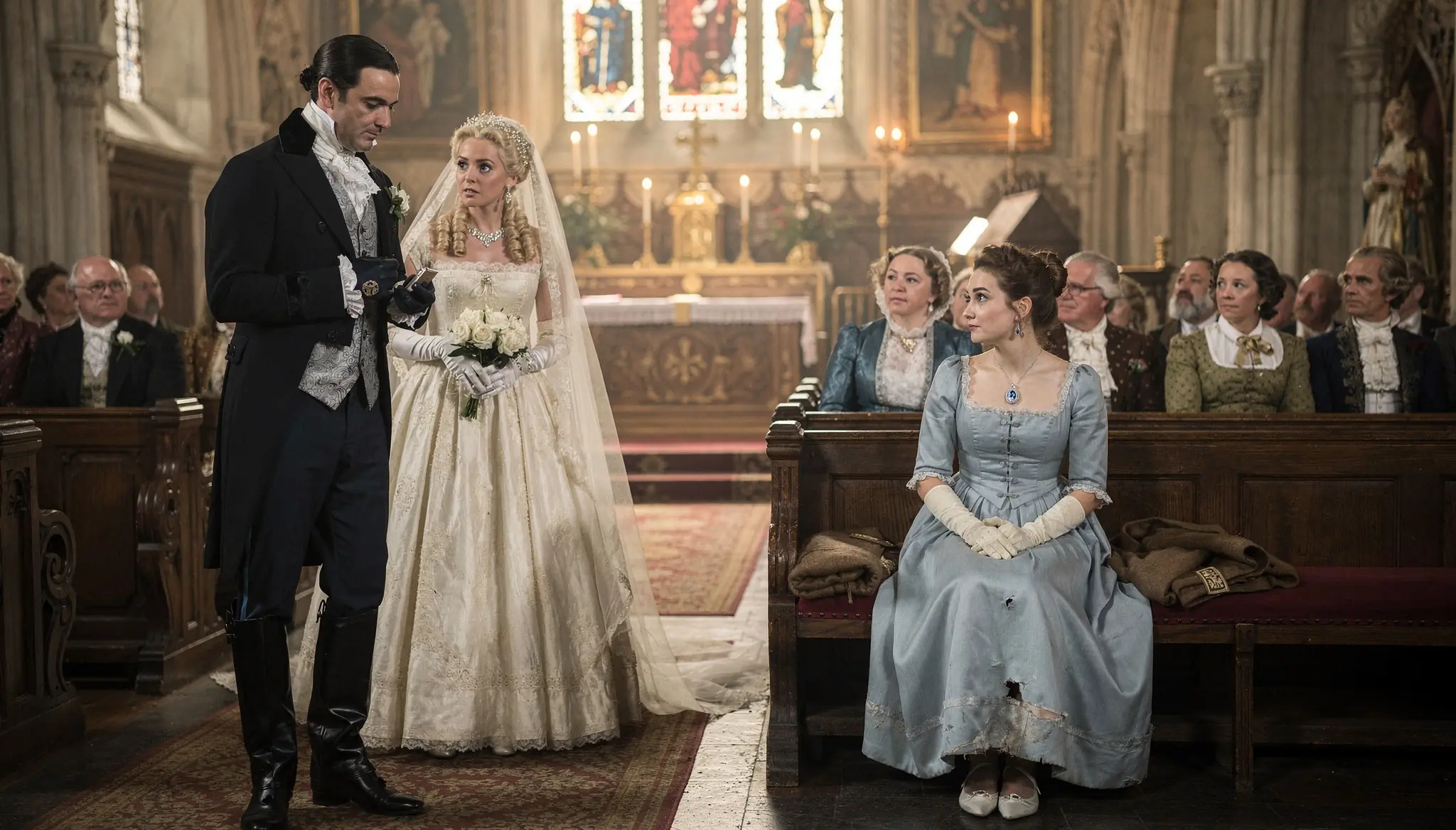
Lady Arabella Harton smiled as though she had just said something kind. Around her, maids carried white roses, silver ribbons, pearl-trimmed veils, and trays of polished crystal through the west gallery of Harton Hall. Tomorrow, she would marry His Grace, Duke Cassian Ravenscourt, one of the wealthiest and most feared noblemen in England.
The entire county had been invited. Lords, ladies, judges, officers, widows with sharp tongues, and mothers desperate to push their daughters near a duke would crowd the chapel and ballroom. Among them would be one guest no one expected to see again: Lady Selene Wickliffe, Arabella’s older stepsister, the girl who had vanished six years earlier in disgrace, and the woman society believed had run away with a stable boy.
Arabella wanted her brought back for one final humiliation.
“She will come?” asked Lady Marabelle Vale, one of Arabella’s bridesmaids.
Arabella turned from the mirror. Her wedding gown shone like moonlight, diamonds rested at her throat, and her blonde hair had been twisted into perfect curls beneath a veil that had cost more than most families earned in a year.
“Oh, she will come,” Arabella said softly. “Poor girls always come when rich people remember their names.”
A few ladies laughed.
At the far end of the room, Lady Honora Harton, Arabella’s mother, lifted a cream-colored invitation from a silver tray. The name had been written in elegant black ink: Lady Selene Wickliffe.
“Make certain no carriage is sent for her,” Honora said. “If she comes, let her arrive as she lives.”
“In rags?” Arabella asked.
“In truth,” Honora replied.
The ladies laughed again, but beside the door stood an elderly maid named Mrs. Blythe, holding folded linen against her chest. Her fingers tightened around the cloth. She did not laugh.
She remembered Selene. She remembered the night the girl had been forced from Harton Hall with only a small trunk, a torn cloak, and one silver locket around her neck. She remembered the lies Lady Honora had told afterward.
Mrs. Blythe remembered something else as well, something Lady Honora had never discovered. The locket was not ordinary. If Duke Cassian Ravenscourt saw it, the wedding might not survive the hour.
Miles away, in a narrow room above a dressmaker’s shop in Bath, Selene Wickliffe stared at the invitation until the letters blurred. Six years had passed without a message from Harton Hall. Six years had gone by since her stepmother had looked down at her and said, “Your father is dead. You are no longer our burden.”
Selene had been nineteen then. Now she was twenty-five, thinner than she had once been, quieter, and far stronger than anyone in that house had ever allowed her to become.
Her room contained very little: a narrow bed, a sewing table, a cracked basin, three books, a small stove, and a wooden box where she kept her mother’s locket. There were no jewels, fine gowns, or family portraits. There was only the locket.
It was silver, oval-shaped, old-fashioned, and worn at the edges. A tiny blue enamel lily was set into the front. Inside was a faded miniature portrait of her mother, Lady Evelyn, a woman Selene barely remembered except through scent, softness, and lullabies.
Selene lifted the locket from the box and fastened it around her neck. Her friend, Miss Clara Finch, stood by the window with the invitation in hand.
“You are not seriously thinking of going.”
Selene said nothing.
Clara’s expression hardened. “They did not invite you out of affection.”
“I know.”
“They want to display you like a warning.”
“I know that, too.”
“Then why go?”
Selene looked down at the locket. For six years, she had pretended she no longer cared. Yet every night, despite the cruelty, she still remembered Arabella as a little girl who used to climb into her bed during thunderstorms.
She wanted to see whether even one person in that house remembered the truth. She also wanted, foolishly or faithfully, to say goodbye properly.
“I will go,” Selene whispered.
Clara shook her head, but her eyes softened. “Then you must not go looking like this.”
Selene gave a sad smile. “This is all I have.”
Her only proper dress had once been pale blue. Years of washing had faded it almost gray. The hem had been repaired with thread that did not quite match, and one sleeve bore a small patch near the wrist. It was clean, modest, and painfully plain.
At Harton Hall, they would call it rags. Selene already knew.
The next morning, while bells rang across the village, carriages rolled up the gravel drive one after another. Ladies stepped down in silk and satin. Gentlemen adjusted their gloves and laughed beneath their breath. Servants rushed across the lawn carrying flowers, wine, silverware, and wedding favors wrapped in white ribbon.
At the center of everything stood Arabella, beautiful, smiling, and admired. She looked every inch the future Duchess of Ravenscourt, yet her eyes kept moving toward the entrance.
“Not yet,” Lady Honora replied.
“Perhaps she was too ashamed to come.”
Honora smiled. “Shame never stops the desperate.”
A footman opened the doors again. This time, the room changed. Not loudly and not all at once, but like cold air entering a warm chamber, silence spread from one guest to another.
Selene Wickliffe stood at the entrance. Her dress was clean but faded. Her gloves were old. Her cloak had been carefully brushed, but age still showed along the seams. She held no fan, wore no pearls, and had arrived alone.
Whispers began immediately.
“That is her.”
“I thought she had left the country.”
“Good heavens, look at her dress.”
“Was she truly once part of this family?”
Selene heard every word. She lowered her eyes and stepped forward. Years of hunger, work, and quiet endurance had taught her how to keep walking while others judged her.
Then Arabella came toward her. For a moment, Selene almost forgot the diamonds, the silk, and the watching crowd. She saw only the little girl she had once loved.
“Arabella,” she said softly.
Arabella stopped close enough to embrace her. She did not.
“Selene,” she replied, smiling like a stranger. “How brave of you to come.”
The word brave carried a hidden blade. Selene understood it.
Lady Honora approached next, dressed in deep wine-colored silk, her posture perfect and her smile practiced.
“My dear stepdaughter,” she said loudly enough for nearby guests to hear. “How touching. After all these years, you have returned to us.”
Selene felt the room watching. “I was invited, Lady Honora.”
“Of course.” Honora’s eyes lowered slowly to Selene’s dress. “And you came exactly as you are. How honest.”
A few ladies covered their smiles with gloved hands.
Arabella turned to a servant. “Lady Selene’s seat is prepared?”
“Yes, my lady.”
“Good. Place her near the bridal table. I would hate for her to miss anything.”
Selene’s cheeks warmed, but she said nothing.
The ceremony was held in the grand chapel attached to Harton Hall. White roses climbed around the pillars, candles burned before stained-glass windows, and the air smelled of beeswax, lilies, and expensive perfume.
Selene was placed exactly where Arabella wanted her: close enough to the front that everyone could see her faded dress, but far enough from the family pew to show she no longer belonged. Guests glanced at her between prayers, some with pity, some with amusement, and others with open satisfaction.
Then the Duke arrived.
Cassian Ravenscourt entered without display, yet the room seemed to straighten around him. He was tall, dark-haired, and solemn, with the kind of quiet authority that made people lower their voices. His face was handsome but not soft. There was grief in him, buried deep beneath discipline.
He had inherited the dukedom young, buried his parents young, and learned early to trust almost no one.
Arabella’s smile widened when she saw him. Every mother in the chapel noticed the way his black coat fit his shoulders and the way the Ravenscourt signet ring flashed on his hand.
But Cassian’s gaze did not remain on his bride. It moved over the guests and then stopped, not on Selene’s face, but on her throat.
On the silver locket.
His expression changed so quickly that only a few people noticed. His hand tightened around his gloves. The blue enamel lily, the oval silver frame, the tiny dent along the lower edge. It was impossible.
The minister began speaking. Arabella moved beside Cassian, glowing with triumph, but the Duke’s eyes returned to Selene again.
She felt it. Slowly, she looked up. For one breath, their eyes met across the chapel. Selene did not know him, but he looked at her as though she had carried a ghost into the room.
The first half of the ceremony passed in a strange haze. Arabella noticed Cassian’s distraction and frowned. Lady Honora noticed it, too. So did Mrs. Blythe, standing near the chapel door with the other servants.
When the minister asked whether anyone knew cause why the marriage should not proceed, no one spoke. Arabella’s smile returned.
Then Selene’s locket slipped free from beneath the collar of her dress and caught the light.
Cassian went still.
The minister continued, “Will you, His Grace Cassian Ravenscourt, take Lady Arabella Harton—”
“No.”
The single word rang through the chapel.
The minister stopped. Arabella turned sharply. “Your Grace?”
Cassian did not look at her. He looked at Selene.
“Where did you get that locket?”
The chapel froze. Selene touched the silver pendant instinctively.
“My mother left it to me.”
Cassian stepped down from the altar. Whispers rose like wind. Lady Honora’s face drained of color. Arabella looked from the Duke to Selene, confusion turning quickly into anger.
Cassian stopped before Selene. His voice was low, but everyone heard him.
“That locket belonged to my mother’s closest friend, Lady Evelyn Ravenscourt.”
Selene’s breath caught.
The Duke’s eyes darkened with recognition, grief, and something far more dangerous.
“Lady Evelyn’s daughter was declared dead when she was a child.”
A murmur exploded across the chapel.
Selene shook her head. “No. My name is Selene Wickliffe.”
Cassian stared at the locket, then at her face. “Not by birth.”
“Your Grace,” Lady Honora interrupted, her voice sharp beneath its polish. “This is highly inappropriate. The girl is confused. She has always been—”
Cassian turned. Lady Honora stopped speaking.
The Duke’s voice became colder than the chapel stone. “Lady Honora, I have seen that locket before. It was made as one of two matching pieces. My mother wore the other until the day she died.”
Selene stood slowly, her knees trembling.
Cassian looked back at her. “Open it.”
Her fingers shook as she obeyed. Inside lay the faded portrait of her mother. Behind the portrait, hidden beneath the old paper backing, was something Selene had never noticed: a small folded strip of parchment.
Cassian carefully removed it. The chapel held its breath.
He unfolded the fragile paper. His face changed, and then he read aloud the words written in fading ink.
“My daughter, Selene Aurelia Ravenscourt, must never be left in the care of Honora Harton.”
The silence that followed was so complete that the candles seemed loud.
Selene’s hand flew to her mouth.
Arabella whispered, “Ravenscourt?”
Cassian looked directly at Lady Honora. “What did you do?”
Lady Honora Harton did not faint. Women like her rarely did. Fainting was for those who had no other weapon.
Instead, she lifted her chin and smiled as though the entire chapel had misunderstood a harmless mistake.
“This is absurd,” she said. “A childish trinket, a faded scrap of paper, and suddenly my stepdaughter is being turned into some lost noblewoman?”
Cassian’s expression did not soften.
Selene could hardly breathe. Selene Aurelia Ravenscourt. Not Wickliffe. Not the unwanted stepdaughter. Not the poor relation invited to be mocked.
Arabella took one step backward from the altar. Her veil trembled around her shoulders.
“Mother,” she whispered. “What is he talking about?”
Honora did not look at her. “Nothing that concerns you.”
“It concerns my wedding.”
“It concerns your future,” Honora snapped.
The sharpness of her tone startled several guests.
Cassian folded the parchment with careful hands. “This wedding is suspended until the truth is known.”
Arabella turned pale. “Suspended?”
A wave of murmurs swept through the chapel. The celebrated union of Harton beauty and Ravenscourt power had been interrupted by a woman in a faded dress and a locket no one had cared to examine.
Selene wanted to disappear. She had not come to ruin anyone, steal a title, or expose a secret. She had come because somewhere inside her broken heart, she still believed family might remember love.
Instead, the Duke was now standing before her like a man staring into his past.
Cassian turned to the elderly maid by the door. “You. You seem less surprised than the others.”
Mrs. Blythe’s face crumpled.
Lady Honora spun toward her. “Do not say a word.”
The command confirmed more than silence ever could.
Cassian’s eyes narrowed. “Step forward.”
Mrs. Blythe came slowly down the aisle, her hands shaking.
“I am sorry,” she whispered before anyone asked her a question. “God forgive me. I am sorry.”
Selene stared at her. “Mrs. Blythe?”
The old maid began to cry. “You were not supposed to learn it this way, miss.”
Lady Honora’s voice cut through the room. “This servant is old and confused.”
Mrs. Blythe looked up, trembling but determined. “No, my lady. I have been silent. That is not the same as being confused.”
The chapel stirred.
Cassian spoke quietly. “Tell us what you know.”
Mrs. Blythe wiped her eyes with the corner of her apron. “Lady Selene was not Lord Wickliffe’s child by birth. He raised her and loved her dearly, but she was born to Lady Evelyn Ravenscourt, Your Grace’s aunt by marriage.”
A gasp passed through the guests. Selene gripped the back of the pew.
Mrs. Blythe continued. “Lady Evelyn died when the child was very young. There were disputes over guardianship. Lord Wickliffe took the child in to keep her safe until certain family matters were settled.”
Cassian’s voice lowered. “And my family was told the child had died of fever.”
Mrs. Blythe nodded through tears. “That was the story sent to Ravenscourt.”
“By whom?” Cassian asked.
Mrs. Blythe’s eyes moved slowly toward Lady Honora. All eyes followed.
Lady Honora’s composure cracked for the first time. “You dare?”
Mrs. Blythe flinched but did not stop. “Lady Honora wished Lord Wickliffe to marry her. She knew he would never send Selene away while he lived. After his death, she found the documents: birth papers, letters, and guardianship records. She locked them in the study, sent Miss Selene from the house, and told society she had run away.”
Selene’s vision blurred.
Six years of shame. Six years of work. Six years of hearing whispers whenever someone recognized her name.
Runaway. Disgraced. Ungrateful.
All false.
Arabella turned slowly toward her mother. “You told me she left us.”
Honora’s lips tightened. “You were young. You would not have understood.”
“You told me she stole money.”
Selene closed her eyes. That lie had traveled farther than any letter she had ever sent.
“You told me she ran away with a servant,” Arabella said, her voice breaking. “You let me hate her.”
Honora’s expression hardened. “I protected you.”
“No,” Arabella whispered. “You used me.”
The words struck the chapel like thunder.
For the first time, Selene saw the bride not only as the cruel woman who had invited her in rags, but also as the little girl who had been fed poison and taught to call it truth.
Still, the pain remained. Arabella had laughed. Arabella had seated her near the front. Arabella had wanted everyone to witness her humiliation.
Cassian turned to Selene. His voice changed. It was no longer the voice of a duke addressing a scandal, but the voice of a man speaking to someone who had been wronged before him.
“Lady Selene, I owe you an apology on behalf of my house. We should have searched harder.”
Selene shook her head, overwhelmed. “I do not even know what I am.”
“You are not what they called you,” he said.
Something in those words broke through the wall she had built around herself.
Lady Honora laughed once, bitterly. “How touching. The Duke sees a locket and forgets reason. Look at her, Your Grace. Does she look like a Ravenscourt? Does she look fit for your family? She arrived at a ducal wedding dressed like a beggar.”
The chapel gasped. Selene went still.
Cassian turned back to Honora. “Careful.”
But Honora had lost the discipline that had protected her for years.
“She has spent years sewing hems and carrying parcels. She is not noble. She is not refined. She is not—”
“She survived you,” Cassian said.
Honora fell silent.
The words did not need volume. They carried enough weight to crush the room.
Cassian looked to the minister, then to the witnesses and assembled guests. “This wedding will not proceed today.”
Arabella swayed. Several bridesmaids rushed to her side, but she pushed them away.
“Cassian,” she whispered, all pride gone. “Please.”
He looked at her, not cruelly, but with finality. “A marriage cannot be built in a house where truth is buried beneath the floorboards.”
Then he turned to Selene. “Come with me. There are records at Ravenscourt House that may prove everything.”
Selene hesitated. The entire chapel watched her. If she walked out with him, society would speak of nothing else. If she stayed, Lady Honora would tear her apart.
Mrs. Blythe touched Selene’s arm gently. “Go, miss.”
Selene lifted her chin. For the first time since entering Harton Hall, she stopped looking at the floor.
Then she walked beside the Duke down the aisle.
No one laughed now. No one whispered about her dress. They stared at the locket, the parchment, Lady Honora, and the bride left standing before an altar covered in white roses that suddenly looked like funeral flowers.
Outside, rain had begun to fall. Cassian helped Selene into his carriage himself. The gesture was small, but every guest watching from the chapel steps understood its meaning. He had chosen to protect the woman they had mocked.
Inside the carriage, Selene sat stiffly with her hands clasped in her lap. Cassian took the opposite seat. For several minutes, neither spoke. Rain tapped against the carriage roof as the horses moved down the long drive.
Finally, Selene whispered, “I did not know.”
“I believe you.”
“I never wanted to stop the wedding.”
“I know.”
She looked at him then. “Do you?”
Cassian’s gaze held hers. “Yes. A person seeking revenge does not look as though every cruel word costs her something.”
Selene’s eyes filled despite her efforts. “I wanted only to see my sister.”
His expression softened. “Then perhaps the cruelest theft was not your name.”
She swallowed.
“It was what they made you believe about love.”
At Ravenscourt House, old portraits lined the entrance hall, their painted eyes following Selene as though they recognized her before she recognized herself. Cassian led her into the library, a magnificent chamber of dark wood, tall windows, and shelves reaching to the ceiling.
He unlocked a cabinet and removed a leather-bound family register. For nearly an hour, they searched through birth entries, sealed packets, and old correspondence between Lady Evelyn Ravenscourt and Lord Wickliffe.
Piece by piece, Selene’s life rearranged itself. Her mother had not been poor. She had not been forgotten. She had been loved.
The most painful letter came last. It had been written by Lord Wickliffe shortly before his death.
Cassian read it aloud, his voice low.
“If anything should happen to me, Selene must be returned to Ravenscourt protection. Honora must not control her inheritance or decide her future. I fear I have trusted too long in appearances.”
Selene covered her face. Lord Wickliffe, the man she had believed was her father, had tried to protect her. And still, she had been cast out.
Cassian closed the letter carefully. “There will be a hearing.”
Selene looked up. “A hearing?”
“Your identity, your inheritance, and Lady Honora’s actions must be brought before the court.”
Fear moved through her. “Society will devour this.”
“Society already devoured your reputation once,” he said. “This time, let it choke on the truth.”
The line startled her. Then, unexpectedly, Selene laughed through her tears.
Cassian looked surprised. It was the first time anyone in that house had heard joy from her.
Over the following weeks, the scandal spread faster than wildfire. The abandoned stepsister, the locket, the interrupted wedding, and the Duke who recognized a lost Ravenscourt heir became the season’s obsession. Newspapers hinted, drawing rooms whispered, and former servants began to come forward.
Mrs. Blythe testified that Lady Honora had burned letters from Ravenscourt House. A former steward admitted he had been ordered to alter household accounts. A solicitor revealed that documents relating to Selene’s guardianship had disappeared after Lord Wickliffe’s death.
Then Arabella, stripped of certainty and pride, arrived at Ravenscourt House one cold afternoon and asked to see Selene.
Selene refused the first time. She refused the second time as well.
On the third visit, she looked through the window and saw Arabella standing alone in the rain. There was no carriage behind her, no mother beside her, and no circle of bridesmaids laughing around her. There was only Arabella, pale, shivering, and humbled.
Selene allowed her in.
Arabella entered the small morning room with red eyes and trembling hands. For a moment, neither sister spoke. Then Arabella dropped to her knees.
Selene stepped back in shock. “Do not do that.”
“I deserve worse.”
“That does not make this right.”
Arabella looked up, crying openly. “I invited you to hurt you.”
The honesty was uglier than any excuse. Selene said nothing.
“I wanted you to feel small because Mother told me you had made us feel small. I wanted you ashamed because I thought you had shamed us. I believed every lie because believing her was easier than missing you.”
Selene’s throat tightened.
Arabella’s voice broke. “I remember you reading to me. I remember you hiding sweets for me when I was ill. I remember calling for you the night you disappeared. Mother told me you left without saying goodbye.”
Selene turned away. “I was not allowed to say goodbye.”
Arabella wept harder. “I know that now.”
The silence between them held six stolen years.
Finally, Selene asked, “What do you want from me?”
Arabella answered without hesitation. “Nothing. I came to say I am sorry, even if you never forgive me.”
That was the first thing Arabella had said that did not ask for comfort. Because of that, Selene believed it. Not completely, and not enough to erase everything, but enough to let the door remain open.
Meanwhile, Duke Cassian found himself thinking of Selene more often than duty required. He admired her dignity, her restraint, and the way she spoke gently to servants who expected sharpness. He admired the way she faced rooms full of people who had once mocked her and did not become cruel in return.
One evening, after another long meeting with solicitors, he found her in the library standing before his mother’s portrait.
“She looks kind,” Selene said.
“She was.”
“Do you miss her?”
“Every day.”
Selene touched the locket. “I miss a mother I barely remember.”
Cassian came to stand beside her. “Then let Ravenscourt remember her for you.”
Selene looked at him. Something quiet passed between them. It was not sudden or reckless, but deep, like a door opening in a room long sealed.
Neither of them named it yet, but both felt it.
The courtroom was filled before the hearing began. Ladies who had once laughed at Selene’s faded dress arrived early, desperate for seats. Gentlemen who had dismissed her as a disgraced stepsister leaned forward to hear every word.
For society, the scandal had become entertainment. For Selene, it was her life.
She sat beside Duke Cassian’s solicitor with the silver locket resting at her throat. She wore a simple dark gown, still modest but no longer shabby. Cassian had offered to provide finer clothing, but Selene had refused anything excessive.
“I will not dress like a lie to prove I was born into truth,” she had said.
Cassian had respected her more for it.
Across the courtroom, Lady Honora Harton sat rigidly in black silk. Her face remained powdered and her posture proud, but her eyes betrayed her. She had not expected servants to speak, records to survive, or the poor woman in rags to sit beneath the protection of Duke Ravenscourt.
The hearing began with the locket. Experts confirmed the crest, enamel work, maker’s mark, and matching piece recorded in Ravenscourt family inventories. Then came the parchment hidden inside it, followed by letters and household records.
Each piece of evidence pressed Lady Honora deeper into silence.
Mrs. Blythe testified with shaking hands. “I was ordered to burn letters addressed to Lady Selene. Some came from Ravenscourt House and some from Lord Wickliffe’s solicitor. I obeyed because I feared losing my position.”
The judge asked, “Who gave that order?”
Mrs. Blythe closed her eyes. “Lady Honora Harton.”
The gallery erupted. The judge called for silence.
Next came the former steward, then the solicitor’s clerk, and finally a retired footman who remembered the night Selene had been sent away.
“She begged to remain until morning,” he said quietly. “It was raining. Lady Honora said the rain might teach her humility.”
Selene lowered her gaze. Cassian, seated behind her, clenched his jaw.
Arabella sat on the opposite side of the gallery, tears streaming silently down her face. She had insisted on attending, not to defend her mother, but to hear everything and stop hiding from what had happened.
When Lady Honora finally spoke in her own defense, she chose pride over repentance.
“I preserved my household,” she declared. “The girl was a disruption. Lord Wickliffe became foolishly attached to her. He would have ruined my daughter’s prospects for a child who did not belong to us.”
Selene looked up.
For years, she had wondered what sin she had committed to deserve exile. Now she knew. She had been loved by someone Lady Honora wanted to control.
That was all.
The judge’s decision came just before noon.
Selene Aurelia Ravenscourt was legally recognized as the surviving daughter of Lady Evelyn Ravenscourt and the rightful heir to the trust and properties that had been concealed from her. Lady Honora Harton was ordered to surrender all withheld assets and face further legal consequences for fraud, concealment, and destruction of correspondence.
The courtroom exploded with whispers.
Selene did not smile. She simply closed her eyes.
For six years, she had carried shame that did not belong to her. At last, she set it down.
Outside the courthouse, reporters and society guests crowded the steps. Cassian offered his arm. This time, Selene accepted it, not because she needed saving, but because she was tired, and because his presence beside her felt less like protection and more like peace.
Arabella waited near the carriage. Her face was pale.
“Selene,” she said softly.
Selene stopped.
“I heard everything,” Arabella whispered. “I am sorry for every year I believed her.”
Selene studied her. The old wound still hurt, but something had changed. Arabella no longer looked like a bride demanding admiration. She looked like a sister trying to become worthy of forgiveness.
Selene reached for her hand. “One apology cannot repair six years.”
“I know.”
“But it can begin the first honest one.”
Arabella began to cry. Selene pulled her into a quiet embrace.
Around them, society watched. Some expected bitterness. Others expected triumph. They received neither.
They saw only two sisters standing on courthouse steps, holding what remained of a love that had been stolen from them and choosing carefully to rebuild it.
Lady Honora’s fall was swift. Invitations stopped, friends vanished, and creditors arrived. Drawing rooms that had once welcomed her closed their doors before her carriage reached the pavement.
For the first time, she learned what it meant to stand outside a room where everyone knew your name and no one wanted you inside.
Selene did not celebrate it. Revenge, she discovered, was far less satisfying than freedom.
She moved into a quiet wing of Ravenscourt House while the estate matters were settled. Cassian ensured she had every comfort but never treated her like a fragile ornament. He asked her opinion on repairs to tenant cottages, invited her to read old family letters, and showed her the portrait gallery while telling stories of the people whose blood she shared.
Slowly, Ravenscourt stopped feeling like proof. It began to feel like home.
One afternoon, Selene found him in the garden beside a stone fountain covered in moss.
“You have given me more kindness than I know how to repay,” she said.
Cassian looked at her. “Do you think kindness is always a debt?”
“For people like me, it often has been.”
His expression softened. “Then learn this from me, Selene. Nothing I have done for you was purchased.”
She looked away, overwhelmed. “You nearly married my sister.”
“I nearly married a woman I did not truly know.”
“And now?”
“And now I know someone I cannot stop thinking about.”
Selene’s breath caught.
Cassian stepped closer, careful not to crowd her. “I will not rush you. I will not ask anything while your life is still being returned to you. But I will tell you the truth because you have had enough lies.”
He paused.
“I love you.”
The garden seemed to still around them.
Selene touched the locket at her throat, the same locket that had brought humiliation, truth, loss, and now this.
“I am afraid,” she whispered.
“So am I.”
“You?”
He gave a faint smile. “Especially me.”
That made her laugh softly, and then her eyes filled.
“I spent years believing I was unwanted.”
Cassian’s voice lowered. “Then let me spend years proving you are not.”
The words entered the deepest part of her heart.
Selene did not answer with a grand declaration. She simply placed her hand in his, and for Cassian, that was enough.
Months passed. Arabella changed more slowly than gossip allowed, but more deeply than anyone expected. She left Harton Hall and moved into a modest townhouse with a widowed aunt.
She dismissed the companions who had once laughed at Selene and began visiting schools supported by the Ravenscourt Trust. At first, society called it performance. Perhaps some of it was. But humility, practiced long enough, became something real.
She and Selene met every Thursday for tea. The first meetings were awkward. The later ones were tender.
They spoke of childhood, Lord Wickliffe, the night Selene disappeared, and all the things they had been too young, frightened, or deceived to understand.
One day, Arabella brought a small parcel. Inside was a book of fairy stories with a cracked green cover.
Selene recognized it immediately. “You kept this?”
Arabella nodded. “You used to read it to me.”
Selene opened the cover. Inside, written in a childish hand, were the words: For Arabella, so she will not be afraid of storms. From Selene.
The sisters cried together that day, not because everything was healed, but because healing had finally become possible.
The wedding of Duke Cassian Ravenscourt and Lady Selene Aurelia Ravenscourt took place the following spring. It was not held in Harton Chapel. Selene could not bear that.
They married in the old village church near Ravenscourt, where ivy climbed the stone walls and wildflowers grew along the path. The ceremony was elegant but not extravagant.
Cassian stood at the altar in dark blue. Selene wore ivory silk with simple embroidery shaped like lilies, a quiet tribute to the locket that had carried her mother’s truth.
Around her neck, she wore the silver pendant. It was not hidden or tucked beneath her collar. It was seen, honored, and remembered.
Arabella stood beside her as attendant, dressed not to outshine her, but to support her.
When Selene entered the church, the congregation rose. This time, no one whispered about rags. No one laughed, and no one wondered whether she belonged.
Cassian looked at her with such open devotion that Selene nearly stopped walking. At the altar, he took her hand.
“You came back to the place that hurt you,” he whispered.
“No,” Selene replied softly. “I walked through it.”
His eyes warmed.
The vows were spoken, the rings exchanged, and when the church bells rang, Selene felt something inside her finally loosen.
After the ceremony, a small wedding breakfast was held beneath white tents in the garden. There was fresh bread, roasted meat, spring berries, honey cakes, and tea served in blue porcelain cups.
Children ran between the tables. Old tenants came to offer blessings. Even Mrs. Blythe attended, weeping into her handkerchief until Selene embraced her and told her she was forgiven.
Near the edge of the garden, a carriage arrived quietly.
Conversation faded.
Lady Honora stepped out.
She looked older, not by years alone, but by defeat. Her gown was plain, her face unpainted, and her pride, once sharpened like a blade, had dulled into exhaustion.
Several guests moved as though to block her.
Selene raised one hand. “Let her come.”
Honora approached slowly. Cassian stood beside Selene, watchful. Arabella turned pale.
For a long moment, Honora said nothing. Then she lowered her head.
“I wronged you.”
No excuse followed. There was no claim of protection and no polished lie.
Only the words.
“I wronged you. I wronged your mother. I wronged Lord Wickliffe, and I wronged my own daughter by teaching her cruelty and calling it sense.”
Arabella began to cry.
Selene studied the woman who had taken so much from her. She thought of the rain, the trunk, the burned letters, and the years spent sewing by candlelight while others called her disgraced.
Forgiveness did not mean forgetting. It did not mean trust. It did not erase justice.
But Selene had not survived cruelty only to let it rule the rest of her life.
“You may live quietly,” Selene said. “You will not be restored to what you had, but you will not be left hungry.”
Honora broke down.
It was not the warm embrace society expected. It was not a perfect ending wrapped in ribbons. It was something harder: mercy with boundaries, peace without surrender, and truth without hatred.
Later that evening, as lanterns glowed across the garden, Cassian found Selene standing beneath a blooming tree with the locket in her palm.
“Are you happy?” he asked.
Selene looked toward Arabella laughing softly with Mrs. Blythe, toward the tenants dancing near the lawn, and toward the home that had once been only a name and was now filled with voices.
Then she looked at her husband.
“I am not the girl they invited in rags anymore.”
Cassian smiled. “No.”
Selene closed the locket gently. “But I am grateful she came.”
He took her hand. Together they walked back toward the lights.
Behind them, the silver locket rested against Selene’s heart, no longer a secret and no longer a wound, but proof that truth may be hidden for years, buried beneath lies and cruelty, yet still find its way into the light.