Stop her. The command was not shouted, yet it cut through the churchyard like a blade. Rice still hung in the air. Laughter from the departing wedding party faltered into uneasy silence as heads turned toward the woman standing at the foot of St. Jude’s stone steps. Travel cloak dusted white, gloves clenched, breath unsteady from the road.
Barbara Norman stared at the bride descending from the church. At her bridegroom’s side, for one suspended, merciless heartbeat, the world made no sense. Then the veil shifted and Barbara saw her sister’s face. Not a stranger, not a mistake. Bry, her twin. The orange blossoms trembled in Bry’s dark curls as she paused on Chuck Elwood’s arm and arranged her features into a look of startled innocence so perfect Barbara might almost have admired it, had the sight not split her cleanly in two.
Chuck, who had courted Barbara for eight months. Chuck, who had asked for her hand beneath the willow in her mother’s garden. Chuck, who was now smiling like a bridegroom in a painting while Barbara stood among trunks, road dust, and humiliation. The guests parted before her, not to welcome, but to watch. Lady Peton’s fan snapped open with surgical precision.
“Miss Norman,” she said, each syllable dipped in sugar and poison. “How unexpected. We had understood you were too unwell to travel.” A ripple moved through the congregation. Whispers quickened. A few ladies lowered their voices only enough to seem polite. Barbara felt every eye upon her, measuring her expression, waiting for tears, for collapse, for scandal fit to seize every drawing room in Bath and London alike.
Her fingers tightened around her reticule until the beading bit into her palm. Pain helped. “I am in excellent health, Lady Peton,” Barbara replied, surprised by the steadiness of her own voice. “Though I confess I did not anticipate finding my sister in my place at the altar.” Chuck flinched as if struck. He took one half step forward, hand lifting. “Barbara, I can explain.” Bry’s gloved fingers closed over his sleeve. He stopped.
That small hesitation, his instinct to obey her, told Barbara more than any apology ever could. A murmur spread. Someone inhaled sharply. Somewhere behind her, a child was hushed. Barbara looked at her sister, then truly looked. Bry’s expression remained soft and luminous for the crowd, but Barbara knew her too well. She saw the triumph hidden in the curve of her mouth, the old familiar thing. Bry had always wanted what drew admiration: new ribbons, praise, attention, suitors. Barbara had simply never imagined she would want this.
The thunder of hooves on cobblestones broke the moment. Heads turned as one. A black carriage edged in silver swept into the lane and halted before the churchyard gate. The matched gray horses pawed at the stones. The crest on the door caught the pale morning sun: a raven above crossed swords. The Duke of Pinson.
Silence descended with almost theatrical force. Even Lady Peton lowered her fan. Robert Pinson stepped down from the carriage with unhurried precision, as though churchyards full of gossiping aristocrats were no more troublesome than a drawing-room chair. He removed his hat. Dark hair, hard mouth, shoulders broad beneath a black greatcoat. A face society called handsome only when too frightened to call it dangerous.
His gray gaze swept the scene once. Bride, groom, guests, Barbara. Then fixed on Barbara alone. He crossed the stones while the crowd fell back before him. Barbara had spoken to him no more than twice in her life, both times at crowded assemblies, both times exchanging little beyond formal civility. Yet he moved toward her now with the calm certainty of a man arriving precisely where he intended to be.
“Indeed,” he replied without looking away from her, “and I intend to correct it.” The church bells, which had begun another peal, seemed suddenly too loud. He turned slightly, enough that his voice would carry to the wedding guests clustered on the steps. “Miss Barbara Norman,” he said, “I have come with a special license and an offer that cannot wait upon another hour, perhaps not even another minute.”
Gasps sounded at once. Barbara’s pulse hammered against her ribs. Bry’s smile faltered. Chuck went visibly pale. The Duke’s gaze returned to Barbara, and for the first time, she saw something beneath the steel of him. Something like recognition, not pity, something deeper. A man who knew what it cost to stand upright while others watched for your ruin.
“I ask for your hand,” he said. “Here, now, before these witnesses. Marry me, and I will give you my name, my protection, and the right to choose your future for yourself.” Barbara could not breathe. The rice clinging to her cloak felt suddenly absurd, childish beside the weight of those words. Around them the world had narrowed to the pressure of his hand around hers and the stunned silence of people who had come for one scandal and found another.
“Why?” she whispered. A flicker crossed his face. Old pain, quickly mastered. “Because betrayal should not have the final word,” he said. “And because you deserve better than to be remembered for another person’s cruelty.” Barbara looked past him once, at Bry in stolen silk, at Chuck’s lowered eyes, at the future that had shattered on these steps before half the county. Then she looked back at the Duke, at power, at danger, at escape, at a choice no one could make for her.
“Yes,” she said. The word came clear, stronger than she felt. A shock of sound moved through the guests. Barbara lifted her chin as the Duke drew her hand onto his arm and turned her toward the church door, while behind them the bells began to ring again, no longer for the bride who had stolen her place, but for the woman who refused to remain broken upon the steps.
The vestry door closed behind them, and the roar of whispers beyond it dulled to a muffled storm. Barbara stood very still. The room was narrow, close with the scent of wax and damp stone. A single candle burned on the table beside the parish register. She had entered it a jilted gentlewoman, and if she spoke the vows, would leave it a duchess. A stranger’s duchess.
Robert Pinson removed his gloves with deliberate care and set them aside. “I shall speak plainly, Miss Norman,” he said. “You deserve at least that much.” Barbara held his gaze, though her pulse still raced. “Plainness would be welcome, Your Grace. I have had my fill of surprises for one morning.” The faintest shadow of approval crossed his face.
“I require a wife,” he said. “An heir. A duchess who can stand before society without trembling when it bares its teeth. Family duty has waited long enough.” The words were cool, almost severe. A lesser woman might have flinched. Barbara found, to her surprise, that she preferred this to false tenderness.
“And I,” she said, “require rescue from a humiliation that would follow me into every drawing room in England.” “Yes.” His answer was immediate, unsoftened. “This marriage will protect your name. It will also serve my house. I offer respect, position, and security. I do not offer romantic nonsense.” Barbara searched his face for mockery and found none, only restraint, only a man who had built walls so high he no longer expected anyone to look beyond them.
“You speak of marriage as a contract.” “Most aristocratic marriages are exactly that,” he said. His voice lowered a fraction. “But I would rather offer an honest contract than a charming lie.” That struck more deeply than she wished to show. Outside, the church bells pealed again, a reminder. Time was moving. The witnesses waited. So did scandal.
Barbara lifted her chin. “Then hear my terms, Your Grace. I will not be your ornament. If I become your wife, I will conduct myself as your duchess in truth. I will not be hidden away as an object of pity acquired in haste.” Something shifted in his expression. Then something almost like respect. “You shall not be hidden,” he said. “On that I give you my word.”
“And,” she added, the next words costing her pride, “I ask only courtesy, nothing more.” A pause. Then he inclined his head. “Courtesy you shall have, and my name will not fail you.” The vicar appeared at the door, pale and uncertain, prayer book in hand. “Your Grace,” he said, “Miss Norman, if you are resolved.”
Barbara looked once at the Duke beside her. This was not the life she had imagined. No tender courtship, no love match, no soft beginning, but it was a choice, and it was hers. “I am resolved,” she said. The ceremony passed in a blur of sacred words and ringing blood. Barbara heard her own voice answer clearly, felt the weight of Robert’s hand when he placed a heavy gold signet ring upon her finger, too large, unmistakably his, pressed there with quiet finality.
When the vicar pronounced them husband and wife, Robert did not kiss her lips. He bowed over her hand instead, his mouth brushing her glove in a gesture so formal it felt almost intimate for its restraint. Then he offered his arm. “Your Grace,” he said. For one startled beat, Barbara did not realize he meant her.
The nave beyond was full when they emerged, faces turned, fans stilled, mouths parted in disbelief. Bry stood rigid in her stolen bridal silk. Chuck looked like a man waking too late from a pleasant dream. Barbara felt the old sting rise. Then Robert’s arm hardened beneath her hand, steady as stone. She lifted her chin and walked beside him through the church as Duchess of Pinson, while every whisper followed them like smoke, and none of it could touch her now.
Outside, the black carriage waited. Robert handed her in with cool efficiency and took his place opposite. As the wheels lurched into motion, Barbara looked back once through the glass. Bry and Chuck remained on the church steps, smaller with every turn of the road. At last, she faced her husband. The silence in the carriage was deep, uncertain. She had escaped one ruin and entered another mystery. And for the first time since dawn, Barbara wondered not what she had lost, but what precisely she had married.
Sterling Park rose out of the mist like a warning. Barbara saw the house first through rain-streaked glass: gray stone, high windows, and black iron gates crowned with ravens. It was magnificent, but not welcoming. A fortress disguised as a family seat. The Duke descended before the carriage had fully settled and turned at once to assist her down. His hand at her waist was brief, proper, and firm enough to steady her on the wet step.
Servants waited in a line beneath the portico, composed to the point of severity. At their head stood the housekeeper, Mrs. Crawford, a woman with silver-threaded hair and a spine as straight as a lance. “Your Grace,” she said to the Duke, then curtsied to Barbara with impeccable precision. “Your Grace, your chambers are prepared.” Your chambers, not ours. Barbara followed her through long corridors paneled in dark oak, past stern portraits and polished floors that reflected candlelight like still water.
The suite assigned to her was elegant: ivory walls, pale blue silk, a fire already laid, but so pristine it might have been prepared for a guest, not a wife. Mrs. Crawford gestured toward a discreet door in the far wall. “His Grace’s apartments adjoin yours through that passage. It is seldom used.” The words were neutral. The meaning was not.
That evening, dinner was laid in a room large enough for thirty, with only two places set at opposite ends of the table. Robert arrived precisely at the hour, dressed in black evening clothes and white cravat, every line of him composed. He asked if the journey had fatigued her. He informed her of the estate’s principal tenants. He spoke of practicalities: staff, correspondence, social obligations. Nothing of himself. Nothing of the man who had stepped into scandal without hesitation and altered the course of her life in ten minutes.
Barbara answered with equal politeness, each exchange falling into the long stretch of silver and candlelight between them. When the meal ended, he escorted her to the drawing room. “I have letters to answer,” he said with a slight bow. “If you require anything, Mrs. Crawford will see to it.” And then he was gone.
Barbara stood for a moment in the hush after him, staring at the fire and feeling the shape of this marriage settle around her. Courtesy, distance, duty. No cruelty. No warmth. Restlessness drove her from the drawing room at last. Wandering the ground floor, she paused before a half-open door and found herself looking into a library that felt unlike the rest of the house: inhabited. A fire burned low. Papers were spread across a broad desk, and above the mantel hung a portrait of a young woman with chestnut hair and laughing eyes, painted with such tenderness that Barbara stepped closer without thinking.
“She was the light of this house,” Barbara turned sharply. Mrs. Crawford stood in the doorway, her face softer than Barbara had yet seen it. “Lady Elizabeth,” the housekeeper said quietly. “His Grace’s sister.” Barbara looked back at the portrait. “She is beautiful.” “She was beloved,” Mrs. Crawford replied. “And she ran away with a man His Grace warned her against. A fortune hunter. She would not listen.” Her mouth tightened. “She died two years later in childbed. The gentleman had gone long before.”
A silence followed. Barbara felt understanding move through her, slow and cold. The Duke’s reserve. His hard-eyed practicality. The way he had looked at her on those church steps, not with pity, but with recognition. He had seen betrayal before. He had watched someone he loved choose ruin. Barbara’s fingers curled lightly at her sides as she studied Lady Elizabeth’s painted smile.
When she returned to her chambers that night, the rain had begun in earnest against the windows. In the room beyond the unused connecting door, her husband moved once, just a muffled tread, then silence again. Barbara stood in the candlelight with her hand resting on the panel between them, struck by a strange, unwelcome tenderness. The most feared duke in England had married her like a man concluding a bargain. Yet for the first time she wondered whether his coldness was not indifference, but grief, still breathing behind locked doors.
The first change was so small Barbara nearly missed it. A stack of books appeared in her morning room without note or explanation: Gothic tales she had once admired in passing, a slim volume of verse she had quoted at dinner, and a treatise on roses she had paused over in the library two days before. No one claimed responsibility. No one needed to. Barbara ran her fingers over the leather spines and felt a warmth she did not trust.
That afternoon she walked the east gardens where winter had left the beds neat and bare beneath a pale sky. She had only just begun imagining where summer roses might climb when she heard measured footsteps on the gravel behind her. Robert fell into step at her side as though this had always been his intention. “The east wall takes morning sun,” he said, looking over the dormant beds. “My mother preferred it for roses. The soil drains better here than in the south plots.”
Barbara turned to him, startled less by the information than by the fact that he had noticed her interest. “You do not object,” she asked, “if I alter the gardens?” His gaze shifted briefly to her face. “This is your home now,” he said. “It ought to bear some mark of you.” The words were simple. They lingered all the same.
They walked on in silence, but it was no longer the brittle silence of strangers. When the path dipped near a wet stone edge, Robert offered his arm without looking at her, as if granting her the dignity of pretending she did not need assistance. Barbara accepted, and the strength beneath her gloved hand was steady, warm, unexpectedly reassuring.
That evening at dinner, the distance between the ends of the table felt less impossible. He told her with dry precision of a tenant’s absurd explanation for overdue rent involving a lame goat, a christening supper, and a blacksmith’s daughter. Barbara tried to remain composed and failed. A laugh escaped her, real and sudden. The sound startled her as much as it did him.
Robert paused, fork in hand, and looked at her, not politely, not distantly, but with open surprise. Then slowly something changed in his face. The severity eased. The corner of his mouth lifted. It was not society’s measured smile. It was warmer, younger, almost boyish for a fleeting second. “I had begun to fear,” he said quietly, “that I had married a woman determined never to laugh in my company.”
Barbara felt heat rise to her cheeks. “I had begun to fear I had married a man who never said anything amusing.” A stillness followed. Then he gave a low huff of laughter and the sound moved through her like fire catching. The moment passed because of course it did. He returned to practical conversation. She spoke of household accounts. The servants moved in and out with silver dishes and unreadable expressions. Yet everything was altered.
Later that night, while her maid brushed out her hair, Barbara found herself thinking not of Bry or Chuck, but of the Duke’s face in candlelight when he had smiled at her as though he had forgotten for one unguarded instant to be feared.
Three days later, a letter arrived on a silver salver. Robert read it by the morning-room window. Barbara saw his jaw tighten before he folded the page with deliberate care. “The season at Bath is beginning,” he said. “Society remains deeply interested in our marriage.” Barbara set down her cup. He met her gaze fully. “Your sister and Mr. Elwood are expected there.”
The room seemed to cool. “We need not go,” he added. And though his tone remained formal, she heard the offer beneath it. “But if you wish to face them, you shall not do so alone.” Barbara’s pulse beat hard against her throat. She thought of church steps, of whispers, of Bry’s triumphant eyes. Then she thought of stone raven gates, hidden books, and a man who noticed where roses might bloom.
“I wish to go,” she said. Robert inclined his head once, but something like approval, something like pride, flickered in his gray eyes. “Very well, Your Grace. Then Bath shall have its answer.” And Barbara, watching him, felt the first true tremor of danger, not from scandal, but from the growing suspicion that this marriage of necessity was becoming something neither of them had intended to invite.
Bath received them in candlelight and curiosity. From the moment Robert handed Barbara down at the Royal Crescent, she felt the city watching. At the Assembly Rooms, whispers followed them like a second orchestra, soft, persistent, impossible to ignore. The jilted twin. The Duke of Pinson’s sudden Duchess. Look how he keeps her near.
Barbara wore bronze silk and her composure like armor. Robert remained at her side with a steadiness that was itself a declaration. His hand at the small of her back never strayed, never presumed, yet she felt every slight pressure as acutely as if he had spoken. When he led her into the first waltz, conversation dimmed around them.
“They stare,” she murmured as they turned beneath chandeliers bright as frost. “Let them,” Robert said, his voice low near her ear. “They ought to see whom I chose.” The word sent a flush through her she could not master. For one treacherous moment, she forgot the room entirely.
It was at Lady Peton’s ball a week later that she saw Bry. Her twin entered in rose silk on Chuck Elwood’s arm, lovely as ever, and somehow diminished by it. Chuck looked drawn, his smiles delayed. Bry’s laughter rang too brightly, as if performed for a crowded theater. Barbara stiffened. At once, Robert’s hand settled more firmly at her waist.
“There is no need to retreat,” he said without looking at her. “They do not command this room.” Before Barbara could answer, Bry had seen them. Shock flashed across her face, quickly masked. She crossed the ballroom with practiced grace, Chuck trailing behind like a reluctant shadow.
“Sister,” Bry said, smiling with all her teeth. “What a marvel! I had heard rumors, but I scarcely believed them. Such astonishing speed, even for you.” Barbara met her gaze evenly. “Bryony. Mr. Elwood. How pleasant.” Robert inclined his head the barest fraction. “Miss Norman. Elwood.”
Bry’s smile sharpened at the deliberate slight. “One might almost think,” she said lightly, “that circumstances forced haste. A duke is a splendid remedy for embarrassment.” Robert’s expression did not alter. “One might think many foolish things, Miss Norman. Sensible people concern themselves with truth.” Bry’s eyes flicked to Barbara, glittering now. “Then perhaps truth would best be spoken privately. Sister, I must have a word with you.”
Robert’s fingers tightened once in warning. Barbara placed her hand over his. “Only a moment.” The terrace beyond was cool and scented faintly with roses. The music from inside came muffled through glass and velvet drapery. Bry dropped her smile the instant the door shut behind them.
“You look very grand,” she said softly. “Tell me, does it comfort you, being displayed?” Barbara’s spine stiffened. “Say what you came to say.” Bry stepped closer, blue eyes bright with malice and something that looked dangerously like desperation. “Your Duke did not marry you for pity, dear sister,” she murmured. “Nor for admiration. He married you for me.”
Barbara went still. Bry’s mouth curved. “He pursued me in London two years ago. I refused him. Proud men do not enjoy refusal. When he saw me wed another, and saw your little humiliation, he found his opportunity. You are not his love match, Barbara. You are his revenge.”
The word struck with brutal precision. Barbara opened her mouth, but no sound came. “Ask him,” Bry whispered. “Ask whether he once sought my hand. Ask why he appeared at that church so conveniently prepared. Every tenderness he shows you is meant for my eyes.” She swept back into the ballroom before Barbara could answer, leaving cold air and poison behind.
Through the terrace doors, Barbara saw Robert turn toward her at once, his attention fixed on her face. He was already moving. And for the first time since the church, Barbara felt the ground shift beneath her, not from public shame, but from the private terror that she might have mistaken kindness for calculation, and begun to love a man whose heart had never truly turned her way.
Robert reached her in three strides. “What did she say?” The question was quiet, but anger rode beneath it like steel under velvet. Barbara forced herself to meet his gaze. The ballroom light spilled across his features, catching the hard line of his jaw, the tension already gathering there. “She said,” Barbara began, and hated that her voice trembled, “that you pursued her in London. That she refused you. That you married me despite her.”
For one terrible beat, Robert said nothing. Then his expression changed. Not guilt, not embarrassment, but something colder. Controlled fury. “Come with me.” He took her hand and led her through the edge of the ballroom, past curious glances and faltering conversation, into a narrow antechamber where only a single lamp burned. The door closed. Silence fell.
Robert turned to face her fully. “I did not court your sister,” he said, each word precise. “I attended a house party in Hampshire two years ago where Miss Norman was present. She sought my attention repeatedly and with very little subtlety. When it became clear she would receive none, she told others I had offered for her and been refused.” Barbara stared at him, searching his face for any crack in the answer.
“I gave the gossip no consequence,” he went on. “I should have ended it then. I was wrong.” The certainty in his voice loosened something in her chest, but fear remained. Fear born not of Bry alone, but of how much Robert’s opinion now mattered. “Then why,” she whispered, “did you come to the church with a license already in hand?”
That struck him silent. For a moment he looked away toward the dark windowpane, as if choosing whether to speak plainly or not at all. “At first,” he said at last, “I came in anger. Barbara felt her breath catch. “A mutual acquaintance sent word of what had been done to you, of the deception, the wedding, the spectacle prepared for your humiliation.” His mouth tightened. “I intended to stop it, to expose them publicly, to ensure the shame fell where it belonged.”
He stepped closer. “But then I saw you.” The words landed softly and more deeply than any oath. “On those church steps,” he continued, voice lower now, “with rice on your cloak and every eye waiting for you to break. You did not break. You stood there with more composure than half the women in London possess in triumph.”
Barbara’s throat tightened. “I did not see a woman in need of rescue,” Robert said. “I saw a woman of rare courage, and in that moment, I wanted—” He stopped, jaw flexing. “I wanted to be the man she chose next.” Tears burned behind Barbara’s eyes before she could stop them.
“You should have told me.” “Yes.” The answer was immediate. “I thought honesty and portions would be easier for you. In truth, it was cowardice. I had no wish to frighten you with the force of my own certainty.” Something in her gave way then, not all at once, but enough. She stepped nearer, close enough to feel his warmth. “And now?” she asked, barely above a whisper.
Robert lifted a hand to her cheek, his touch careful, almost reverent. “Now I am done with half-truths,” he said. His gray eyes held hers, unguarded at last. “I love you, Barbara. I believe I began to love you before I understood the danger of it. If you doubt me, I shall spend the rest of my life earning your faith.”
Barbara closed her eyes for one trembling heartbeat. When she opened them, the fear was still there, but no longer stronger than what she felt for him. “I have been afraid of being made a fool twice,” she whispered. He bent his forehead to hers. “Then let us end it tonight.”
Beyond the door, the music swelled and faltered as if the whole ballroom waited on a breath. Barbara’s fingers closed in his sleeve. “Very well,” she said. “But if we return, Your Grace, we return together.” A slow, fierce tenderness moved through his expression. “Together,” he said, and when he took her hand and reached for the door, Barbara knew the next moments would either restore everything Bry had tried to poison or shatter what had only just begun to live between them.
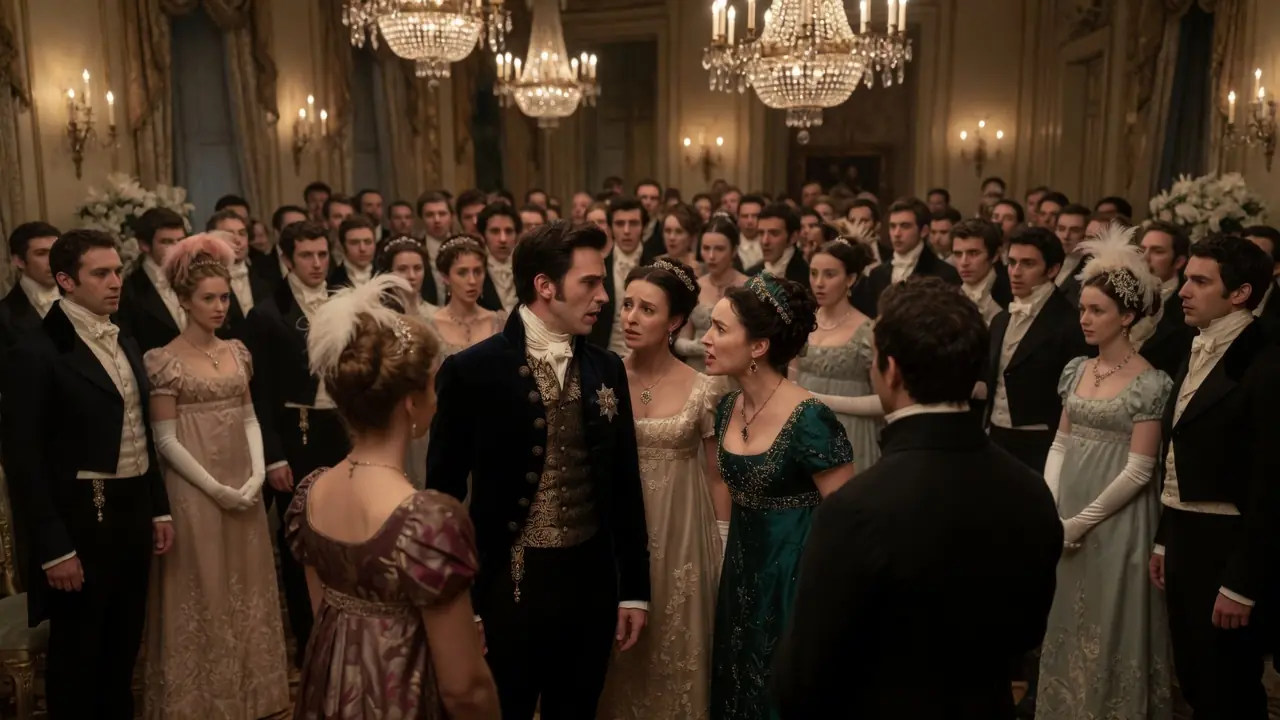
The ballroom quieted before they reached the center of it. Conversations thinned. Fans stilled. Even the musicians, sensing something in the Duke’s face, let the final notes of the set fall away into a hush bright with expectation. Robert did not release Barbara’s hand. He led her through the circle opening before them and stopped directly before Bry Norman and Mr. Chuck Elwood, who stood near the refreshment tables like figures caught in a painted scene. Neither could escape.
Bry recovered first. “Your Grace,” she began, smile brittle. “Surely this is not—” “It is precisely the moment,” Robert said. He did not raise his voice. He had no need. The room bent toward him. “You have repeated a falsehood tonight,” he said, his gaze fixed on Bry. “You have claimed that I once courted you, that I was refused, and that my marriage to the Duchess of Pinson was undertaken in revenge.”
A ripple moved through the assembly. Bry’s color rose and fell. “I merely spoke of what I believed—” “You lied.” The words landed cleanly. Robert’s tone remained cold, almost elegant in its restraint, which made the humiliation sharper. “The truth is this. You pursued my notice at a Hampshire house party two years ago. I gave you none. When your vanity could not tolerate indifference, you fashioned a romance and a refusal from air and repeated it until fools believed it.”
A soft gasp sounded from somewhere behind Lady Peton’s fan. Robert went on. “I ignored your invention then because it was beneath my attention. I do not ignore it now because you have used it to wound my wife.” He turned slightly then, not away from Barbara, but toward her, drawing her visibly into the center of his claim. “Let this room hear me plainly,” he said. “I married Barbara Norman because I esteemed her the moment I saw her stand under public cruelty with dignity enough to shame those who watched. I married her because she is courageous, intelligent, and worth more than the approval of every person present. I married her because I wanted her, and I would make the same choice again tomorrow and every day after.”
Silence, absolute and stunned. Chuck Elwood looked as though the floor had opened beneath him. Bry’s lips parted, but no defense came. Barbara felt the blood rushing in her ears. Felt the weight of a hundred eyes. Felt, more powerfully than any of it, the steady warmth of Robert’s hand around hers.
Then Robert looked down at her, and the severity in his face gentled into something the room had likely never seen from him. “My duchess,” he said for all to hear. “Will you dance with me?” Barbara placed her free hand in his with a calm she had not possessed on those church steps. “Yes,” she said.
The orchestra resumed as if released from enchantment, strings rising into a waltz beneath the chandeliers. Robert drew her into the first turn, his hand firm at her waist, his gaze never leaving her face. Around them, the assembly slowly returned to motion. Whispers flared again, but changed now, less cruel, more awed. Lady Peton looked positively starved of words. Bry stood rigid and colorless. Chuck did not meet anyone’s eye.
“They will speak of this for years,” Barbara murmured as they turned. “Let them,” Robert said, a quiet warmth beneath the old steel. “The only account that matters is ours.” Barbara looked up at him, at the feared Duke who had arrived like judgment and become impossibly home. “What if I still falter?” she asked softly. “Truth for truth now.”
His hand tightened, tender and sure. “Then you will not falter alone.” The answer undid her more completely than triumph ever could. As they moved beneath the glittering chandeliers, Barbara understood at last that Bry had not stolen her future. She had shattered a false one. What remained had been built in scandal, chosen in courage, and sealed not by rescue, but by recognition.
The jilted bride had entered Bath as a spectacle. She left the floor in the arms of a man who had claimed her before society, before scandal, before pride itself, and in doing so gave her not merely revenge, but something rarer: a love fierce enough to survive the world’s gaze.
Sterling Park rose out of the mist like a warning.