No one in Victorian England spoke the name Lady Beatrice Ashworth aloud anymore, even though she lived in one of the grandest houses for miles. Thornfield Manor stood proud and elegant, its tall windows shining in the spring sun, but inside its walls one young woman lived like a secret that was never meant to be discovered.
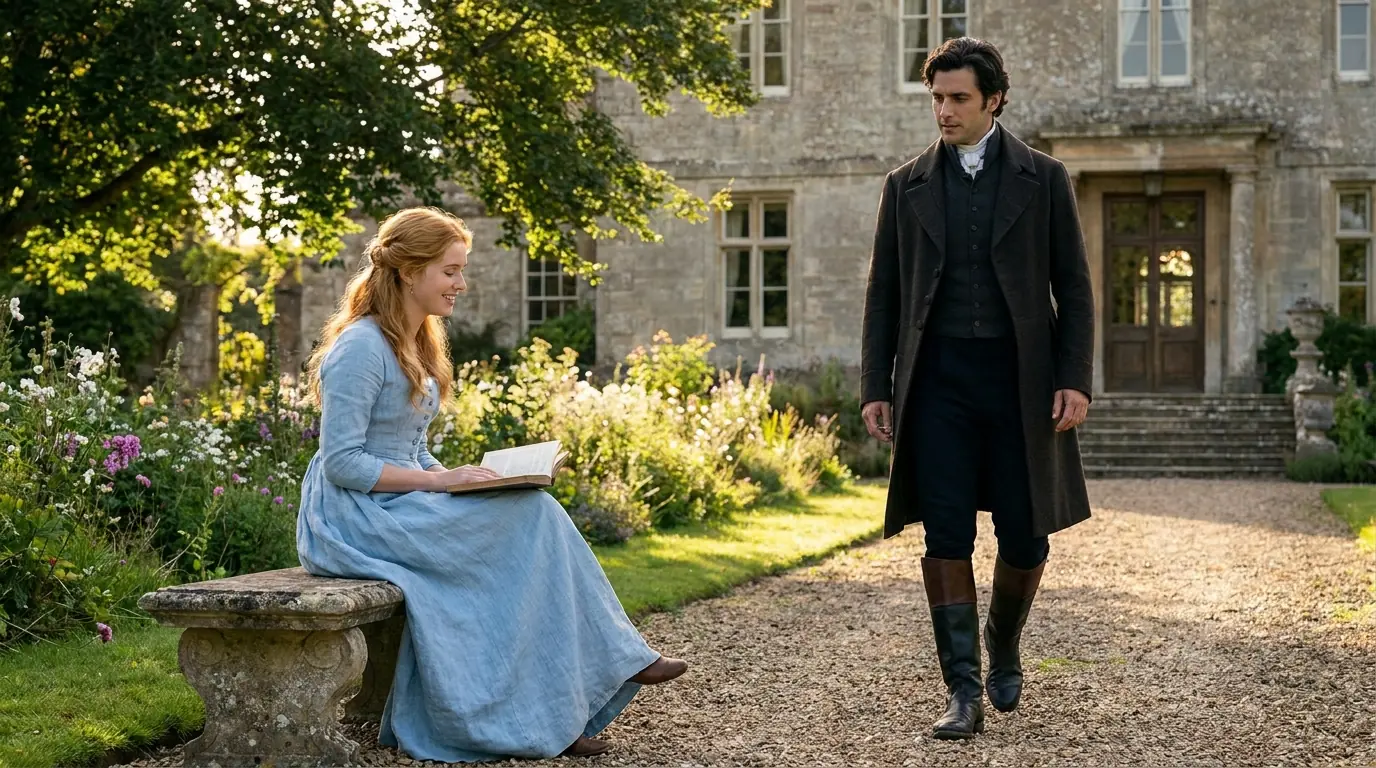
Beatrice sat alone in the East Garden, where roses bloomed freely and birds sang without fear. The air smelled of fresh earth and petals, and the warmth of the afternoon sun rested gently on her shoulders. A worn book of Shakespeare lay open in her lap. Reading had become her refuge, her quiet rebellion against a life that had been slowly taken from her.
At twenty years old, Beatrice had learned to accept loneliness. Once, she had been seen at gatherings, praised for her beauty and kindness, welcomed warmly by society. That was before her father died. That was before her stepmother decided Beatrice no longer had a place in the world.
Her golden hair caught the light as she turned a page, unaware that her peace was about to be shattered.
Beatrice. What are you doing out here where anyone might see you?
The sharp voice sliced through the calm like a blade. Beatrice stood at once, closing her book as Countess Viola Ashworth marched toward her, skirts brushing the gravel path. The Countess was elegant, flawless, and cold, every inch the woman who controlled Thornfield Manor with careful precision.
I was reading, Beatrice said quietly. The doctor suggested fresh air might help my headaches.
Viola's smile was thin and sharp.
How convenient that you feel well today, especially when we are expecting visitors.
Beatrice's fingers tightened around her book.
Visitors?
Lord Huntington and his son, Viola replied briskly. Business matters. Cordelia will join us for tea. You, however, will remain in your chambers. We will say you are unwell.
Beatrice lowered her gaze. She had heard these words many times before. Invitations lost, dresses ruined, rumors spread about her weak health. Over three years, she had faded from society until most people believed she barely existed at all.
As you wish, stepmother, she said softly.
And be sure to lock your door, Viola added coldly. We would not want you startling our guests.
Beatrice turned and walked back toward the manor, her steps steady despite the ache in her chest. She had learned long ago that arguing only made things worse.
Inside, Cordelia Ashworth sat at her dressing table, watching her reflection as her maid arranged her hair. Unlike her mother, Cordelia's eyes held warmth, and her heart carried guilt she could no longer ignore.
The maid nodded.
Yes, Miss Cordelia. The Countess was quite firm.
Cordelia sighed.
It isn't fair. She treats her like a shameful secret.
But fairness had no place in Viola Ashworth's plans.
That afternoon, as Viola and Cordelia prepared to receive their guests, the sound of carriage wheels echoed through the drive. Moments later, the butler entered, his composed face betraying surprise.
Your Ladyship, he announced, the Duke of Wellington has arrived and requests an audience.
Viola nearly dropped her teacup.
The Duke, she whispered, then straightened at once. Show him in immediately.
Arthur Wellesley, Duke of Wellington, stepped into the drawing room with quiet authority. Tall, dark-haired, and calm, he carried himself with the confidence that came from knowing his power and never needing to prove it. At thirty-two, he was the most sought-after man in England, yet he remained untouched by flattery or schemes.
Countess Ashworth, he greeted politely. Miss Ashworth. I apologize for arriving unannounced.
Viola glowed with excitement.
Your Grace, we are honored.
Arthur's gaze drifted toward the window overlooking the East Garden.
I understand Thornfield has remarkable gardens. My late mother loved such places.
They are our pride, Viola said quickly. Perhaps Cordelia could show you the rose garden.
Cordelia hesitated. She followed his gaze and saw Beatrice in the distance, seated once more with her book, unaware she was visible from the window.
Mother, Cordelia said carefully, didn't you say the East Garden was being replanted?
Before Viola could respond, the Duke spoke again.
Who is the young lady in the garden? he asked calmly. I do not believe we have been introduced.
The silence that followed was heavy.
That is my sister, Cordelia said gently, Lady Beatrice Ashworth.
My stepdaughter, Viola corrected sharply. She is rarely seen due to her delicate health.
Arthur's eyes narrowed slightly.
She appears quite well. Reading Shakespeare in the sun hardly suggests illness.
Viola forced a laugh.
She has good days and bad.
Then I should like to meet her while she is well, the Duke said, rising to his feet. It would be improper to visit Thornfield and not meet all of its family.
Viola's control slipped for just a moment, fear flashing behind her eyes, but she could not refuse a Duke.
Outside, Beatrice remained unaware as Arthur crossed the lawn toward her, the scent of roses carried on the breeze, lifting a strand of her hair as she read. When she looked up and saw him, she stood at once, startled.
Your Grace, she said, curtsying deeply.
The fault is mine, Arthur replied warmly. I interrupted your reading.
She glanced at her simple dress.
I fear I am not properly dressed to receive you.
I disagree, he said gently. What are you reading?
Sonnet 116, she replied. Let me not to the marriage of true minds admit impediments.
Arthur continued the verse without hesitation, his voice steady and rich.
Beatrice looked at him in surprise.
A Cambridge education, he said with a faint smile. May I join you?
They spoke easily about books, gardens, and thoughts rarely shared aloud. Beatrice found herself laughing, something she had not done freely in years. Arthur listened with genuine interest, not polite tolerance.
Inside the manor, Viola watched in silent fury. By the time Arthur escorted Beatrice back toward the terrace, he had already decided one thing. This woman was not weak. She was not invisible. And whatever secret surrounded her, he intended to uncover it.
The barriers that had hidden Beatrice from the world for years had begun to crack. And nothing at Thornfield Manor would ever be the same again.
That night, Thornfield Manor did not sleep peacefully. Countess Viola paced her private sitting room long after the servants had withdrawn, her sharp heels striking the floor like warnings. Three years of careful control had nearly unraveled in one afternoon. The Duke's calm gaze, his pointed questions, and worst of all, the way he had looked at Beatrice, lingered in her mind like a threat.
She was not meant to be seen, Viola muttered to herself, not yet.
In the East Wing, Beatrice lay awake, staring at the ceiling. Her heart still raced from the afternoon's events. The Duke's voice echoed in her thoughts, warm and steady, nothing like the dismissive tone she had grown used to. For the first time in years, someone had listened to her without pity or impatience.
A soft knock broke the silence.
Beatrice, Cordelia whispered as she slipped inside.
You should not be here, Beatrice said gently, though relief washed over her.
I know, Cordelia replied, closing the door. But after today, I could not stay away.
They sat together on the edge of the bed, the candlelight flickering between them.
He noticed you, Cordelia said quietly, truly noticed you.
Beatrice looked down.
It was only polite conversation.
No, Cordelia insisted. I have watched the Duke with a dozen young women. He has never looked at any of them the way he looked at you.
Beatrice felt warmth rise to her cheeks, followed quickly by fear.
Mother will not allow this to continue.
Cordelia's expression hardened.
Then perhaps it should not be her decision anymore.
Before Beatrice could respond, footsteps sounded in the corridor. Cordelia stood at once.
Be careful, she whispered. Tomorrow will matter more than you realize.
The following morning dawned bright and clear. Birds sang outside Beatrice's window as though unaware of the tension thickening the manor's air. Her maid, Eleanor, entered with breakfast, her face unusually pale.
My lady, Eleanor said softly, the Countess has ordered the doctor to visit you today.
Beatrice's stomach tightened.
Why?
She says yesterday's excitement may have weakened you.
They both knew what that meant.
Downstairs, Viola issued instructions with ruthless efficiency. If the Duke calls again, he will be told Beatrice is confined to her bed. Dr. Blackwell will confirm it.
And if His Grace insists? a servant asked hesitantly.
Viola's eyes flashed.
Even a duke cannot argue with illness.
By mid-morning, Dr. Blackwell arrived. He examined Beatrice briefly, his hands shaking slightly as he listened to her heart.
You appear well, he murmured, avoiding her eyes.
And yet? Beatrice asked calmly.
And yet, he sighed, the countess fears nervous exhaustion. Complete rest is advised.
After he left, Beatrice sat very still. This was no longer just about being hidden. Something darker lay beneath Viola's fear.
An hour later, the unmistakable sound of carriage wheels filled the drive. The duke had returned.
Viola greeted him herself this time, her smile fixed and flawless.
Your Grace, how kind of you to call again. I regret to say Beatrice is quite unwell today.
Arthur's expression did not change.
That is unfortunate. I had hoped to bring her several books she expressed interest in.
Another time, perhaps, Viola replied smoothly.
Arthur nodded once.
Then I shall speak with Miss Cordelia instead.
Cordelia met him in the music room, fingers resting lightly on the pianoforte keys. When the servants withdrew, her polite smile faded.
She is not ill, Cordelia said quietly. Mother is lying.
Arthur studied her carefully.
Why?
Cordelia hesitated, then spoke the truth she had carried alone for years.
Because Beatrice's inheritance becomes hers on her next birthday. Until then, mother controls everything.
And after? Arthur asked.
After, Cordelia whispered, she loses her power.
Arthur's jaw tightened. Pieces were falling into place.
That evening, Eleanor overheard a conversation outside the countess's sitting room. Viola's voice was sharp, urgent.
There are facilities, she said, private ones. Places for delicate young women who cannot manage their own affairs.
Eleanor's blood ran cold. She went straight to Beatrice.
They mean to lock you away, Eleanor whispered. Not tomorrow, perhaps not next week, but soon. Before your birthday.
Beatrice felt the room spin.
She would not dare.
She would, Eleanor insisted. I heard it myself.
Fear gave way to clarity. For the first time, Beatrice understood that obedience would not save her.
That night, Cordelia returned, closing the door behind her with shaking hands.
The duke knows, she said. Not everything, but enough. He is suspicious.
Beatrice looked at her sister, hope and terror colliding.
What does that mean?
It means, Cordelia said firmly, you will not face this alone.
The next day, Arthur received a sealed envelope at his lodging in the village. Inside were copies of financial records, discreetly obtained, and a short note from Cordelia.
She is in danger. Please help her.
Arthur read the documents slowly, his expression hardening with each line. By the time he reached the end, his decision was made.
Back at Thornfield, Viola prepared her final move, unaware that her carefully built prison was about to collapse. Because the Duke of Wellington did not ignore injustice. And he did not abandon women who deserved better.
By nightfall, escape was no longer a question of if. It was a matter of when.
The night before everything changed, Thornfield Manor felt like a house holding its breath. Beatrice sat by her window, fully dressed, though it was past midnight. The moonlight spilled across the floor, pale and quiet, as if urging her forward. Her small travel bag rested at her feet. Inside were only the essentials: a few clothes, her mother's pearl hair comb, her father's ring, and the book of Shakespeare that had kept her company through so many lonely days.
Eleanor slipped into the room without a sound.
It is time, my lady, she whispered. The east gate is clear. The duke's carriage waits beyond the trees.
Beatrice's heart pounded.
Cordelia?
She has done her part, Eleanor said. The countess believes you are asleep. Dr. Blackwell has been dismissed for the night.
Beatrice stood. Her legs trembled, but her resolve did not.
They moved through the servants' corridors, shadows among shadows. Every creak of the floor sent fear racing through Beatrice's chest. At one point, voices echoed nearby, and they pressed into an alcove, barely breathing until the footsteps passed.
When they reached the garden door, Eleanor paused.
My lady, she said softly, your father would be proud of you.
Tears filled Beatrice's eyes. She embraced Eleanor tightly, then slipped out into the cool night air.
The carriage stood just beyond the hedges, unmarked and ready. Arthur stepped forward the moment he saw her.
You are safe now, he said quietly, helping her inside.
As the horses moved, Thornfield Manor faded into the darkness behind them.
By morning, Countess Viola discovered the truth. Beatrice's chambers were empty. Rage shook Viola to her core. Orders were shouted, servants were accused, but it was already too late.
Word had reached London, and worse, official papers followed soon after. Arthur had acted swiftly. Within days, Viola's guardianship was revoked. Financial records were exposed. The court saw the truth clearly: a young woman deliberately hidden, declared ill to maintain control over her inheritance.
Cordelia was sent to stay with family friends for her own protection.
Beatrice, meanwhile, found herself in London, sheltered in the home of Arthur's aunt, surrounded by calm, kindness, and safety for the first time in years.
Arthur visited daily, not as a rescuer, not as a duke issuing commands, but as a man deeply concerned for her heart.
You do not owe me anything, he told her one afternoon as they walked in the garden. I did this because it was right.
I know, Beatrice replied. But I'm grateful beyond words.
As the weeks passed, the fear slowly loosened its grip. Beatrice smiled more easily. She spoke without hesitation. She laughed. And Arthur watched her bloom.
On the morning of her twenty-first birthday, sunlight streamed through the windows. The day belonged to her now. Her fortune, her name, her future were hers alone.
That evening, Arthur asked her to walk with him beneath the lanterns in the garden.
I will not speak as a duke tonight, he said, only as a man.
He took her hands.
I admire your strength. I admire your kindness. And I love you.
Beatrice's breath caught.
I love you, too.
He knelt then, offering a ring that shimmered softly in the light.
Will you be my wife?
Tears slipped down her cheeks as she nodded.
Yes.
Their wedding was quiet, but joyful. No secrets, no shadows. Only warmth, honesty, and hope.
One year later, Beatrice stood beside Arthur as the Duchess of Wellington, her hand resting gently over her heart as she watched the gardens bloom once more. She was no longer hidden. She was no longer despised. She was seen, cherished, and free.
And Thornfield Manor was only a distant memory of the life she had bravely left behind.