The call came at 4:47 in the morning, and before Derek Hutchens touched the screen, he already knew why Corey was calling.
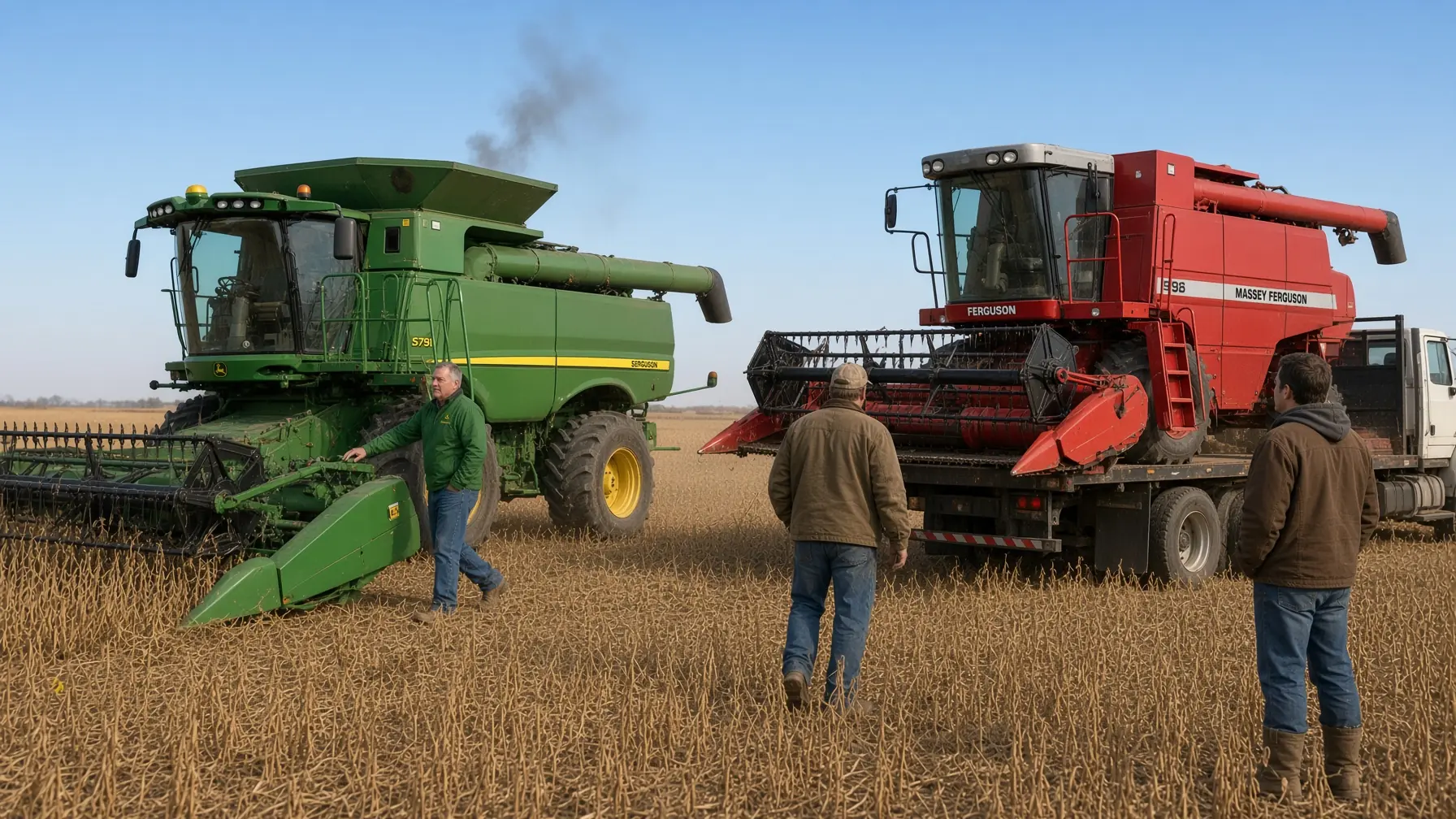
He stood barefoot in the kitchen of his farmhouse north of Brookings, South Dakota, with one hand around a coffee mug and the other resting against the counter. Outside, the yard light painted a weak yellow circle around the machine shed while everything beyond it disappeared into darkness. They had roughly three hundred forty acres of soybeans still standing, the beans had finally dried into a good harvest range, and a strong autumn system was moving toward eastern South Dakota. The forecast did not guarantee disaster, but it did guarantee less certainty than Derek wanted with that many acres still in the field.
The phone screen read COREY JENSEN.
Derek answered.
Corey said only three words.
“It’s down again.”
Derek closed his eyes.
He did not ask whether Corey had cycled the battery disconnect. He did not ask whether he had shut the combine completely down, waited, restarted it, cleared the code, or tried raising the header manually. They had been through that routine often enough that Corey knew it better than some technicians.
“Where?”
“Northeast forty. About where it quit Tuesday.”
“Same code?”
“Hydraulic pressure-control fault. Header dropped, machine derated, harvest functions locked out.”
“I’m coming.”
Derek put the untouched coffee in the sink, pulled on his boots, and took the truck keys from the hook beside the door.
This was the fourth serious interruption in thirty-one days.
The combine was a nearly new John Deere S790, purchased the previous spring for roughly $417,000 after options and trade allowance. It had less than three hundred engine hours. Derek had ordered it with the precision package, yield mapping, automatic adjustments, guidance integration, remote diagnostics, and almost every feature the dealership believed would make harvest faster and easier.
Derek had believed them.
He had been buying Deere equipment his entire adult life. His father ran green. His grandfather ran green. In the back corner of the Hutchens shop sat a 1979 John Deere 4440 with faded paint, a cracked seat, and enough accumulated repairs to tell the history of three generations. It still started every spring.
Brand loyalty in the Hutchens family was not something printed on hats.
It had simply never been questioned.
Until now.
Derek reached the northeast forty a few minutes after five.
The S790 sat crooked among soybean rows, header still lowered, work lights glowing but the separator silent. Corey stood beside the left rear tire with his arms crossed. At thirty-eight, he had worked for Derek for eleven years and was not prone to exaggeration. When Corey looked disgusted with a machine, Derek paid attention.
Derek climbed out.
“Show me.”
Corey led him into the cab.
The display carried a hydraulic-control warning and an instruction to contact authorized service. Corey opened the diagnostic history. The fault had appeared three times during the previous twenty minutes.
“Dealer?”
“Called already.”
“When?”
“Four-thirty.”
“And?”
“They’ll send Travis when he clears another machine.”
“When?”
“They said before noon.”
Derek looked through the windshield toward the dark rows.
“Noon.”
Corey shrugged.
“He’s twenty miles west on a corn machine.”
Derek could not blame Travis Miller.
Travis was a good field technician, one of the reasons the Hutchens family had remained with the dealership for so long. He understood hydraulics, electrical systems, machine networks, and the peculiar way modern combines sometimes reported the symptom of a problem rather than its source. During harvest he regularly worked fourteen-hour days because every farmer believed his disabled machine should become the highest priority in the county.
The problem was no longer Travis.
The problem was that Derek had begun expecting to need Travis.
The first failure had come during wheat.
Seventy acres into a field, the feeder-house drive stopped. No broken chain. No failed belt. No obvious obstruction. The machine simply refused to command the drive correctly. Travis spent several hours checking wiring and sensor signals before replacing a control module under warranty.
Three days later, the machine returned to the field.
Then the rotor system began throwing an intermittent fault.
It would operate normally for thirty or forty minutes, reduce power, report an out-of-range reading, then force a shutdown. Software calibration was attempted. A sensor array was replaced. Eventually the problem disappeared.
Then the unloading auger stopped halfway through its swing during soybean harvest.
It had not been unloading grain at the time, which saved them from a worse mess, but Corey spent an hour following the manual procedure to return it while Derek argued with technical support about whether the position sensor or the control circuit was responsible.
And two days earlier, a hydraulic fault had interrupted header control.
Now it was back.
Different messages.
Different components.
Same machine.
Derek pulled out his phone and opened the file he had begun keeping after the wheat breakdown.
Dates.
Hours.
Codes.
Parts replaced.
Dealer visits.
Field time lost.
He had stopped using phrases like “this thing never runs” because Melissa, his wife, had pointed out that frustration was not accounting. The combine had run many productive hours. But during critical harvest windows, Derek had documented enough fault-related downtime to make one fact impossible to dismiss.
He no longer trusted it.
That mattered more than the percentage.
Corey leaned against the cab doorway.
“What do you want to do?”
“Wait for Travis.”
“And the beans?”
Derek looked toward the east.
“Older combine can keep going on the south piece.”
Their operation owned a second, older machine that had been expected to reduce harvest pressure, not carry the season by itself. It was slower and needed more attention, but it still worked.
Corey nodded.
“I’ll move over.”
“Keep this one where it is. Don’t keep resetting it.”
“Wasn’t planning to.”
Derek watched Corey walk toward the pickup.
Then he looked at the S790.
A machine costing more than four hundred thousand dollars sat motionless in a field while a combine more than twice its age was about to carry on without it.
That irritated him.
But irritation was still not the same thing as evidence.
So he waited.
Travis arrived at 10:51.
He parked the service truck beside the S790, greeted Derek with an expression that was half apology and half exhaustion, then climbed straight into the diagnostics.
“Same hydraulic family?”
Derek asked.
“Looks like it.”
“You replaced the valve block.”
“Dealer did. I installed it.”
“How many hours ago?”
“Not many.”
For the next forty minutes, Travis commanded functions through the diagnostic software, checked pressures, inspected connectors, and compared the current fault history with previous events. He moved between the cab and the hydraulic compartment three times before sitting back on his heels.
“What?” Derek asked.
Travis wiped his hands.
“The control block is not responding consistently.”
“So it failed again?”
“Maybe.”
“That word is becoming expensive.”
“I know.”
“What else?”
Travis hesitated.
“There could be something upstream. Harness. Reference voltage. Power distribution. Network issue. If the block isn’t getting clean commands, replacing it again may fix the symptom and not the cause.”
Derek stared.
“That sounds familiar.”
“It should.”
“What do you recommend?”
“Replace the block because it’s not behaving correctly, inspect the harness more deeply, and escalate the whole history to district service.”
“You have another block?”
Travis looked down.
“No.”
“Where is one?”
“Inventory shows Iowa.”
“When?”
“If that inventory is accurate, maybe tomorrow. Maybe Monday.”
Derek laughed once.
Not because anything was funny.
“Monday.”
“I know.”
“You got a loaner?”
“Mark is working on one.”
“That means no.”
“That means he’s working on one.”
Derek looked toward the combine.
“Travis, if this were yours, would you keep it?”
The technician gave him a long look.
“I’m not answering that.”
“That bad?”
“No. I like being employed.”
Derek smiled despite himself.
Then the smile disappeared.
“I’m done with it.”
Travis stood.
“Done?”
“This machine.”
“Derek—”
“I’m not blaming you.”
“I know.”
“I’m not even saying the whole model is bad.”
“That’s good, because I service several that have been excellent.”
“I believe you.”
Derek looked at the field.
“I just don’t want this one anymore.”
That was the moment his frustration became a decision.
Not because an error code appeared.
Because repeated uncertainty had finally become more expensive to him than the cost of leaving.
He drove directly to the dealership.
The general manager, Mark Ellison, saw Derek cross the showroom and stood before he reached the office.
“Travis called. We’ve got the district rep involved.”
“I want to trade it.”
Mark stopped.
“For another S790?”
“No.”
“What are you thinking?”
“I don’t know yet.”
Mark closed the office door.
“Sit down.”
Derek sat.
Mark opened the finance screen.
The numbers were ugly.
“You’re eleven months into this note.”
“I know.”
“Payoff is around three hundred seventy-four thousand.”
“I know.”
“If we value the machine conventionally, you could bury yourself on the difference.”
“How much?”
Mark gave him a preliminary range.
Depending on warranty adjustment, actual resale, manufacturer participation, and whether Derek traded within the dealership, he could take a loss approaching six figures.
Derek looked at the monitor.
Mark leaned back.
“I’m not trying to trap you in it. I’m telling you that getting out because you’re angry could cost more than fixing it.”
“I’m not angry.”
“That makes this conversation stranger.”
“I don’t trust the machine.”
“Every combine can break.”
“I know.”
“You switch brands tomorrow and the next one might break Tuesday.”