His bride hid her pain beneath her dress. When the Duke discovered why, his heart broke. Arthur Pendleton, Duke of Blackwood, believed he was saving a forgotten woman. Clara Ashford was intelligent, beautiful, and trapped in a life she did not deserve. Offering her marriage seemed like the simplest solution.
What Arthur didn't know was that Clara carried a secret beneath her gowns, a secret hidden for four long years. Then one stormy night, fate revealed the truth. And the Duke discovered that some wounds are far deeper than anyone can see.
One. In the autumn of 1775, the ton could talk of nothing else but the absolute madness of the Duke of Blackwood. Arthur Pendleton was, by every measure society used to judge a man, entirely above reproach. He was devastatingly wealthy, possessed of a towering frame, a very handsome face, and silver eyes sharp enough to cut glass, and carried himself with the kind of quiet authority that made lesser men step aside without being asked.
Debutantes swooned. Matriarchs schemed. Entire households rearranged themselves around the hope that he might glance their way. And yet Arthur remained unmoved, cold, unhurried, indifferent to the carefully constructed performances that society laid before him like offerings.
When rumor spread that the Duke intended to visit the Vaughan estate to discuss a property acquisition, every woman in House Vaughan prepared accordingly. The highly disliked and greedy Lady Vaughan spent three days drilling her daughters in deportment. Her daughters, Millicent and Sophia, had their hair dressed, their wittiest remarks rehearsed, their finest gowns pressed. They were, by fashionable accounts, beauties of the first order, and they were very well aware of it.
Nobody thought to mention Clara. Of a fact, she was never remembered except when a chore needed to be done. Clara Ashford, daughter of the late Lord Ashford by his first marriage, stepdaughter to Lady Vaughan, his second wife, had not been seen in public since she was 16 years old, since after her father passed on. She had not attended a single ball, assembly, or afternoon call in 4 years.
Society, which abhors a void, had filled her absence with invention. Some whispered she was grotesquely deformed. Others said she had lost her mind. The rumors varied in detail, but agreed on the essential point. Clara Ashford was something to be hidden, and her family was simply doing the merciful thing.
The truth was far simpler and far crueler than any rumor. Clara was kept in the back rooms of the Vaughan estate because she was useful there. She cooked. She cleaned. She managed the household accounts that Lady Vaughan could not be troubled with. She mended her step-sisters' dresses, kept the fires lit, and served meals that were presented to guests as though they had appeared by magic.
She was not precisely a servant because servants were paid. She was simply the invisible mechanism that kept the household running, and she had been so for 4 years, since her father died and left her entirely in Lady Vaughan's hands.
On the afternoon of the Duke's visit, Clara was not supposed to be seen at all, but the parlor maid had been sent on an errand, the tea had gone cold, and Lady Vaughan's withering look across the room required no translation. Clara picked up the tray in the kitchen, smoothed her worn gray dress with both hands, and carried it into the parlor.
She did not look up immediately. She never did. Looking up invited attention, which she always got, and attention in this house was never a good thing. She set the tray down, arranged the cups, and began to pour.
Arthur Pendleton, who had been watching Millicent and Sophia perform their careful smiles with the patience of a man enduring something he could not yet politely end, looked up when Clara entered the room. He looked up because there was something in her movement, quiet, self-contained, entirely without performance, that was different from everything else in the room.
Then she lifted her eyes briefly to check the tray arrangement, and his breath left him. She was not what any rumor had said. She was not plain. She was, in the most arresting and inconvenient way possible, one of the most beautiful women he had ever looked at. Luminous dark eyes, features of a particular delicate precision, a quality of stillness in her face that was not dullness but deep, contained intelligence, and well-defined feminine curves.
Her dress was worn and her hair simply arranged, but none of it concealed a single thing. She met his gaze for the briefest fraction of a second and then looked immediately back at the teacups. Arthur looked back at his documents. He was a man of strict logic. A duke being disarmed by a servant girl in a gray dress was not something he had time for.
The meeting proceeded. Property deeds were laid across the table. His solicitor pointed out the key clauses. Arthur was mostly listening when the girl, still present, standing at the sideboard with the stillness of someone who has learned that stillness is safer than movement, spoke.
"The deed on page four," she said quietly, directing her words at no one in particular, her eyes on the tray. "The boundary clause in the third paragraph. There is a slight error. The acreage described does not correspond to the land registry reference cited."
He looked at the girl in the gray dress, stunned. She was still looking at the tray, her expression perfectly neutral, as though she had commented on nothing more significant than the weather. "Your name?" he said.
She looked up. A flicker of something crossed her face, the instinct of someone who has learned that being noticed is the precursor to being punished. "Clara, your grace," she said. "Clara Ashford."
He held her gaze. She did not look away, and that, more than anything, told him something. After the meeting concluded with the deed flagged, the solicitor chastened, and the step-sisters' careful smiles still arranged on their faces like furniture nobody was using, Arthur made certain inquiries.
He spoke to Lady Vaughan privately. He was not a man who dithered. He learned Clara was one of the daughters of the house and was mostly surprised at how she was dressed and treated, but he wasn't a man who asked questions that did not concern him. He simply thought she'd be very useful as a secretary since she was clearly intelligent and she could help ward off the unwanted attention from the females of the ton and his mother's constant nagging to get a wife, which was becoming unbearable by the day, if he married her.
Also, he could save her from the misery she was clearly in, though he couldn't understand why he felt compelled to do that. Lady Vaughan, presented with a figure that settled every Vaughan debt and then some, agreed with gratifying swiftness that her stepdaughter's situation might be rearranged.
He told Clara the arrangement plainly the next morning in the parlor with Lady Vaughan absent and the door open. "You will come to Blackwood Hall as my wife in name," he said. "Publicly, that is what you will be, the Duchess of Blackwood. Privately, I have need of a secretary. Someone who can read a fraudulent contract clause and understand what they are looking at."
He paused. "You will have your own rooms, your own income, and your own freedom. I am not trading one cage for another. I am offering you a door." She looked at him. "Why?" she asked.
"Because no one with your mind should be carrying tea trays," he said. "And because whoever arranged this for you should not be permitted to continue." She was quiet for a long moment. "I accept, your grace," she said.
She said it the way someone signs a legal document with full attention and no illusions. What he could not see beneath the gray wool dress with its high collar and long sleeves buttoned tightly to the wrists was the reason Clara Ashford never showed her skin. He would learn that later, and it would undo him completely.
Two. Blackwood Hall in autumn was a place of dark mahogany, high ceilings, and fires that crackled pleasantly against the October chill. Arthur had lived there for 7 years and considered it entirely adequate. It contained an excellent library, a respectable wine cellar, and very few surprises.
Then Clara arrived. Within a week, she seemed to know the house better than he did. Arthur first noticed it when he came down to breakfast and found a vase of late roses moved from the east drawing room to the south one. "They were dying," Clara explained when he asked. "The flowers. The room."
Arthur stared at her. "The room," she repeated calmly. "Nobody ever sits in it because it's gloomy. The flowers receive more sunlight there." Arthur looked at the flowers. The flowers did indeed appear happier. He found this mildly irritating.
Three days later, he arrived at his study to discover a single sheet of paper resting neatly on his desk. "Cook is being overcharged. See attached." That was the entire note. Arthur frowned. He examined the figures. Then he examined them again. By the third reading, he was forced to acknowledge that Clara had somehow uncovered a supplier who had been quietly inflating invoices for months.
By luncheon, the supplier had received a strongly worded letter. By dinner, Arthur was wondering how a woman hidden away in a neglected corner of society had managed to identify a problem that had escaped half the estate staff.
The following week, she reconciled six months of household accounts in four days. The week after that, she reorganized the delivery records. The housekeeper adored her. The cook feared her. The gardeners had begun consulting her voluntarily. Arthur was beginning to suspect she might conquer England if left unsupervised.
The practical solution was to move her into the study. Entirely for efficiency, of course. Nothing else. The transformation that followed was difficult to ignore. Proper food helped. So did warmth. So did the absence of people waiting for an excuse to criticize her.
The first time Arthur truly noticed the change, he blamed the light. Afternoon sun poured through the study windows, catching in Clara's hair as she bent over a ledger. He looked away. Then he looked back. Unfortunately, the problem remained. Clara Ashford was becoming alarmingly beautiful. Or perhaps she always had been. The difference was that she now lived safe enough to let it show.
Arthur filed this observation under information that served no practical purpose. The file became increasingly large. What surprised him most, however, was not her beauty. It was her sense of humor.
He had expected intelligence. He had expected competence. He had not expected to be reviewing estate figures on a cold Tuesday morning when Clara glanced at a document and asked, without looking up, "Is this a test of my arithmetic, Your Grace, or are you simply ensuring I never discover how dreadful your handwriting truly is?"
Arthur promptly inhaled brandy. The coughing fit that followed was deeply undignified. Across the desk, Clara maintained a perfectly innocent expression. Only her eyes betrayed her. They were laughing.
Arthur finally recovered enough to say, "My handwriting is perfectly legible." "It is," Clara agreed. He narrowed his eyes. She added, "To medical professionals."
For reasons he could not adequately explain, he laughed. The sound startled him almost as much as the joke. It felt oddly unfamiliar, like finding a door in one's own house and realizing it had been there the entire time.
The difficulty was that Clara never seemed to be trying. She did not flirt. She did not seek attention. She did not maneuver conversations toward intimacy the way half the unmarried ladies of the ton seemed trained to do from birth. She simply existed. Cheerfully, intelligently, and with such genuine delight in small things that Arthur found himself watching her before he realized he was doing it.
One afternoon, he entered the library intending to retrieve a legal volume and found Clara crouched beside a bookshelf. A footman stood nearby looking deeply uncertain. "What is happening?" Arthur asked. Clara raised one finger. "Negotiations."
Arthur looked down. A mouse looked back. The mouse appeared unconvinced. "Negotiations?" Arthur repeated. "We've reached a sensitive stage." The footman nodded solemnly. Arthur stared at both of them. Then he quietly left.
When he returned 20 minutes later, the mouse had apparently agreed to relocation. Clara looked pleased with herself, and the footman seemed to have developed profound respect for her diplomatic abilities. Arthur decided not to ask questions.
He was beginning to understand that life was simpler when Clara Ashford was allowed to manage things in her own peculiar way. He also discovered he had started finding excuses to talk to her. This realization arrived midway through a lengthy explanation about an estate drainage dispute.
Arthur did not care about drainage. He had never cared about drainage. Yet somehow he had spent 10 minutes discussing it. Clara listened attentively. Worse, she asked sensible questions. By the end of the conversation, Arthur cared about drainage. He considered this entirely her fault.
The clothing, however, remained a mystery. No matter the weather, Clara dressed exactly the same way. High collars, long sleeves, buttons fastened neatly to her wrists. In September, it seemed merely conservative. By October, when fires warmed every room in the house, it began to feel deliberate.
He mentioned it once over dinner. "You must find Blackwood Hall terribly warm." Clara didn't even hesitate. "The English sun is merciless to pale complexions." Arthur accepted this explanation. Several hours later, he remembered they were having the conversation after sunset. By then it felt far too late to revisit the matter.
So he let it go, or tried to. He became very busy telling himself that Clara's wardrobe was none of his concern. One morning she caught him staring absently out the window while she was discussing a contract renewal. "Your grace," she said kindly, "if the oak tree outside is participating in this negotiation, I feel I should be introduced."
Arthur turned back. Clara was studying her papers with remarkable concentration. The corner of her mouth, however, had betrayed her. He felt the room grow warmer, which was absurd. It was October.
By the end of the second month, Arthur was honest enough to admit what he had known for weeks. He was in very significant trouble.
Three. The storm arrived just after dusk. Arthur heard it long before he looked up from the correspondence spread across his desk. Rain rattled against the windows. Wind moved through the chimneys with a low mournful sound. Somewhere deep within Blackwood Hall, a door slammed hard enough to make the candles flicker.
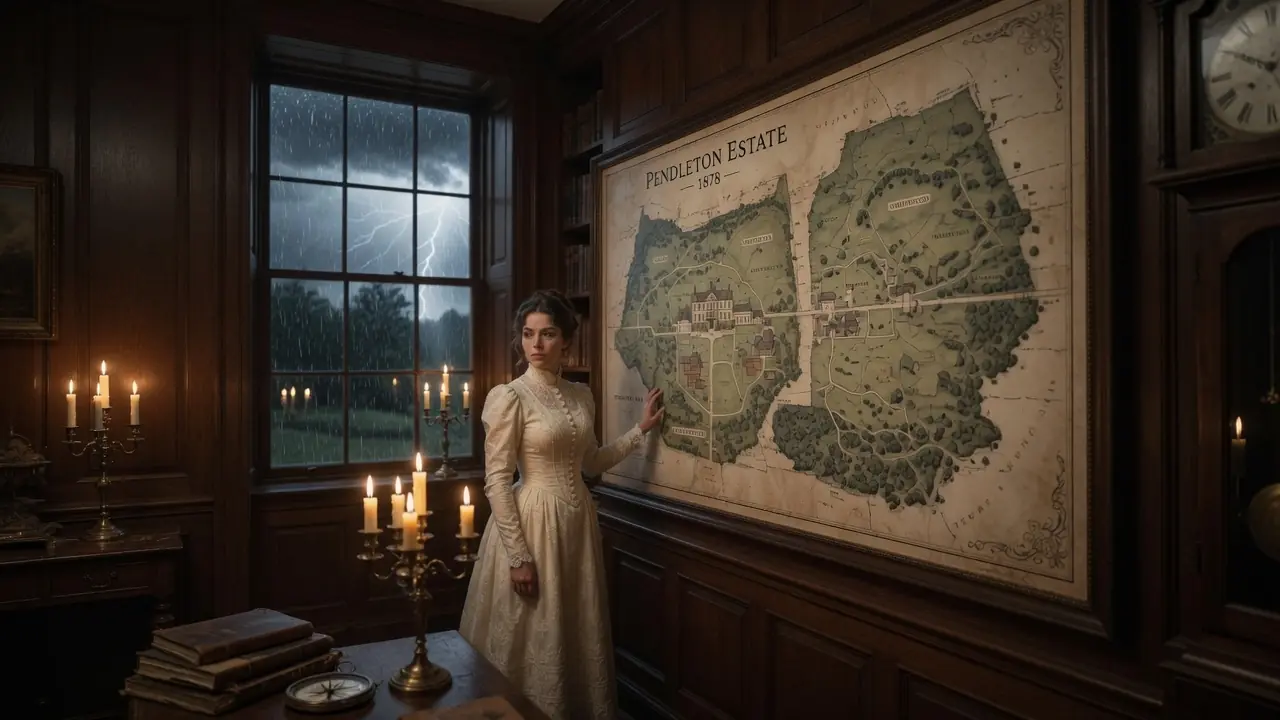
Outside, autumn was doing its best to tear the countryside apart. Inside, Arthur was attempting to survive a boundary dispute. This was proving surprisingly difficult. Estate maps covered nearly every available surface in the study. Letters, surveys, tenancy agreements, and legal opinions had spread across the room like an invading army.
Across the table, Clara appeared entirely unbothered by the chaos. She leaned over one of the maps, one hand resting lightly on the parchment as she followed a faded line of ink along the edge. A loose curl had escaped from her carefully pinned hair. Arthur had noticed it 20 minutes ago. This was unfortunate.
"The tenant's claim is weak," Clara said. Arthur dragged his attention back to the map. "How weak?" She tapped a point near the bottom corner. "The original survey is clear. The boundary marker is here." Her finger moved. "The tenant knows that."
"Then why argue?" Clara glanced up. "He is hoping you're rich enough to find being right inconvenient." Arthur laughed. "A reasonable assumption. Foremost Dukes. Foremost." She nodded. "You spent 4 hours this week investigating a tenancy dispute worth less than 50 pounds."
"That sounds excessive when you say it aloud." "It was excessive." "I prefer thorough." "You prefer paperwork." Arthur considered defending himself. Unfortunately, she was correct. Again.
"I begin to suspect employing you was a strategic mistake." The corner of her mouth lifted. "I've suspected the same for weeks." Arthur shook his head. "You have become alarmingly confident." "You keep proving me right. It encourages bad habits."
He laughed despite himself. The sound mingled with the storm outside. For a moment Clara laughed, too, and something in Arthur's chest tightened unexpectedly. The trouble with Clara was that she never seemed to realize what she was doing to him. She simply existed. And somehow that was worse.
She returned her attention to the survey. A few moments later she frowned. "I believe this surveyor actively disliked the letter G." Arthur looked over. "What?" She pointed to the annotation. "The man writes every other letter perfectly. Then he reaches a G and appears to lose faith in civilization."
Arthur stared at the document. To his annoyance, she was right. The letter looked as though it had been drawn during an earthquake. He laughed again. Clara smiled. The room suddenly felt smaller or perhaps warmer. Arthur wasn't entirely sure.
The fire crackled behind them. Rain pressed steadily against the windows. The storm seemed impossibly far away. He became aware all at once that they were standing very close. The maps required it. At least that was the official explanation. The table was wide. The documents were extensive. Neither of them had mentioned that they could have moved hours ago.
Clara reached for the edge of the survey. Arthur reached for it at the same time. Their hands stopped inches apart. Neither touched the paper. Neither moved. Silence settled over the room. Arthur became painfully aware of everything. The fire. The rain. The scent of lavender. The fact that Clara's eyes were very close to his.
Clara looked up. For one suspended moment, neither of them spoke. Then he saw it. The slight twitch at the corner of her mouth. The beginning of a joke. Arthur knew that expression. Whenever something frightened Clara, she made it funny. Whenever a conversation became too personal, she found a way to redirect it. Whenever a moment mattered, she hid behind humor.
He had watched her for weeks. Not this time. Before she could speak, he lifted a hand. His fingers brushed her jaw. Barely a touch. Clara froze. The joke disappeared. So did every excuse either of them had been hiding behind.
The storm outside faded into nothing. Arthur could hear only his own heartbeat and hers. "Clara." He had no idea what he intended to say after that. Her gaze met his, completely unguarded. The look in her eyes hit him harder than any declaration ever could. Longing, hope, fear. Enough feeling to steal the breath from his lungs.
"Arthur," she whispered. His name, not "your grace," not "duke." Arthur. The sound of it undid something inside him. Slowly, carefully, he drew her closer. For the briefest moment she hesitated. Not because she wanted to pull away, because she wanted to trust it.
Then she stepped into his arms. Arthur's hands settled at her shoulders. The world narrowed to her warmth, to her nearness, to the certainty that this felt more right than anything had in a very long time.
Then the silk shifted. A tiny sound, barely more than a thread snapping. Clara went rigid. Arthur felt it instantly. The shoulder seam of her gown gave way. The fabric slipped. Candlelight touched bare skin.
Everything stopped. Clara gasped. The sound was small, terrified. She jerked backwards so quickly that the chair behind her nearly overturned. One hand flew to her shoulder. Her face lost all color. "No." The word escaped her before she seemed aware she'd spoken.
With shaking fingers she pulled the silk back into place. Her breathing had become uneven. Panicked, she wouldn't look at him. "I apologize," she said quickly, too quickly. "Please, I apologize. Please don't."
"Clara." His voice came out low, not shocked, not disgusted, something else, something far more dangerous. She stood perfectly still, one hand clutching the torn fabric, her head bowed.
Arthur had only seen it for a second. A single second. But it was enough. Across her shoulder and the visible curve of her upper back were scars. Not one. Not two. Many. Silver lines crossing older ones. Some faded with time. Others less so. Deliberate. Systematic. The unmistakable marks of someone who had been hurt over and over again. Not by accident. Not once. For years.
And in that moment, Arthur understood why Clara wore high collars in summer. Why she covered every inch of skin. Why fear had flashed across her face so quickly. The realization struck him with terrible force. Someone had done this to her. Someone had done it on purpose.
And judging by the look on Clara's face, she fully expected him to turn away.
Four. The study fell silent. Not completely. The storm still battered the windows. Rain drummed against the glass. The fire crackled softly behind them. But neither of them seemed to hear any of it.
Clara stood frozen. One hand gripped the torn silk at her shoulder so tightly her knuckles had gone white. She still wasn't looking at him. "I apologize," she whispered. The words came out automatically. As though she had spoken them a hundred times before. "Please. I apologize."
Arthur's chest tightened. She was apologizing. Not because she had done anything wrong. Because she had been seen. "Clara." She flinched. The movement was small. Almost invisible. Arthur wished he hadn't noticed it.
"Look at me." She shook her head. For a moment, he thought she might refuse. Then, slowly, she turned. The pride in her nearly undid him. Her eyes were bright with unshed tears. Her chin remained lifted, as though she had decided long ago that if people were going to hurt her, they would at least have to do it while she stood upright.
Arthur let her look at him, really look at him. He needed her to see there was no disgust in his face, no pity, no revulsion, only heartbreak. Something shifted in her expression, not relief, not quite, but the terrible certainty she had arrived with seemed to loosen slightly.
Then, before he could think better of it, Arthur dropped to one knee. The movement surprised both of them. Clara stared. So did Arthur, briefly. He had not planned to kneel. Yet standing suddenly felt impossible.
He was a duke. People bowed to him, kneeled to him, moved aside for him. And all he could think was that Clara Ashford had spent years being forced to make herself smaller for people who did not deserve the courtesy.
So he stayed where he was. He took her free hand carefully, as though it were something precious, as though it had not been treated nearly carefully enough. "Who did this to you?" His voice was quiet. The fury beneath it was not.
Clara stared at their joined hands. For a long moment she said nothing. When she finally spoke, the words seemed dragged from somewhere deep inside her. "My stepmother." Arthur felt something cold settle in his chest. "Lady Vaughan?"
Clara nodded. "Sometimes Millicent." A pause. "Mostly when Lady Vaughan wasn't there." Arthur closed his eyes briefly. The room suddenly felt too small, too warm, too full of things he could not yet afford to feel.
"How long?" "After my father died." Her voice cracked. "Four years." Four years. The words echoed through his head. Four years. Four years of dinners. Four years of servants. Four years of guests. Four years of people looking directly at her suffering and seeing absolutely nothing because they had not bothered to look.
Arthur rose slowly. Clara tensed. The reflex broke something inside him. Not because she feared him. Because fear had become instinct. Carefully, he touched the silk gathered at her shoulder. She went still.
Then he bent his head and pressed a kiss against one of the scars. Just once. A quiet gesture. Nothing more. The sound Clara made was small. Not quite a sob. Not quite a breath. More like the sound something makes when it has carried too much weight for too long and is finally allowed to set part of it down.
"They told society I was too ugly to be seen." The words came out unevenly. "They said it was kinder that way." Arthur looked at her. She laughed once. The sound was awful. Broken. "If people believed I was ugly, they wouldn't ask questions." Her eyes filled. "So they stopped asking." She swallowed hard. "And I became very good at hiding."
Arthur understood. The dresses. The collars. The sleeves. The way she never exposed her skin. Even in summer. Even here. "The dresses," he said quietly. Clara nodded. "Always."
For the first time since the seam had torn, she met his eyes fully. "I was afraid." Arthur felt his stomach drop. "Of what?" She looked away. The answer came so softly he almost missed it. "You."
His entire body went still. Clara laughed shakily. Embarrassed now. Ashamed of the confession. "I was afraid you would see and send me back." Arthur stared at her. For a moment, he genuinely thought he had misheard.
"Send you back?" She nodded. "To them." The room became very quiet. Not because of the storm. Not because of the fire. Because Arthur suddenly understood that Clara had never truly believed she was safe. Not completely. Not even here. Not with him.
The realization hurt far more than he was prepared for. "Clara." She looked up. "I need you to listen very carefully." Something in his voice made her still. "You are not here because I pity you." Her breath caught. "You are not a responsibility." He took a step closer. "You are not a charity case." Another. "You are the person I most want to see when I walk into a room."
Clara's eyes widened. Arthur continued before courage could abandon him. "I realized that some time ago." A faint, humorless smile touched his mouth. "I have been handling the matter very badly."
To his immense relief, Clara gave a watery laugh. Just a small one. But it was enough. The room felt alive again. A little. "You noticed?" she asked. "I noticed when I spent 20 minutes discussing drainage systems because you happen to be present. Despite everything."
She smiled. Arthur would have moved mountains to keep it there. Then his expression hardened. The warmth vanished. The cold fury returned. Because there was still one thing left to discuss.
"What they did to you." Clara immediately looked away. Arthur's jaw tightened. "No." She blinked. "No. You do not get to lower your eyes for their crimes." The words came out sharper than intended. He softened slightly. "They did this." His gaze flicked briefly toward the scars. "They should be ashamed, not you."
The tears she'd been fighting finally spilled over. Arthur stepped forward immediately. This time she came willingly. He wrapped his arms around her carefully. As though she were precious and irreplaceable. Because she was.
Against his shoulder, Clara cried quietly. Arthur held her. The storm raged outside. The fire burned low. Time passed. He didn't move. Eventually her breathing steadied. Eventually the tears stopped. Eventually she relaxed against him.
And for the first time since entering Blackwood Hall, Clara seemed to believe she was safe.
The next morning, Arthur summoned his solicitor before breakfast. This alone caused concern. Men who had worked for the Duke of Blackwood for years understood that Arthur disliked unnecessary urgency.
When the solicitor arrived, Arthur handed him a list. The man read it. Then read it again. Then wisely decided not to ask questions. Every Vaughan debt. Every Vaughan property. Every Vaughan obligation. Every outstanding loan. Every financial vulnerability. Arthur wanted all of it.
By noon, three clerks were involved. By evening, six. By the end of the week, Lady Vaughan's financial future had become a matter of historical interest.
Arthur did not seek revenge. Revenge was emotional, temporary, untidy. Arthur preferred consequences. The Vaughan finances were already fragile. His solicitors merely applied pressure in exactly the right places. Debts were called, properties reassessed, obligations enforced. Nothing illegal, nothing improper, nothing that could be challenged.
Just the natural result of years of greed finally meeting scrutiny. Arthur did not want them ruined. He wanted something far more lasting. He wanted them to spend the rest of their lives knowing exactly what they had done and exactly what it had cost them.
That, he decided, was sufficient.
Five. The seasonal ball of the ton was held in the second week of November in the assembly rooms that had hosted every significant social reckoning of the past 40 years. It was the event at which reputations were confirmed or destroyed, alliances made visible, and society's collective verdict rendered on everything it had been whispering about since autumn.
Arthur had been waiting for this particular evening for 3 weeks. The whispers about the Duke's hidden wife had reached a particular pitch, fueled partly by the visible collapse of House Vaughan's financial position, and partly by the simple fact that no one had yet seen the Duchess of Blackwood in public.
The rumors had intensified. The monster bride had acquired significant momentum in drawing rooms across London. Clara's preparations had required several conversations about what, exactly, she was willing to show.
She and the modiste had had those conversations carefully. The resulting gown was ivory, fitted precisely, with a neckline showing her collarbone and throat, sleeves ending at the elbow. The back was a deliberate choice. It dipped low, showing the upper portion of her back, where the scars were visible in certain lights.
She had chosen this herself. He had not suggested it. She had told him 2 days before the ball, with the expression she used when she had reached a conclusion she would not revisit. "I am not hiding anymore," she had said, "not for them, not for anyone."
He had looked at her for a long moment. "All right," he said, and meant it entirely.
The herald did his job. "His Grace, Arthur Pendleton, Duke of Blackwood, and Her Grace, Clara Pendleton, Duchess of Blackwood." The doors opened. The room went silent.
Not a polite pause, a complete involuntary stillness. Champagne glasses held mid-raise. Sentences stopping on their second word. Every head turning at once with the unanimous quality of weather.
Standing in the doorway beside Arthur was Clara, and she was, in the plain and irrefutable terms of the evidence before 200 assembled members of the ton, extraordinary. Not extraordinary in the careful, constructed way of women prepared for visibility their entire lives. Extraordinary in the way of someone who had simply stopped permitting anyone else to decide what she was allowed to be.
Her posture was exact, her face warm and present and entirely clear. The ivory gown lit by the chandeliers. The scars on her back visible to anyone standing at the right angle and entirely unbothered by being so.
The silence held for several seconds. Then it broke, a collective release, half gasp, half the sound of 200 people simultaneously needing to say something to the nearest person.
Arthur walked her into the room at an unhurried pace. He watched the faces, because the faces were the point. He found, among them, the ones he had been looking for.
Lady Vaughan stood near the east wall with Millicent and Sophia, and all three had gone the color of people who understand that the world has rearranged itself in a direction they cannot recover from. Lady Vaughan's expression moved through several phases quickly, shock, disbelief, the frantic calculation of someone looking for an exit, and landed on something pale and still and without resource.
Millicent had dropped her fan. She had not picked it up. Clara saw them. Arthur felt the slight change in her beside him, not hesitation, but acknowledgement. She looked at them for exactly one moment, clearly and without expression, and then looked away. She did not stop walking.
She had already decided what they were worth, and one moment was all she had allotted. The Ton, which had spent four years constructing an elaborate mythology around the Duke's hidden monster wife, pivoted with smooth efficiency toward a better story.
Within 15 minutes, Clara had been approached by more people than she had spoken to in her entire life. She handled it with a grace that was entirely natural and a humor entirely her own.
She said something sharp and warm to the Countess of Bridemore that made the Countess laugh genuinely. She asked Lord Hargreave, who had been pronouncing on estate management all evening, one precise question about crop rotation that he could not answer, then answered it herself in two sentences without making him feel worse than necessary.
She charmed three people who had been whispering about her an hour earlier and left them under the impression that they had always been on her side.
Arthur watched from the edge of the room. He watched her work through the crowd with the settled quality of someone who has been competent their whole life and has simply, finally, been given a room in which to be seen being so.
He crossed to her when the first wave of attention ebbed. She turned when she felt him beside her, and the look she gave him was different from every other expression she had worn in the room, warmer, more direct, and with a relief in it she was not trying to hide.
"You look," he said quietly, "like someone deciding whether to be pleased or overwhelmed." "I have settled on both simultaneously," she said. "I am capable of holding multiple conditions at once." "I had noticed," he said.
She looked around the room, then back at him. "Causing a complete silence in a room full of gossips is quite a dramatic way to make an introduction." "I am a duke," he said. "I had a reputation to maintain."
"And the look on Lady Vaughan's face was that also reputation maintenance?" "That," he said, "was something else entirely." She studied him. "What happens to them?"
"The financial reckoning is already concluded," he said. "The Vaughan debts have been called in full. There are no more Vaughan properties." He paused. "They will know, for the remainder of their reduced lives, what they did and what it cost them. That is sufficient."
She was quiet a moment, then she said, "You did not do it from revenge." "No." "You did it because you felt responsible," she said. "Because you were in that parlor and did not see it."
He looked at her. She returned the look with the particular directness that had dismantled him from the beginning, clear-eyed, unsparing, and entirely without cruelty. "I did not see it," he said. "I am not going to pretend otherwise."
She nodded. "You saw enough to take me out of there," she said. "That is not nothing." He held her gaze. Then he said, "I should tell you something."
"You should tell me many things," she agreed. "You are a very restrained man." "I am aware," he said. "I have recognized this as a specific limitation for approximately 2 months."
He turned to face her fully. "I brought you to Blackwood Hall because you were brilliant and being wasted, and that was true. What I did not tell you, because I had not yet examined it honestly, is that I also brought you because the thought of leaving you in that house was something I could not bring myself to do."
He paused. "Not from principle. Because of you, specifically." Clara looked at him, very still. "The night in the study," he said, "when I held you, I should have said then. I did not have the words properly yet."
His silver eyes were steady on hers. "I love you. Not as a secretary. Not as a convenient arrangement. I love you because you are the most honest, sharp, courageous person I have ever been in a room with, and because you showed me your scars and braced for the worst, and I understood in that moment there was nothing I wanted more than to spend the rest of my life being the proof that the worst is not what you get."
He stopped. "That is what I should have said that night." Clara looked at him for a long moment. Something moved through her expression, the guardedness of long habit, and then something newer and stronger dissolving it, layer by layer, until what remained was settled and certain and unguarded.
"I love you, too," she said. "I have been aware of this for some time and handling it very poorly." He recognized his own words. The corner of his mouth moved. "That is fair," he said. "I thought so," she said.
He raised her hand and pressed his lips to her fingers there in the middle of the assembly rooms, with 200 members of the ton watching and drawing whatever conclusions they pleased.
Clara laughed a real laugh, bright and sudden, and the sound of it moved through him the way it always did, like warmth through cold rooms. They danced. She told him frankly that she was not particularly practiced. He told her it did not matter and meant it.
They made adjustments as they went, which seemed to him an accurate description of most things worth doing.
Later, when the carriages were called and the assembly rooms slowly emptied and November's cold received the departing guests in quiet handfuls, Arthur and Clara rode back to Blackwood Hall in the particular silence of two people who have said what needed saying and are now in the comfortable aftermath.
She had her head slightly turned watching lamplight move past the carriage window. He was watching her. "The gown," he said, "showing your back. That was for you, not for them."
She turned. "It was for me," she said, "and also a little for me as seen by them, which is still for me." She paused. "I spent four years covering something that was their shame and not mine. I decided I was finished with it."
"Yes," he said. "Your face," she said, "in the study when you saw. That was the first time I understood it might be finished." She looked at him steadily. "You went to your knee. A duke on his knee on his own study floor. I had been hiding something for four years because I believed it made me less."
She held his gaze. "You were on your knee in 30 seconds." Arthur said nothing. There was nothing adequate and she did not require him to fill silence with inadequate things.
Blackwood Hall came into view as the carriage turned the last bend, old gray stone, lit windows, the particular quality of a place that has become home through the slow accumulation of a life shared with someone.
Clara looked at it. He looked at her looking at it. "Are you all right?" he asked. She turned. Her expression was settled and certain and warm and it was entirely for him. "Yes," she said, "for the first time in quite a long while I am."
He took her hand. She held on. The carriage rolled through the gates and the hall's lights were bright against the dark and they faced whatever came next in a house where the windows faced the right direction and the person beside you saw you completely and did not look away.
Clara Pendleton, Duchess of Blackwood, decided, as the footman opened the door and the cold night air came in clean and sharp, that this was more than she had been promised and more than she had allowed herself to hope for. It was, she thought, everything.