Clara Thorne drove the shovel into the earth with both hands, her wedding ring scraping against the wooden handle, and she did not cry. Not once. She had already given Thomas every tear she had. Now the ground was hard, and the sun was merciless, and five men were watching her from the ridge above the ranch, watching her the way wolves watch something wounded. She straightened her spine. She did not look up.
The morning Thomas Thorne died, the sky above the Texas Hill Country was the most beautiful it had been all summer. Clara remembered that. She remembered standing on the porch in her bare feet, watching the light come pink and gold over the limestone ridges, thinking that maybe the drought would finally break. That maybe the creek would rise again and the cattle would have water and Thomas would stop lying awake at night staring at the ceiling with that quiet grinding worry that had been eating him alive for months. She remembered thinking the day felt like a promise.
By noon, two ranch hands had carried her husband's body home across a saddle. They said he had fallen, said his horse had thrown him near the eastern canyon, that he had struck his head on the rock shelf below. They said it was an accident. They said it with their hats in their hands and their eyes fixed on the ground, and Clara had stood very still in the doorway and looked at Thomas's hands, his big, careful, calloused hands, and she had known. Thomas Thorne did not fall off horses. He had ridden since before he could read. He had broken 40 head of wild mustang in a single season the year they were first married. His body moved with animals the way water moved with stone naturally without resistance, without error.
Clara had watched him ride in thunderstorms. She had watched him ride at a full gallop in complete darkness across terrain no sane man would attempt in daylight. Thomas Thorne did not fall off horses, but she said nothing. Not that day. She washed his face and combed his hair and dressed him in the good shirt she had sewn for their anniversary. And she sent word to the pastor, and she stood beside his grave in the yellow grass, while the whole of Thorn Ridge, all 43 souls of it, came to pay respects, and she held her composure with both hands. The way a person holds a cracked clay vessel, careful and deliberate, because she understood that the moment she let go, everything would come apart.
Silas Vance did not come to the funeral. He sent a man instead. Young fellow, maybe 20 years old, with new boots and a silver hatband, and the particular loose-hipped confidence of someone who had never once been afraid of consequences. He stood at the edge of the gathering with his thumbs hooked in his belt, and he watched Clara the entire time, not with grief, not with courtesy, but with the quiet, calculating attention of a man taking inventory. 3 days after the burial, Vance himself wrote in. He came with four men always. Four Clara would learn always the same four. And he came in the middle of the afternoon when the heat was at its worst and the air smelled like dust and dry cedar and something faintly metallic that she could never quite name. He came the way a man comes when he already knows the answer to every question he is about to ask.
Clara was on the porch when she heard the horses. She did not go inside. She did not reach for the shotgun propped just inside the door, though she thought about it. Instead, she set down the tin cup she was holding, smoothed the front of her black dress with both palms, and waited. Silas Vance was not what she had expected. She had heard of him, of course. Everyone in Kendall County had heard of Silas Vance. He was the kind of man whose name moved through a community before he did quietly sideways like smoke under a door. People said he owned 3,000 acres to the south and was buying up more. People said Judge Harrison Croft owed him favors no honest man could name. People said a lot of things in low voices and then changed the subject when anyone looked at them too directly.
In person, Vance was trim and graying and almost pleasant looking. He had the kind of face that belonged in a church. Open forehead, steady eyes, a mouth that rested in a natural half smile. He wore his gun low on his hip, but so did half the men in Texas. He tipped his hat when he pulled up in front of the porch. "Mrs. Thorne," he said. "I am sorry for your loss." "Mr. Vance," Clara said. He looked around the yard slowly, the way a buyer looks at land. "Hard time for a woman alone," he said. "This place is a lot to manage without a man." "I've managed it before," Clara said. "I expect I'll manage it again."
Vance smiled. It didn't reach his eyes. "I'm sure you will. I'm sure you'll do your absolute best." He pulled a folded envelope from his breast pocket and held it out toward her without dismounting. One of his men edged his horse slightly forward close enough that the animal's breath came heavy on the porch steps. "I put together a fair offer. Given the drought, given the circumstances, it's more than most would pay." Clara looked at the envelope. She did not take it. "Thorn Ridge isn't for sale," she said.
Vance kept the envelope extended for a long moment. Then he tucked it back into his pocket with the unhurried patience of a man who has all the time in the world. "You should think on it," he said. "A woman alone out here, it's a dangerous kind of life. Lot of things can go wrong." He paused. "Lot of things already have." He held her gaze for just a beat too long, and then he reined his horse around and rode back down the lane without hurry, his four men falling into formation behind him.
Clara stood on the porch until they were gone. Then she went inside and sat at the kitchen table and pressed both hands flat against the wood and breathed. She thought about Thomas's hands. They came back the next morning. Not Vance this time two of the men, the young one with the silver hatband and a broader fellow with a red beard who had never once introduced himself in any of their visits and showed no intention of starting. They rode up to the fence line and they sat there. Just sat for nearly an hour watching the house while Clara moved through her morning work, feeding the chickens, drawing water from the well, checking the fence posts along the near pasture. She did not look at them directly, but she felt them the way you feel heat from a fire you're pretending not to see.
When she went inside, she stood at the window and watched them ride away. That evening, she found that the gate on the southern pasture had been left open. Three head of cattle had wandered down the canyon. She spent until dark getting them back. The morning after that the men came again. And the morning after that it was always the same configuration. Two men, sometimes three, riding up slow, parking themselves at the fence line, watching, never speaking, never threatening directly, not in words she could take to the sheriff. Just watching, just present, like a wound that won't close.
She went to Sheriff Len Berquette on the fifth day. Berquette was a heavy man with kind eyes that had slowly learned to look away from the wrong things over the years, and he listened to Clara with his elbows on his desk and his fingers interlaced and his expression arranged into something that was almost sympathy. "Mrs. Thorne," he said when she finished. "I understand this is upsetting. Truly, I do. But riding up to a fence line isn't against any law I can enforce. They haven't threatened you. They haven't touched your property." "My gate was opened." "You can't prove that was them."
Clara looked at him for a long moment. "My husband is 3 weeks dead," she said quietly. "Silas Vance showed up at my door 4 days after the burial with a purchase offer. Now his men ride to my fence every morning. You know what that is, Sheriff?" Berquette looked at his hands. "What I know and what I can act on are two different things, ma'am." She stood up. "Thomas always said that about you," she said. "That you knew things." She left before he could answer.
On a Thursday in late July, when the heat was pressing down on the Hill Country like a flat iron on wet cloth, Clara sat at Thomas's desk and went through his papers for the fourth time. She had gone through them the first time in a kind of grief-numbed fog, looking for nothing in particular. The second time with purpose, looking for debts she didn't know about. The third time with something sharper and colder than grief, looking for what Thomas had been worried about in those last weeks. What had been behind the ceiling staring and the early rising and the long silences.
The fourth time she found it, it was not where she expected, not in the deed box or the accounting ledger. It was folded into the back cover of the Bible that had belonged to Thomas's mother, a surveying document handwritten in a small, careful hand notarized in Fredericksburg, dated 6 months prior, a boundary survey. And what it showed, what it clearly, unmistakably showed, was that the Eastern Canyon, the parcel of land Silas Vance had been claiming as his own for three years. The land he had built a section of fence across and run cattle on, and spoken of in town, as though it were as natural and settled as sunrise did not belong to Silas Vance. It had always belonged to Thomas Thorne, and Thomas had known.
Then she went to the barn and saddled her horse and she rode 11 miles north to the nearest telegraph office. The reply took 2 days. She checked each morning and each evening riding the 11 miles there and 11 miles back with Vance's men at the fence line watching her go and watching her return with the same flat patient attention. She did not acknowledge them. She kept her eyes forward and her back straight and her hands steady on the reins, and she thought about nothing except the next 11 miles.
On the second evening, the telegraph operator, a boy of maybe 17, with ink-stained fingers and a solemn expression, slid a folded paper across the counter to her without a word. She read it twice standing there. Then she folded it and put it in her pocket. "Coming one week. Don't do anything yet. E." She rode home in the dark.
Elias Thorne arrived on a Sunday. Clara didn't know he was coming that particular morning. His wire had said one week, and it had been 9 days, and she had started to build a careful internal structure around the possibility that he wasn't coming at all. That whatever life had made of Elias in 20 years of absence had left him with too many reasons not to return to a place he had left hard and never looked back at. She was at the well when she heard the horse on the lane. She turned.
He was taller than she remembered. Or perhaps she had simply remembered wrong. She had only met him twice, both times years ago, once at her wedding and once at a family gathering in Comfort that had ended in some manner of argument she had never fully understood. He was lean in the way men get lean when they spend years outdoors and eat when there's food and don't when there isn't. And his face had lines in it that hadn't been there before. And he wore his hat pulled low against the morning sun so that she couldn't fully read his eyes until he had dismounted and crossed the yard and was standing directly in front of her.
He looked like Thomas. Not in the obvious ways. His coloring was darker, his jaw sharper, his mouth a harder line, but something in the structure of his face, something in the way he carried grief in the set of his shoulders without letting it touch his expression. "Clara," he said. "Elias," she said. They stood there for a moment with nine days of wire silence between them and 20 years of absence and a dead man's name hanging in the air like smoke. "How bad is it?" he asked. "Bad," she said. "Come inside. I'll show you everything."
He tied his horse to the porch rail and followed her in. And she spread Thomas's surveying document on the kitchen table and laid the facts out plain and without drama because she understood by then that drama was a luxury she could not afford. She told him about Vance, about the funeral offer, about the men at the fence, about Sheriff Berquette and his careful practiced uselessness, about the document in the Bible and what it meant.
Elias listened without interrupting. He stood across the table from her with his arms crossed and his eyes on the document, and he didn't say anything for a long time after she finished. "You went to the sheriff," he said finally. "Yes." "He gave you nothing." "Less than nothing. He gave me the shape of nothing. Made it look almost like something so I'd go away satisfied." Elias looked at her. Something shifted in his expression, the faintest approximation of recognition of a kind of dark familiar amusement. "That's Croft's doing," he said. "The judge. You know what Vance has on him?" "I know there's something," Clara said. "Thomas believed the land claim the canyon parcel was processed through Croft's court improperly. Paperwork that shouldn't have been filed filed. Survey lines that didn't match the original grant. Thomas told you this?" "Thomas told me almost nothing," Clara said. And the plain flatness of that sentence cost her more than she showed. "I found it in his papers after. I think he was still trying to figure out how much he could prove."
Elias was quiet again. He looked at the document. He looked at her. "They're going to keep coming," he said. "Every morning they're going to wear you down until you either sell or something worse happens. I know you have a gun, shotgun by the door, and a revolver in the bedroom." He nodded slowly. "All right," he said. "I'm going to stay in the bunk house. I'm going to watch their patterns for a few days, what time they come, how many, whether they rotate, and then we're going to figure out what to do about Judge Croft." Clara looked at him across the table. "What are you going to do when they come tomorrow morning?" "Nothing," Elias said. "Not yet." "They won't like seeing you here." "No," he agreed. "They won't."
Clara was quiet for a moment. Then she said, "Elias, I need you to understand something before we go any further." She put her hand flat on Thomas's survey document. "I am not trying to start a war. I am trying to keep my land and prove what happened to my husband. Those are two different things, and if you can't keep that distinction clear, then I need you to ride back out the way you came." Elias looked at her hand on the document. He looked at her face. "I understand the distinction," he said quietly. "Good," Clara said, "because I have been keeping this ranch alive and keeping myself alive and keeping myself sane for 3 weeks, and I have done it by being careful and being smart and being patient. And I will not have all of that undone because someone decided the time for patience was over." "I heard you," Elias said. "Make sure you keep hearing me," she said. He almost smiled. Just almost. "You're fiercer than Thomas let on." "He said Thomas always tried to protect people from the parts of me that might make them uncomfortable," Clara said. She picked up the document and folded it. "That was one of the small ways he was wrong."
They came the next morning as she had known they would. Three of them this time. The young one with the silver hatband, the red bearded one, and a third man Clara hadn't seen before. Heavy set with a short-brimmed hat and the particular blank expression of a man hired specifically for his willingness to look at people without feeling anything. They pulled up to the fence line at 7. Same as always. Clara was at the well. Elias was on the porch. He was doing nothing dramatic. He was sitting in the chair Thomas had always sat in, drinking coffee from the same tin cup Thomas had always used, and he was watching the three men at the fence, with the particular quality of stillness that Clara would later come to understand was not patience at all. It was something that had learned to wear patience's clothes.
The three men looked at him. He looked at them. Nobody moved for a long time. Then the young one with the silver hatband said something to the red-bearded man. Clara couldn't hear it and the red-bearded man said something back and the third man just kept looking at Elias with his blank hired expression. Elias raised his coffee cup very slightly in their direction. A greeting almost cordial. The three men sat there for another 10 minutes. Then they turned and rode back down the lane without a word.
Clara walked up to the porch. She stood at the bottom of the steps. "They'll tell Vance tonight," she said. "Yes," Elias said. "He'll want to know who you are." "Yes." "And when he finds out," Elias looked down at her from the porch. The morning light was full on his face, and for just a moment, she saw Thomas in him so clearly that it was like a hand around her throat. "When he finds out," Elias said quietly, "things are going to change around here." Clara looked down the empty lane where the dust was still settling. "Good," she said. She meant it.
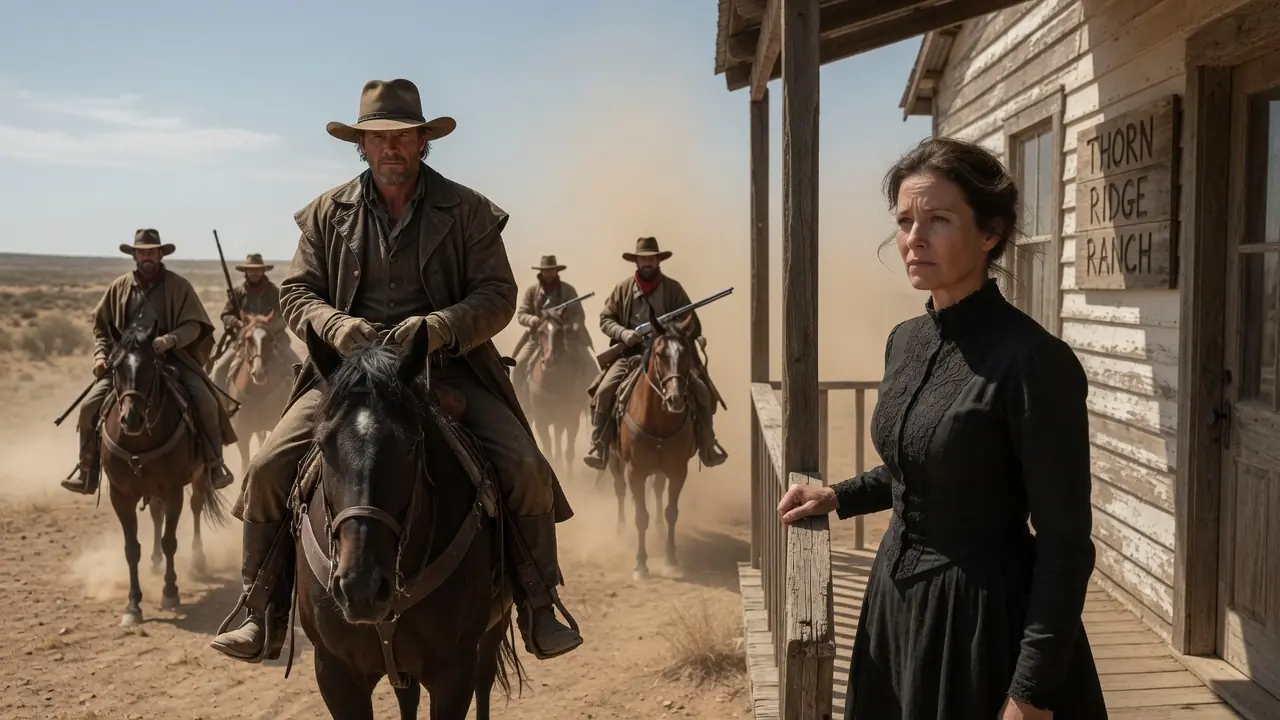
Silas Vance came himself the next morning. Not with four men this time, with all of them. Six riders spread wide across the lane and Vance at the center and the particular kind of silence that falls when a man arrives somewhere already certain of how the conversation is going to end. Clara heard the horses from the kitchen. She set down her coffee and walked to the door and opened it before they reached the porch. Because she had learned in the past 3 weeks that letting men like Vance knock gave them something a small power, an entrance, a sense of arrival that fed something in them, she refused to feed.
Elias was already outside. He was standing at the top of the porch steps with his thumbs hooked in his belt. And he was looking at the six riders the same way he had looked at the three men the morning before with that particular quality of attention that was not aggression and not passivity but something that existed in the space between them. Something that was very hard to read and very easy to feel.
Vance pulled up his horse 10 ft from the porch and looked at Elias for a long moment without speaking. Then he said, "I don't believe I know you." "No," Elias said. "You don't." Vance smiled the way he always smiled. Pleasant surface, nothing behind it. "Friend of the family." "Brother," Elias said. "Thomas Thorne was my brother." The smile stayed in place, but something changed underneath it. Something recalibrated.
Clara watched Vance's eyes move across Elias slowly. The way a man looks at a card he wasn't expecting to see in a hand he thought he understood. And then Vance said, "I was sorry to hear about Thomas. Terrible thing." "Yes," Elias said. "It was." "Accident like that. It was a terrible thing." Elias said again, "And the second time he said it, the words meant something completely different. And every man in that yard knew it, and nobody said anything about it." Vance shifted in his saddle.
"I've been trying to help Mrs. Thorne," he said. "Made her a fair offer on this property. A generous offer given the circumstances. Widow alone out here. It's no kind of life." "My sister-in-law has a life she is satisfied with," Elias said. "She has a ranch that belonged to her husband and belongs to her now. She has made her position clear to you on that subject." "Things change," Vance said. "Some things," Elias agreed. The two men looked at each other across 10 ft of yard and three weeks of unspoken accusation and a dead man's name. Neither of them was willing to say plainly, and Clara stood in the doorway and felt the weight of it pressing against the morning air like weather coming in.
Then Vance said, "What line of work are you in, Mr. Thorne?" "I range," Elias said. "Ranching. I range," he said again. "Just that." He let the words sit without explanation, and Vance understood enough to know that pressing on it would tell him less, not more. Vance looked at Clara for the first time. "Mrs. Thorne," he said with that half bow politeness that cost him nothing. "My offer stands. You think on it." He looked back at Elias. "Good to meet you, Mr. Thorne." "Mr. Vance," Elias said. Vance turned his horse and rode out his six men falling in around him. And Clara watched them go and did not breathe fully until the last horse had cleared the bend in the lane.
She said, "He'll find out who you are." "He already knows," Elias said. "He just doesn't know that I know he knows." Clara looked at him. "That's not a reassuring sentence." "It wasn't meant to be."
He rode out alone that afternoon and did not tell her where he was going. Clara spent the hours of his absence in Thomas's office, going through the accounting ledger with the same slow, careful attention she had given the survey document, looking not for what was there, but for what was missing for the gaps and the silences that spoke louder than any entry. Thomas had been meticulous. His columns were even, his notations precise, his handwriting the same careful print at the end of a long day as at the beginning of a fresh one. But in the six months before his death, the entries had changed. Not dramatically. Nothing that would catch an eye that wasn't already looking. But the gaps between notations had grown. The water rights payments that should have appeared in March had no corresponding receipt. A boundary inspection he had apparently commissioned in February was logged as paid, but the inspector's name had been written and then crossed out and rewritten as a set of initials she didn't recognize.
She was still sitting there when Elias came back at dusk. He came into the office without knocking and she didn't look up. "Sit down," she said. "I need to show you something." He sat. She walked him through the ledger the same way she had walked herself through it slowly without jumping to conclusions, letting the pattern build at its own pace. He listened without interrupting. He had the quality she was learning of a man who had spent a great deal of his life gathering information in situations where asking questions directly was not an option.
When she finished, he said the initials RHC. "Yes. Richard Harrison Croft." He said. "The judge." The silence in the room shifted weight. "Thomas was paying him," Clara said. It was not a question. "Not paying. Being paid." Elias turned back several pages in the ledger and pointed to a column she had flagged. "Look at the direction of the notation. Thomas logged this as income, not expense. Someone was paying him." Clara stared at the entry. She had read it four times and missed that. "For what?" "For staying quiet," Elias said, "or trying to. My guess is Croft was passing something through Thomas using his name, his property records, his survey access to legitimize Vance's land grab on paper. And when Thomas figured out what was being done with his name, he stopped cooperating," Clara said, "and started documenting," Elias said.
They sat across the desk from each other in the fading light with a dead man's careful handwriting between them, and Clara felt something settle in her chest. Not peace, nothing like peace, but a clarity that was almost worse than grief because it had edges and a direction. "He knew they were going to kill him," she said. Elias was quiet. "He knew," she said again. "And he didn't tell me." "He was trying to protect you." "He was wrong, too," Clara said. And the flatness in her voice was the flattest thing she had ever heard herself say. And she meant every syllable of it. "He was wrong. I was his wife, not a child, to be kept in a safe room. If he had told me," she stopped, started again. "If he had told me, we could have gone to someone. We could have gotten the document out, gotten it filed somewhere Croft couldn't reach. We could have." "Clara." "He was wrong," she said for the third time, and that was the last of it, because there was nowhere useful for the sentence to go. Thomas was gone. What he had decided and why he had decided it and all the ways she wished he had decided differently, none of it changed the ground they were standing on.
She closed the ledger. "What did you find this afternoon?" she asked. Elias leaned back in the chair. "I rode the canyon boundary. The survey document you found it matches the original land grant markers. The stones are still there. Some of them have been moved. Not much, just enough to shift the line on paper, but if you know what you're looking at, you can see where they were." "Can you prove they were moved?" "I marked their current positions and their original sockets," he said. "Took measurements. It's not court ready on its own, but combined with Thomas's document and the ledger." He paused. "We need someone who knows land law. Someone who can take this material and build a case that survives a judge. We can't go through Croft." "No." "The circuit judge comes through Fredericksburg in August," Clara said. "Judge Abel Morrow. Thomas spoke well of him. Said he was one of the last ones Croft hadn't gotten to." Elias nodded slowly. "August is 3 weeks." "Yes." "That's a long time to keep Vance patient." "He's not patient," Clara said. "He's calculating. There's a difference. He'll move when he thinks the moment is right. When he thinks there's no one left who'd ask questions." She looked at her brother-in-law across the desk. "We have to make sure the moment never looks right," she said.
Vance's men did not come the following morning or the morning after. The absence was not a relief. Clara knew better than to take it as one. She walked the fence lines twice a day and checked the water troughs and counted the cattle and watched the horizon with the same careful attention she had been giving the lane. Because a man like Vance did not withdraw because he had given up. He withdrew because he was repositioning.
On the fourth day of silence, their nearest neighbor, Margaret Hail, a widow herself, 63 years old, with a sharp mind and the kind of plain-spoken honesty that came from decades of hard country living, rode over on her gray mare and tied up at the porch rail and said without preamble. "I heard Elias Thorne was here." "He is," Clara said. Margaret looked at the bunk house. "Good," she said. "Because Silas Vance was at the general store in town yesterday asking about him." Clara felt something tighten in her chest. "What kind of asking?" "The careful kind," Margaret said. "The kind where you don't ask the question you're actually asking. He was talking to Amos Reed about range work about men who drift through the county. He described a man, lean, dark, mid-40s, quiet, said he was trying to place a face he'd seen. And Amos. Amos didn't know, but Luwellyn Marsh was in the store." Margaret's expression said the rest. Luwellyn Marsh knew everything about everyone in Kendall County and had never once kept any of it to herself. "She knows Elias rode through here 6 years ago. She knows who he is." Clara said nothing for a moment. Then she said, "How long before Vance knows if he doesn't know already?" Margaret said, "By tomorrow morning." Clara looked toward the bunk house. "Thank you, Margaret." "You don't need to thank me. Thomas was a good man, and Vance is a snake, and those are the only two facts that matter to me." Margaret gathered her reins. "You watch yourself, Clara, both of you." She rode back out the way she came.
Clara told Elias that evening over supper. He sat with the information for a moment, the way he sat with most things, letting it settle, turning it, looking at its underside. Then he said, "All right." "All right?" Clara set down her fork. "It changes the timeline," he said. "But not the direction. If Vance knows who you are, what you've done, he's not going to wait. He'll move before August before the circuit judge." "Yes," Elias said. "Then what are we doing?" "We're getting the document to someone Croft can't reach before Vance decides to move," Elias said. He looked at her steadily. "Do you trust Margaret Hail?" Clara blinked. "With my life." "Then I need you to make a copy of Thomas's survey document tonight. The best copy you can produce. And tomorrow morning, I need you to take the original to Margaret. Not the copy. The original. And ask her to keep it somewhere no one would look." "And the copy?" "The copy stays here," Elias said. "Visible. If Vance's men search this house, they find the copy. They take it and they think they've solved the problem." Clara looked at him. "And the original survives." "With a woman nobody's watching," Elias said, "because nobody thinks the old widow 2 miles east is part of this." Clara sat back in her chair. Outside the night sounds of the hill country moved through the dark. The creek running low. The insects the distant call of something in the cedar. Normal sounds, ordinary sounds. The sounds of a world that did not know it was holding its breath. "You've done this before," she said. It wasn't an accusation, just an observation.
Elias was quiet for a moment. "I spent 11 years working for the Pinkerton Agency," he said. "Before that, four years as a range detective in New Mexico territory. I've put men in prison. I've," he stopped, started again. "I've done things I don't regret, and things I do, and the things I regret are the times I move too fast or too hard or before the ground was solid under me." He looked at her. "I'm not going to do that here." Clara looked at him for a long moment. This man, who was her husband's brother, who had been absent for 20 years, who had shown up 9 days late with nothing but a quiet manner and a competence she had not been expecting, and a grief he carried so deep in his bones that she only saw it sometimes at the corner of his expression when he thought she wasn't watching. "Why did you leave?" she said. "20 years ago. Thomas never told me the full of it." Elias looked at the table. "That's a different story," he said. "For a different time. When this one's finished," he said. She accepted that for now.
She made the copy by lamplight sitting at Thomas's desk with the original in front of her and a clean sheet of paper and Thomas's drafting pen, and she reproduced every line and notation as precisely as her hand would allow. She was not a surveyor. She was not a draftsman, but she had spent years keeping the financial records for this ranch, and she had a steady hand and a precise eye. And when she finished at 2:00 in the morning, and held the copy next to the original in the lamplight, she thought she hoped that a man in a hurry, who expected to find what he was looking for, might not immediately see the difference.
She rode to Margaret's before sunrise. Margaret opened the door before she could knock because Margaret had lived alone for 12 years and had the particular alertness of a woman who had learned to sleep light. She looked at Clara's face and then at the document in her hands and she said, "Come in." Clara explained quickly and plainly. Margaret listened the same way. When Clara finished, Margaret took the document and walked to the fireplace and moved the stone on the left side of the hearth. A stone that rocked Clara now saw on a shallow carved socket and placed the folded document in the space beneath it and rocked the stone back into place. She stood up and looked at Clara. "He won't find it here," she said. "No one knows about that except my husband and he's been dead for 9 years." "Margaret, don't." Margaret said, "Don't thank me again. Go home. Be careful."
Clara rode home as the sun came up and Elias was on the porch with his coffee and she gave him one nod as she dismounted and he gave her one nod back. It was enough.
Silas Vance came on a Wednesday, not in the morning this time in the afternoon when the heat was at its worst and the light was white and flat and there was no mercy in any direction. He came alone, just him, no riders. And Clara knew the moment she heard a single horse on the lane that the rules of the thing had changed. He tied his horse at the rail and he walked up to the porch and he looked at Elias and he said, "Elias Thorne, Pinkerton man, New Mexico, Kansas, Missouri. I know your work." "Then you know I'm thorough." Elias said. "I know you're here unofficially." Vance said. "No agency behind you, just a family matter." He said those last two words with a particular careful delicacy that was its own kind of threat. "Family matters are the ones a man takes seriously," Elias said.
Vance looked at him for a moment. Then he looked at Clara. "I'm going to be honest with you, Mrs. Thorne, because I think you're a smart woman and I think the time for delicacy is passed." He folded his hands in front of him. "There is a document that your husband apparently believed gave him a claim over the Eastern Canyon parcel. That document contains errors, survey errors. I have an affidavit from Judge Croft confirming the correct boundary. If you take your version to a court, you will lose. You will have spent money you don't have, and you will still be alone on a ranch you cannot manage." Clara said, "Is that what happened to Thomas?" "He tried to take it to a court." The air went very still. Vance's expression did not change. That was the tell that it did not change at all, that it stayed exactly as arranged as it had been, which was the expression of a man who had practiced not reacting.
"Your husband had an accident," he said. "He did," Clara said. "He had it on land you're claiming as your own. He had it after he found a surveying document that proved you wrong. He had it after he commissioned an independent survey and before he could file any of it anywhere." She took one step forward on the porch. "That's a remarkable sequence of accidents, Mr. Vance." Vance looked at her for a long moment. Then he looked at Elias. Then back at her. "My offer on this property," he said quietly. "Expires at the end of this week." "It expired the day you made it," Clara said.
Vance picked up his hat from where he'd held it at his side, put it back on his head, and walked back to his horse. He mounted without hurry. He looked at the two of them on the porch from the height of the saddle, and what was in his face now was not the pleasant half smile. It was something older and flatter and much more honest. "That document you're holding," he said. "It won't survive what's coming." He rode out. Elias turned to look at Clara. "He knows," Elias said. "He suspects," Clara said. "There's a difference." She looked down the lane. "He doesn't know Margaret has the original. He thinks the document is here. So, he's coming for it." "Yes," Clara said. "Let him come."
She went inside. Elias stood on the porch for a moment longer, looking at the empty lane, and he felt something he had not felt in years. A kind of absolute clear-edged certainty about what came next and what it would cost and whether it was worth paying. "Thomas," he thought, "You should have called me sooner." He turned and followed Clara inside, and the door closed behind him, and the ranch sat quiet in the white afternoon heat, waiting for what Wednesday night would bring.
They came that night, not Wednesday. Thursday just past 2 in the morning when the dark was at its deepest and the hill country had gone to that particular silence that exists in the space between the last sound of night and the first sound of morning. A silence so complete it had texture, had weight, had the quality of held breath. Clara was not asleep. She had not slept properly in 4 weeks and she had stopped pretending she would. She lay in the bed she had shared with Thomas for 11 years. And she stared at the ceiling, and she listened to the ranch, the way Thomas had always listened to it, not for anything specific, just for the shape of it, for the way sound moved across the property in the dark, so that when something shifted, she would feel the difference before she could name it.
She felt it at 2:13 in the morning. Not a sound, an absence. The horses in the barn had gone quiet in a way that was different from sleep quiet, the way animals go quiet when they are paying attention to something they cannot see but can smell. She was out of bed before the thought completed itself. She pulled on her boots and her dress and took the revolver from the nightstand and she was at the bedroom door when she heard the first footstep on the porch. One man, heavy trying to be quiet and not quite succeeding.
She did not open the door. She moved to the window instead, staying low, and looked out across the yard and counted what she could see in the dark. Two horses tied at the far fence, not the porch rail, the far fence where they wouldn't be heard. Two shapes moving near the bunk house. One on the porch. That was three minimum, possibly more she couldn't place. She needed Elias. But Elias was in the bunk house, which was where two of them were. She stood in the dark of the bedroom with the revolver in her hand and made herself think clearly because the alternative to thinking clearly was panic. And panic would get her killed and get Elias killed and put Thomas's document in Silas Vance's hands before August ever came.
The man on the porch tried the front door. It was barred from the inside. He tried it twice, three times with increasing pressure, and then there was a pause and Clara heard him move toward the office window. She moved faster. She went out the bedroom down the back hall into the kitchen and she picked up the shotgun from beside the door and she put her back against the kitchen wall and she waited.
The office window gave with a low crack of wood, the kind of sound that in daylight would mean nothing, but in that particular silence was enormous. Then she heard something she had not expected. From the bunk house, a shout cut short. A crash. Then another crash heavier. Then silence again, a different silence. And then Elias's voice low and controlled. "Don't." Just that one word. But the way he said it. Clara breathed.
She heard the man in the office moving through the dark hands on the desk drawer handles the particular sound of someone searching fast and trying not to make noise. He went to the desk first, then to the shelves. Then she heard the sound she had been waiting for. The sound of him finding the copy of the survey document where she had left it folded and placed in the center desk drawer with Thomas's reading glasses on top of it to make it look like something precious and kept. She heard him unfold it, heard the paper settle.
She stepped into the office doorway and said, "Don't move." He moved. He came at her fast and she had approximately 1 second to decide. And she stepped left instead of back because stepping back was what he expected. And stepping left put him off angle and the edge of his arm caught her shoulder instead of her throat. And she went down hard against the door frame, but she kept the shotgun and she came up with it before he could turn around. "I said, 'Don't move,'" she said. He stopped.
She could see him now. The blank-faced man, the heavy set one with the short-brimmed hat, the one Vance kept specifically for the jobs that required not feeling anything. He was breathing hard and his hat was gone, and he was holding the folded paper in one fist, and he was looking at the shotgun with the expression of a man rapidly revising his assessment of the situation. "Put the paper on the desk," Clara said. He put it on the desk. "Now go out the window you came in," she said. "Slow." He went. She stood in the office with the shotgun at her shoulder until she heard him hit the ground outside and then she heard him run and then she heard horses on the far fence moving fast and then she heard nothing.
And then Elias was in the doorway. He had a cut above his left eye. He was holding his right side with one hand in a way that told her something had connected there. But he was standing and he was steady and his expression was the same as it always was. That particular infuriating calm. "Two in the bunk house," he said. "They're not going to be a problem." "Are they alive?" "Yes," he said. "I didn't kill anyone." Clara set the shotgun down against the wall. Her hands were shaking now with the particular delayed shaking that comes after when the body realizes what the mind has already processed and moves to process it from the other direction. She looked at her hands. She made them stop. "He got the copy," she said. "Good," Elias said. "You're bleeding." "I know."
She crossed the room and looked at the cut above his eye. Not deep. She had seen worse. She went to the kitchen for the cloth and the basin, and she cleaned it without sentimentality, and he sat still under her hands without complaint, and neither of them spoke for a moment. Then Elias said, "He'll take the copy to Vance tonight. Vance will have it by morning." "And by morning, he'll know it's a copy." Clara said. "Maybe, maybe not right away. The notarization is in the right place. The measurements are close." He paused. "Close enough to buy us a day." "One day," Clara said. "One day," Elias said. "It's enough." She pulled back and looked at him. There was something in his face that she hadn't seen before. Not tension exactly, but the particular sharpened aliveness of a man standing at the edge of something he has been moving toward for a long time. "You already know what we're doing tomorrow," she said. "We're going to Fredericksburg," he said. "And we're going to find out where Judge Morrow is before August."
They left before sunrise. Clara rode to Margaret's first while Elias waited on the lane and she went inside and retrieved the original document from beneath the hearthstone. And Margaret looked at her face in the gray pre-dawn light and said, "Tonight." "Last night," Clara said. "We're all right. The document's safe. We're taking it today." Margaret held her hands for a moment, just held them. Then she let go and said, "Go. Be careful. Come back."
Clara rode back to the lane, and they went south together toward Fredericksburg, riding through the early morning before the heat came, and the hills rose and fell around them in the pale light. And the cedar smelled clean and sharp, and there was a hawk turning slow circles above the ridge to the east. And Clara thought Thomas loved this. This specific hour of this specific landscape. This was the hour he always said made the rest of it worth it. She kept that thought and rode.
Fredericksburg was alive by the time they reached it. It was a market day and the main street was moving with wagons and commerce and the particular density of a frontier town going about its business with focused intention. Clara had been here dozens of times for supplies, for legal filings, for the occasional social occasion that Thomas had always had to talk her into. She knew the layout. She knew the people. She also knew that Silas Vance kept an office above the feed store on the eastern end of the main street, and that Judge Croft's courthouse was three buildings down from that, and that the two men had lunch together at the hotel dining room every Thursday. It was Thursday.
"Don't go anywhere near that end of the street," Clara said quietly as they tied their horses at the rail outside the land office. "I know," Elias said. "I mean it. If Croft sees you, Clara." He looked at her. "I know." She took a breath. "The land office first. I want to see what Vance filed and when." The clerk, his name is Walter Puit. He was friendly with Thomas. They went in together.
Walter Puit was a slight man of 50, with a permanent squint from years of reading small print in inadequate light, and he looked up from his ledger. When the door opened, and his face did several things in rapid succession, when he recognized Clara, surprise grief calculation, and then a kind of settling that was almost relief, as if he had been waiting for her to walk in, and had begun to doubt she would. "Mrs. Thorne." He said, "I was I've been meaning to send a letter." "Walter." Clara said, "This is my brother-in-law, Elias Thorne. I need to see the filing record on the Eastern Canyon parcel, the Vance claim, all of it." Puit looked at Elias, looked at Clara. He came out from behind the counter and went to the door and looked out onto the street for a moment and then he came back and said very quietly, "How much do you know?" Clara said, "Enough to be here. What do you know that I don't?"
Walter Puit had the expression of a man who had been holding something heavy for a long time and had just been given permission to set it down. He went to the back of the office and came out with a ledger and put it on the counter and he opened it to a page marked with a folded slip of paper and he said, "Thomas came to me in February, 6 months before before the accident. He asked me the same questions you're asking." Clara's chest tightened. "What did you tell him?" "I showed him the filing," Puit said. "The Vance claim on the canyon parcel. It was filed properly. All the right signatures, all the right notarizations. But Thomas looked at the survey numbers and he said they were wrong. He said the eastern boundary marker was off by 400 ft." "It is," Clara said. Puit nodded slowly. "I know," he said. "I knew when the filing came in, but the notarization was signed by Judge Croft." "And you do not?" He stopped. Started again. "There are things in this town that a man with a family and a job he needs to keep does not push on." Clara looked at him for a long moment. "My husband pushed on it," she said. Puit looked at the ledger. "Yes," he said. "He did."
The silence in the room had the quality of confession. Elias said. "Is there a record of the original land grant, the Thorn parcel going back to the original filing?" "Yes," Puit said. "That I can show you freely. It was filed before Croft's time and nobody's touched it." He went to the back again and returned with a different ledger. Older the spine cracked and the pages thick with age. He opened it and turned it on the counter to face them. Clara looked at the entry. She looked at the survey numbers. She looked at Elias. "The boundary line," she said, "matches Thomas's document," Elias said. "Exactly." Puit said very quietly. "There's something else." He reached into his vest pocket and produced a folded piece of paper worn at the creases clearly carried for some time. He set it on the counter between them. "Thomas left this with me in February. He said if anything happened to him and someone came asking I should give it to that someone."
Clara's hand was on the paper before she had made a conscious decision to reach for it. She unfolded it. It was Thomas's handwriting. The same careful print dated February the 14th, 5 months before his death. "If you are reading this, then something has gone wrong. The enclosed account is a truthful record of what Silas Vance and Judge H. Croft have done with the Eastern Canyon parcel and what they offered me and what I refused. I refused because the land is not mine to sell and the silence is not mine to keep. The survey document is in the Bible. My wife does not know yet. I am sorry for that. I am going to tell her when I have more to show her. I did not want to frighten her before I had something solid to hand her alongside the fear. That was probably wrong of me. Clara is braver than I have always given her credit for and smarter, and she will see this through if I cannot."
Clara stood at the counter of the Fredericksburg land office and read her dead husband's handwriting, and she did not cry. She had promised herself she would not cry in front of anyone except in private, and she kept that promise, but it cost her more in that moment than anything else the past 4 weeks had cost her. She folded the letter and put it in her pocket. "Thomas, you knew me better at the end than you showed." Elias was looking at her. She met his eyes and shook her head once. She was fine. They could continue. And he accepted that without pushing.
"Walter," she said, and her voice was entirely level. "Is there any way to reach Judge Morrow before his August circuit? Any emergency filing procedure? Anything that would bring him here sooner?" Puit thought for a moment. "There's a federal land dispute protocol," he said carefully. "If a party can demonstrate active interference with a valid federal land grant, the circuit judge has authority to convene early. It bypasses the local court entirely." "What do we need to file?" "The original grant record which is here and I can certify a copy of today. A sworn statement from a party with direct knowledge of the boundary dispute. The survey document you mentioned," he paused. "And something that demonstrates active interference, not just a dispute. Active interference, destruction of evidence fraud in a court filing, something of that weight."
Clara thought of the two men in the bunk house, the man who had taken the copy through the office window. Silas Vance riding up her lane every morning for 4 weeks. "I have witnesses to active interference," she said. "I have a neighbor who has watched Vance's men come to my property for a month. I have two men who broke into my home last night who are currently" "Where are they?" Elias said. "Tied to the fence post." Elias said. "Margaret's watching them." Puit blinked. "I need you to prepare the filing," Clara said. "Everything you can certify today, certify today. Can you do that?" "Yes." Puit said. "But Mrs. Thorne, when Croft finds out" "Croft is going to find out." Clara said. "That's fine. The federal filing goes above Croft. That's the point." Puit looked at her for a long moment. He straightened slightly the way a man straightens when he has made a decision he has been avoiding. "Give me 2 hours," he said. "You have one," Clara said.
Elias stepped outside while Puit worked. Clara remained at the counter watching Puit move through the ledgers and files, making certified copies with steady hands. She thought about the letter in her pocket. She thought about Thomas sitting at this same counter in February, handing Puit the folded paper, riding home to a wife he had decided not to tell yet. She thought about all the evenings they had sat on the porch, and he had been quiet, and she had thought he was just tired, just carrying the ordinary weight of the work, and she had let him be quiet, because she had trusted his judgment on what to say and when. She would not do that again with anyone ever.
She heard the door open behind her and thought it was Elias. It was not Elias. She knew before she turned from the particular quality of the silence that entered with the footsteps two sets of them measured unhurried. Judge Harrison Croft was 60 years old, silver-haired, and had the bearing of a man who had occupied positions of authority for so long that authority had simply become the way he held his body. He was wearing his town clothes, not his court clothes, which somehow made him more threatening, not less. The man beside him was younger, heavy shouldered, wearing a deputy's badge and an expression that was not quite neutral.
Croft looked at Clara. He looked at the ledger open on the counter. He looked at Puit, who had gone very still with a pen in his hand and three certified copies laid out in front of him. "Mrs. Thorne," Croft said. "I heard you were in town." "Judge." Clara said. "I also heard you had some trouble at the ranch last night." He said it with an expression of concern. That was the most precisely calibrated false thing she had ever seen. "Some men on your property. Terrible business." "Yes," Clara said. "The sheriff will be interested to hear about it." "The sheriff," Croft said, "works through my court." "The Federal Circuit does not," Clara said. The silence in the land office changed temperature. Croft looked at Puit. Something passed between them that was not a word. Something older and heavier than a word. Puit's hand Clara saw had tightened on the pen. Don't, she thought. Walter, don't.
Puit set the pen down. He picked up the three certified copies and the original grant ledger entry and he looked at Judge Harrison Croft across the counter and he said in a voice that was not entirely steady but was entirely clear. "These are certified copies of public land records. Judge, I am authorized to produce them on request. The filing fee has been paid." Croft looked at him for a long moment. "You understand what you're doing?" Croft said. "I understand what I'm doing," Puit said. Clara took the documents from the counter and put them inside her coat and she turned to face Croft directly. She was aware of the deputy beside him. She was aware that Elias was outside. She was aware that there was a gun in the holster on the deputy's hip and a document in her coat and a dead man's letter in her pocket and a living woman standing in the way of all of it. She was afraid. She had not stopped being afraid for 4 weeks. She had simply learned to operate within it around it through it the way water operates around stone. Not by ignoring the obstacle, but by finding the lines of least resistance with the most efficiency.
"My husband found out what you and Vance were doing," Clara said quietly. "He documented it and he died for it. I have his document. I have his letter. I have the land records your clerk just certified. I have two men sitting tied to a fence post who came to my house last night and I have a neighbor who will testify to four weeks of harassment." She held Croft's gaze. "I am going to file all of it with the Federal Circuit and you do not have enough reach to stop that." Croft said, "You're making an enemy of a man you cannot afford to have as an enemy." "You were already my enemy," Clara said. "You made yourself that the day my husband died on that canyon ledge. I'm just the only one in this room willing to say it plainly."
She walked past him to the door. The deputy moved slightly, just slightly, a shift of weight, a suggestion. The door opened from the outside. Elias stepped in. He looked at the deputy. He looked at Croft. He said nothing. He simply stood in the doorway with the particular quality of stillness that Clara had come to understand was not patience, but its precise opposite. A stillness that was all compressed direction, all accumulated intention, waiting for the exact moment it was needed. The deputy stepped back. Croft looked at Elias Thorne for a long measuring moment. Then he looked at Clara. "This isn't over," he said. "No," Clara said. "It isn't. But it's closer to over than it was this morning."
She walked out into the Fredericksburg street with Thomas's letter against her heart and his survey document in Margaret Hail's hearth and three certified copies of the land records inside her coat. And the sun was brutal and the street was loud with market day commerce and somewhere down the block a child was laughing at something and the world was impossibly entirely going about its ordinary business. Elias fell into step beside her. "Croft will send word to Vance within the hour," he said. "I know." Clara said. "Vance will know the copy was a copy." "I know that, too." "And he'll know we have everything we need to file, which means" Clara said "he's going to move before we can get it tomorrow. Not in days, tonight. Tomorrow at the latest." Elias walked beside her. The street moved around them. "Then we need to be ready," he said. Clara looked straight ahead. "We are ready," she said. And she meant it down to the bone, down to whatever part of her had kept her standing through four weeks of grief and threat and careful, patient, deliberate survival. She meant it the way Thomas had meant everything he ever said to her completely without reservation.
Whatever Vance sent next, Thorn Ridge would be standing when it was over. She was going to make certain of it. They rode hard back to Thorn Ridge, not because they were panicking. Clara had made a decision somewhere on the Fredericksburg street that panic was a thing she would not spend energy on. But because every hour between Croft sending word and Vance receiving it was an hour they needed to use. And using it meant moving. Elias set the pace without being asked. He understood urgency the way he understood most things, not as emotion, but as arithmetic. Hours subtracted from the total, distance to cover, things to put in order before the order of things changed.
Clara rode beside him and thought. By the time they reached the ranch lane, she had a plan. Margaret was on the porch when they arrived, sitting in the chair Thomas had always sat in, with the composure of a woman who has decided that if she is going to be part of something, she is going to be present for all of it. The two men from the bunk house were still tied to the fence post considerably less comfortable than they had been at 2:00 in the morning and looking at the dirt with the expressions of men who had revised their career choices several times in the past 8 hours. "Anyone come by?" Elias asked dismounting. "One rider," Margaret said. "Didn't stop. Slowed at the lane and looked and kept going. Counting." Elias said. "Making sure we're back."
Clara tied her horse and went up the steps. "We have until tonight," she said. "Maybe less." Margaret looked at her with the clear-eyed assessment that Clara had come to think of as the old woman's greatest quality. She never needed the situation explained twice, never softened what she saw into something more comfortable. "Then we'd better talk about what tonight looks like," she said. Clara told her about Croft, about the land office, the certified copies Thomas's letter. Margaret listened without interrupting and when Clara finished the old woman sat very still for a moment and then said "Thomas left that letter in February." "Yes." "5 months he carried this alone." "Yes," Clara said. Margaret looked out toward the canyon ridge. "Damn fool man," she said with a particular combination of grief and affection that Clara understood completely. "Damn brave fool man."
Clara sat down on the porch steps. "Margaret, I need you to go home." Margaret looked at her sharply. "I need you to go home and I need you to take the two men at the fence post with you and tie them somewhere secure on your property because when Vance comes tonight, he's going to come with enough men to end this and I will not have you here for that." "I'm not afraid of Silas Vance." "I know you're not." Clara said. "That's not why. I need a witness who isn't here when it happens. I need someone alive and credible and unimpeachable who can testify to everything, to the weeks of harassment, to the break-in, to those two men. If something goes wrong tonight, and both Elias and I are, if the federal filing needs someone else to present it," she stopped, looked at Margaret directly. "I need you to survive this more than I need you beside me." Margaret held her gaze for a long time. "You're smarter than Thomas gave you credit for," she said finally. "I know," Clara said. Margaret stood up and straightened her skirts and walked to the fence post and untied the two men with the crisp efficiency of a woman who has been doing practical tasks her whole life and sees no reason to make them complicated. She looked at them with complete contempt and said, "You two are coming with me and you're going to behave because the alternative is that I leave you here and whatever happens to you tonight happens to you. Your choice." They chose to go with her.
Clara watched Margaret ride off with her two prisoners. And then she turned back to the ranch and looked at the house, the barn, the bunk house, the fence lines running out to the pasture, the lane curving down to the road, and she felt Thomas in all of it, in every post and board and stone. And she thought, this is yours. This is ours, and I am not giving it to anyone. "All right," she said to Elias. "Tell me what you need."
He was methodical about it. That was what she was learning about him. That underneath the quiet and the stillness, Elias Thorne was one of the most organized minds she had ever encountered. He moved through the preparation the way Thomas had moved through the ranch work with the efficiency of someone who had done the thinking before the doing, and was now simply executing a plan that already existed. He checked every entry point. He redistributed what ammunition they had. He moved the horses from the barn to the back pasture far enough from the main buildings that they would be away from fire if fire was what Vance decided on. He walked the perimeter twice. He said very little during any of it, and what he said was specific and functional, and Clara answered in kind, because they had developed in the past week a working language that did not require explanation.
At 4:00 in the afternoon, he came into the kitchen and sat down and said, "I want to talk to you about something." Clara set down the water jug. "Say it." "I need you to know," he said "that my intention tonight is to hold this ranch and hold these documents until morning. That's the goal. Nothing else." "I know that." "I need you to know that I am not." He stopped. Something moved in his face. Something that was working against the habitual control. "I spent 11 years doing work that required me to make certain kinds of decisions quickly, and not all of those decisions were ones I'd make the same way twice. I need you to know that I am not going to make those kinds of decisions tonight. Not here. Not in Thomas's house." Clara looked at him. She understood what he was telling her. Not the words, but beneath the words, the specific shape of the thing he was carrying. The thing he had been carrying for 20 years. The thing that had made him leave a family and a place and keep moving, keep moving, keep moving until his brother died and something stopped him.
"Elias," she said. "Why did you leave?" He looked at his hands. "You said that was a different story for a different time," she said. "I'm asking now before tonight." He was quiet for a long moment, long enough that she thought he wasn't going to answer. Then he said, "I killed a man in New Mexico, 1881. I was working a range dispute cattle theft. Nothing complicated. The man I was tracking, I cornered him and he drew and I shot him. And that was all straightforward, all within the bounds of what I was hired to do." He paused. "He had a son, 14 years old. The boy came out of the trees and saw what I'd done. And I I had the gun in my hand. And the boy looked at me. The way a person looks at something they cannot survive understanding. And I and I" "Did you hurt the boy?" Clara said. "No." Elias said immediately. "No. I put the gun away and I sent the boy to the nearest town and I filed my report and I collected my fee. But I kept seeing his face for months. I kept seeing it and I started thinking about what kind of work it was that put a man in the position of standing over a body with a gun in his hand while a child looked at him."
He looked up. "Thomas wrote to me the following spring, asked me to come home. And I wrote back and said I wasn't the kind of man who came home." "You were wrong," Clara said. "Yes," he said. "I know that now. I knew it probably then." He met her eyes. "I'm here now. And I am going to keep you and this ranch safe tonight, and I'm going to do it without becoming something you'd have to forgive." Clara held his gaze. "Elias. Thomas didn't leave you that choice in his letter. He didn't write to me and say, 'Tell Elias to be careful. Tell Elias not to cross any lines.' He just wrote 'he will see this through' because he knew you. Whatever you think you became in those 11 years, Thomas knew who you were underneath it." Elias looked at her for a long time. "He was usually right about people," he said finally. "Almost always," Clara said, "except about me. He always thought I was more fragile than I was." "That almost smile again just at the corner." "I don't make that mistake," he said. "Good," she said. "Now, let's go over the plan one more time."
Vance came at 9:00. He didn't bother with the pretense of night this time. 9:00 with enough dusk left to see by with eight men spread wide across the lane and a lit torch in the hand of the man on the far right and Vance himself at the center on his gray horse with the expression of a man who had finished calculating and arrived at his answer. Clara was on the porch. Elias was not visible. That was intentional. Vance pulled up at the porch rail and looked at Clara and said, "The document you gave my man last night was a copy." "Yes," Clara said. "Where's the original?" "Filed," Clara said. "In Fredericksburg along with certified copies of the original Thorn land Grant Thomas' sworn account and a formal request for an emergency convening of the Federal Circuit Court." Vance was very still.
"The land office is closed after 5:00." "Walter Puit opened it again at 7." Clara said. "He's been wanting to do the right thing for a long time. He just needed someone to go first." Something changed in Vance's face. Not the explosion she might have expected. He was too controlled for that, but a kind of settling a coldness coming up through the surface. Pleasantness like water rising through floorboards. "That filing will not survive Croft's review." He said. "It won't go through Croft." Clara said. "It's a federal filing. It bypasses his court entirely. Judge Morrow will receive it by tomorrow's post." Vance looked at her for a long moment. Then he looked at the torch on his right flank. Then he looked back at her, and what she saw in his face in that moment was the specific calculated arithmetic of a man deciding how much worse he was willing to make this.
"Mrs. Thorne," he said, "be reasonable." "I have been reasonable for 4 weeks." Clara said. "I was reasonable when you came to my door 4 days after my husband's burial. I was reasonable when your men rode to my fence every morning. I was reasonable when two of your men broke into my house in the middle of the night." Her voice was entirely level. "Entirely. I am done being reasonable. You are trespassing on my property and I would like you to leave."
"Clara?" The voice came from the left. Not Vance, one of his men, the young one with the silver hatband. And there was something in his voice that was not the flat-hired confidence she had heard from him before. Something almost uncertain, because Elias had appeared at the corner of the barn, just standing there in the dusk with nothing in his hands, watching eight men with the same quality of attention he had given three men at a fence line 8 days ago. And every one of those eight men felt it the way you feel a change in pressure before a storm. The way animals go quiet before something they cannot see.
"That's far enough," Elias said. He was not speaking loudly. He didn't need to. Vance looked at him. "Eight men, Thorne." "I can count," Elias said. "You're one man." "Your men broke into this house last night," Elias said. "Two of them are currently in the custody of a neighbor who will be providing testimony. The third left with a copy of a document that has already been superseded by a federal filing. You rode onto this property tonight with a lit torch." He looked at each of the eight men in turn, slowly, one by one. "Every man here is a witness to attempted arson and criminal trespass. Every man here will be named in the federal proceeding." He paused. "I used to work for the Pinkerton Agency. I have contacts in three federal marshals offices. I know how to file a report that sticks." He let that settle. "Is this job worth that?"
The man with the torch shifted in his saddle. The silver hatband man looked at Vance. Vance said sharply. "Hold." Elias looked at Vance. "It's over," he said quietly. "The filing is done. The evidence is in multiple locations you cannot reach. Margaret Hail has a sworn statement from Thomas dated February. The land office has the certified records. The Federal Circuit will have everything by tomorrow." He took one step forward. "You cannot outrun all of that. And the men you pay to ride to a widow's fence line every morning are not men who will go to federal prison for you." The silence stretched. Vance's gray horse moved sideways, once restless, feeling what its rider was holding in his body and expressing it the way horses do.
Then the man with the torch lowered it. Vance saw it. He looked at the man. The man did not raise it again. Something went out of the situation. Then the specific tension that exists at the edge of violence when violence is the next available option. When that option closes, it is a palpable thing. The closing of it like a door settling into its frame. Vance looked at Clara. His face was not angry. It was something else, something older and colder than anger. The expression of a man who is not giving up, but is repositioning the way he had repositioned 4 weeks ago when she first refused his offer.
"Judge Croft will contest every filing you have made." He said. "He is welcome to," Clara said "in the federal court in front of Judge Morrow publicly." Vance turned his horse. "Mr. Vance," Clara said. He stopped, looked back. "My husband's name was Thomas Elmore Thorne," she said. "He was 41 years old. He was the best man I have ever known. And you killed him for 400 ft of canyon land." Her voice did not shake. It was very clear, very quiet, completely without theater. "I want you to know that I know that. And I want you to know that I am going to spend whatever it takes to make certain that a federal court knows it, too." Vance held her gaze. Then he rode out. His men went with him. All eight. The torch went dark somewhere down the lane, smothered in the dirt, and the sound of the horses faded into the dark.
And then Thorn Ridge was quiet. Clara stood on the porch. Her legs were not entirely steady. She became aware of this the way she had become aware of her shaking hands in the office two nights ago from a distance with a kind of dispassionate observation as if cataloging the physical evidence of something her body understood and her mind was still catching up to. Elias came to the porch and stood beside her. Neither of them spoke for a moment. Then Clara said, "He's not done." "No," Elias said. "But he's done here tonight. He'll go to Croft. They'll try to have the filing blocked." "They can try. Puit certified everything before 5:00 and signed it himself. Croft can contest it, but he can't kill it." Elias paused. "And contesting it means a public proceeding. Means Morrow looks at everything. Means Croft has to defend a filing that was fraudulent to begin with." He looked at her. "That is not a fight Croft wants to have in front of a federal judge."
Clara nodded slowly. She breathed. "Elias," she said. "Yes." "Thomas's letter, the part where he said he was sorry for not telling me sooner." Elias was quiet. "I want you to know that I forgive him." She said. "I have been angry at him for keeping it from me, and I am going to keep being angry at him for a while yet because I am allowed to be. But underneath the anger," she stopped. Started again. "He was trying to carry it so I wouldn't have to. That was Thomas. That was who he was. He couldn't help it." Her voice was very steady. "I forgive him for it." Elias looked out across the dark ranch. "He would be glad to hear that." "I know," she said. "I'm saying it out loud so I don't forget I said it."
They stood on the porch in the dark together. The two of them, the brother who had come back and the widow who had never left. And the hill country settled around them into its late night sounds, and the crisis that had just passed left the particular silence that comes after a sustained focused effort, not quite peace, not quite relief, but the specific quiet of ground that has been held.
Then Elias said, "I need to tell you something." Clara looked at him. "I got a wire this morning before we left for Fredericksburg." He reached into his breast pocket and produced a folded paper and held it out to her. "I've been waiting for the right time and I've been wrong to wait." She took it. She opened it. It was from the Pinkerton office in San Antonio. Short, six lines. She read it once and then she read it again and then she stood very still on the porch with Thomas's ranch behind her and the dark hill country ahead of her and the paper in her hands.
The wire said that a man named Doyle Marsh, one of Vance's original writers present at the Eastern Canyon in the weeks before Thomas's death, had walked into the San Antonio field office 4 days ago. He had asked about the terms of a voluntary cooperation agreement. He had stated that he had witnessed an event on the Eastern Canyon ledge on the morning of July the 3rd and that the event had not been an accident.
Clara lowered the paper. "He has a witness," she said. "You have a witness." "We have a witness," Elias said. "He'll testify for terms. The Pinkerton office is working with the federal marshall. They contacted me because my name was already in the file Thomas had written to them, too, apparently in the spring." He paused. "Thomas built more of this case than either of us knew." Clara looked at the wire again. Doyle Marsh, a name she had never heard. A man who had stood on a canyon ledge and watched something happen and had been carrying it for 4 weeks until it was too heavy to keep carrying. She thought about the weight of that. She thought about what it must have cost him to walk into that office. She thought about Thomas. "He planned all the way to the end," she thought. "He built a case knowing he might not be the one to finish it. He planted things with Puit, with the ledger, with the letter, like a man planting seeds in ground he might not live to harvest. He trusted that someone would find it," she said. "He trusted you would find it," Elias said.
Clara folded the wire and held it and looked out at the dark. Tomorrow she would write to the federal marshall. Tomorrow she would ensure the Morrow filing was confirmed received. Tomorrow she would ride to Margaret's and bring her home and tell her what had happened and watch the old woman try not to look relieved. Tomorrow there would be more steps, more filings, more careful patient, deliberate work because this was not over. Vance was not in a cell. Croft was not before a judge and Thomas's justice was not yet complete. But tonight, standing on the porch of a ranch that was still hers with a witness in San Antonio and a filing in Fredericksburg and a certified copy of a land grant that told the truth. Clara Thorne felt something she had not felt in 4 weeks. She felt the ground under her feet. Solid, specific, hers.
"Elias," she said. "Yes." "Stay," she said. "Not just through the trial. Stay." She said it simply without drama. The way you say a thing you have been thinking for several days and have finally decided is true enough to say aloud. "This ranch is too big for one person and Thomas would want Thomas would have." "I know what Thomas would want," Elias said. "Then stay." He was quiet for a moment. He looked out at the dark. The way a man looks at a place he has been telling himself for 20 years he doesn't belong. And she watched him look at it. And she watched something shift in the set of his shoulders. Something that had been held too long beginning finally to release. "Let me get through the trial first," he said. "After the trial," Clara said. "Yes. Stay." He didn't answer, but he didn't say no.
And in the morning, when Clara rose before dawn and went to the porch with her coffee, Elias was already there in Thomas's chair, watching the light come up gold and pink over the limestone ridges, watching it the same way Thomas had always watched it. And Clara stood in the doorway and looked at the two of them, the living and the dead, the brother who left and the husband who stayed. All of it braided together in this one man sitting in this one chair at this one hour. And she thought, "Thomas, I am all right. We are going to be all right." She stepped out onto the porch and sat in her own chair and wrapped both hands around her coffee cup and watched the Hill Country come back to light.
The letter from Judge Abel Morrow arrived on a Tuesday. Clara was at the well when she heard the rider on the lane, and she straightened and turned and watched the postal rider come up at a trot and hand down the envelope with the federal court seal pressed into the wax and ride back out without stopping because postal riders in Kendall County had learned that lingering at Thorn Ridge in recent weeks was the kind of decision that attracted attention. She carried the envelope to the porch without opening it. She sat down in her chair and held it in both hands and breathed. Elias came out of the barn and saw her sitting there and crossed the yard and sat in Thomas's chair and waited.
She opened it. She read it once. Then she handed it to Elias without speaking. He read it. He set it on his knee. "August the 9th," he said. "6 days." Clara said. "Fredericksburg courthouse. Tomorrow's convening the full proceeding. Federal jurisdiction, which means Croft is out." He paused. "He's summoning Vance. He's summoning Croft. He's requesting the presence of all parties with documented interest in the Eastern Canyon parcel." "He received everything," Clara said. "Everything filed, everything from the Marshall's office." Elias looked at the letter again. "He mentions Doyle Marsh by name. He's calling him as a federal witness." Clara sat with that for a moment. Doyle Marsh, who had stood on a canyon ledge and watched Thomas die and had been walking around with that in his chest for four weeks until it finally broke him open. She did not know this man. She did not know what had driven him into that San Antonio office, or what he had looked like when he did it, or whether he had been afraid. She knew only that he had done it, and that it had mattered, and that Thomas, with his careful ledger, and his letter in Puit's pocket, and his wire to the Pinkerton office, had somehow made it possible for a stranger to find the courage to tell the truth.
"I need to write to Margaret," Clara said. "I'll ride over this afternoon," Elias said. "Tell her in person." Clara nodded. She looked at the letter one more time. Federal Court, August 9th. 6 days. 6 days to hold steady. She had held steady for 5 weeks. She could manage six more days.
Vance made one more move before the 9th. She had expected it. Elias had expected it. What neither of them had expected was the form it took. On the Thursday before the hearing, Sheriff Len Berquette rode out to Thorn Ridge alone. No deputies. Late morning unhurried with his hat in his hands before he even dismounted which told Clara something important about the purpose of the visit before he opened his mouth. She met him in the yard. "Mrs. Thorne," he said. He looked uncomfortable in the specific way of a man who knows he has been wrong for a long time and has finally run out of road to avoid acknowledging it. "I came to tell you something." "Say it, Len," she said.
He looked at her. First time in their acquaintance that he had looked at her directly. "Silas Vance came to my office yesterday. He wants me to file an obstruction complaint against your brother-in-law. Says Elias interfered with a lawful entry onto the property the other night." He paused. "He wants me to have Elias detained before the hearing." Clara felt something cold move through her. "And?" "And I told him no." Berquette said. The yard was very quiet. "I told him no." Berquette said again as if he needed to hear himself say it twice to be sure it was real. "I told him there was no lawful entry. I told him two men tied to a fence post and a third who exited through a broken window were not conducting a lawful entry. And I told him" he stopped, cleared his throat. "I told him I had been aware for some time that Thomas Thorne's death did not sit right and that I had not done enough about it and that I did not intend to compound that failure by helping him prevent a federal proceeding."
Clara looked at the man who had told her he knew things but couldn't act on what he knew who had given Thomas's widow the shape of nothing and called it sympathy. And she felt the particular complicated feeling of watching a person do the right thing years too late. Not gratitude, not quite forgiveness, but something adjacent to both. Something that acknowledged the reality of what had changed without minimizing the cost of what it had taken to change it. "Thank you, Len," she said. "I should have." "Yes," she said. "You should have. But you're here now." He put his hat back on. He looked at the porch at the house at the lane. "Thomas was a good man," he said. "He was the best man," Clara said. Berquette nodded once and rode out.
Elias appeared at the corner of the barn. He had heard it all. He said nothing and Clara said nothing and they went back to work.
The night before the hearing, Clara could not sleep. She lay in the dark and she talked to Thomas. Not out loud. She was not the kind of woman who spoke to the dead aloud because she felt that the dead deserve the same honesty you'd give the living. And she was not entirely sure she could be honest with Thomas at full volume. But in the quiet in the particular interior space that existed between wakefulness and sleep, she talked to him. She told him about the letter from Morrow. She told him about Berquette coming out. She told him about Elias sitting in his chair in the mornings watching the light come up over the ridge. About the way Elias had fixed the south fence post that had been loose since spring without being asked about the way the ranch felt different with another person in it. Not the same as it had felt with Thomas. Nothing would ever be the same as that, but different in a way that was not entirely empty. She told him she was going into the courtroom tomorrow and she was going to finish what he had started and she was going to do it as well as he would have wanted it done. She told him she was still angry at him for keeping it from her. She told him she loved him.
Then she got up at 4 in the morning and dressed and made coffee and sat at the kitchen table with Thomas's ledger open in front of her and went through it one more time. Not because she needed to. She had memorized every entry, but because it was his handwriting, and his handwriting was the closest thing she had to his voice, and she wanted to go into the day with that in her.
Elias came into the kitchen at 5 and did not comment on the fact that she had clearly been up for hours. He poured himself coffee and sat across from her and looked at the ledger and said, "Ready?" "Yes." Clara said. She meant it.
The Fredericksburg courthouse had never held so many people for a proceeding in its history. Clara knew this because Walter Puit told her so in a low voice when she arrived, and found people lined along the wall, three deep and overflowing, onto the steps outside. Word had moved through Kendall County. The way words move in a place where everyone knows everything and has been holding their breath about something for a long time. Fast, electric, with the particular energy of a community that has needed permission to say out loud what it has been thinking in private.
Vance was already in the room when Clara entered. He was seated at the respondents table with two lawyers she did not recognize. Men brought in from San Antonio. She guessed from the quality of their coats, and he looked at her when she came in with an expression that she had learned to read over the past 5 weeks. Not the pleasant surface anymore, not the flat cold of the night on the porch. Something else, something that recognized finally that the ground had shifted in a way he could not shift back.
Croft was not at the judicial bench. He was seated at a table to the side alone with a lawyer of his own and the specific stillness of a man who understands that the next several hours are going to determine the shape of the rest of his life. Judge Abel Morrow was 65, spare and gray-haired with a face that had the quality of a man who had spent decades listening to people lie to him and had developed an extremely accurate instrument for detecting it. He entered without ceremony, took his seat, looked at the room over his glasses, and said, "This court is in session. We will have order, and we will have brevity. I have read the filings. I have significant questions. We will begin."
Clara sat at the petitioner's table beside the federal marshall's representative, a young lawyer from Austin named Henry Cole, who had the organized intensity of someone who believed deeply in the work. And she put her hands flat on the table in front of her and she breathed.
Morrow opened with the land grant records. He had Puit take the stand first and Puit, who had clearly not slept the night before and was carrying the weight of months of compounded conscience, testified with the particular relief of a man who has been waiting for exactly this opportunity. He walked through the original Thorn Grant, the Vance filing the discrepancy in the survey numbers Thomas's visit in February, and the letter Thomas had left with him. He answered every question without flinching. Vance's lawyers objected four times. Morrow sustained none of them.
When Puit was done, Morrow looked at the courtroom over his glasses and said, "I want to address something before we proceed." The original land grant filed in this county in 1871 places the eastern boundary of the Thorn parcel at a point 412 ft east of the boundary claimed in the 1886 Vance filing. Those two numbers do not represent a surveying error. They represent a deliberate alteration. He looked at Vance's table. "I will be giving all parties the opportunity to account for that. We will begin with the petitioner's witness."
Henry Cole stood. "The petitioner calls Doyle Marsh." The room went very still. Clara had imagined this moment many times in the past week. She had imagined a man who would be small somehow diminished. Guilt-worn, frightened. What came through the door was a lean man in his 40s with a weathered face and the hands of someone who had worked outdoors his whole life and the particular expression of someone who has made a decision that cost them something significant and has made peace with the cost. He sat in the witness chair. He looked at the room. He did not look at Vance.
Cole said, "Mr. Marsh, were you employed by Silas Vance in the summer of 1888?" "Yes," Marsh said. "Were you present in the vicinity of the Eastern Canyon on the Thorn Vance boundary on the morning of July the 3rd of this year?" "Yes," Marsh said. "Tell the court what you witnessed."
Doyle Marsh put his hands on his knees and looked at nothing in particular and told the truth. He told it plainly, without embellishment, with the spare directness of a man who had rehearsed it enough times in his own head that the performance had worn off, and only the fact remained. He had ridden to the canyon that morning with two other Vance men. Thomas Thorne had been there with his surveying equipment. There had been a confrontation. Thomas had refused to leave. One of the Vance men, he named him, Cole Parish, who had since left the county, had moved on Thomas from behind. Thomas had gone over the ledge. It had not been an accident.
The room did not make a sound. Clara sat at the petitioner's table and listened to a stranger describe the last minutes of her husband's life, and she held herself together with everything she had, every piece of discipline and composure she had built over 5 weeks of practice. And she thought, "Thomas, I'm here. I heard him. It's going into the record."
Vance's lead lawyer stood for cross-examination and spent 20 minutes trying to find a crack in Marsh's account and did not find one because the truth has a particular structural integrity that a constructed story does not. And Morrow watched the attempt with the expression of a man watching something he has seen before and is not impressed by.
When it was over, Morrow looked at his notes for a long moment. Then he said, "The court will hear from Judge Croft." What happened next was the thing Clara had not allowed herself to anticipate because anticipating it would have meant hoping for it and she had learned that hope was a thing you had to hold carefully or it became a weight rather than a buoy.
Croft's own lawyer stood up before Croft was called. He said, "Your honor, my client wishes to address the court directly outside the formal examination procedure if the court will permit." Morrow looked at him. "On what subject?" The lawyer said "On the subject of his role in the preparation and notarization of the 1886 Vance Land filing." The room moved. Not physically nobody got up, but something shifted in the air, a collective intake, a realignment. Morrow said, "The court will permit it."
Croft stood. He was still silver-haired, still bearing still the man who had walked into the land office 4 days ago with a deputy at his side and the assumption of immunity written into every line of his posture. But something was different now. The assumption was gone. What remained was just a man of 60 standing in a federal courtroom with no more road left. "In the spring of 1886," Croft said, "Silas Vance approached me regarding the boundary dispute on the Eastern Canyon parcel. He represented to me that the original survey had contained an error and that a corrected filing was a matter of administrative accuracy." He paused. "I did not personally verify the survey numbers. I accepted Vance's representation and notarized the filing." Another pause longer. "I was subsequently made aware that the representation was false. I did not act on that awareness. I allowed the filing to stand and I allowed subsequent pressure to be applied to Thomas Thorne to prevent him from challenging it." He stopped. "I am prepared to provide a full account to this court and to cooperate with any federal investigation." He sat down.
The room broke open. Morrow called for order three times before he got it. And when he got it, he looked at Vance's table with an expression that required no interpretation and said, "Mr. Vance, your attorneys will advise you that the next 15 minutes are among the most consequential of your life. I would suggest you use them wisely."
Vance looked at Croft. It was the look of a man watching something he built collapse watching it with the particular cold fury of someone who had always understood that every structure he erected was built on something rotten and had simply gambled that the rot would hold long enough. It had not held long enough. His lead lawyer leaned in and spoke quietly. Vance listened. His face did not change. Then he said to the room to no one in particular in a voice that was almost conversational. "I want to note for the record that I dispute every material claim made in this proceeding." Morrow looked at him over his glasses. "Noted," he said, "and irrelevant to what I am about to say."
He looked at the full courtroom at all the people three deep against the walls who had come because they had been holding something in for a long time and needed to be present when it came out. Then he looked at the petitioner's table. "The Eastern Canyon parcel," Morrow said, "reverts to the Thorn Estate effective immediately pending the formal order which I will sign before I leave this building today. The 1886 Vance filing is voided in its entirety. All cattle fencing or improvements placed on the parcel by the Vance operation since 1886 constitute trespass and are subject to remedy." He looked at the federal marshall's representative. "I am referring the matter of Thomas Thorne's death to the federal marshall's office for criminal investigation with the testimony of Doyle Marsh entered as formal record."
He looked at Croft's lawyer. "Your client's cooperation will be noted. His conduct will be investigated." He looked at Vance one last time. "Mr. Vance, I would not leave this county." He stood. The room stood with him. The way rooms stand when something has just happened that people will tell their grandchildren about. And the sound that came up was not applause. It was something lower and more complicated than applause. The sound of a community exhaling something it had been holding for a very long time.
Clara sat at the petitioner's table after the room began to empty. She did not move right away. She needed a moment in which nothing was required of her. No composure, no steadiness, no careful calibrated management of what she showed and what she kept inside. She needed 60 seconds in which she was just a woman sitting in a chair in a courthouse with her husband's name spoken into a federal record and justice beginning finally to take the shape it should have taken months ago.
Henry Cole shook her hand. Puit came to the table and held her hand in both of his and said something she didn't fully hear. Margaret appeared from the crowd and sat in the chair beside her and put an arm around her shoulders and didn't say anything at all, which was exactly right. Elias stood at a small distance, giving her the space she needed, watching her the way he had watched the three men at the fence line on that first morning with complete, steady, patient attention.
When she was ready, she stood. She looked at Elias. He crossed the room and stood in front of her and held out his hand. Not in the formal way, just offered it. Open the way you offer a hand to someone you intend to walk with. She took it. They walked out of the courthouse together into the august heat of Fredericksburg, and the street was loud and bright, and the people on the steps parted for them without being asked, and Clara looked up at the sky, the same Texas sky that had been beautiful and merciless and indifferent for 5 weeks. The sky Thomas had loved the sky she had stood under, the morning she became a widow, and she thought, "All right. All right."
The formal order arrived at Thorn Ridge on a Thursday. Clara signed for it at the door and carried it to Thomas's desk and read it through from beginning to end. Every line, every notation, every legal formality, she read it with the same care she had brought to the ledger entries and the survey document and the letter in the Bible. Because Thomas had taught her, not in so many words, but in everything he had shown her over 11 years, that the details mattered, that the precise language of a thing was the difference between something solid and something that could be undone.
It was solid. She put it in the deed box. She locked the deed box. She put the key in the pocket of her dress. Then she went out to where Elias was working on the south fence line, and she stood and watched him for a moment. The way he worked steady and unhurried. The way he handled the tools with the competence of a man who had grown up on a ranch and never entirely left it behind, no matter how far he ranged. "It's done," she said. He looked up. "The order came," she said. "The canyon is ours. The Federal Marshall's office confirmed the investigation is open." Croft signed his full cooperation statement yesterday. She paused. "Cole Parish was arrested in San Antonio this morning." Elias straightened. He held the fence tool in one hand, and he looked at her with the particular expression she had come to know best on his face. Not the almost smile, not the controlled calm, but the thing underneath both of those, the thing that was simply him, simply Elias, the man Thomas had known better than he had ever shown. "Thomas did that," Elias said. "He built every piece of it." "We finished it," Clara said. He looked at her for a moment. "Yes," he said. "We did."
She sat down on the fence rail and looked out at the canyon ridge in the distance. Her canyon ridge, her land, the land Thomas had surveyed and documented and died trying to protect. And she felt the august heat on her face and the solid wood of the fence rail under her and the particular quality of ground that belongs to you that has always belonged to you that no one can take because the record of it is now in a federal courthouse and in three separate locations and in the testimony of a man who chose truth over silence.
"Elias," she said. He went back to the fence, methodical, steady. "That story you were going to tell me," she said, "about why you left after the boy in New Mexico." He worked for a moment without answering. "You said after the trial," she said. "The trial's over," he said. "Yes," she said. He set down the tool. He put his forearms on the fence rail beside her and looked out at the same canyon ridge, the same sky, the same heat. "After New Mexico," he said, "I spent 3 years telling myself I was the wrong kind of man for a settled life, that the things I'd done and the things I was willing to do made me unsuitable for this." He gestured a small motion that encompassed the fence, the ranch, the sky, all of it. "Home. Roots. Belonging to a place." "And now?" Clara said. He was quiet for a moment. "Now, I think I was using the boy in New Mexico as a reason for something I was afraid of for other reasons," he said. "And I think Thomas knew that. And I think that's why he kept writing all those years. Not because he needed anything from me, because he knew I needed a door left open." Clara looked at the canyon ridge. "He left a lot of doors open," she said. "That was Thomas. He always knew which ones mattered."
Elias picked up the fence tool and went back to work. And Clara sat on the rail in the August heat and watched the canyon that was hers, that had always been hers. And she thought about Thomas, who had planted seeds in February, knowing he might not live to see August, who had left letters and Bibles and documents in hearths and wires to Pinkerton offices, and a door open for a brother who needed one who had loved her better than he had sometimes shown and known her better than she had sometimes felt. She thought about what it meant to finish something a person you loved had started. Not to replace them, not to move past them. Not to put their absence behind you, like a thing to be escaped, but to carry what they built forward into ground. They never reached to tend what they planted, to keep what they kept, and to stand on the land they died for, and say, "This is ours. This is real. This is not going anywhere."
She thought about Elias at the fence staying. She thought about Margaret riding two miles east in the dark to hide a document under a hearthstone. She thought about Walter Puit with a pen in his hand and a judge in his doorway saying, "These are public records and I am authorized to produce them." She thought about Doyle Marsh walking into an office in San Antonio with the weight of a dead man on his conscience and putting it down. She thought about all the small, ordinary, unremarkable acts of courage that had built this outcome. Not the dramatic ones, not the confrontations on the porch or the standoffs in the yard, but the quiet ones, the choosing right ones, the ones that happened in the moment between doing nothing and doing something. When a person looked at what was easy and what was true and chose true.
She thought about Thomas, who had chosen true, all the way to the end. The fencework sounds continued behind her steady and real, and the canyon ridge held its ground in the distance, and the deed was in the box with the key in her pocket. And the investigation was open, and the order was signed, and the land was hers. And Clara Thorne sat in the august sun on the fence rail of the ranch she had kept, and the land she had fought for, and the life she was not finished with. And she knew with the same bone-deep certainty, with which she had always known the things that mattered, that Thomas Thorne had not died for nothing. He had died for this and this was going to last.