Edward Cole found Daisy standing in the middle of Margaret Bennett’s bean field at 5:43 on a Thursday morning.
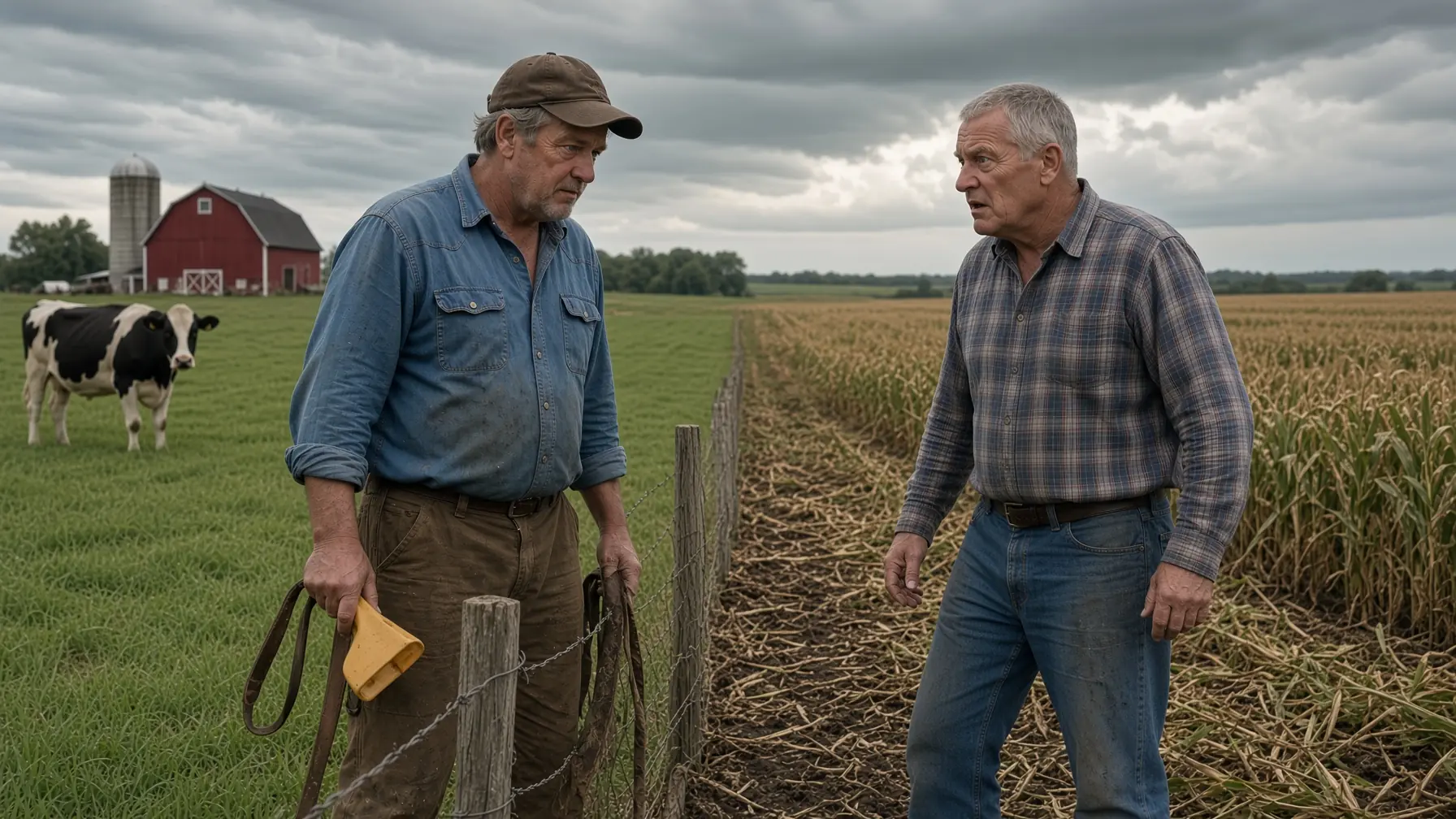
For several seconds, he simply stared.
The old Hereford cow stared back.
Daisy had a white face, reddish-brown body, one chipped horn, and absolutely no understanding of property boundaries.
A strip of broken fence wire trailed behind her.
Around her, nearly half an acre of green bean plants had been trampled, flattened, or eaten down to stems.
Edward closed his eyes.
“No.”
Daisy chewed.
“Please tell me you didn’t.”
She chewed again.
The evidence suggested she had.
Edward climbed over the drainage ditch separating the two farms and walked into Margaret’s field.
The farther he went, the worse it looked.
Daisy had not simply walked in, eaten breakfast, and stopped.
She had wandered.
There were hoofprints through six rows.
Plants crushed beneath her weight.
A section near the irrigation lane looked as if she had lain down in it.
Edward saw where she had entered.
The corner post between the Cole pasture and Margaret’s field had split at ground level.
Two strands of wire were down.
The third hung loose.
Daisy must have pushed through sometime during the night.
Edward swore softly.
He had noticed that post leaning three days earlier.
He had even put a replacement post in the back of his pickup.
Then the baler broke.
Then his hydraulic hose split.
Then his wife called to remind him about their son’s school meeting.
The post slipped from urgent to later.
Later had become this.
Daisy lifted her head.
“Come on.”
Edward caught her halter.
She followed him without resistance.
Of course she did.
Daisy had always been gentle.
His daughter Emma had learned to lead cattle using Daisy when she was eight.
That somehow made the ruined beans more insulting.
Edward led the cow back through the broken fence.
Then he stood at the opening.
Across the field, Margaret Bennett’s farmhouse was still dark.
She was seventy-two.
Widowed.
Stubborn.
And one of the hardest-working people Edward had ever known.
Her husband, Harold, had died five years earlier.
Everyone assumed she would lease the land.
Instead Margaret reduced the acreage, sold half the equipment, and kept farming twenty-three acres herself with occasional help from her grandson.
The beans were important.
Edward knew that.
Margaret sold most of them to two farm stands and a small regional grocer.
She had talked about that crop three weeks earlier when they met beside the mailboxes.
“Best stand I’ve had in years.”
Edward had looked across the road toward the field.
“Looks good.”
“If the weather doesn’t ruin it.”
“Don’t say that out loud.”
She laughed.
Now Daisy had done what the weather had not.
Edward looked toward the eastern sky.
Dark gray clouds were building beyond the tree line.
He pulled his phone from his pocket.
The forecast showed thunderstorms beginning before seven.
Heavy rain.
Possibly an inch.
He looked down at Daisy’s tracks.
Deep impressions in dry soil.
Distinct.
Obvious.
Then back toward Margaret’s house.
All he had to do was walk over.
Knock.
Tell her.
Daisy broke through.
My fence failed.
I should have repaired it.
I’ll pay for the damage.
That was the correct thing.
Edward knew it immediately.
He also knew he had $612 in the farm checking account.
The combine needed a bearing.
His property insurance deductible was high.
Feed bills were due.
The spring had already been bad.
Margaret’s beans might represent several thousand dollars.
Maybe more.
He imagined her face.
Not anger.
Disappointment.
That was worse.
The Coles and Bennetts had shared a property line for thirty-one years.
Harold Bennett had helped Edward’s father pull a tractor from a flooded ditch in 1997.
Margaret brought food when Edward’s mother died.
When Edward broke his wrist, Harold cut his hay.
When Harold died, Edward repaired Margaret’s north gate without charging her.
That was how rural neighbors worked.
Not perfectly.
But with memory.
Edward looked toward the clouds again.
Rain.
His stomach tightened.
If he fixed the fence now and the storm came hard enough, Daisy’s tracks might wash away.
Margaret might assume deer.
Or escaped wildlife.
Maybe she would never know.
The thought appeared so quickly that Edward hated himself for having it.
Then another thought followed.
The damage was already done.
Telling her would not restore one bean plant.
What good would confession actually accomplish besides transferring money his family did not have?
He could help Margaret later.
Buy some produce.
Repair something.
Make it right indirectly.
Edward knew exactly what he was doing.
He was turning fear into philosophy.
At 5:51, he loaded a post driver and fencing tools into the ATV.
By 6:09, the broken corner post was replaced.
By 6:18, the wire was restrung.
Edward picked up the broken pieces of the old post.
Then he noticed a tuft of Daisy’s reddish hair caught on the barbed wire.
He froze.
Rain began tapping against the brim of his cap.
One drop.
Then another.
He pulled the hair free.
Held it in his palm.
For a moment, he almost put it back.
Instead, he shoved it into his pocket.
That was the first thing he did that could not be blamed on an accident.
The cow escaping was negligence.
The hair was a choice.
Edward drove the ATV home as rain began falling harder.
At 6:32, the field disappeared behind a gray sheet of water.
By 7:15, runoff was flowing along the roadside ditches.
Edward stood inside his equipment shed watching the storm.
His wife Laura came through the side door carrying coffee.
“You’ve been out already?”
“Fence.”
“What happened?”
“Corner post broke.”
“Cattle get out?”
Edward took the coffee.
“No.”
The answer came too quickly.
Laura looked at him.
“No?”
“No.”
He drank.
She stared another second.
Then walked away.
Edward remained in the shed.
He had lied twice before breakfast.
Once to his wife.
Once to himself.
At 9:40, the rain stopped.
At 10:17, Margaret Bennett’s white pickup pulled into Edward’s yard.
He saw it through the kitchen window.
His stomach dropped.
Laura called from the laundry room.
“Margaret’s here.”
“I see.”
He walked outside.
Margaret stepped from the truck wearing mud-covered boots.
Her gray hair was tied beneath a faded blue cap.
Her face looked more confused than angry.
“Morning.”
“Morning.”
“Got a question.”
Edward nodded.
She pointed toward her field.
“Something got into my beans.”
He forced himself to look surprised.
“Really?”