The champagne flute slipped from the server's tray and shattered against the marble floor of the Harrington estate. And in the half-second silence that followed, Renata heard her husband's voice carrying across the dining room, sharp, performative, aimed at her. "She grew up in Regent Park," Douglas Harrington was saying to the man beside him, a city councillor named Bryce Wentworth, whose wife had been glancing at Renata all evening with the particular expression of a woman cataloging exits. "Practically raised herself. You have to admire the ambition, at least."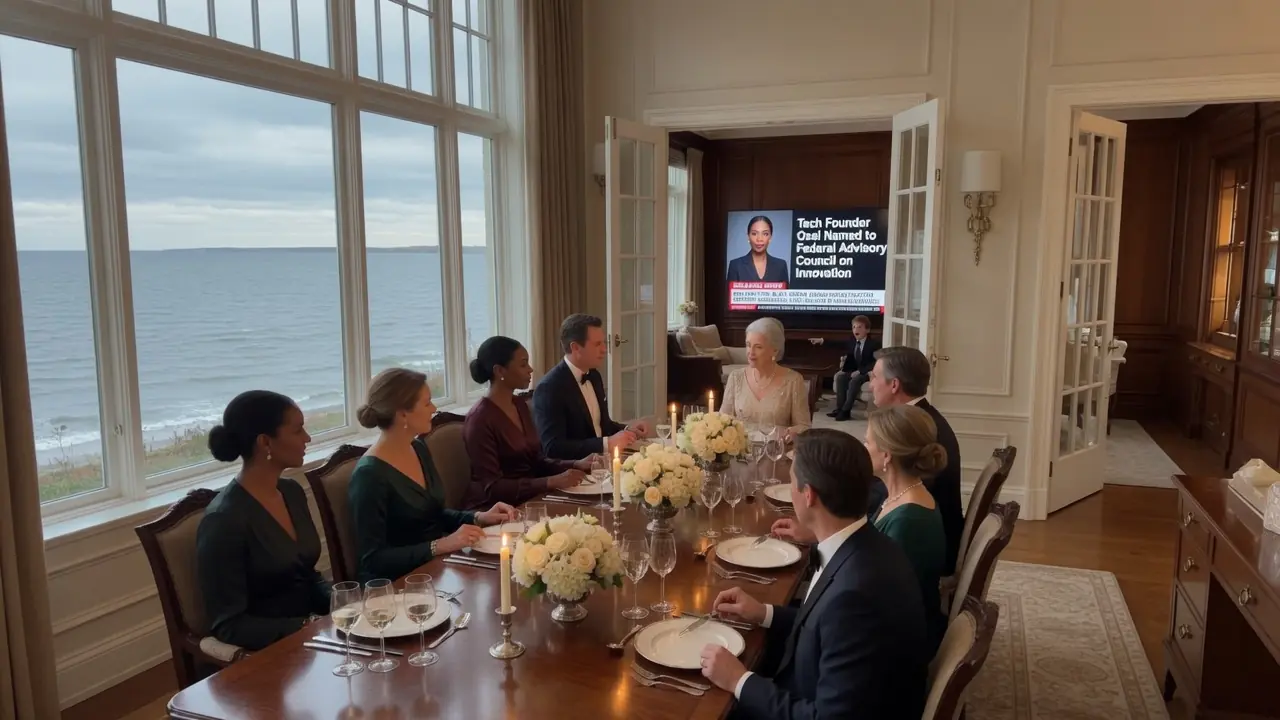
The word ambition landed the way it always did in this family, like a compliment wearing borrowed clothes. Renata Osei did not look up from her wine glass. She had learned in the six years she had been married to Douglas that the best response to being described in his family's presence was no response at all. She turned the stem of the glass slowly in her fingers and watched the candlelight move through the burgundy and thought about the quarterly report she had left unfinished on her laptop at home. Outside the tall windows of the Harrington dining room, Lake Ontario was flat and gray in the October evening and the lawns of the estate stretched down toward the water in the particular manicured way that suggested no one had ever actually walked across them barefoot.
Renata had grown up 40 minutes east of here in a two-bedroom apartment where the radiator knocked all winter and her mother worked doubles at the hospital to make sure the lights stayed on. She had made her first $50,000 at 26, her first million at 29, and she had walked into a room very much like this one on the arm of Douglas Harrington at 32. She had been misreading it ever since. "Renata's company does something with software, is that right?" Bryce Wentworth's wife asked from across the table, not unkindly, the way people spoke to someone they were trying to be polite to at a dinner they had not expected to include her.
"Infrastructure analytics," Renata said. The woman nodded in a way that suggested this information had not landed anywhere useful for her, and then looked back at her husband. Douglas caught Renata's eye from three seats down and gave her the small smile he always gave her at these dinners. The one that said, "You're doing fine. Don't make it a thing."
Renata took a sip of her wine and did not make it a thing. This was the Harrington Autumn Gathering. It happened every October at the family estate in Oakville, and it had been happening every October for as long as any of them could remember. Douglas's mother, Eleanor Harrington, organized it with the precision of a military operation, and its purpose, as far as Renata had been able to determine across six years of attendance, was to confirm that everyone in the family was roughly where they were supposed to be. The right houses, the right clubs, the right children in the right schools, the right wives.
Renata had never quite fit the last category, and Eleanor had never quite let her forget it. It had started subtly enough. The first year, there had been a seating arrangement that placed Renata at the far end of the table beside Douglas's elderly uncle who was hard of hearing and spent most of the meal discussing the 1988 provincial election. The second year, Eleanor had introduced Renata to a family friend as Douglas's companion.
Douglas always noticed. Douglas always apologized afterward in the car on the way home or the next morning over coffee with a sincerity that Renata genuinely believed was sincere. He loved her. She was certain of that. But love, she had come to understand, was not the same as protection.
Douglas loved her and he could not or would not do the thing that protection required, which was to be uncomfortable on her behalf in a room full of people who had known him his whole life. She had therefore developed her own method. She was quiet at these dinners. She was pleasant. She made no demands.
She had brought, in the early years, bottles of wine and small hostess gifts that Eleanor received with the faint surprise of someone who had not expected effort and which were never mentioned again. She had learned the correct way to address Douglas's grandmother. She had attended the dinners even when she had had early morning flights and board meetings the next day because Douglas had asked her to and because she told herself it mattered. What she had not understood in those years was that none of it was ever going to be enough. Not because she lacked something, but because what the Harrington family had decided about her had been decided before she walked through the door and no amount of quiet pleasantness was going to undo a decision that had never been spoken out loud in the first place.
She understood this now. She just hadn't decided yet what to do about it. The dinner moved through its courses, soup, then salad, then a roast that the family's chef had been preparing since morning. The conversation moved the way it always did, around business, around real estate, around the children's schools and the family cottage, and the question of whether Douglas's brother Ashton was going to run for the seat in Burlington next year. Renata listened.
She contributed when someone addressed her directly, and several people did, though always with a faint tentativeness, as if they were still working out which version of her they were dealing with. It was after the main course, when the wine had been poured a third time, and the conversation had loosened and sprawled, that Eleanor Harrington said the thing she said. She said it to Douglas, not to Renata directly, never directly, but in that particular way she had of speaking about Renata, as if Renata were not present, or as if her presence were the kind that could be spoken over without consequence. "I ran into Patricia Edelman at the club on Thursday," Eleanor said, addressing Douglas but making no effort to lower her voice.
"Her son just got married. Lovely girl, doctor. Comes from a very good family in Forest Hill." She paused, adjusting the napkin in her lap. "It made me think about choices, about what we invest in and what pays off."
The table had not gone quiet. That was the insidious thing about these remarks. They were never loud enough to stop a conversation, only loud enough to be heard by the right people. Bryce Wentworth was still talking to Ashton about the Burlington seat. Pamela's husband was refilling glasses at the other end of the table, but Douglas had heard, and Renata had heard, and Douglas's sister Caroline, who was sitting two seats from Renata, and who was the only member of the Harrington family who had ever shown Renata anything that resembled genuine warmth had gone very still.
Douglas set down his fork. "Mother," he said. "I'm simply making an observation," Eleanor replied in the voice of a woman who had been making observations her entire life without consequence. "It's not the kind of observation that needs to be made." "Douglas, I—" "Not tonight, Mother."
There was a small silence. Eleanor looked at her wine glass. Bryce Wentworth's conversation with Ashton faltered and recovered. Pamela studied her dessert spoon. Renata said nothing.
She had finished her wine and there was no more coming and she thought very deliberately about the quarterly report and about the call she had at 8:00 the next morning and about whether she had remembered to confirm the car for the airport on Thursday. It was the kind of silence that passes and then the conversation picks back up and by the time the dessert came no one had mentioned it again. This too, Renata had learned. These things passed. They were filed away unaddressed and the evening continued and at the end of the night Douglas would apologize in the car and she would say it was fine and it would not be fine but they would both behave as though it were because that had become the grammar of their marriage.
At these dinners, it was the agreement they had never formally made but had arrived at together. Whether out of love or exhaustion, she was no longer certain. What she had not accounted for was the television. The Harrington dining room had tall French doors that opened into a sitting room and the sitting room had against one wall a large flat screen television that Eleanor's grandchildren used on rainy weekend afternoons. It had been dark all evening.
One of the grandchildren, Ashton's youngest, a boy of about 10 with his grandfather's wide-set jaw, had crept in from the hall during dessert, turned it on with the volume low, and curled into the armchair nearest the doors with a tablet on his lap and the TV in the background, the way children of that generation did everything: in layers, none of it fully committed to. The news was on. It was the 10:00 national broadcast. Renata was aware of it peripherally, a blue flicker at the edge of her vision, the murmur of a broadcaster's voice. She was focused on her plate, on the tarte tatin that the Harrington chef made well, on the conversation Pamela and Caroline were having about the Christmas market, which Renata had been asked to contribute to three times in the last year and had not, because organizing community events for Douglas's family circle required a performance of belonging she was not always able to sustain.
She did not hear the name at first. The broadcaster said it clearly. Then the chyron appeared on the screen, and it was Ashton's youngest who looked up from his tablet and said, with the matter-of-fact curiosity of a 10-year-old who has not yet learned to perform discretion, "Hey, is that the lady from dinner?" Nobody moved for a moment. Then Caroline turned around in her chair, and Pamela turned, and Bryce Wentworth looked, and then Douglas, and then slowly Eleanor Harrington.
On the screen, in the clear high-definition light of a professional studio, Renata's face looked back at them. Not her face exactly, but a professional, recent photograph, the one her communications team had taken in September. Beside it, in the white block lettering that the network used for its major stories, were the words, "Tech founder Osei named to Federal Advisory Council on Innovation." The broadcaster was saying her name again, saying the company's name, and saying the figure—$340 million in annual revenue, the largest Black woman-owned tech company in the country—with the particular reverence that financial figures receive when read aloud on national television. The report said that the appointment had been announced that afternoon by the Minister of Innovation, that it represented a significant moment, and that she would be advising directly on the government's digital infrastructure policy for the next four years.
The sitting room was very quiet. Ashton's youngest looked from the television to the table and back again with the uncomplicated delight of a child who has found an interesting coincidence. Renata put down her dessert fork. She had known about the appointment since Tuesday. Her communications team had managed the embargo carefully, had coordinated the release with the Minister's office, had ensured that the announcement went out on Thursday afternoon to catch the evening news cycle.
She had known it would be tonight. She had known the national broadcast would run the story at 10:00. She had said nothing about it, not to Douglas, not to anyone at this table, because the announcement belonged to her work, her world, the one that existed outside the Harrington estate, and she had learned a long time ago that bringing her work into these evenings served no one. She had not planned this, not exactly, but she had not prevented it, either. Douglas was looking at her.
His expression had moved through several things very quickly. Surprise, then a complicated pride, then something that looked like the beginning of understanding, as though he were seeing, for the first time, the precise geometry of the position she had been placed in for 6 years. "Renata," he said, just her name, but the way he said it contained a question he did not know how to finish. "I was going to tell you Thursday," she said. "The embargo lifted at 4:00."
Eleanor Harrington had not spoken. She was looking at the television. Her wine glass was in her hand, but she had not lifted it. Beside her, Ashton's wife had placed her napkin on the table with the slow, deliberate care of someone buying time. Bryce Wentworth had turned fully in his seat, and his wife was looking at Renata with an expression that had rearranged itself completely from the one she had worn at the beginning of the evening.
Pamela said, "$340 million?" "That's the last fiscal year," Renata said. "Q3 is tracking higher." Caroline let out a breath that was almost a laugh, quickly suppressed, and pressed her fingers to her mouth. Eleanor set down her wine glass.
She did not apologize. Renata had not expected her to. Eleanor Harrington was not a woman who apologized, had never been, and even this moment, which was as clear a public accounting as any Renata had ever witnessed, was not going to change the architecture of who Eleanor was. But something happened in Eleanor's face in the silence that followed. It was a reorganization.
The small, load-bearing assumptions that had held her certainty in place for six years shifted visibly, the way the ground shifts just before something settles. And what replaced them was not warmth, and was not regret, but was, at the very least, the first honest assessment Eleanor Harrington had ever made of the woman her son had married. It was not nothing. It was not enough, but it was, Renata thought, the first real thing that had passed between them. The broadcaster moved on to the next story.
Ashton's youngest turned back to his tablet. The tarte tatin sat unfinished on several plates. What happened after was not dramatic, and that was the thing that Renata would remember most. There was no confrontation. There was no scene.
The dinner concluded in the polite, slightly accelerated way of evenings that have already said everything that needed to be said. Pamela asked a question about the advisory council that was, for the first time, a genuine question, not a gesture toward politeness, but an actual inquiry. Delivered with the focused attention of someone recalibrating, Bryce Wentworth said something about the digital infrastructure policy that revealed he understood it better than he had let on all evening. Douglas reached under the table and found her hand, and she let him hold it. Eleanor spoke to Renata once more before the evening ended.
It was brief. It was in the front hall while coats were being retrieved, and Douglas was saying goodbye to Ashton on the steps. Eleanor came to stand beside her, looked at the middle distance for a moment in the way of a woman choosing words, and said, "Douglas chose well." It was the smallest acknowledgement possible. It was delivered without warmth, in the register of a concession rather than a compliment.
It was, by any measure, the least she could have offered. Renata looked at her. Eleanor Harrington was in her 70s now, still straight-backed, still immaculate, still the unmoved center of a family that organized itself around her authority. She had spent 6 years forming her verdict on Renata, and had never, until this evening, had cause to examine whether the verdict was correct. "Thank you," Renata said, because it cost her nothing, and because she was a woman who had learned that graciousness in victory was not the same as forgiveness.
She picked up her coat. She walked out into the October evening where Douglas was waiting on the steps and the lake was still gray and flat below the lawn and the cold air smelled like wood smoke and the end of the season. And she thought, "Six years." Not with bitterness, exactly. With something more precise than that.
She had built her company from a studio apartment in Regent Park with a second-hand laptop and two clients she had found through a business forum at 11:00 on a Tuesday night. She had worked through three recessions and one pandemic and a funding environment that had been designed at every stage with someone else in mind. She had hired 84 people, had taken a meeting in Geneva and another in Singapore in the same week without sleeping on either flight because she couldn't afford to. She had done all of that while attending these dinners, while accepting the positioning at the far end of the table, while being described as ambitious by a man who had never built anything in his life. She had done it without performing it for anyone who hadn't earned the right to see it.
That was the thing she wanted to hold on to. Not the look on Eleanor's face, not the pivot in the room, not even the clean shock of the television announcer saying her name while $60,000 worth of Harrington silverware sat still on the table. What she wanted to hold on to was the fact that she had kept that part of herself entirely separate, had not sought their validation, had not needed the announcement in order to know what she was worth. The announcement had come regardless and it had landed the way it landed and none of that had been her doing. In the car, Douglas was quiet for a long time.
The highway unfurled ahead of them in the dark and the lights of Oakville fell away behind. Then he said, "I owe you more than an apology." Renata looked at him. He was watching the road, both hands on the wheel, and his profile in the dark was the face of a man who had genuinely not understood something until tonight, and who was beginning to understand that the not understanding had cost someone he loved. "You do," she said.
"I know. I don't want the apology yet," she continued. "I want you to sit with it for a while. I want you to think about what it looked like from where I was sitting. All six years of it."
He nodded. He kept his eyes on the road. "Okay," he said. The city came up ahead of them, the lights of Toronto spreading out across the horizon, and Renata rolled the window down an inch and let the October air in and thought about the call she had at 8:00 and the quarterly report and the minister's office and all the things that would begin tomorrow and the day after, the ongoing work of a life she had built by herself, piece by piece, in rooms where no one had expected her to succeed. She was not finished with the marriage.
She was not finished with Douglas. But she was finished, finally and completely, with the version of herself that had spent six years trying to be legible to people who had chosen not to read. Whatever happened next, in that car, in that marriage, in the advisories and the boardrooms and the annual Harrington dinners that may or may not continue, she would not be attending as someone who needed to prove herself. She had proved herself to the only person whose opinion had ever mattered, herself. And that, she thought, as the city lights gathered around them and the highway narrowed into familiar streets and Douglas drove in his careful, careful silence, was the thing Eleanor Harrington could never take back.