I should tell you before I tell you anything else that my grandmother never did anything by accident.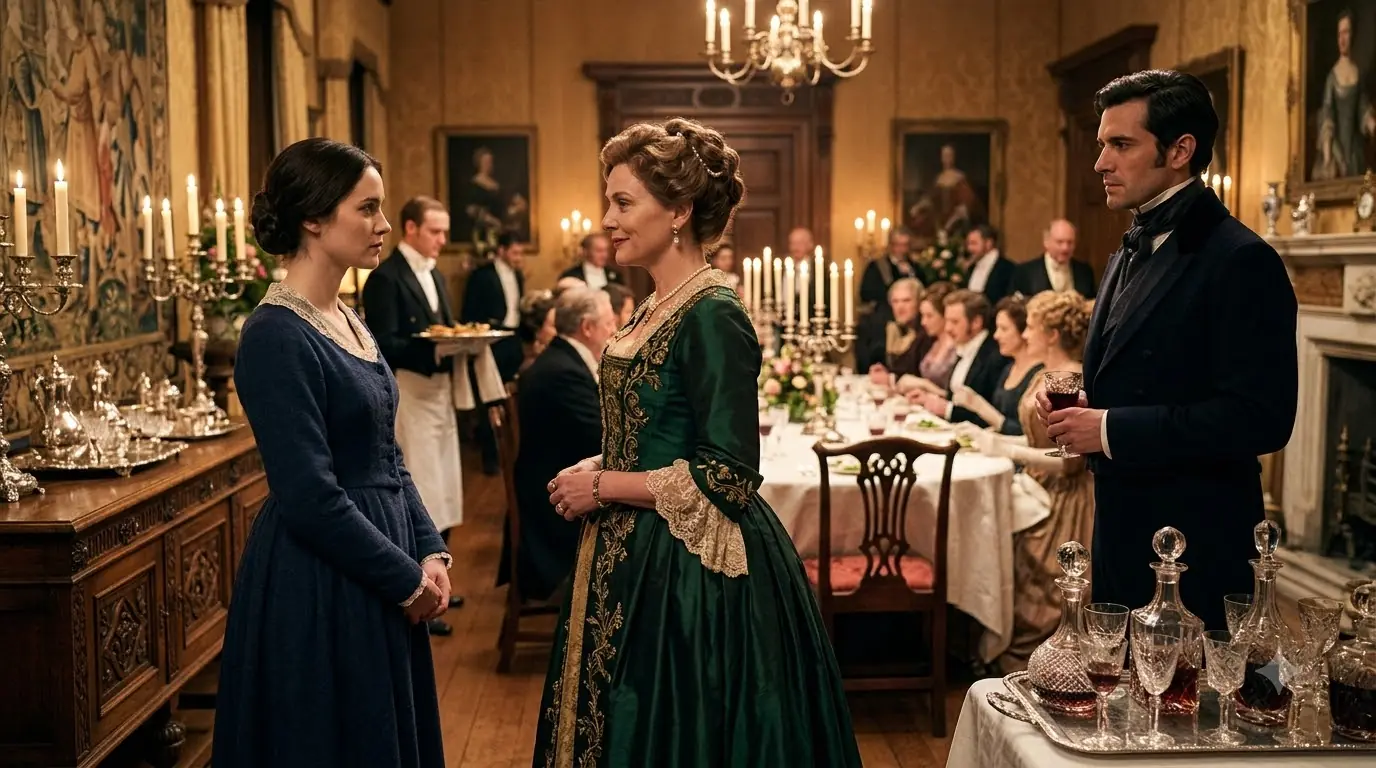
She was 81 years old, barely five feet tall, and she had outlasted two kings, three fashionable periods of interior decoration, and every person in England who had ever underestimated her. She received callers in a high-backed chair she claimed had belonged to a French cardinal, and she had a habit of folding her hands in her lap and watching a person speak without any expression at all, which made most of England deeply uncomfortable.
I had spent a lifetime growing accustomed to it. My brother Edric, the Duke of Drevenmore, had not.
But I am getting ahead of myself. My name does not matter here. What matters is that I was present at Drevenmore Park that summer, and I watched every move my grandmother made, and I have thought about it often in the years since.
My brother was, in the language of the drawing rooms, a difficult man. He was not cruel. I want to say that plainly, because cruelty would have been easier to explain. Edric was simply exacting. He had inherited the dukedom at 22 when our father died of a chest complaint in February, and he had spent the 12 years since in a posture of controlled competence that brooked no waste, no softness, and very little warmth.
He ran the estates efficiently. He spoke in Parliament with a kind of spare, unanswerable authority that made other lords shift in their seats. He attended whatever social engagements were required of his position, said the correct things to the correct people, and returned home looking no different than when he had left.
Mothers with daughters had been steering their finest toward him for six seasons, and he had studied each one of them with the same measured attention he gave to a proposed drainage scheme: thorough, dispassionate, and ultimately unconvinced. He was 34 years old. My grandmother had decided she had been patient long enough.
"I am inviting the Fairfields," she announced one morning at breakfast, without preamble or ceremony.
Edric looked up from his correspondence. "The who?"
"The Fairfields of Atterstoke. The Reverend Fairfield served the parish at Westhaven for 30 years. His wife is a sensible woman. They have a daughter."
Edric set down his letter. "Grandmother?"
"Her name is Merryn," she said, in the tone she used when she had already concluded the discussion. "She will be here for the garden party on Saturday. I expect you to be civil."
I happened to catch my grandmother's eye across the table. She looked at me with perfect serenity and took a sip of her tea.
Edric pressed on. "I don't recall expressing any interest in—"
"You have expressed no interest in anything, Edric. That is rather the point." She returned her cup to its saucer with a small, precise click. "I met Miss Fairfield at a charitable committee in April, at which she contributed more practical good sense to the discussion than the previous four chairwomen combined. I liked her considerably. I intend for you to meet her. That is all."
It was not all, as I knew very well, but Edric did not argue further. He recognized that particular tone. It was the one that meant the matter was already settled, and he was simply being extended the courtesy of being informed.
The garden party was a modest affair, as Drevenmore's entertainments went: two dozen guests on the south lawn, lanterns hung from the lime trees, a light supper set out beneath the awning as the afternoon turned toward evening. My grandmother stationed herself at the top of the steps like a general surveying a field, and received every arrival with the propriety of a hostess who has organized seven decades of social occasions and never once misjudged the seating.
I saw Miss Fairfield arrive with her parents at half past four. She was not what the drawing rooms called handsome. She was perhaps five and twenty, slight, with dark hair dressed simply and a gown that was clean and well-pressed, but plainly of a different order than the silk and embroidery moving around her. She had an open face, not pretty in the fashionable arrangement of features, but composed in a way I found restful to look at.
She walked beside her mother without the performed ease of a girl who has practiced her entrance, and when my grandmother descended the steps to greet her personally, her expression showed surprise, and then something that was clearly genuine pleasure.
"My dear," my grandmother said, taking her hands. "I am glad you came."
"I am glad to be invited," Miss Fairfield said. Her voice was quiet and quite direct. "The drive from Atterstoke is beautiful this time of year. I should not have liked to miss it."
I liked her immediately. Edric, standing at the far end of the lawn in conversation with Lord Pemberton, had not yet looked their way.
My grandmother introduced them at the supper table with the particular efficiency of a woman who has positioned her chess pieces and is now simply waiting for the board to catch up.
"Edric, you will sit beside Miss Fairfield."
She smiled at them both with perfect warmth and went to arrange something elsewhere, leaving them to their chairs and the polite machinery of introductory conversation.
I seated myself close enough to observe without being conspicuous, which is a skill I had developed over many years of watching my grandmother operate.
Edric offered Miss Fairfield the expected courtesies. He asked about her journey. She answered with the journey's details. He asked about Atterstoke. She spoke about Atterstoke without embellishment. He asked some pleasantry about the summer, and she said that she thought this summer rather better than last on account of the rainfall being more evenly distributed, which she had found was not a universally held view, but which had done considerable good to the kitchen garden at the parsonage.
There was a pause.
"You have a kitchen garden?" Edric said.
"Several beds, yes. My father keeps the herbs. The rest falls to me largely when I am at home."
He studied her. I recognized the particular quality of his attention when he was genuinely listening. There was a fractional stillness in his bearing, a slight narrowing of his gaze. He had given her none of the polished deflection he employed with women he found merely agreeable. He was actually looking at her.
"Does that occupy a great deal of your time?" he asked.