I was changing the lock on my gate when Vivien Hargrove stepped out of a white SUV like she'd arrived to repossess the mountain.
She looked at my faded work shirt, then at my mud-caked boots, and let out a short laugh.
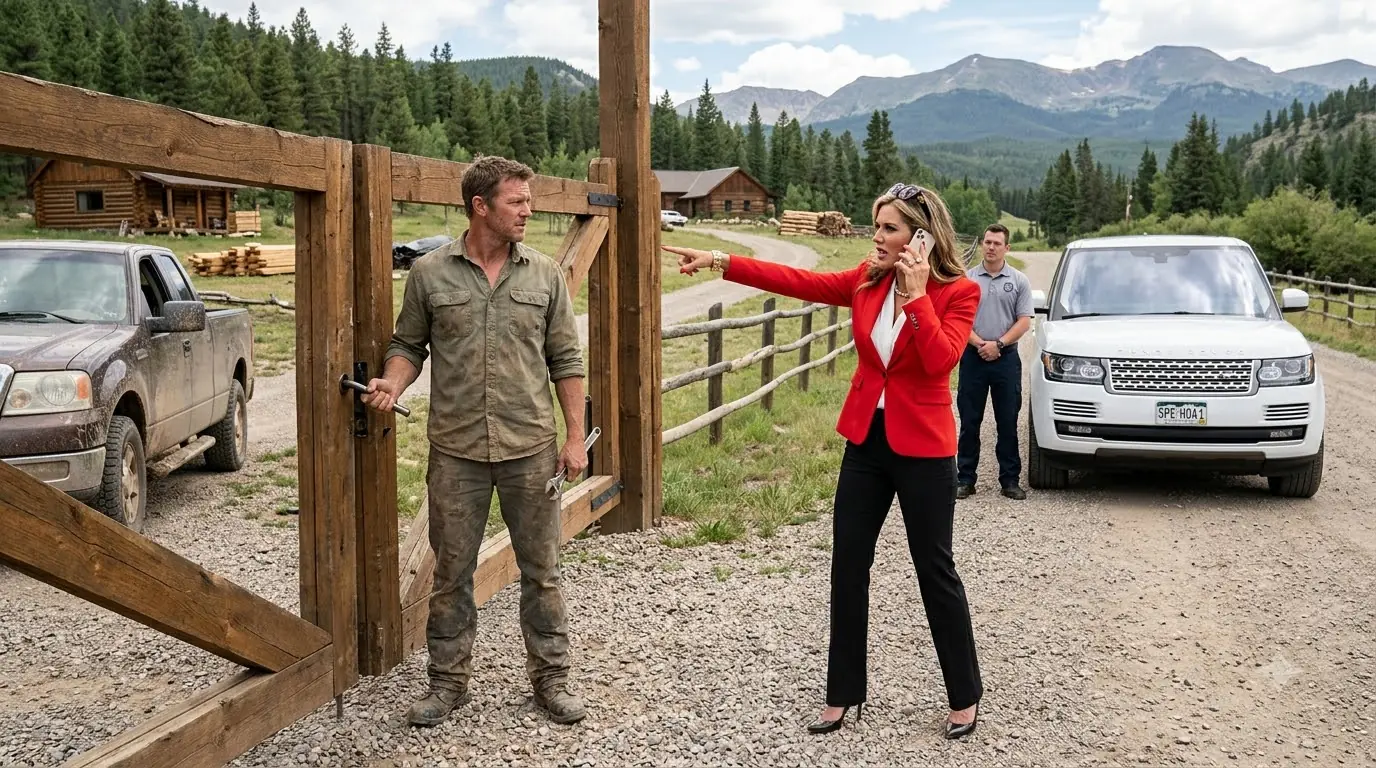
"You have three minutes to vacate HOA property," she said. I told her it was my land. She turned to her security guard and didn't bother looking back at me.
"Call the cops." 20 minutes later, a sheriff's cruiser rolled up. Sheriff Owen Cade climbed out, looked straight at me, and went completely still. "Mason Ror."
Vivien smiled. That smile disappeared the moment Owen said two words: "SEAL team." My name is Mason Ror. I'm 42 years old and I don't talk much about what I used to do for a living.
That's not unusual for men who've done the kind of work I've done. There's no particular reason to mention it and plenty of good reasons not to.
What I will say is that after spending more than 15 years moving through the world on other people's schedules with other people's equipment toward other people's objectives, I had reached a point where the thing I wanted most was a piece of ground that belonged to no one but me.
That piece of ground turned out to be 61 acres of timber and high meadow in the mountains of Colorado. Left to me by my uncle Warren Ror when he passed away in late autumn 2 years ago.
Warren had owned the property for over four decades. He built a timber-frame cabin there in the 1970s and spent every summer and most falls he could manage living in it the way people used to live in mountain cabins: quietly, independently, without much thought for what was happening on the other side of the tree line.
The Silver Pines Estates development came later, carved out of adjacent parcels to the east and north roughly a decade after Warren bought the land. He watched them build it, watched the white fences go in and the community signage appear at the entrance, and went on about his business as though none of it had anything to do with him. It didn't.
His land was his land, and the plat map at the county recorder's office said so plainly. I drove up from Colorado Springs on a Tuesday in early March, a duffel in the cab, and a full truck bed of tools and lumber. The cabin needed significant work, new roof decking, rewired electrical throughout, a cracked foundation wall on the north side, and enough rotted floorboards to keep me busy through the spring. I was glad for it. I wanted to use my hands on something I could own at the end of the day, and I wanted quiet.
And for the first week, I had both. I didn't introduce myself to anyone in the neighborhood. I kept to the property, cleared the overgrown east fence line, pulled the rotted floorboards, and woke up each morning to the same view of the same mountains, which was more than I'd had in years. Then Vivien Hargrove drove through my open gate without knocking, without calling ahead, and without appearing to believe that any of that was necessary. She came dressed for a board meeting, leather folio under one arm, sunglasses pushed up into her highlighted hair, and she looked around the yard with the practiced assessment of someone who has spent years deciding what belongs and what doesn't.
She looked at the lumber stacked against the barn wall, the tools laid out on the tailgate of my truck, the stripped fence rails leaning against the post pile. Then she looked at me. "You must be the new caretaker," she said. When I told her I was the owner, she looked at my 12-year-old Ford pickup with the cracked side mirror and let a slow smile cross her face that said she'd already decided what kind of person I was. She introduced herself as president of Silver Pines Estates HOA and produced a printed sheet from her folio.
According to her, I needed to repaint the fence to match the neighborhood palette. I needed to move my truck out of the front sighteline. I needed to remove a tool storage shed that was, in her words, not in keeping with the architectural character of the neighborhood. Any modification to the entry gate required written approval from the architectural review committee before work could begin. I listened to all of it and then told her as plainly as I knew how that I was not a member of the HOA.
She blinked once as though I'd said something mildly interesting and then said, "Everyone around here belongs to something." I didn't argue. I had learned a long time ago that arguing with the loudest person in the room accomplishes nothing.