The sound that brought Malcolm Reed out of his kitchen was not a chainsaw.
He had already heard enough chainsaws that week.
This sound was sharper.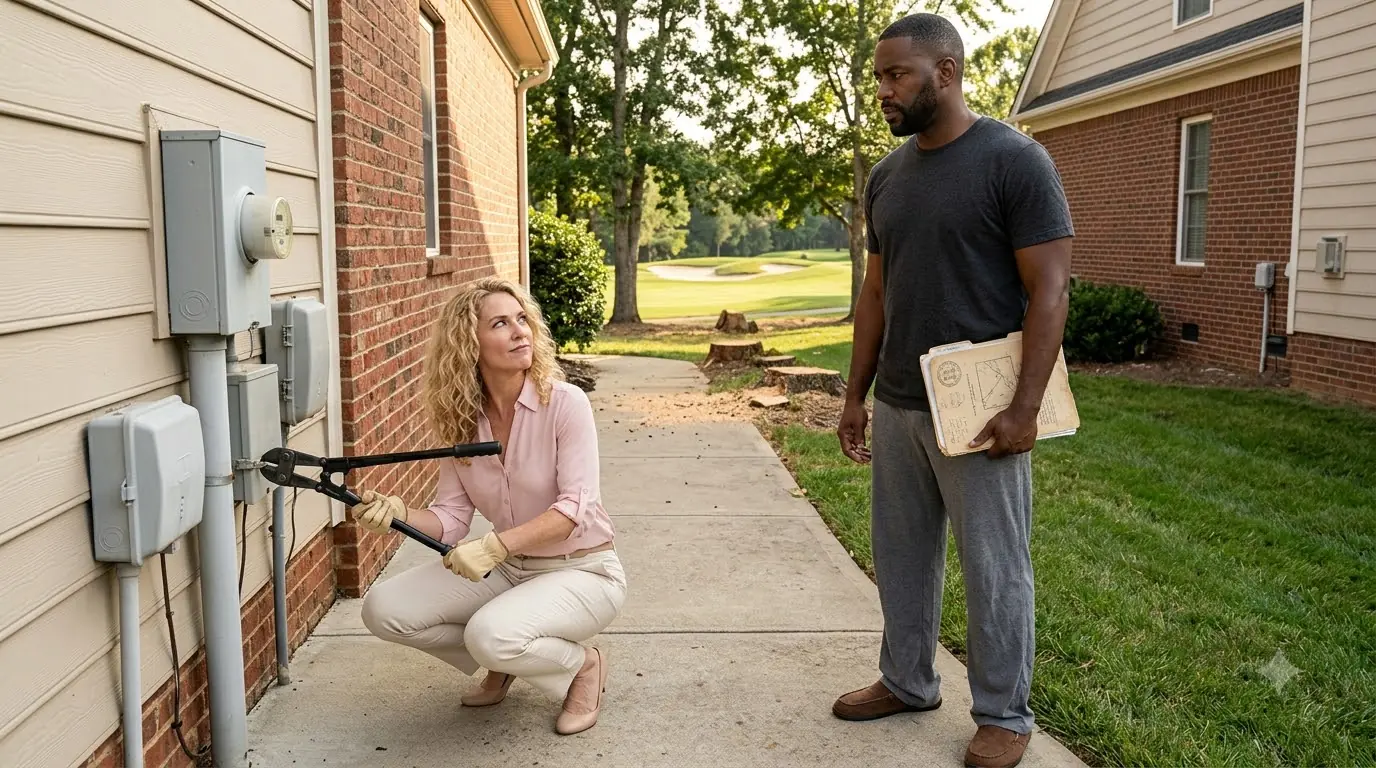
Metal against metal.
Once.
Then again.
A heavy snap followed by the scrape of something hitting the concrete walkway beside his house.
Malcolm set down his coffee.
He had been standing barefoot in gray lounge pants and a charcoal T-shirt, reading an email from his contractor while waiting for a load of replacement fencing to arrive. Saturday afternoon was supposed to be quiet.
Quiet had become difficult in Fairmont Ridge, an expensive golf-course subdivision outside Charlotte, North Carolina, ever since the homeowners association decided that the neighborhood needed what HOA president Heather Cole called “a stronger visual identity.”
Malcolm called it something else.
People cutting down things that did not belong to them.
He stepped through the back door.
The first thing he saw was Heather crouched against his siding.
She wore cream trousers, a pale pink blouse with the sleeves rolled neatly above her forearms, beige work gloves, and nude low heels that had no business being on a side-yard concrete path. Her shoulder-length blonde hair fell in polished curls around her face.
In both hands, she held a pair of heavy black bolt cutters.
The jaws were positioned near one of the exterior utility boxes attached beside Malcolm’s electrical service.
Malcolm stopped.
“Heather.”
She turned.
There was no embarrassment.
No surprise.
Only irritation at being interrupted.
“Finally.”
Malcolm stared at the bolt cutters.
“What exactly are you doing?”
Heather stood slowly.
Behind her, the view opened across the back of Malcolm’s property.
Or what remained of it.
Twenty enormous oak trees had stood there six days earlier.
Some had trunks wider than Malcolm’s shoulders.
His grandfather had told him that several were already mature when Franklin Reed purchased the original acreage in 1968.
Now twenty fresh stumps interrupted the torn ground like pale wounds.
Branches had been hauled away.
Wood chips covered the soil.
Beyond the destruction, the eighth green of Fairmont Ridge Golf Club was suddenly visible from three neighboring houses that had never possessed an unobstructed golf-course view before.
Heather pointed toward the utility box.
“You failed to comply with the board’s access notice.”
“What access notice?”
“The landscaping crews need electrical service for restoration work.”
“You mean the people who cut down my trees?”
“They were not your trees.”
Malcolm’s expression changed.
Heather saw it.
Ignored it.
“They were located inside a community visual corridor.”
“A what?”
“A visual corridor.”
“That phrase isn’t in my deed.”
“It’s in the updated landscape standards.”
Malcolm stepped closer, though he kept several feet between them.
“You are standing on my property with bolt cutters beside my electrical equipment.”
Heather laughed.
“Don’t be dramatic.”
Malcolm looked at the tool.
“You brought a tool designed to cut metal.”
“The utility cover was secured.”
“Because it is my utility box.”
“The HOA has emergency access authority.”
“No, it doesn’t.”
Heather’s face tightened.
“I have been president of this association for nine years.”
“And I’ve owned this house for twelve.”
“I know the covenants.”
Malcolm nodded.
“Good.”
“Then tell me which section lets you cut twenty mature trees from a privately deeded parcel.”
Heather folded her arms.
“The board approved the landscape correction.”
“Which section?”
She did not answer.
Malcolm asked again.
“Which section, Heather?”
She looked toward the stumps.
“You should be thanking us.”
He almost laughed.
“For what?”
“Your rear property line was completely overgrown.”
“Those were oak trees.”
“Those were eighty-year-old obstructions.”
Malcolm stared at her.
Heather continued.
“Your house now has a clean golf-course view.”
“I didn’t ask for one.”
“Your property value will increase.”
“I didn’t ask for that either.”
“You’re being emotional.”
Malcolm became very still.
Heather interpreted that as victory.
She stepped closer.
“Twenty old trees were blocking sunlight, restricting sight lines, dropping debris into the drainage channel, and undermining the aesthetic consistency of the rear corridor.”
Malcolm glanced toward the stumps again.
His grandfather had planted a wooden swing between two of those trees when Malcolm was six.
The swing was gone.
So was the branch that held it.
His mother had taken pictures beneath those trees on the day Malcolm graduated college.
His grandmother’s ashes had been scattered beyond the largest oak near the creek.
Heather knew none of that.
Perhaps it would not have mattered if she did.
Malcolm looked back at her.
“You entered my land without permission.”
“We provided notice.”
“You taped a letter to my mailbox after the crews had already started.”
“The date on the letter was earlier.”
Malcolm looked at her carefully.
That sentence mattered.
“How much earlier?”
Heather hesitated.
“Three days.”
“The envelope was dry after two days of rain.”
Her eyes narrowed.
Malcolm continued.
“The notice claimed it was delivered Monday.”
“It was.”
“I have cameras.”
The confidence in her face flickered.
Only briefly.
Then returned.
“Fine.”
“Maybe someone forgot to deliver it on time.”
“That doesn’t invalidate board approval.”
Malcolm reached toward the weathered manila file tucked beneath his arm.
Heather noticed it for the first time.
“What is that?”
“My grandfather’s file.”
She smiled.
“Your grandfather has been dead for fourteen years.”
“Yes.”
“I don’t see what old family paperwork has to do with current HOA regulations.”
Malcolm looked toward the stumps.
“Neither did I.”
“Until Tuesday.”
Heather sighed.
“Malcolm, I have an entire neighborhood to run.”
“No.”
“You have a volunteer board position.”
Her face flushed.
“This association manages almost eleven million dollars in common property.”
“And apparently that convinced you that you own mine.”
Heather lifted the bolt cutters again.
“If you continue obstructing the remediation contractors, we can levy daily compliance penalties.”
“For what?”
“Interference with approved community improvements.”
Malcolm nodded slowly.
“Do it.”
Heather blinked.
“What?”
“Fine me.”
“I will.”
“Put every reason in writing.”
She studied him.
Malcolm continued.
“And make sure you sign it personally.”
Heather laughed.
“You think paperwork is going to scare me?”
“No.”
Malcolm looked at the file.
“I think paperwork is going to scare you.”
Six days earlier, Malcolm had been in Atlanta for work.
He owned a small commercial building company specializing in medical offices and restaurant renovations. Not glamorous, but profitable. He understood permits, easements, surveys, setbacks, contractor agreements, and the kind of expensive mistakes people made when they assumed property boundaries were approximate suggestions.
Tuesday morning, his neighbor David Marshall called him.
David lived two houses north.
“Malcolm.”
“What’s wrong?”
“You know there are crews behind your place?”
Malcolm thought David meant golf-course maintenance.
“What crews?”
“Tree guys.”
Malcolm sat up in the hotel bed.
“What tree guys?”
“Big trucks.”
“Chipper.”
“They’ve already dropped several.”
Malcolm was on his feet before David finished.
“Whose trees?”
Silence.
That gave him the answer.
“David.”
“Yours.”
Malcolm drove home that afternoon.
The damage was already done.
Twenty trees.
Every one along the western and southern rear boundary.
Marked with orange paint.
Cut low.
No accidental encroachment.
No one-tree surveying error.
Someone had planned it.
Malcolm called the company printed on a stump-grinding truck parked nearby.
Carolina Canopy Services.
The foreman, Luis Hernandez, immediately became uncomfortable.
“We were hired by Fairmont Ridge HOA.”
“For my property?”
“We were told the land was association buffer.”
“Who told you?”
Luis looked toward his clipboard.
“Work authorization says Heather Cole.”
Malcolm asked for a copy.
Luis hesitated.