I told Vanessa Holloway three times that the utility pole standing at the edge of my land was not something she had any right to touch.
She only smiled, looked at me the way people look at a man they assume cannot read his own paperwork and then turned to the crew and said, "Take it down."
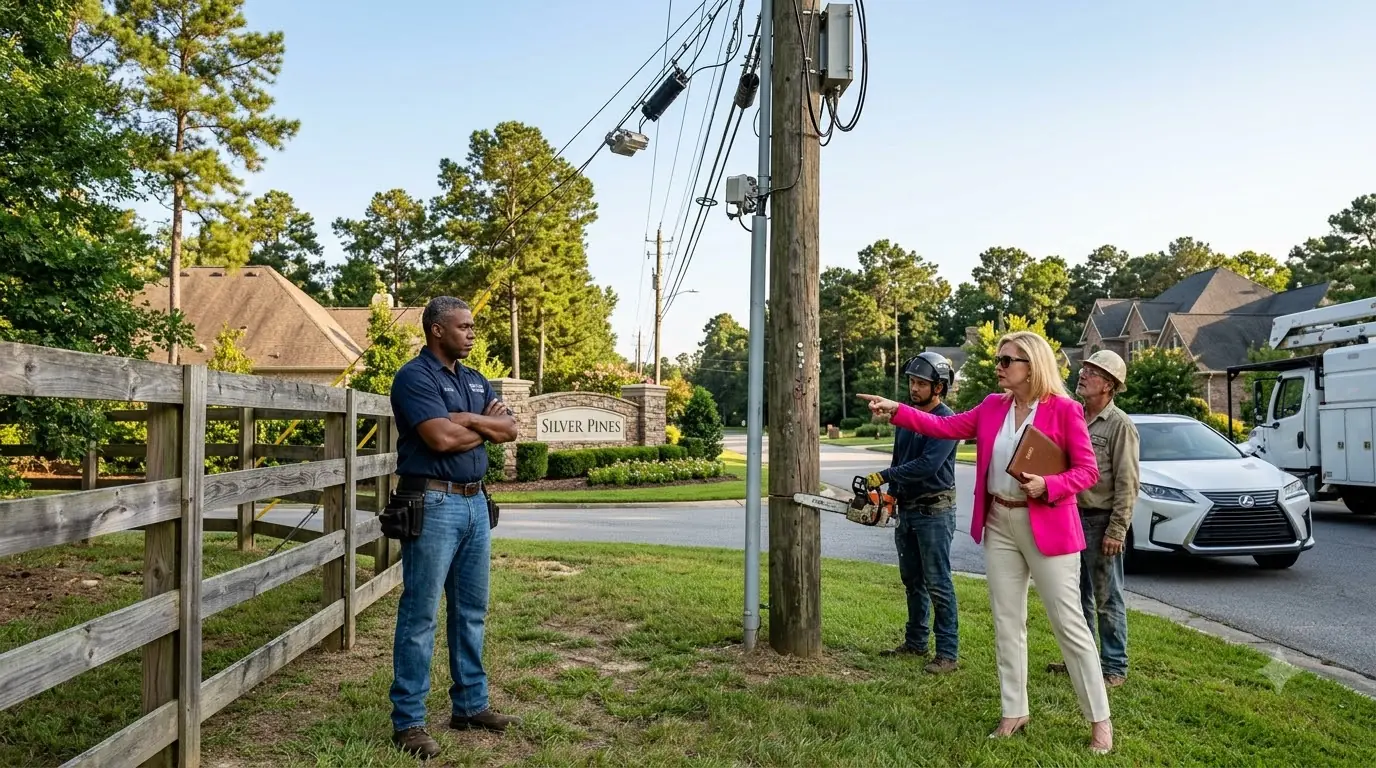
Less than 10 minutes later, the saws went quiet and the whole neighborhood behind the tree line dropped into darkness. 180 homes lost power right before dinner. Vanessa turned toward me, her face gone white as chalk.
All I asked her was, "Did you ever read the easement?" My name is Isaiah Benton. I am 47 years old and I live on 11 acres that my family has held since long before anybody thought to build a gated entrance anywhere near it. The land sits at the front of what is now called Silver Pines, a subdivision of roughly 180 houses laid out in three phases behind a curtain of loblolly pine. My grandfather bought the parcel when the road out front was still gravel and the nearest street light was four miles east.
I grew up on that ground, learned to drive a tractor on it, buried two dogs under the pan tree on it, and I still keep my shop in the same tin building where my father kept his. I spent 19 years as a field supervisor for a regional electric utility before I stepped out on my own and opened a small electrical maintenance company. That last part matters more than anybody in Silver Pines ever bothered to ask about. Along the eastern margin of my property, maybe 14 feet inside my line, stands a wooden distribution pole about 45 feet tall, weathered gray, with a crossarm, three primary conductors, a neutral, and a transformer bank that hums on hot afternoons like a bee trapped in a coffee can. There is a recorded utility corridor running through that strip.
And the conductors overhead carry a feeder that leaves the substation two and a half miles north and works its way south. For most of my adult life, nobody looked twice at it. Delivery drivers used it as a landmark. Kids leaned bicycles against it. The county mowed around the base every other summer and never said a word to me about any of it.
Then Vanessa Holloway became president of the Silver Pines Homeowners Association and the pole stopped being furniture and became an insult. Vanessa came down my driveway on a Tuesday in June in a white sport utility that had never been off pavement in its life. She got out in linen slacks and sunglasses that cost more than my mower, carried a leather folder against her hip, and walked up to me while I was replacing a broken hinge on the shop door. She did not ask if it was a good time. She introduced herself as the president of the association, said she had been trying to reach me, and then said the thing that told me everything I needed to know about how the next several weeks were going to go.
The association wanted a monument entrance at the front road. She said a low wall of stacked stone, brass lettering, ornamental pear trees, uplighting on the sign. Then she said, "And we are going to have that pole relocated." Not, "We would like to," or, "We are looking into whether." She said it the way you announce a decision that has already been made in a room you were never invited into.
I set the screwdriver down on the workbench, wiped my hands on a rag, and told her plainly that a homeowners association does not get to relocate distribution equipment. She tipped her head slightly, and I watched her take inventory of me. The work shirt with my company name stitched over the pocket, the boots, the gray coming in at my temples, the fact that I was standing in a metal building instead of an office. Then she asked with a smile that never reached her eyes, "Are you a land attorney?" I said, "No."
I said, "I would recommend you read the recorded documents before you make plans around that pole." I said it once calmly in a normal voice because I have learned that when somebody has already decided who you are, volume does not change their mind. She told me the association had a landscape architect, a contractor, a budget, and two years of discussion behind it. She told me the pole was, and I am quoting her because I wrote it down that evening, an eyesore attached to a parcel that has not been maintained to community standards. My parcel is not in her community.
It is not in her association. It has never paid a dollar of her dues, and it is not bound by a single line of her covenants. I told her that, too. Vanessa put her sunglasses back on, which I came to understand was her way of ending a conversation, and said she would have her contractor coordinate with me as a courtesy. Then she drove off, and I stood there in the doorway of my shop, thinking about how the word courtesy had just been used to mean permission she did not believe she needed.
Two days later, I came out at first light to check the water trough on the east fence, and there was orange paint on the ground around the base of the pole. Four short marks in a rough square, and a longer arrow pointed west toward the subdivision. Nobody had called me. Nobody had knocked. Somebody had walked 14 feet onto my land in the dark and marked out a footprint around a live piece of the electric distribution system.
I photographed the marks from six angles that morning with the fence line in frame so the property boundary was obvious and I saved the files with the date. Then I sat down at the kitchen table with a cup of coffee going cold beside me and wrote the first of what became three written warnings. I kept it short and unemotional. I stated that the parcel was privately held, that the pole and overhead conductors sat within a recorded utility corridor, that neither the association nor its contractors had authorization to enter or perform work, and that any question about the equipment needed to go to the electric utility directly. I sent it to Vanessa and copied the association's general mailbox so it would land in more than one inbox.
Her reply came in under an hour and it was three sentences long. She thanked me for my input. She said the association was working with licensed professionals. She said she trusted I would not stand in the way of an improvement that benefited 180 families. 4 days after that, a letter arrived on association stationery addressed to me at my own mailbox requesting that I cooperate with the community revitalization plan.
The letter was a small masterpiece of implication. It referenced architectural review. It referenced setback consistency. It referenced the board's authority to approve improvements within the community. And then in the very next line, it described the front entrance improvements as including removal of obsolete overhead structures at the northeast approach.