I bought the ranch because I wanted two things I had spent most of my adult life without.
Privacy and peace.
After nearly seventeen years of federal service, those two things had become more valuable to me than almost anything money could buy.
My name is Ethan Cole. I was forty-three years old when I bought the property, a little over one hundred and sixty acres of pasture, oak-covered hills, dry creek beds, and old fencing on the edge of a fast-growing county in Colorado.
The ranch wasn't glamorous.
The house was a weathered two-story place built in the late 1970s. The barn needed a new roof. Several sections of fence leaned badly enough that a determined cow could probably escape with minimal effort.
But the land itself was beautiful.
There were miles of open pasture.
Massive oak trees stood along the western ridge.
A narrow creek crossed the southern end of the property after heavy rain.
From my back porch, I could see the mountains in the distance on clear mornings.
Most importantly, the nearest neighboring house was far enough away that I couldn't hear anyone's television, leaf blower, argument, or garage door.
After years of apartments, temporary assignments, hotel rooms, and government offices, silence felt almost luxurious.
I had spent most of my career learning to notice things other people missed.
Cars that appeared twice.
Doors that should have been locked.
A person who answered a question too quickly.
A window that had changed position between photographs.
The job had trained me to live with a certain level of vigilance.
The ranch was supposed to be the one place where I could turn some of that off.
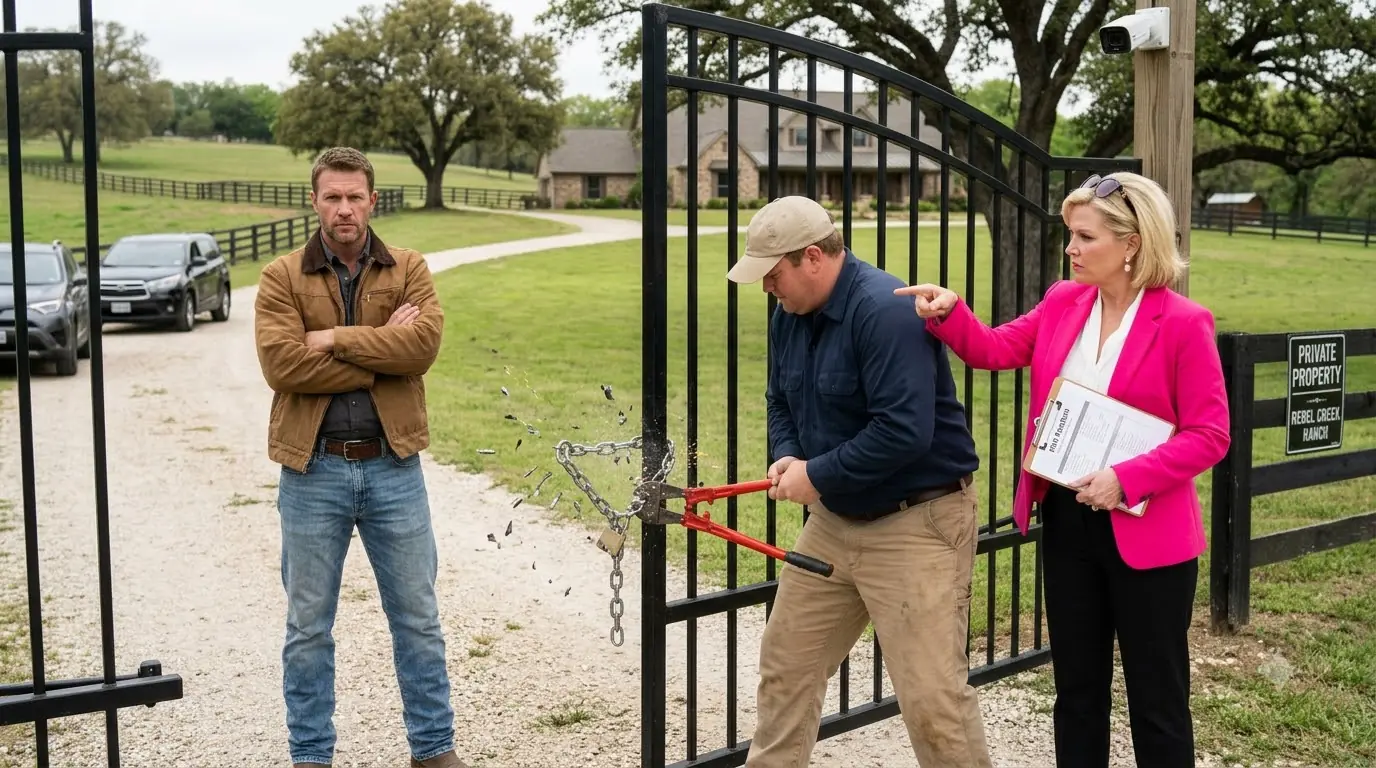
At the entrance stood a heavy steel gate between two stone columns.
A gravel driveway ran almost half a mile from that gate to the house.
The previous owner had used a simple latch.
I replaced it during my first weekend.
I installed a thick galvanized chain and a hardened steel padlock rated for outdoor commercial use.
Then I mounted two security cameras.
One faced the driveway.
The other faced the public road.
A third camera farther inside captured the gate from the ranch side.
Some people might have considered that excessive.
I considered it habit.
The lock wasn't there to intimidate anyone.
It wasn't a political statement.
It wasn't a message to the neighborhood.
It was simple.
This was private property.
Nobody entered unless I allowed it.
For the first four months, that arrangement worked perfectly.
Then the HOA letter arrived.
Technically, my ranch sat beside a planned residential community called Stone Creek Estates.
When the development was constructed years earlier, the developer had purchased hundreds of acres surrounding several older agricultural parcels.
My ranch was one of those parcels.
It predated the subdivision.
That detail was important.
Before closing on the property, I had paid for an independent title examination and a boundary survey.
I had also read every recorded covenant, easement, restriction, access agreement, and property description connected to the land.
Occupational habit.
I don't sign documents I haven't read.
The ranch was not part of Stone Creek Estates.
There was an old utility easement crossing twenty feet of the eastern edge.
There was a county drainage right along one section of the creek.
There was no HOA inspection easement.
No community access right.
No shared road agreement through my gate.
Nothing.
So when I opened my mailbox one Monday afternoon and found an envelope stamped STONE CREEK ESTATES HOMEOWNERS ASSOCIATION, I assumed it was advertising or a mistake.
It wasn't.
The letter was addressed to:
PROPERTY OWNER, 6847 RIDGEWAY RANCH ROAD.
The language was formal enough to sound official without actually saying much.
The association had “identified potential exterior compliance concerns” regarding my fencing, accessory structures, and visible land conditions.
It intended to conduct a “community standards inspection” of my property the following Thursday between 9:00 a.m. and noon.
I read that paragraph twice.
Then I laughed.
Not because it was funny.
Because there was something almost impressive about the confidence.
They had not asked.
They had notified me.
As if an HOA representative could simply schedule a visit to a private ranch that wasn't part of the HOA.
I took the letter inside.
Pulled out the title binder from my office.
Read everything again.
I checked the county property map.
The recorded plat.
The warranty deed.
The title exceptions.
The survey.
Nothing had changed.
At 4:18 p.m., I called the number printed at the bottom of the letter.
A woman answered.
“Stone Creek Estates Association office.”
“My name is Ethan Cole. I received an inspection notice for 6847 Ridgeway Ranch Road.”
There was typing.
“Yes, Mr. Cole. Thursday morning.”
“No.”
A pause.
“Excuse me?”
“You don't have authorization to inspect my property.”
Another pause.
Longer this time.
“Sir, the association has inspection authority over properties affecting community standards.”
“My ranch isn't in your association.”
“It borders the community.”
“That isn't the same thing.”
“The board has determined that certain visible conditions may impact adjacent homeowners.”
“What conditions?”
“Fencing, vegetation, outbuildings.”
I looked through the kitchen window toward a barn that had been standing there longer than Stone Creek Estates existed.
“What section of your governing documents gives you physical access to my land?”
The woman hesitated.
“I would have to review that.”
“Please do.”
“We can have the board president contact you.”
“Good.”
“Her name is Rebecca Dalton.”
I wrote the name down.
“Tell Ms. Dalton she does not have permission to enter my property.”
The woman became quieter.
“I'll make a note.”
“Make it clear.”
I ended the call.
I thought that would be enough.
I was wrong.
Rebecca Dalton arrived the next morning.
At 8:36, my phone vibrated while I was making coffee.
GATE CAMERA: MOTION DETECTED.
I opened the security application.
A white Lexus SUV had stopped outside the ranch entrance.
A woman stepped out.
Late forties.
Blonde hair arranged perfectly despite the wind.
Cream trousers.
Bright red blazer.
Oversized sunglasses.
She carried a leather folder under one arm and a clipboard in the other hand.
Even before she looked toward the camera, I knew who she was.
Rebecca Dalton did not knock on the gate.
She simply stood there, examined the lock, then pressed the intercom button.
I answered from the kitchen.
“Yes?”
“Mr. Cole?”
“Yes.”
“This is Rebecca Dalton, president of Stone Creek Estates Homeowners Association.”
“I assumed.”
Her mouth tightened slightly.
“I received your message yesterday.”
“Good.”
“I thought it would be more productive if we discussed this directly.”
“Fine.”
She looked toward the house even though it was barely visible from the road.
“Our architectural and compliance committee needs access to document several concerns.”
“No.”
Rebecca took off her sunglasses.
Maybe she expected seeing her eyes would make the sentence more persuasive.
It didn't.
“Mr. Cole, this is a routine inspection.”
“Not of my property.”
“The ranch directly borders Stone Creek.”
“Yes.”
“Your fencing is visible from two community streets.”
“So are the mountains.”
Her expression hardened.
“This doesn't need to become confrontational.”
“It isn't.”
I took a drink of coffee.
“You asked for access. I declined.”
“I didn't ask.”
That sentence told me everything I needed to know about Rebecca Dalton.
I went outside.
Not because I needed to.
Because conversations sometimes became clearer face-to-face.
I walked down the driveway and stopped on my side of the gate.
Rebecca watched me approach.
She looked at my jeans, work boots, gray shirt, and old canvas jacket.
I could almost see her making assumptions.
That was fine.
My job had benefited from other people's assumptions for nearly two decades.
“Mr. Cole.”
“Ms. Dalton.”
She opened her leather folder.
“I have a scheduled inspection order from the board.”
She held up a sheet.
I didn't reach for it.
“An HOA board order isn't a warrant.”
“It authorizes our committee.”
“On property governed by your HOA.”
Rebecca’s jaw tightened.
“As I explained yesterday, surrounding properties can be subject to community-impact provisions.”
“Show me.”
“I have the documents.”
“Show me the recorded provision giving your association entry rights onto this parcel.”
She looked down at the folder.
Flipped two pages.
Then another.
“The community declaration establishes broad enforcement powers.”
“Page?”
She stopped.
“I'm not going to stand here debating technical language.”
“Then you're not coming through the gate.”