Daniel Brooks was gone for exactly four days, attending a civil engineering conference two states away.
When he pulled his truck back into his own neighborhood on a warm spring afternoon, the first thing he noticed was silence where there should have been the familiar hum of his own driveway under his tires.
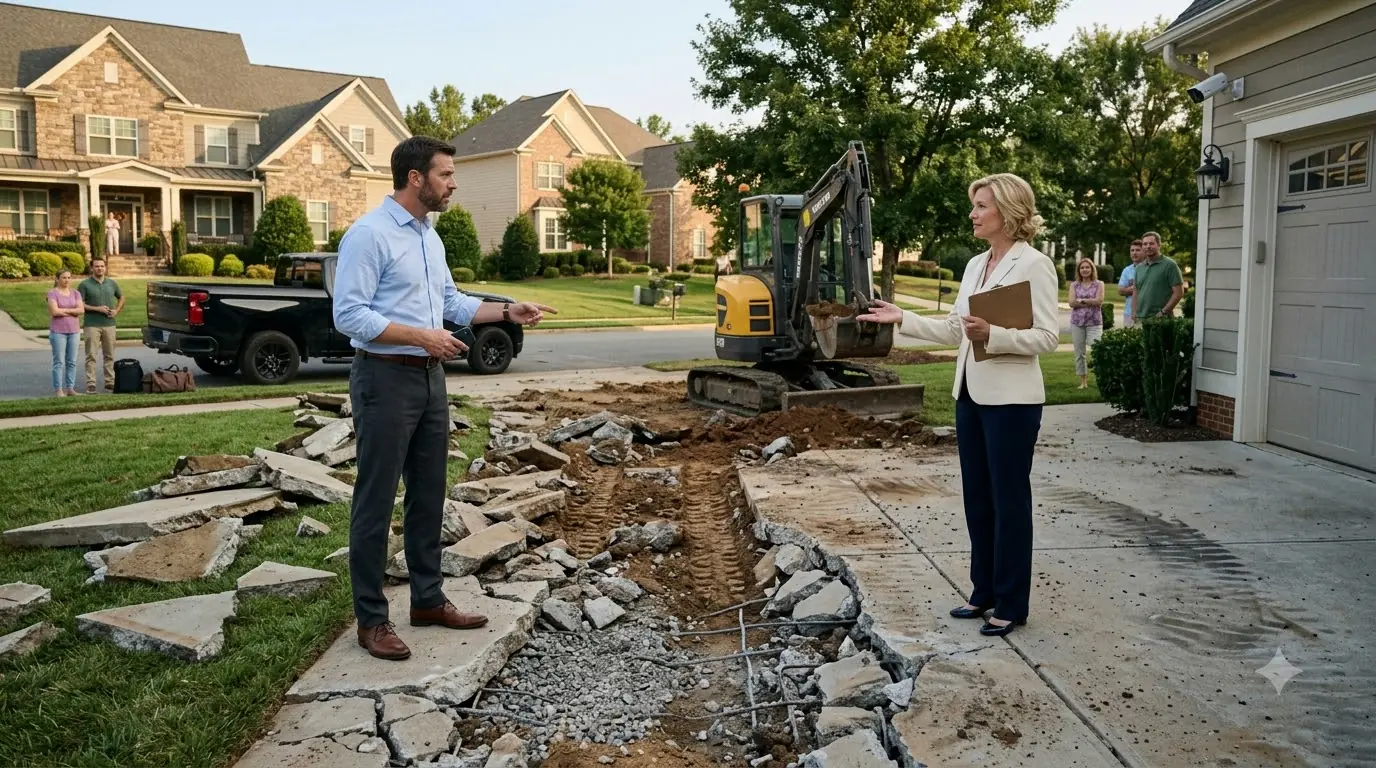
What he found instead made his stomach drop.
The concrete driveway he had poured only weeks earlier, a driveway that had cost him nearly $40,000 and represented months of careful planning, had been ripped apart.
Jagged slabs lay scattered like broken teeth across his front yard, a yellow excavator sat idle nearby with mud still wet beneath its treads, and staked directly into the wreckage, almost mockingly upright, stood a small metal sign bearing the seal of the homeowners association and three words that would ignite a battle none of them saw coming: "Violation corrected."
What Karen Whitmore did not know, as she watched from her porch with quiet satisfaction that same morning, was that Daniel had installed a cloud security camera above his garage door only two months before. It was a small precaution he had taken after noticing suspicious activity in the neighborhood.
She did not know that every second of the demolition had been recorded, timestamped, and safely stored somewhere she could never reach. And she certainly did not know that the very next morning, a county inspector named Mark Ellis would be standing on her doorstep asking a single question that would silence the entire cul-de-sac: "Where was your permit to excavate a residential driveway?"
The neighborhood itself, spread across gently rolling terrain on the edge of a growing suburban corridor, had been built roughly fifteen years earlier by a developer who marketed it as an exclusive enclave for professionals seeking quiet, orderly living away from the noise of the city center.
Homes ranged from modest three-bedroom properties to sprawling estates with private pools, and the homeowners association had originally been formed with reasonable intentions, tasked with maintaining shared landscaping, enforcing basic architectural consistency, and organizing the occasional community barbecue.
For the first several years of its existence, the association functioned exactly as intended, a mild administrative presence that residents barely noticed beyond a modest monthly fee and the occasional newsletter.
It was only after Karen Whitmore assumed the presidency that the character of the organization began to shift, slowly at first, then with increasing speed until what had once been a background convenience became, for many residents, a source of quiet dread.
For nearly a decade, Daniel Brooks had lived quietly on Cedar Hollow Lane, a peaceful street lined with oak trees and manicured lawns in one of the more prestigious subdivisions on the outskirts of the city.
He was 42 years old, a civil engineer by trade, the kind of man who read contracts twice before signing them and who believed, with the stubborn optimism of someone who had never truly been wronged by a system, that rules existed for good reason.
He kept mostly to himself, waved at neighbors, mowed his lawn on schedule, and paid his homeowners association dues without complaint. When the concrete on his old driveway began to crack and shift due to unstable soil beneath it, Daniel did what any responsible homeowner would do.
He hired a licensed contractor, drew up proper drainage plans using his own professional expertise, and submitted every required document to the county planning office. He waited three weeks for approval and passed two separate inspections.
The final concrete pour was flawless, reinforced, and fully compliant with every building code that applied to his lot. County inspectors signed off without hesitation. On paper and in practice, Daniel Brooks had done everything exactly right.
The trouble was that doing everything right with the county meant nothing to Karen Whitmore, and it never had. Karen was 55 years old, sharp-featured, immaculately dressed even for a simple walk to the mailbox, and she had served as president of the Cedar Hollow Homeowners Association for six consecutive years, a reign that had grown steadily more authoritarian with each passing season.