I came home on a Friday and found my son's treehouse turned into a pile of splintered lumber. Nailed to the fence was a notice signed by Lenora Voss, president of the Homeowners Association, declaring that the structure had lowered property values and had been removed under emergency authority. She looked at me like I was just another powerless man who needed to be put in his place and told me I should learn where I stood in this neighborhood. But when I traced the name of the contractor she had hired, it led me to a map. And that map pointed straight at the clubhouse the association had built without the county ever approving it. I want you to imagine that moment because it changes everything that follows.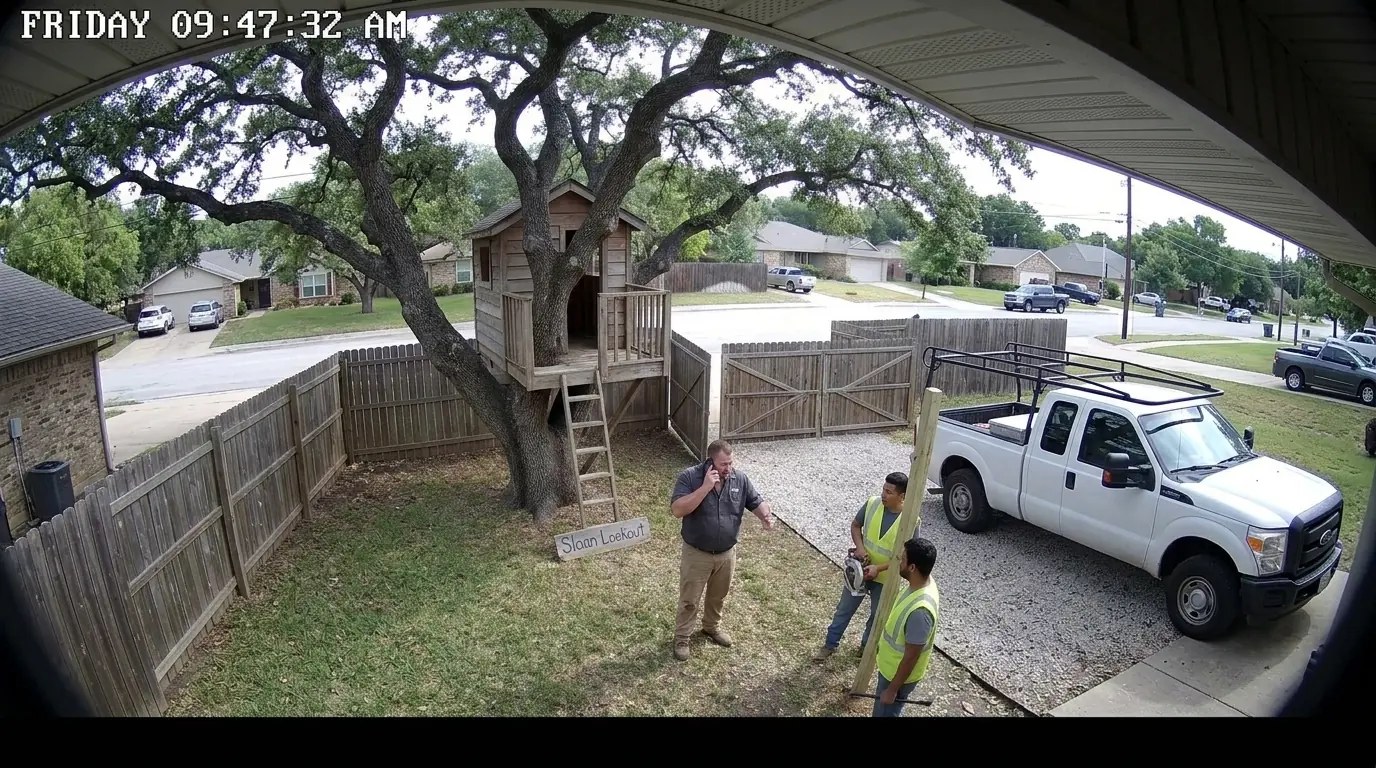
I had spent the afternoon inspecting a commercial job site an hour outside of town, the kind of work I had done for almost 15 years, checking foundations and reading blueprints for a living. When I pulled into my own driveway, the side gate to the backyard was standing wide open, which was strange because I always kept it latched. I remember the sound my boots made on the gravel path, slower than usual, as though some part of me already understood what I was walking toward before my eyes confirmed it. The cedar treehouse that my son Milo and I had built over three long months was gone, reduced to cut boards scattered beneath the old oak like the aftermath of a storm.
It was not simply taken apart. The support beams had been sawed through. The platform boards split into pieces too short to ever be reassembled. And the little hand-painted sign that read "Sloan Lookout" lay face down in the dirt. Zip-tied to the fence post was a laminated notice bearing the seal of our homeowners association, stating that the unauthorized structure had been removed under what it called emergency protection of property value. There was no court order attached to that notice. There was no signature from a county inspector, no record of a hearing, nothing that resembled due process. I photographed the scene carefully: the tire ruts pressed into the grass near the back gate, the faint outline of a truck's tread leading out toward the street, and the torn edges of wood that showed someone had used a power saw rather than simple hand tools.
My neighbor Ellis Warren came around the fence line while I was still crouched over the debris, and he told me his security camera had caught a truck belonging to a company called Harrove Property Services pulling in through the gate that morning. I did not watch the footage right away because Milo was due home from his weekend with his grandmother within the hour, and I wanted to be the one who told him, not the wreckage itself. When he saw the pile of wood, he did not shout or cry the way I half expected. He knelt down, picked up the broken lookout sign, turned it over in his hands, and asked me quietly if we had done something wrong. I told him no, that he had done nothing wrong at all. And I sent him to stay with his aunt for the rest of the weekend so I could handle what needed to be handled without him watching me lose my composure.
Once I was alone, I called Lenora directly. She did not deny giving the order. She told me the treehouse was crude, overly masculine, and inconsistent with the image the community was trying to project to prospective buyers. When I asked which provision of the governing documents authorized her to enter private property and destroy a structure without notice, she laughed softly and said that men like me tended to believe that owning a toolbox was the same thing as understanding regulations. She assured me the association had acted entirely within its rights and suggested I not turn a minor inconvenience into something larger than it needed to be. I told her I had no intention of making it larger than it already was. I only intended to find out exactly how large it already was.
After I hung up, I sat on the back steps and read through the notice one more time under the porch light, and that was when I noticed the section number she had cited did not belong to any clause about accessory structures at all. It belonged to an entirely different section, one governing the removal of dead trees posing a hazard to neighboring properties. And nothing about that description matched a treehouse built from healthy cedar 6 months earlier.
Six months before that Friday, Milo had asked if we could build a small place where he could read outside without his little sister interrupting him every 10 minutes. I designed something modest: a platform of about 64 square ft, no electricity, no plumbing, nothing that would draw the attention of a building inspector under normal circumstances. The floor sat below the height threshold set by county code, and every board of it rested well within the boundary lines of our own lot, nowhere near a drainage easement or a shared utility corridor. Before we drove the first nail, I did what 15 years in construction had trained me to do. I pulled the plat map for our lot, confirmed the setback distances, and sent a sketch of the design to the architectural review committee for the association the way the covenants required for any visible structure. Within a week, I received an email back from the committee chair at the time, a woman who was not Lenora, confirming that because the structure fell under the minimum square footage threshold, no separate permit was required, and the design was approved as submitted. I kept that email in a folder on my computer and never imagined I would need it again.
Lenora had not paid much attention to me until I stood up at a budget meeting and questioned a proposal to renovate the clubhouse using money from the reserve fund. She wanted marble countertops, a new bar, and furniture that seemed excessive for a building most residents used a handful of times a year. I asked whether the clubhouse generated any income and why residents had never been shown the vendor contracts behind its maintenance costs. She told the room that financial questions were probably too complicated for someone who spent his days working with blueprints rather than budgets, and several people laughed along with her.
After that meeting, the small citations started arriving in my mailbox with unusual regularity. My truck was parked a few inches over an invisible line one week. My trash bin was brought in an hour later than some unwritten standard the next. My fence was cited for uneven staining, and my lawn was flagged as overgrown using a photograph that on closer inspection had clearly been taken outside a different house entirely. Neighbors who were wealthier or friendlier with Lenora seemed to commit identical infractions without ever receiving so much as a warning letter.
In meetings with the other board members, Lenora liked to say that single men in the neighborhood needed closer supervision than families did, as though bachelorhood itself were a kind of ongoing violation. She suggested more than once that I had built the treehouse to prove something to myself rather than to give my son a place to read. And in one exchange, she told me directly that a grown man should not need to construct a fortress in his backyard just to feel like he still controlled something in his life. I let most of these comments pass without response because I did not want to give her the reaction she seemed to be fishing for. Destroying the treehouse, though, told me she had stopped settling for small citations and had moved into something far more deliberate.