The first thing I noticed that morning was the water. My pond was moving—not from wind, not from rain. Fish, thousands of them. They were packed so tightly beneath the surface that the entire pond looked like it was boiling.
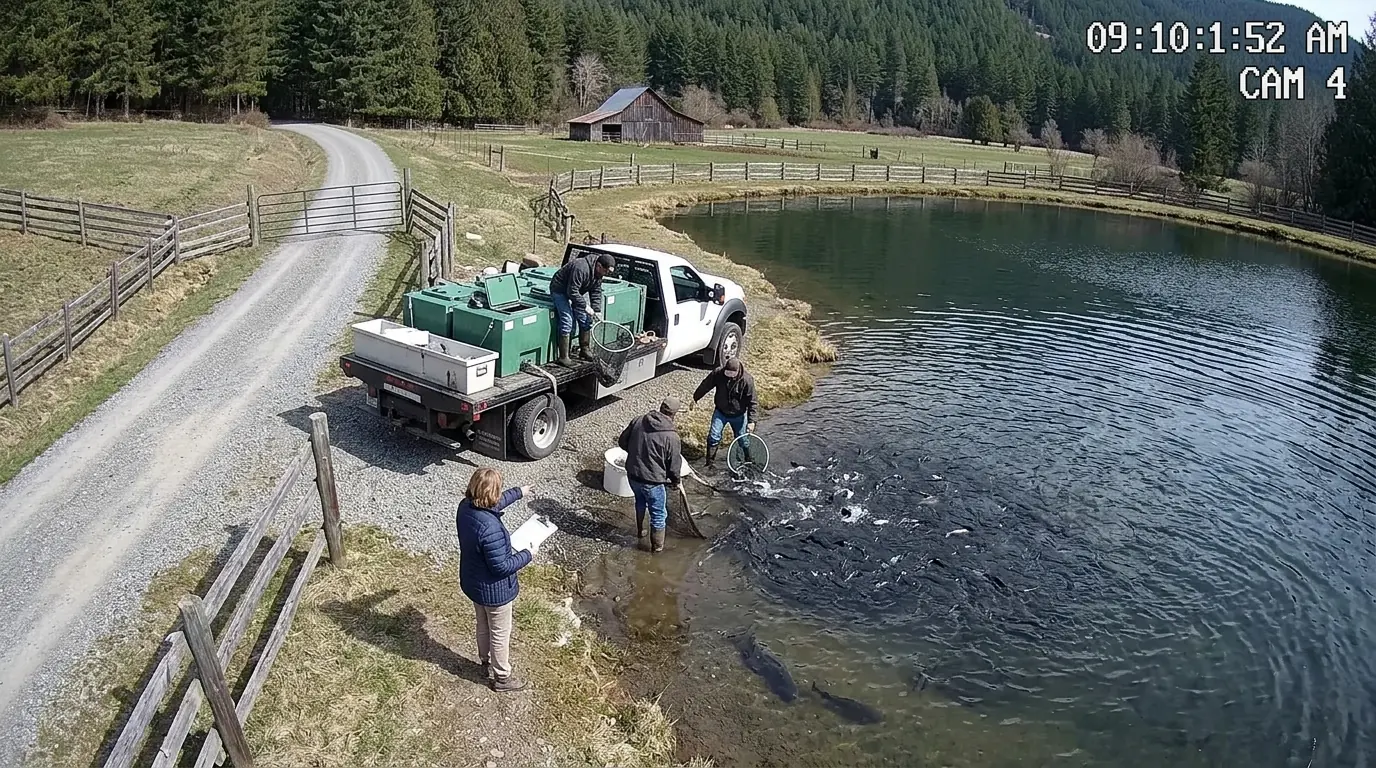
I stood on the bank staring at them when Karen Whitmore, the president of our HOA, stepped out of an SUV behind me. She smiled.
"Problem solved," she said.
I turned around. "What problem?"
"The fish," she replied. "Silver Ridge needed somewhere to put them."
Then she handed me a bill for $4,800 for emergency pond management.
I almost laughed. Then I noticed the tags on some of the fish. They weren't ordinary fish. And three weeks later, those same fish would become the beginning of a business worth hundreds of thousands of dollars. Karen had dumped a fortune into my pond. She just didn't know it yet.
My name is Robert Hayes. I'm 68 years old, and I'd owned my mountain property for more than twenty years. It sat at the edge of Silver Ridge Estates, separated from the neighborhood by an old wooden fence and a narrow strip of forest. The property was about 180 acres. There was my house, a barn, several fields, and a pond I'd spent years maintaining.
The pond wasn't enormous—maybe seven acres when the water level was high—but it was deep, clean, spring-fed, and full of wildlife. I'd stocked it with bass and trout years earlier, mostly for fishing. Occasionally, I'd invite neighbors over, but it was private. There was a locked gate at the access road, and the only people who had permission to enter were me, my family, and the county contractors who occasionally inspected the drainage system.
Silver Ridge Estates had grown around my property over the years. When I bought my land, there were barely a dozen houses nearby. Now there were more than two hundred. And Karen had somehow convinced herself that everything around those houses belonged to the HOA: my pond, my access road, my trees, sometimes apparently even my fish.
But this time, something was different. Much different. Because I hadn't put those thousands of fish into the pond. Someone else had, and Karen had just admitted it.
I opened the folder again. The first page was an invoice from a company called Mountain Aquatic Services: "Fish relocation and emergency habitat transfer."
I looked at the date: three days earlier. I looked at Karen. "You hired a company to put these fish here?"
"We had an environmental issue at the community retention ponds, and—"
"Instead of getting permission from me?"
Karen interrupted, "Your pond was the closest suitable water source."
"You didn't ask."
"You weren't available."
"I live here."
Karen's jaw tightened. Then she lowered her voice. "Robert, don't make this difficult."
That was when I knew this wasn't about fish. Karen wasn't the kind of person who made a $4,800 decision because she wanted to help the neighborhood. There had to be something behind it. So, I asked the obvious question: "What exactly are these fish?"
Karen hesitated—only for a second, but I noticed. "Fish," she said.
"That's not an answer. Are they community-stocked fish species?"
She looked irritated. "I don't have time for this." Then she walked back toward her SUV. Before getting inside, she turned around. "You have seven days to pay the management bill."
"And if I don't?"
Her expression hardened. "Then the HOA will take further action."
She drove away. I watched the SUV disappear down the road. Then I looked at the pond. Thousands of fish moved beneath the surface. And for the first time, I wondered why Karen had been so desperate to get them out of Silver Ridge.