Imagine getting a fine for $3,400. Not for something you built on HOA property, not for breaking a single rule, but for a building that the HOA legally had zero power over. And the worst part was that they knew. They knew the whole time.
This is the story of how one man turned a $3,400 extortion attempt into the biggest mistake an HOA board ever made. Marcus Del Rey had owned his property on Sycamore Ridge for eleven years. Eleven years of mowing the lawn on schedule, paying dues on time, and keeping his nose clean. He was not the type to cause problems. He was the type who fixed them quietly and moved on.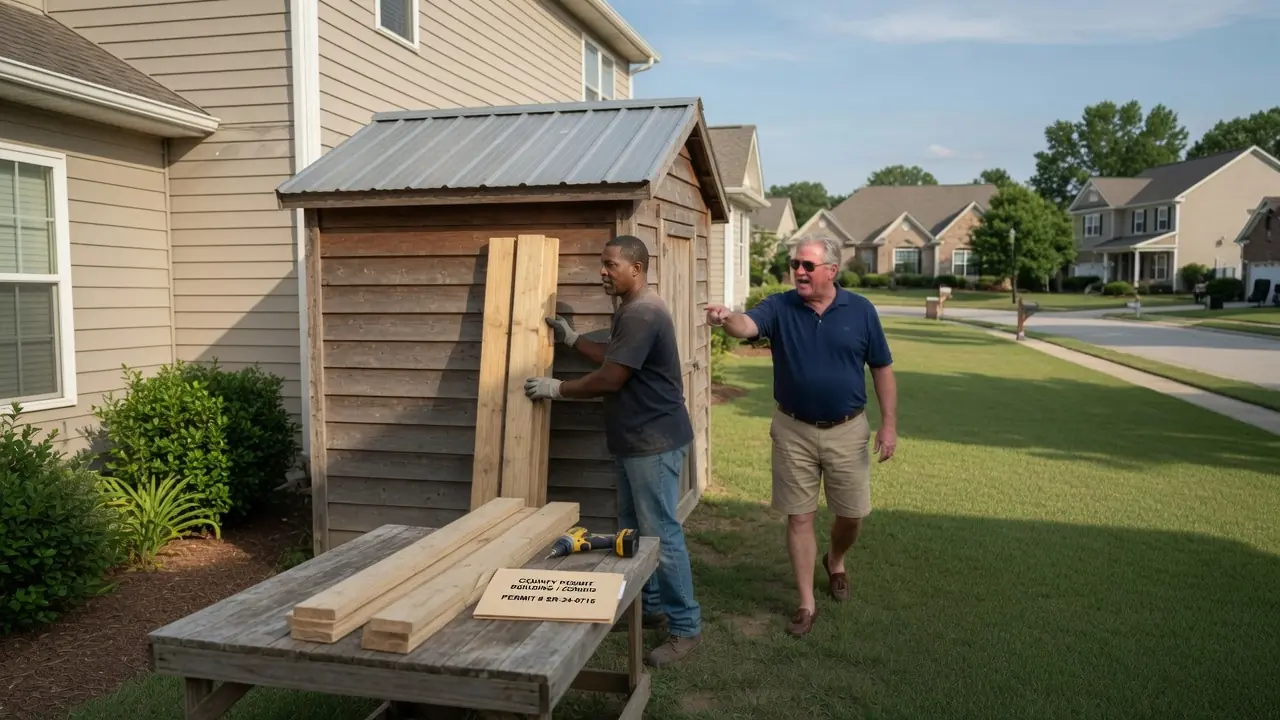
Three years ago, Marcus decided to build a small workshop shed in the back corner of his property. Nothing fancy, about 200 square feet, wood-frame, with a tin roof. He got the county permit, passed inspection, and built the thing over a single weekend with his brother-in-law, Dante. It sat in the far rear corner of his lot, partially hidden by a row of overgrown cedar trees.
Life went on. Nobody said a word. Not a letter, not a knock on the door, not even a sideways glance from a neighbor until the envelope arrived. It was a Tuesday morning when Marcus found it wedged between his screen door and the front frame.
The fine was $3,400, due within 30 days, or they would place a lien on his property. Marcus almost laughed. Almost. He went inside, poured a coffee, and pulled out his original permit paperwork.
The shed had passed county inspection. He had never received a single warning or request for architectural review. And more importantly, he was almost certain he had never submitted anything to the HOA about it because he never thought he needed to. But then again, did he?
He called his neighbor Priya, who had lived on Sycamore Ridge for twenty years and knew the HOA rule book like a second Bible. She told him to check his original property deed and the HOA covenant boundaries before he did anything else. “Marcus,” she said, “not every inch of your lot is automatically inside their jurisdiction. Go check.”
He almost brushed it off. He nearly just wrote the check to make it go away. Thank God he did not, because what Marcus found in those documents changed everything. He dug out his original property deed, the survey map attached to it, and a copy of the HOA covenant boundary map he had received when he first moved in.
He spread them all across his kitchen table and started comparing. That back corner, the exact corner where his shed sat, was on a narrow strip of land that fell outside the recorded HOA boundary. The HOA covenant covered most of his lot, yes, but that rear strip, roughly 40 feet wide along the back fence line, was not included in the covenant boundary. It was on his property, but it was not in their jurisdiction.
Marcus stared at that map for a long time. His shed was built on land the HOA had absolutely no legal authority over. He called Priya back. She came over, looked at the maps herself, and confirmed what he was seeing.
Then she said something that made his stomach drop. “Marcus, you know who handled the last boundary survey update? Raymond Holt, the HOA president.” Raymond Holt had been president of the Sycamore Ridge HOA for six years. He was the kind of man who wore golf shirts to neighborhood meetings and spoke at volume levels slightly too loud for any indoor space.
He had been the one who signed Marcus’s fine letter. Marcus went back to the county records office the next morning and requested everything: the original plat, the HOA covenant filing, and any survey amendments on record. What he found was a document that made his hands go cold. Three years ago, the same year Marcus built his shed, Raymond Holt had requested an updated boundary clarification from the county as part of an HOA filing.
The county’s response, documented and stamped, clearly outlined which parcels and strips within the development fell outside HOA covenant jurisdiction. Marcus’s rear strip was specifically listed. Raymond Holt had received and signed that letter. He knew.
He had known for three years that the shed sat on land he had no authority over, and he fined Marcus anyway. This was not a mistake. This was calculated. Marcus retained an attorney, a property law specialist named Claudette Vance, and within a week, she sent a formal response to the HOA board.
The letter outlined the boundary discrepancy, referenced the county documentation, included the signed Raymond Holt correspondence, and demanded the fine be withdrawn immediately. It also noted that pursuing a lien on property outside HOA jurisdiction could constitute unlawful collection practices. The board went quiet for two weeks. Nothing.
Then they came back with a response that managed to be both arrogant and desperate at the same time. They claimed the boundary question was subject to interpretation and that they intended to pursue the matter at a formal hearing. Fine. Marcus would be there.
The hearing was held on a Thursday evening in the community center on Birwood Lane. Marcus arrived with a rolled survey map, a folder of county documents, Claudette Vance at his side, and Priya in the second row for moral support. Raymond Holt sat at the board table like he owned the room. Three other board members flanked him, looking considerably less confident.
Claudette did not raise her voice once. She laid the maps on the table. She placed the county boundary letter, Raymond’s signature clearly visible, directly in front of the board. She explained calmly and precisely that the shed sat on land outside their covenant, that the board’s own president had received confirmation of this boundary three years prior, and that proceeding with this fine would expose each board member personally to legal liability.
The room was dead silent. One of the board members, a woman named Teresa who had joined the board only six months ago, leaned over and looked at the signature on the county letter. Then she looked at Raymond. “Raymond,” she said quietly, “did you know about this?”
He did not answer. The vote to withdraw the fine was four to one. Raymond cast the only vote against it. Two weeks later, Raymond Holt resigned from the HOA board.
The official statement cited personal reasons. Everyone on Sycamore Ridge knew exactly what those reasons were. Marcus received a written apology from the board. The fine was formally dismissed.
The lien was never filed. And that little wood-frame, tin-roof shed still stands in the back corner of his lot on land the HOA never had the right to touch. Here is the part that still gets me. Marcus almost paid.
He was this close to just writing a check and moving on the way most people do because fighting back feels exhausting. And most HOA boards count on exactly that. They count on you not reading the fine print. They count on you not pulling the survey maps.
They count on you being too tired to fight. But sometimes the fine print is the entire case. Know your deed. Know your boundaries. And never assume the people fining you actually have the authority to do it.