They find him $400 for keeping a fishing boat beside his own backyard.
They called it unauthorized use of HOA waters.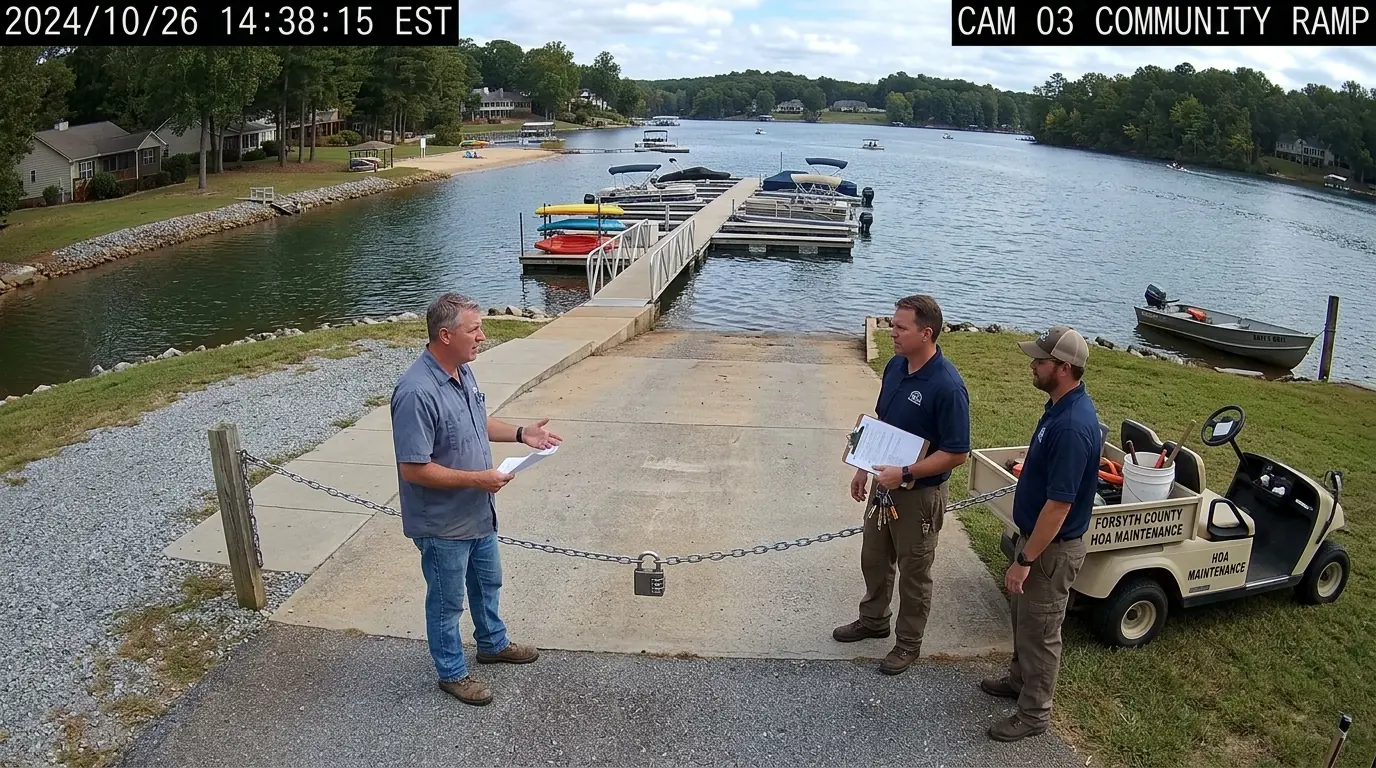
What the board never bothered to read was the paperwork in their own filing cabinet. The paperwork showing that their lake only existed because of a small earthen dam on his land.
And nobody asked the obvious question, what happens to a man-made lake when the man keeping it full stops paying for the privilege?
HOA fine me for my boat? Then their lake started disappearing.
I've lived on that lake for 19 years. When my wife and I bought the place, Forsyth County still had more pasture than subdivisions. Our community was 11 houses on a paved loop around a shallow spring-fed pond.
We bought a fixer-upper because the back lot sloped to the water and my wife wanted to drink coffee where she could watch herons.
Then Atlanta money moved north. The neighborhood grew to 140 homes. We got a stone entrance, a gate, an HOA landscaping contract, and an $81,000 floating dock with underwater LED lights because apparently fish need mood lighting.
I kept a 14-ft aluminum fishing boat, not a bass boat, not a pontoon with a wet bar, a dented Alumacraft with a 20-horse outboard tied to a cedar post on my private shoreline where it had sat for nearly two decades.
The first letter came on a Tuesday in March. Notice of violation, unapproved watercraft storage, fine $150.
Additional violation, unauthorized use of HOA waters, fine $250.
I read it twice, then walked it to my neighbor's house. He's a retired air traffic controller who wears cargo shorts in every weather condition Georgia can produce, so the whole street calls him cargo shorts, including his wife.
He looked over his glasses and laughed.
400 bucks for that little tin can?
Apparently, it's a community appearance issue.
It's a boat on a lake.
He handed the letter back. Talk to the president. He's reasonable, but for his second coffee.
That turned out to be wrong.
The HOA president was in his mid-50s, worked in commercial real estate, and tilted his head when you spoke as though he were patiently waiting for you to finish being incorrect.
"The boat has to go," he said in my driveway holding a clipboard. "Watercraft storage is limited to the community dock by permit."
"It's on my property. The water isn't yours."
"I didn't say it was."
He gave me a thin smile. "Look, I understand you've been here a long time, but this isn't the old neighborhood anymore. Homes are selling for over a million dollars. We can't have the lake looking like a fish camp."
I asked whether he had read the recorded plat. He said the association's files were extensive and that he had reviewed them thoroughly.
That was the whole problem. He said it with complete confidence, and it was a lie he didn't know he was telling.
The fines kept coming. Every 30 days, another $150 plus administrative processing. When I challenged them in writing, the board voted unanimously to uphold them in a meeting I wasn't told about until afterward.
Then they revoked my community ramp permit. They chained the ramp and gave the combination to everyone except me.
In the newsletter, the president wrote about residents who treat shared amenities as personal property, which was subtle in the same way a car alarm is subtle.
At the mailboxes, a woman with an enormous permanent, my wife and I called her Curly, stopped me.
"I heard you've been running a fishing business on the lake."
"I catch bream and put them back."
"That isn't what the board said."
The smoker three houses down was the only person who defended me publicly. He stood at the end of his driveway every evening with a cigarette and a beer like he was guarding a checkpoint.
"They fined me $100 because my trash can was visible from the street," he said.
"Visible from the street. It's a trash can. Where's it supposed to be? Orbit?"
By July, I owed $1,100 in fines and it started losing sleep. So, I did what I should have done in March. I pulled every document I owned.
Never pick a fight with the quiet man who kept 19 years of paperwork in a fireproof box.
The original deed, the 1997 plat, the refinance survey, the closing packet still wrapped in the title company's brittle rubber band.
And there it was. My parcel included a narrow, flag-shaped strip running along the southeast side of the lake. I'd always thought of it as the weedy section nobody wanted.
That strip contained the dam. The lake wasn't natural. In 1979, a developer had dammed a spring-fed creek to create a shallow farm pond. The earthen dam was about 90 ft long and 18 ft tall. The concrete riser, valve assembly, and outlet pipe beneath it all sat entirely inside my property lines. Not common area, not shared property, not covered by any easement requiring me to maintain a fixed recreational water level.
The HOA owned the dock, swim beach, pavilion, shoreline path, kayak rack, and most of the developed common shoreline. It did not own my shoreline, the dam parcel, or the plug in the bathtub.
I sat on the basement floor for a while, then I remembered something else. For 19 years, I'd maintained that dam myself.
Every fall, I cleared leaves and beaver sticks from the trash rack. After one storm, I paid a contractor to repair erosion on the downstream slope. I replaced a corroded valve coupling, mowed the grass, and kept woody growth away from the embankment.
I never sent the HOA an invoice. The dam was on my land, so I treated it like a fence or a drainage ditch. Apparently, three different boards had never wondered who was doing the work.
I hired a licensed engineer from Gainesville who specialized in small dams. He spent 2 days inspecting the embankment, outlet structure, and pipe.
His report was 22 pages. Summary was simple. The embankment was structurally sound, no dangerous seepage, no sinkholes, no signs of internal erosion.
He called it a well-maintained small dam in better condition than most comparable structures in the county. The outlet system was another matter. The old corrugated metal pipe had badly corroded joints, the concrete riser was deteriorating, and the valve was no longer reliable for long-term water level control, although it could still be operated under professional supervision.