"Seven days, Mr. Radford. After that, $250 a day and a court date."
"You don't have jurisdiction over my land."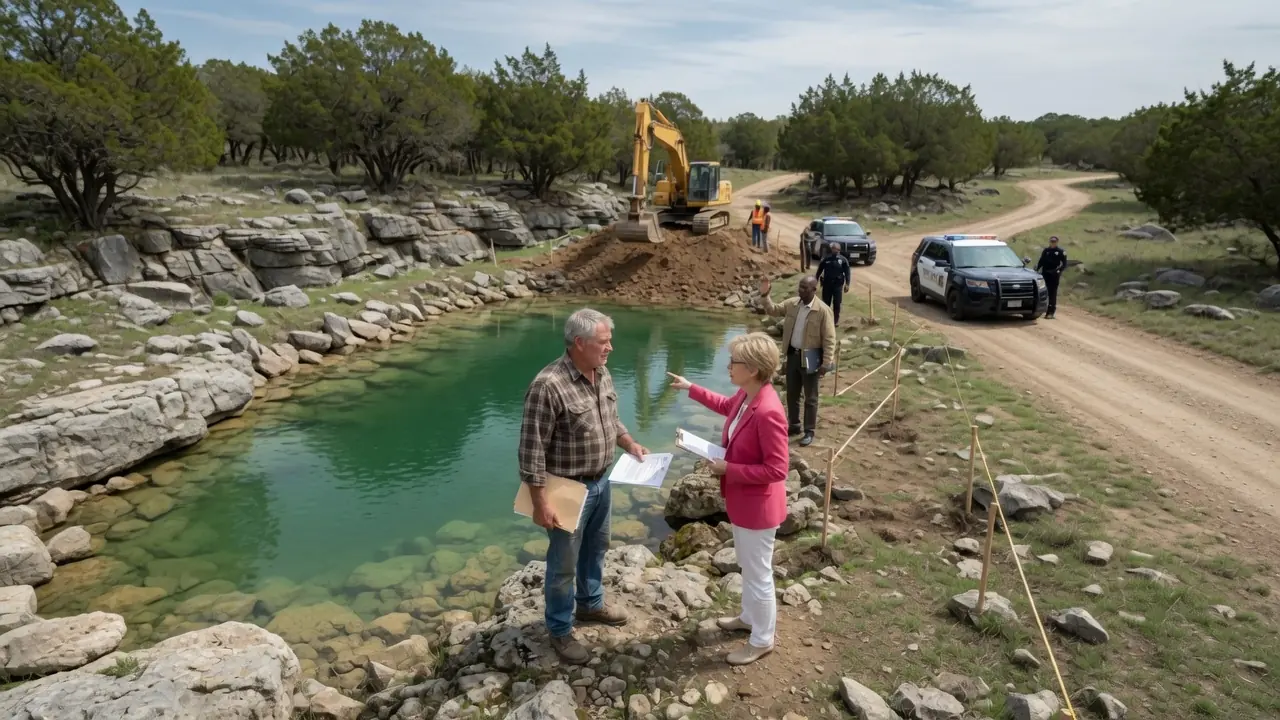
"We'll let a judge decide that."
Dorothea Vance turned around, got in her Audi, and drove back into the neighborhood she'd lived in for four years. I've been on this land for fifty-eight. Seven days—seven days to fill in the swimming hole my grandfather dug by hand in 1967, the one my kids learned to swim in, where my father fished every summer until he couldn't anymore.
Dorothea had showed up at my gate the same morning the letter arrived. HOA board president, clipboard, pressed blazer, and the smile of someone who has never once been told no. What she didn't know, standing there with her clipboard and her confidence, was that she had just handed me everything I needed to bury her.
To understand why that swimming hole was worth fighting for, you have to understand the man who built it. Duster Radford bought forty-two acres of scrub pine ridge in Clarksville, Virginia, in 1952. Nobody wanted that land—too rocky, too remote, too much work. Duster bought it anyway because it was his, and that meant something to him in a way that's hard to explain to people who've never had to scratch for anything.
He dug the swimming hole in the summer of 1967: a spring-fed depression about sixty feet wide and eight feet deep at the center. He did most of it by hand. The smell of turned limestone and wet clay hung over that part of the property for the rest of the summer. By fall, the spring had filled it clean and cold, and Duster set a flat limestone slab at the edge for a bench, heavy enough that three men couldn't move it without a lever. It's still there today.
Three generations of Radfords learned to swim in that hole. My father caught his first bass out of it. My own kids spent every July of their childhood waist-deep in water so clear you could count the pebbles on the bottom.
That's what Dorothea wanted me to bury under six feet of fill dirt.
Twelve years ago, a developer named Carrington Properties bought up the surrounding ridge land and carved it into a subdivision: Whispering Bluff Estates. Eighty-nine homes, a clubhouse, a set of CC&Rs thick as a phone book, and an HOA that took itself extremely seriously from day one.
My property was grandfathered. I was there before the HOA existed, and the county deed records made that clear. I wasn't a member. I wasn't subject to their rules. I was just a neighbor.
That distinction, apparently, drove Dorothea Vance absolutely crazy. She'd been HOA board president for three consecutive terms. A former real estate paralegal, she drove a pearl-white Audi Q7 and wore her reading glasses on a lanyard, even indoors—the universal symbol of a person who needs you to know they are very busy and very important. The first time she knocked on my door, she handed me a business card with the HOA logo on it and explained, smiling, that my swimming hole was an eyesore and a liability to neighborhood property values. I thanked her and closed the door.
That was four years ago. Since then, the letters had come in steady rotation regarding my gravel driveway, my barn, and my vegetable garden visible from the road. Each time, I'd pull the deed, write a polite response citing my grandfathered status, and file it in a manila folder I labeled with what I consider appropriate understatement: *HOA Nonsense*.
But three months before the morning she showed up at my gate, something changed. The HOA quietly amended its CC&Rs to include a new provision: all water features, natural or constructed, visible from community roadways had to meet state-certified safety standards or be decommissioned within thirty days of written notice. They mailed the amendment to all residents. I was not a resident, so I didn't get a copy.
I found out about it the way most people find out bad things are happening to them: from a neighbor at a gas station three weeks after the fact. Webb Trumble, a retired county surveyor who'd lived on the adjacent parcel for thirty-one years, flagged me down on my way home. He'd heard about the amendment from someone at the hardware store.
The certified letter arrived on a Tuesday morning. I was in the workshop sanding a walnut jewelry box when I heard the mail truck come up the road. Didn't think much of it. Walked out expecting a seed catalog and the electric bill. The yellow USPS certified envelope was sandwiched between them like it was trying to hide.
HOA letterhead, Dorothea's signature at the bottom. Underneath her name, in italics: *For the community's protection and betterment.*
The letter cited their new CC&R amendment, referenced a Virginia Department of Health provision about impoundments, and gave me exactly seven calendar days to fill, grade, and revegetate the swimming hole or face $250 daily fines and a civil lawsuit.
I set the letter down on the workbench beside the half-finished walnut box and stared at it for a long time—the kind of stare you reserve for things you can't quite believe are real. The smell of sawdust and linseed oil hung in the air. A normal Tuesday morning doing its best to stay normal.
I called my daughter, then my brother, then Webb Trumble, who listened to the whole thing in silence and then said, flat and certain as a survey stake, "She can't do that, Olen. Your land isn't in the HOA."
Five words. The first match strike.
That same afternoon, I drove to the county clerk's office, pulled the original deed, pulled the HOA's articles of incorporation, and pulled the recorded plat map for Whispering Bluff Estates. I spread everything across the reading table, and the county clerk, a quiet woman named Prentiss, watched me work through it with the expression of someone who has seen this exact situation before and already knows how it ends.
The plat map told the story clearly. My grandfathered parcel was delineated in black and white. The HOA's jurisdiction boundary ended at my property line. Under the Virginia Property Owners Association Act, Section 55.1-1800, HOA authority is explicitly limited to lot owners within the recorded subdivision. I was not a lot owner within their subdivision; I was a neighbor they had decided to treat like a problem. Any attorney would have told them this in about four minutes.
I went home and wrote a response letter myself. No attorney yet—just me, the deed recording number, the plat map reference, the statute citation, and twenty years of patience that had officially run out. I sent it certified mail, photographed the tracking number, and filed the receipt.
> **Takeaway:** When an HOA sends you a notice, pull your deed and the recorded plat map from your county clerk's office before you do anything else. Jurisdiction questions are answered by documents, not by whoever has the nicer letterhead.
Two days later, Dorothea called me directly. First time she'd ever done that. Her voice was the temperature of a professional smile: warm on the surface, nothing underneath. She told me the HOA's legal team had reviewed my response and stood by the notice. She said the swimming hole constituted a public safety hazard, and they had a community obligation to address it.
I asked her to put that in writing. She said she would, then hung up. She shouldn't have agreed to that.
The written follow-up arrived three days later. Same letterhead, same language, slightly more formal, and now on record that the HOA was knowingly asserting authority over a non-member parcel after being formally notified it had no such authority. That distinction matters a lot, but I'll get to why.
That evening, I walked down to the swimming hole at dusk. The water was dark green-black, completely still except for the ring a bass made near the far bank—one quiet circle spreading out and gone. The cedar smell was rich and heavy, the way it gets when the air cools after a warm October day. I sat on Duster's limestone bench, put my hand flat on the surface: rough, warm, gritty with lichen, still exactly where he'd set it.
I thought about what Duster would have done with a certified letter from a woman who'd lived in the county for four years telling him to destroy something he built with his own hands. I already knew the answer. Duster Radford did not fill things in. Neither would I.
But I needed help—the kind with a law degree and a working knowledge of HOA governance documents. Because what I didn't know yet, sitting on that bench in the October dusk, was that Dorothea's letter hadn't just started a fight; it had started a paper trail, and that paper trail was about to become the most expensive thing she'd ever put her signature on.
Dorothea didn't wait. While I was pulling deed records and writing certified letters, she was already moving to her next play. And I'll give her this: she was not a woman who did things halfway. If she decided to come at you, she came with both hands.
She filed a formal complaint with the Shenandoah County Environmental Health Division. The complaint claimed my swimming hole was an unregulated impoundment posing a vector-borne illness risk: mosquitoes, standing water, public health emergency, the whole production. She attached photographs taken from the county road with what must have been a decent zoom lens, a printed excerpt from Virginia's swimming pool regulations, and a letter on HOA letterhead describing the situation as a neighborhood health crisis requiring immediate government intervention.
It was, I have to admit, a smart move. She couldn't force me to fill the hole herself, so she was going to get the county to do it for her.
A county environmental health inspector named Merritt Dokes showed up at my gate the following Friday morning. Thin man, methodical, driving a white pickup with the county seal on the door. He had a clipboard—they always have a clipboard—a water testing kit, and the expression of someone who has driven out to enough of these situations to know that the truth is usually somewhere in the middle and usually less dramatic than the complaint.
I met him at the gate and offered him coffee. He declined. We walked the path down to the swimming hole together through the wild blackberry growing in thick at the edges, the morning air carrying that particular mix of turned earth and something faintly diesel drifting over from a neighbor's tractor running somewhere beyond the ridge.
Merritt was quiet the whole walk down. He set his kit on Duster's limestone bench—I didn't say anything about that—and got to work. He tested the water, measured the depth, checked the spring inflow, and took notes in the careful, unhurried way of a man who has been doing this long enough to not be impressed by urgency.
Then he told me what he found.
Spring-fed water, it turns out, runs exceptionally clean when it hasn't been interfered with. The test results were well within acceptable ranges for any category of water use. More importantly, he explained that under Virginia Code Section 32.1-248, state swimming pool and bathing facility regulations apply to facilities open to the public or operated for compensation. A private spring-fed pond on a grandfathered residential parcel used exclusively by the property owner and family doesn't qualify. Not even close. Dorothea's complaint was not actionable.
Merritt left me a copy of the inspection results, shook my hand, and drove away. The whole thing took less than an hour. I stood there in the morning quiet after his truck disappeared up the road, listening to the spring running over the limestone lip into the hole, and thought about how much time and county resources had just been spent on a complaint filed by someone who had never once bothered to check whether the law she was citing actually applied.
> **Takeaway:** State health codes for swimming pools apply to public or commercial facilities. A private pond on your own land is an entirely different legal category, and a quick read of the actual statute makes that clear.
I filed the inspection results in my manila folder. The folder, at this point, was getting thick.
Two days later, Dorothea's attorney entered the picture. A man named Fawcett, operating out of a strip mall in the next county, primarily handling property disputes for developers. He sent me a letter referencing Virginia's Uniform Statewide Building Code, suggesting the swimming hole might require a building permit as a water impoundment structure and that failure to obtain one could constitute a code violation subject to county enforcement.
The citation was, to put it charitably, creative. The argument required ignoring several key definitions in the very code section he was citing. But it was written on attorney letterhead with confident language, and I understood exactly what it was designed to do: make me feel like the legal ground was shifting under my feet. Make me doubt. Make me wonder if maybe I should just fill the hole and be done with it.
I photographed the letter, added it to the folder—which I had now relabeled in red marker: *They're Getting Desperate*—and I called a real lawyer.
Her name was Britta Sone, a property rights attorney in Winchester, Virginia, who specialized in easement and HOA disputes. She had the kind of direct, fast-talking energy that makes you feel like the conversation is already three steps ahead of wherever you thought it was going. I sent her the complete file—every letter, every certified mail receipt, the inspection results, Fawcett's creative building code citation, all of it—and she called me back the same afternoon. She didn't ease into it.
"They have no jurisdiction over your parcel. That's the first problem—for them, not you. The second problem is that by sending you notices purporting to impose fines after you formally notified them of that fact, they've potentially committed tortious interference with your property rights. The third problem is the most interesting one."
She paused. I could hear papers moving.
"Their CC&R amendment, the one they used to justify this whole thing, was adopted without a proper membership vote. I pulled their recorded bylaws from the county this morning. The amendment required a two-thirds supermajority of all members. There is no record of that vote occurring, which means the amendment they've been threatening you with may be legally void."
I sat with that for a second. "So they've been threatening me with a rule that doesn't legally exist?"
"That's one way to put it," Britta said.
> **Takeaway:** HOA CC&R amendments that skip the voting threshold required by the HOA's own governing documents can be void on their face. Those governing documents are public records anyone can pull from the county.
Britta filed a formal cease-and-desist letter the following week. Seven pages, eleven statute citations. It addressed all three issues—no jurisdiction, tortious interference, void amendment—and included a litigation hold notice demanding all HOA board communications related to my property be preserved for potential legal proceedings. It was sent via certified mail to Dorothea, to Fawcett, and to the HOA's registered agent simultaneously.
I would have paid good money to see Dorothea's face when she opened it. Instead, I got Cressida Park's text. Cressida was a retired schoolteacher who'd lived in Whispering Bluff for eight years and had never once voted for Dorothea for anything. She attended every HOA board meeting and had a gift for summarizing them in text messages of remarkable precision. She texted me the morning after Britta's letter landed: *Emergency board meeting last night. Dorothea's face was a color I don't have a name for. They're going to court.*
The board had voted to seek a county court injunction, citing public nuisance statutes to force me to fill the pond. Fawcett was retained for the expanded engagement, and in a move that told me everything I needed to know about how Dorothea ran that board, the HOA's monthly assessment was quietly increased by $11 to cover the legal costs. No vote, no member notification—just a line change on the next invoice. Several residents noticed. Several residents were unhappy.
I learned about the injunction filing on a Thursday afternoon while I was re-staining my front porch. Half-empty can of cedar stain between my boots, the sharp medicinal smell of turpentine on my hands, afternoon light cutting long across the yard. I put the brush down, wiped my hands on a rag, and called Britta.
She told me not to panic. I told her I wasn't panicking. She said she knew. Then she said something that stuck: "I've been waiting for exactly this, because now they've put it in front of a judge, and judges read documents."
That evening, while Britta began preparing the court response, my neighbor Webb Trumble called. Webb was eighty-one years old, sharp as a finishing nail, and had spent thirty years as a county surveyor before retirement. He'd been quietly turning something over in his mind since I first told him about the situation, and he'd finally gone down to his basement to check.
He kept thirty years of property surveys in a fireproof filing cabinet, organized by year and labeled by parcel. Buried in a 1961 survey of the ridge land predating the Whispering Bluff subdivision by six years, he'd found something nobody had thought to look for: a recorded drainage easement running across the southwest corner of what was now the HOA's common area, directly through the natural drainage path that fed my swimming hole.
Webb read me the easement language over the phone, slowly, the way surveyors read legal descriptions, every word carrying weight. When he finished, I stood in my kitchen and didn't say anything for a moment. Then I got a new folder and a red marker. I wrote: *Oh, they really didn't know.*
A drainage easement from 1961 was interesting. What it pointed to was explosive.
Britta ordered a full title search the morning after Webb's call—not just on my property, but on the HOA's recorded common areas, the plat itself, and every instrument recorded against the ridge land going back to 1955. She used a title company out of Woodstock that she'd worked with for years. They were thorough and they were fast. Four days later, a package arrived at Britta's office that she called me about before she'd even finished reading it.
"Olen," she said, "Carrington had a condition."
When Carrington Properties got Whispering Bluff Estates approved by Shenandoah County in 2012, subdivision approval came with strings attached, the way it always does with large residential developments on ridge land with natural drainage. One of those strings was a drainage management agreement recorded with the county as a condition of plat approval, still fully active. That agreement designated the natural spring and its drainage path, which ran directly through my swimming hole, as a protected natural drainage feature under the county's stormwater management ordinance.
Read that again. The county had approved the entire Whispering Bluff subdivision partly on the basis that my swimming hole would continue to exist and function as a natural drainage element. It wasn't just my property; it was built into the county's stormwater infrastructure plan for that entire section of ridge.
Which meant that if I filled the swimming hole—if I did exactly what Dorothea's letter demanded—the county's protected drainage feature would be obstructed. That would be a stormwater ordinance violation committed by whoever caused the obstruction, which, per the demand letter, would be me acting under HOA coercion, potentially making the HOA liable for instigating a regulatory violation on a non-member's land that they had no authority over in the first place.
Britta put it in one clean sentence: "If you fill that pond because they told you to and the drainage backs up, they may have just made themselves responsible for it."
I sat with that at my kitchen table, the afternoon sun coming in sideways through the window, catching the dust in the air the way it does on quiet days when something large has just shifted. Outside, a pair of cedar waxwings were working through the wild cherry tree at the edge of the yard—quick, efficient, completely unbothered, doing exactly what they were supposed to do.
I thought about Dorothea standing at my gate with her clipboard and her seven-day deadline. I thought about Fawcett and his creative building code citations. I thought about the $11 assessment increase that nobody voted on. None of them had pulled the plat approval documents. None of them had looked at what conditions Carrington had agreed to when they built their subdivision around my land. They had built an entire legal campaign on top of a foundation they had never once checked.
Here's what I now held:
* Proof the HOA had no jurisdiction
* A cease-and-desist on file
* A county inspection clearing the water
* A 1961 drainage easement
* A stormwater agreement actively protecting the feature they wanted destroyed
* Evidence the CC&R amendment was void
* A paper trail showing a baseless regulatory complaint
* A court date coming up fast
The trap wasn't set yet, but every piece was on the table.
> **Takeaway:** Before complying with any order to alter a natural feature on your land, request the subdivision's original plat approval documents from the county. Drainage conditions recorded at approval are legally binding and often protect features the current HOA never knew existed.
Britta and I met in person at her office in Winchester—third-floor walk-up, filing cabinets floor-to-ceiling, a window overlooking a parking garage that she had clearly stopped seeing years ago. She had the entire Radford file spread across a conference table: legal pads, highlighted statutes, a timeline she'd drawn by hand on a yellow sheet that already had coffee rings on it. She looked up when I walked in and said, "We're running three tracks at once. You good with that?"
I told her I'd spent thirty years managing three systems on a diesel pipeline at the same time. She nodded like that was exactly the right answer.
**Track One was legal.** Britta filed Olen's formal response to the injunction petition and attached to it a counterclaim against the HOA on three grounds: tortious interference with property rights, filing a knowingly baseless regulatory complaint with the county, and attempting to enforce a void CC&R amendment against a non-member. She also filed a formal request with the Shenandoah County Board of Supervisors asking them to initiate a compliance review of the HOA's recorded drainage obligations under the stormwater agreement.
This was the slow track. Courts move at their own pace, but every filing was a public record. Every document became part of a permanent file that anyone—a journalist, a real estate attorney, a prospective homebuyer doing due diligence on Whispering Bluff Estates—could pull and read.
> **Takeaway:** Counterclaims in property disputes are public filings. They create a documented record that follows an HOA and can affect its ability to maintain community trust, secure financing, or defend future enforcement actions.
**Track Two was regulatory.** Following Britta's guidance, I contacted the Virginia Department of Environmental Quality (DEQ) and filed a formal written inquiry asking whether the county-recorded stormwater drainage agreement covering my property's natural spring constituted a protected natural feature under 9 VAC 25-870, Virginia's stormwater management regulations.
This was not a complaint. It was a question—a polite, formally submitted written question that the DEQ was required to respond to on the record. The response, when it came, would be a government document: stamped, dated, signed, and permanently on file—the kind of document that ends arguments. I mailed it on a Wednesday morning from the post office in town. The woman behind the counter asked if I wanted delivery confirmation. I said yes to everything available.
**Track Three was the neighbors.** Cressida Park had been doing quiet work—not organizing, just talking, the way retired teachers talk, which is to say clearly, calmly, and with the specific authority of someone who has spent decades making complicated things make sense to people who didn't think they could understand them. She'd identified the households with grievances:
* The Fennell family, fined the previous spring for a vegetable garden visible from the road.
* Rawson Hicks, a retired firefighter whose disability access ramp had been cited as an unauthorized structural alteration.
* The Portillo family, denied approval for a fence style that three other households on the same street already had.
Over fences, at the mailbox, in the parking lot of the Kroger three miles down Route 7, Cressida was connecting dots. She wasn't asking anyone to do anything yet; she was just making sure they knew they weren't alone.
**Track Four was physical: the survey.** I hired Darnell Fitch, a licensed land surveyor out of Woodstock, to conduct a formal boundary survey of my entire parcel. Full documentation, official record, with particular attention to the drainage easement corridor and the swimming hole's position within it.
Darnell showed up on a cold morning with his equipment case and two field assistants. They worked through the day, the theodolite catching the pale November light on the ridge, the crunch of frozen grass under their boots as they moved from corner to corner. By afternoon, bright orange survey stakes with reflective tape stood at every boundary point, including three along the line closest to the HOA's common area. Legal, visible, permanent. They made it unmistakably clear to anyone who walked that land or drove that road exactly where my property ended and exactly where the HOA's authority stopped, which was, to be precise, twelve feet short of my gate.
There was one more piece to the legal track, one I hadn't expected to be useful, but turned out to be maybe the most useful thing I did in the entire process. Under the Virginia Property Owners Association Act, Section 55.1-1815, HOAs are required to make their governing documents available to any person who requests them, including non-members who believe they're being affected by HOA actions. Britta formally requested the HOA's complete governance file: all meeting minutes, all amendment votes, all financial disclosures. Fawcett objected. Britta noted the objection in her next filing.
Every move they made was becoming part of the record, and the record was almost ready.
While we were building the case quietly and methodically, Dorothea was getting nervous, and nervous people do one of two things: they back down, or they double down. Dorothea was not a backing-down person. She started working the neighborhood narrative. At the next HOA meeting, which Cressida attended and summarized with her usual precision, Dorothea presented my swimming hole as a breeding ground for mosquitoes, a drowning liability, and, most creatively, a contributor to declining property appraisal metrics across the entire subdivision. She had charts. She had photographs. She had the particular energy of someone who has decided that the best defense is a louder offense.
Then the flyer appeared. One page, featuring a photograph of the swimming hole taken through a zoom lens from the county road. Bold text at the top: *Neighborhood Safety Concern*. Below the photo, a paragraph about standing water, vector-borne illness, property values, and the HOA's responsible action in addressing the threat.
No mention that the water had tested clean by the county's own inspector. No mention that the hole had existed for fifty-seven years without incident. No mention of the counterclaim, the void amendment, or the stormwater agreement.
A copy landed in my mailbox—not mailed to me, just slipped in by an unknown hand, which told me everything I needed to know about how confident Dorothea actually was. I photographed it and sent it to Britta. She photographed it and opened a new subfolder: *Defamation Potential*. She noted that the property value claim in the flyer was unsubstantiated and potentially actionable if I could demonstrate damage. She filed it away the way good attorneys file things: not to use today, but to have when the moment came.
> **Takeaway:** Document everything an HOA sends or distributes about your property—flyers, emails, meeting minutes. Unsubstantiated public claims about your land can have legal implications, but only if you have the paper trail to back them up.
Then Fawcett tried something genuinely clever. He contacted my homeowner's insurance carrier directly, suggesting the swimming hole represented an uninsured liability the carrier should be aware of. The play was elegant in a sneaky kind of way: either my premiums go up and I become motivated to fill the hole to bring them back down, or the insurer pressures me to eliminate the liability myself. Either way, Dorothea gets what she wants without having to win in court.
I got a routine inquiry letter from my carrier, a regional company I'd been with for twenty-two years, asking me to provide information about the water feature on my property. I forwarded it to Britta before I even set it down. She responded to the insurer directly, attaching the county inspection results, the DEQ inquiry confirmation, and a brief legal summary explaining the private-use exemption under Virginia Code Section 32.1-248. The insurer reviewed the materials, classified the inquiry as resolved, and closed the file. The whole thing cost Fawcett one phone call, cost me one afternoon, and produced nothing for either of them.
But here's the thing about people who are losing: they don't always know it yet.
Meanwhile, I filed a Freedom of Information Act (FOIA) request with Shenandoah County under the Virginia Freedom of Information Act, Section 2.2-3700. I requested all county communications related to the HOA's complaint against my property, all records of the HOA's stormwater drainage obligations, and all permits and conditions issued to Carrington Properties during the Whispering Bluff subdivision approval process. The county had five working days to respond.
The response arrived in a box. That box sat on my kitchen table on a rainy Friday evening, coffee going cold at my elbow, yellow legal pad filling up with notes, rain ticking steady against the window glass. Outside, the path to the swimming hole was running with water—sheets of it coming off the limestone cap, filling the hole a little faster than usual. I could hear the spring from where I was sitting, that low, constant sound it makes when the water's running high.
I kept reading, and somewhere in the middle of that box, between county planning emails and permit applications I hadn't expected to see, I found something that changed the shape of everything: an email chain from 2011 between a Carrington Properties executive and the county planning department. In one message, the Carrington executive specifically referenced Duster Radford's property by name and noted that the swimming hole spring drainage had been incorporated into the subdivision stormwater plan as a natural detention feature.
They built their subdivision around my grandfather's swimming hole. They told the county it would stay. Then they sold the lots, formed an HOA, and apparently forgot to mention any of that.
I circled that paragraph three times in red pen.
The court hearing was five weeks out. Dorothea, from everything Cressida was reporting, had decided the outcome was already settled. At the next board meeting, she referred to the injunction as a formality. "The Radford situation is nearly resolved," she said, describing the upcoming hearing as a matter of paperwork rather than genuine uncertainty. She said this, apparently, with complete confidence.
She hadn't seen Britta's counterclaim file. She hadn't seen the Carrington email. She hadn't seen the DEQ inquiry on record. Confidence built on incomplete information is just a longer way of spelling 'mistake'.
Then she showed up at my door on a Saturday morning, unannounced, wearing casual clothes—a calculated choice from a woman who was never not calculating. She was carrying something wrapped in a dish towel that appeared to be a coffee cake, which is a remarkable escalation of social weaponry and one I genuinely did not anticipate.
She proposed what she called a "community solution": the HOA would pay me $8,500 to fill the swimming hole myself and release all claims against the board. She presented it as generosity. I thanked her for the coffee cake—which, to be fair, smelled like it had actual cardamom in it—and told her I'd be in touch.
I called Britta the moment Dorothea's Audi cleared the end of my driveway. An unsolicited settlement offer made directly to a represented party has procedural implications. Britta was interested. She noted the dollar figure. She noted the timing—five weeks before a court hearing. She added it to the file.
> **Takeaway:** If an HOA contacts you directly with a settlement offer after you've retained legal representation, tell your attorney immediately. Direct contact with a represented party is a procedural violation, and the offer itself signals how worried they actually are.
The offer told me something important: $8,500 was not nothing for an HOA the size of Whispering Bluff. That was real money coming out of a community assessment fund. You don't offer real money to someone you think you're going to beat in court.
While Dorothea was baking coffee cake and making offers, Cressida had been counting signatures. Under the HOA's own bylaws, a petition signed by ten percent of the membership triggered a mandatory special meeting. Ten percent of eighty-nine households was nine signatures. Cressida had seven: the Fennells, Rawson Hicks, the Portillos, and four others who'd had enough of CC&R enforcement that seemed to follow no consistent logic except proximity to whoever had crossed Dorothea recently.
Then Dorothea made a phone call she should not have made. Three of the seven signatories received individual calls from her in the same week. Separate calls, same message, wrapped in different words each time, but identical in substance: their pending requests before the Architectural Review Committee (ARC) might be affected by their decision to sign the petition.
Rawson Hicks—retired firefighter, front-row HOA meeting regular, man with a decade-long dispute over a flagpole—recorded his call on his cell phone. He didn't know exactly why he did it; he said later it just felt like the kind of thing that should be documented. He was right. He sent the recording to Cressida, Cressida sent it to me, and I sent it to Britta. Britta listened to it once, said nothing for a moment, and then said, "Keep that file backed up in three places."
The recording didn't stop two more people from signing the petition; it accelerated them. Word got around the way word gets around in a subdivision of eighty-nine households where people see each other at the mailbox every morning. By the end of the week, the petition had nine signatures. Then a tenth arrived from a resident named Oleander Tibbs, sixty-seven years old, a retired firefighter like Rawson, and nursing a flagpole grievance of his own that had apparently been fermenting since 2014.
The petition was delivered to the HOA's registered agent on a Thursday. The board was required to schedule a special meeting within thirty days.
The DEQ letter arrived the following Tuesday via certified mail on official Virginia Department of Environmental Quality letterhead. It confirmed that the spring-fed drainage feature on my property, given its incorporation into Shenandoah County's recorded stormwater management plan, constituted a regulated natural drainage feature under 9 VAC 25-870. Any alteration, including filling, would require a DEQ permit. The permit process included a mandatory drainage impact analysis. Typical timeline: four to eight months.
Dorothea's seven-day deadline had required me to do something that would have taken eight months to legally authorize.
I read that letter standing in my driveway in the thin October light, the kind that comes off the ridge in the morning and makes everything look like it's been lacquered. I read it twice. Then I folded it carefully, put it in my shirt pocket, and walked down to the swimming hole. The heron was there, standing on Duster's bench, still as limestone, looking at the water. I stood there with it for a while.
Everything was ready.
The Whispering Bluff HOA special meeting was called for a Tuesday evening in November. The clubhouse parking lot filled up in a way it had never filled up for a routine monthly meeting. Forty-one of the subdivision's eighty-nine households sent at least one member. People were standing along the back wall. Cressida was in the third row with a folder on her lap. Oleander Tibbs was in the second. Rawson Hicks sat in the front row, one seat from the aisle, phone in his breast pocket, audio app already running.
I was in the parking lot. Britta had advised me not to go inside—not because I couldn't, but because what needed to happen tonight needed to happen without me in the room. What I'd done was give Cressida everything: the DEQ letter, the Carrington email from the FOIA box, the drainage easement recording, the evidence of the void CC&R amendment, and a printed copy of Rawson's phone call transcript. Cressida had read every page twice.
Dorothea called the meeting to order at 7:05 p.m. She read a prepared statement about responsible governance, community safety, and the board's ongoing efforts to protect property values. Forty-one people listened. She did not mention the counterclaim. She did not mention the DEQ letter. She did not mention that the CC&R amendment she'd used to justify the entire campaign had been adopted without a legal vote.
During the open comment period, Cressida raised her hand. She was recognized. She stood up the way retired teachers stand up when they've decided to explain something completely—without hurry, without performance, with the quiet authority of someone who has spent a career making complicated things make sense.
She read the DEQ letter aloud, specifically the part about regulated natural drainage features and permit requirements. She held up the Carrington email from 2011 and read the passage about my grandfather's swimming hole being incorporated into the subdivision stormwater plan. She stated, clearly and without editorializing, that the CC&R amendment the board had used to threaten a non-member landowner had been adopted without the two-thirds supermajority required by the HOA's own bylaws, making it legally void. She said all of this in the same calm tone she once used to explain long division to ten-year-olds. Then she sat down.
The room was quiet for a moment—the specific quiet that happens when forty-one people are processing the same information at the same time.
Then the questions started:
* Why had these documents never been shared with members?
* Why was the HOA spending community assessment money on a lawsuit against a property it had no jurisdiction over?
* Why had the monthly fee increased without a vote?
Three people asked variations of the same question in the first five minutes.
Dorothea attempted to manage it. These were complex legal matters. The board was acting in good faith. This wasn't the appropriate forum for detailed legal discussion.
Then Rawson Hicks raised his hand. He was recognized. He stood up, held out his phone, and said he had a recording he thought the members should hear. Fifteen seconds: Dorothea's voice, recognizable and clear, telling Rawson that his pending ARC application might be affected by his decision to sign the petition.
The room went silent in a different way this time. Not processing quiet—*something has just happened* quiet.
Dorothea said the recording was out of context, that Rawson had misunderstood, that the meeting was getting off track. From the second row, one of the board members, Aldrich Spears, the HOA treasurer, asked quietly to see the financial statements for the legal fees incurred to date. Dorothea told him it wasn't the appropriate forum.
He said, gently, but with the specific firmness of a man who has been a treasurer long enough to know what accountability looks like, "I think it is."
Two days later, in Shenandoah County Circuit Court, Judge Pruitt took the bench. He was a spare man in his late sixties who had been on the bench for thirty-one years and had the settled, unhurried manner of someone who has seen every variety of property dispute and stopped being surprised by any of them.
Britta presented in twenty-two minutes: no jurisdiction, void amendment, active DEQ protection, Carrington stormwater incorporation, tortious interference counterclaim. Documents for every point, statute citations in the margins.
Fawcett argued for forty minutes. He cited four statutes, none of which applied cleanly to the facts of the case.
Judge Pruitt denied the injunction petition from the bench. He noted for the record that the HOA's enforcement action against a non-member parcel was—and I want you to hear this the way I heard it—"without colorable legal foundation." That is judge language. What it means in plain English is: *this should never have been filed.*
Britta and I walked out of the courthouse into thin November light. She doesn't usually show visible satisfaction. That afternoon, she made an exception.
After the gavel came down, things moved the way things move when the fight has gone out of the room. Three months after the hearing, the HOA board—now operating under interim president Aldrich Spears, following Dorothea's quiet resignation from all board positions—reached a settlement on the counterclaim.
The terms weren't disclosed publicly. What I can tell you is that my legal fees were covered in full. The void CC&R amendment was formally rescinded by a proper membership vote—unanimous, as it turned out. The $11 monthly assessment increase that had been levied without a vote was reversed and credited back to residents. Fawcett's relationship with the HOA ended; he did not send a farewell card.
On the regulatory side, the Virginia DEQ formalized its determination that my spring-fed swimming hole was a protected natural drainage feature under state stormwater regulations. That determination was recorded with Shenandoah County. What it means practically is that any future attempt to require the filling of that hole by anyone for any reason would require a full DEQ permit process and drainage impact analysis. The swimming hole is, in the most official sense available to the Commonwealth of Virginia, protected.
Dorothea listed her home in Whispering Bluff Estates four months after the settlement. It sold in six weeks. She didn't attend the closing in person.
Oleander Tibbs, at the first regular board meeting held under the new leadership, raised the flagpole issue he'd been carrying since 2014. It was approved in four minutes. He told me later it was the most satisfying four minutes of his retirement.
Here's what I did with the settlement money beyond covering legal fees: I approached Shenandoah County's Parks Department with a proposal for a formal conservation easement on the swimming hole and its surrounding two acres, permanently protecting it as a natural area. The county accepted, and the easement was recorded. What that means is that regardless of what happens to the rest of my property, regardless of who owns this land after I'm gone, that swimming hole stays exactly as Duster Radford left it—spring-fed, limestone-benched, cedar-scented. Nobody fills it. Nobody grades it. Nobody sends a certified letter about it.
Webb Trumble, who found the drainage easement that changed everything, said he didn't want any recognition. He's eighty-one, in good health, and has better things to do than attend ceremonies. But with contributions from several Whispering Bluff residents who felt they owed something to how this ended—including Cressida, the Fennells, the Portillos, and Rawson Hicks—we established a small scholarship fund at the county high school named for Duster Radford, for students pursuing degrees in environmental science, land use law, or civil engineering. The first recipient was a seventeen-year-old named Emmett Qualls from two counties over who wants to be a water resources engineer. I shook his hand at the ceremony in the spring. His grip was strong, but his hand was still soft, the way young hands are. I thought about Duster's hands, which were neither of those things, and which built something that is now, formally and legally, going to outlast all of us.
It's May now. The water is the same dark green-black it has always been. A great blue heron has taken to standing on the limestone bench in the early mornings, completely still in that absolute way herons are still, which makes you feel like you're the one who is restless. I walk down the cedar path in the morning and stand there and watch it, and it doesn't leave. And the spring runs cold and clean over the limestone lip, and fifty-seven years of use have left no mark on the water at all.
Duster knew what he was doing when he set that bench where he set it.