The strawberries don't care what's happening in your life. They ripen on their own schedule, and if you miss the window by even a few days, the whole row goes soft, and that's money you don't get back. 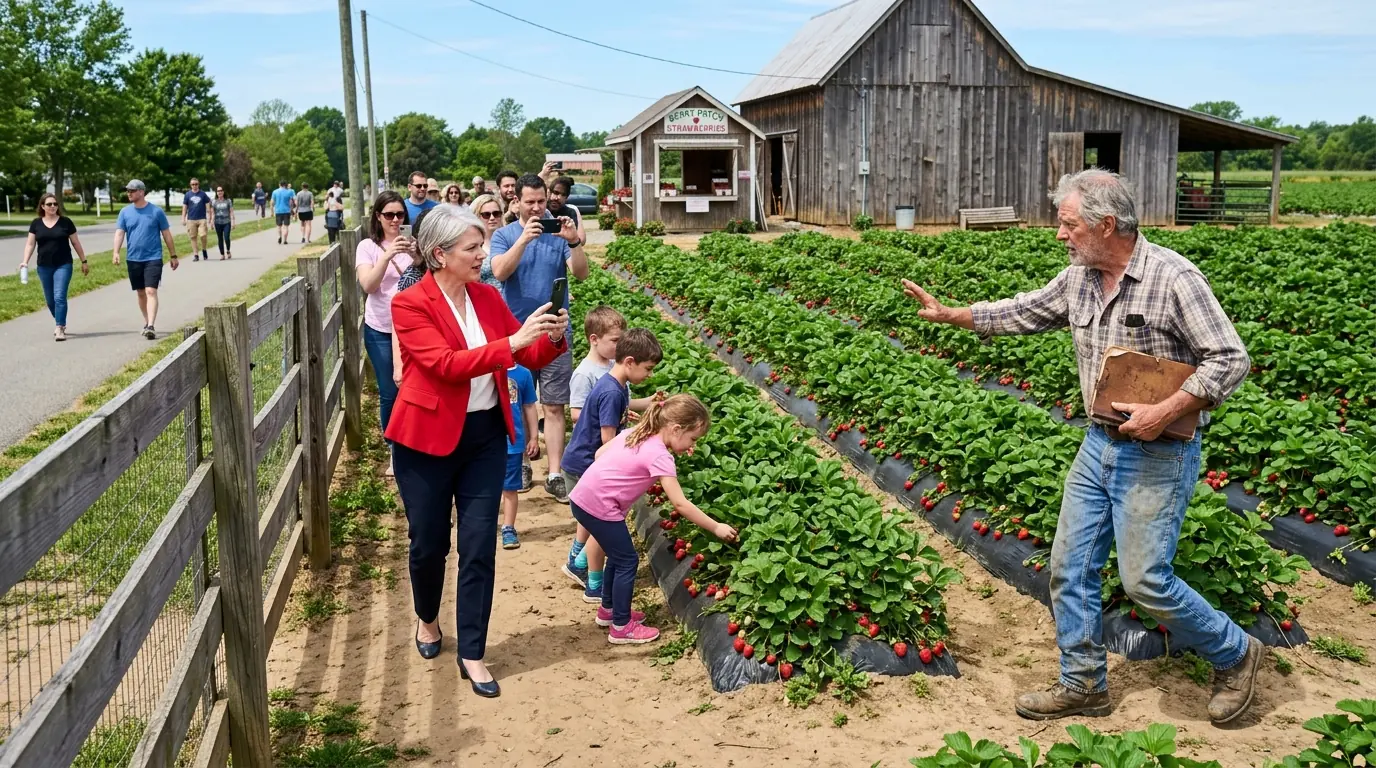
I knew this before I knew much else about farming because Elena told me the first season I tried to rush the east rows. She was an agricultural engineer and didn't let that kind of mistake happen twice. She designed this farm, every row of it. I want to be specific about that because it matters to everything that comes after.
When Elena decided we were going to grow strawberries on this corner lot at the edge of Crestfield Commons, she spent three months testing the soil composition before she put a single plant in the ground. She mapped the drainage grades and calculated the row orientation for optimal morning sun exposure on this specific parcel. She chose the varieties based on our climate, our soil type, and the average last frost date for this county—not for the county two hours south where most of the planting guides are written. She built a planting calendar from scratch, and it's still tacked to the inside of my barn door, laminated in her careful engineer's printing with row numbers, planting windows, and soil amendment schedules laid out in columns that haven't needed changing in three seasons. I follow it every morning. I followed it this morning, same as the morning before, same as every morning since she sat at the kitchen table and drew up the first draft.
Elena died eighteen months ago. I don't talk about it much. There's not a lot to say that the rows don't already show. I was a shop teacher for twenty-two years at Ridgeline High, where I taught kids to measure twice and cut once to build things that were level and true, helping them understand that a joint made right doesn't need to apologize for itself. I learned farming from Elena, the same way I taught everything else: from the ground up, in the right order, without skipping the parts that seem slow. She started me on soil chemistry, moved me to drainage, and didn't let me pick a strawberry for the first two seasons without explaining exactly why each decision had been made the way it was. I'm not a natural farmer the way she was; I'm a man who was taught carefully by someone who knew what she was doing, and I have tried to be worth the teaching.
The farm is eleven acres across three sections of strawberry rows: north, center, and east. Elena always called the east section the most productive because of the way morning light moves across it in spring, and she built four seasons of yield charts to back it up. I've been updating those charts every harvest since she stopped being able to, and the numbers keep being what she said they'd be. I don't know why I still find that surprising. I keep a farm log the same way she showed me. She designed the format: date, row number, harvest weight by flat, labor hours, soil observations, weather notes, and farm-stand revenue. One page per week, filled in by hand every evening after the work is done. I've done it three years running without missing a day. Elena said a farm that doesn't document itself is a farm that's guessing, and she had no patience for guessing. Neither do I anymore.
The farm stand runs Saturdays from eight to noon. It's just a folding table at the end of the driveway with hand-lettered signs, flats of strawberries, and mason jars of jam on a tablecloth Elena picked out the first year we opened. The jam recipe was hers, too—three seasons of trial batches before she wrote it down, and I make it exactly the way she wrote it. One Saturday in late April, a man I didn't recognize stopped and looked at the jars for a long moment without picking any up, finally asking if we used commercial pectin. I told him no, and he bought four. That's about as much conversation as the farm stand gets from me, and most of my regulars have figured that out by now. They come back, which I appreciate more than I probably show. I supply two restaurants on a weekly basis: Greystone Bistro takes two cases every Tuesday, and Alderman's, a farm-to-table place downtown, takes one case and a standing jam order. Both accounts have been in place for two years, and together, they cover a real part of the budget I built my retirement around. The farm is not a hobby, and it is not a grief project; it pays specific bills and I run it to pay them.
The neighborhood came in around us; that's the only accurate way to put it. Crestfield Commons was developed nine years after Elena bought this parcel. The HOA boundary was drawn to include everything in the subdivision except our corner lot, which was already a functioning farm and not for sale. We were here first. We didn't join the neighborhood; the neighborhood grew up on three sides of us, and for nine years that arrangement worked fine. Nobody bothered the farm, and the farm didn't bother anybody. I had no particular opinion about the HOA, and I assumed the HOA had no particular opinion about me. The community walking path runs along the eastern fence line, allowing people to see the rows from there, especially in late spring when the plants are full and the fruit is coming in red. I never had a problem with that. Looking at something and walking onto it are two different things, and for nine years nobody confused them.
That Saturday in early May was a decent morning. I sold out of the medium flats by ten-thirty. A regular named Patrice, who buys two flats most weeks to make her own preserves, stopped by near the end and waited while I made change for the customer ahead of her. When I handed her the bags, she mentioned, not particularly dramatically, that she'd seen a woman from the HOA on the path the day before—phone out, taking pictures of the rows, and walking back and forth along the fence for a good while.
"Seemed real focused on it," Patrice said.
I thanked her and she left. I finished the morning, broke down the table, went inside, and filled in the log: weather, harvest weight, revenue. I closed the notebook and set it on the stack where it goes. Outside, the east rows were two weeks from peak. I thought about the Greystone order for the following Tuesday, and I thought about whether the center section was going to need water before the weekend. I did not think much about the woman on the path. Nine years of quiet is a long time; you start to believe it means something permanent.
She came on a Saturday, two weeks after Patrice mentioned the woman on the path with the phone. I was at the farm stand making change for a family when she walked up the driveway with a kind of ease that told me she'd been planning this—not tentative, not hesitant, but the walk of someone who had already decided how the conversation was going to go. She introduced herself as Diane Mercer, HOA President of Crestfield Commons. She was in her mid-fifties, well put-together, with a smile you could tell had started as professional and stayed long enough to become real. She said she'd been admiring the farm from the walking path for weeks and that it was—and I'm going to quote this exactly because I have thought about it many times since—"exactly the kind of authentic, community-rooted feature that Crestfield Commons has always needed."
I didn't say anything as I went back to the flat I was breaking down, and she didn't seem to need me to say anything beyond that. She raised her phone and took three photos of the rows before I'd finished the sentence, doing it casually, the way you photograph something that already belongs to the story you're telling: the rows, the farm-stand table, and the mason jars in a line. She shifted her angle to get the east section in the frame. I watched her do it, and I didn't stop her because I didn't know yet what she intended to do with them. She bought a flat of strawberries, paid full price, said she hoped to see more of the farm, and then left, walking back toward the path with her eyes already on her phone screen. I finished the morning and filled in the log. Revenue was solid. Under observations, I wrote: *Visitor HOA President Diane Mercer. Photographed rows and farm stand without asking.* I didn't know yet why I was writing it down. Habit, I suppose—Elena's habit passed to me.
The newsletter arrived eight days later, front page, above the fold. The photo was one Diane had taken at the farm stand—the east rows in the background, a mason jar catching the light. The headline read: *"Crestfield's Working Farm: A Hidden Gem in Our Own Backyard."* My full name was in the second paragraph, and my farm-stand hours were listed in the sidebar under community features and events, between an announcement about walking path resurfacing and a reminder about leaf blower ordinances. Below the main article, set in a bordered box like an advertisement, it said: *Visit the Whitmore Farm, open Saturdays 8:00 a.m. to 12:00 p.m. Come experience Crestfield's very own working farm.*
There was no mention that the farm was private property, and no mention that anyone had been asked. There was also no mention that I had been contacted at any point prior to publication. I read it at the kitchen table. I read it twice, set it down, and looked at it the way you look at something that isn't wrong in any single, specific place, but is wrong in a way that takes a moment to locate. Then I opened the farm log and wrote the date, and beneath it: *HOA newsletter volume 14, issue four. Name and property description used without permission. Photo used without permission. Farm stand hours listed as HOA community event. No contact made prior to publication.* I underlined the last line, not for emphasis, but just to be sure it was there. I put the newsletter in the recycling and went out to check the center section, which I'd been meaning to water since Thursday.
The email came four days after that, sent from Diane's HOA account, formatted with a small logo at the top—a stylized house with a tree growing out of the roof, which I noticed and did not comment on. The subject line was *"Strawberry Saturday: A Crestfield Community Celebration."* She was planning a neighborhood event with families, children, and photos—a celebration of what she called Crestfield's green spirit. The date she had chosen was the fourteenth, which put it squarely in the middle of the east section's peak ripening window. She described the farm as a shared community treasure and said she was so excited to bring neighbors together around this beautiful space. She asked me to expect visitors, using the word *we* eleven times. I counted; I'm a shop teacher, so I count things.
The newsletter had been a violation on paper, but this was different. This was a date circled on a calendar that belonged to my farm, with forty families attached to it and a notification sent to me after the fact. She did not ask for permission, and there was no question in the email at all—not one. She had written the whole thing as though the terms had already been settled somewhere and I was receiving notice of what had been decided on my behalf. The closest thing to an acknowledgement was the final line: "Please let me know if you have any questions."
I read it twice, standing at the kitchen counter, still in my work clothes from the morning. I looked out the window at the rows for a moment, then set the phone face down, went to the printer, and printed the email. I wrote the date in the margin, and below it in my own handwriting: *No permission requested. No permission granted.* I took a manila folder from the file drawer—the kind with the metal clasp at the top—wrote on the tab in capital letters, "CRESTFIELD HOA CORRESPONDENCE," and put the printed email inside. I closed the drawer and did not reply.
That evening, I went out to the barn later than usual. The light was going, the rows running gray in the dusk. I stood at the barn door and looked at Elena's calendar. The east section's planting window was marked in her handwriting: row numbers, projected yield, and the peak date range. She had built in a five-day weather buffer because that was the kind of thing she thought about. The fourteenth fell three days before the projected peak. The rows would be at maximum fragility on that date—full fruit, thin skin, everything right where it needed to be, and exactly wrong for forty people walking through it. I reached up and traced the number with one finger: *14* in Elena's handwriting, the ink three seasons old. Then I pulled my hand back, turned off the barn light, and went inside. I still didn't know what I was going to do, but I knew what that date meant for those rows, and I knew she didn't.
On the morning of the fourteenth, I was at the barn before sunrise, driven by the thought that had been sitting in the back of my mind since I stood at that calendar. I walked the east rows with a flashlight—rows seven through twelve, the peak window section—and checked each plant by hand. They were right where Elena's schedule said they would be: three days from peak, full and tight, the kind of fruit that bruises if you look at it wrong. The east section at three days from peak is a specific thing; the plants are dense and low, the berries dark red to the point of almost purple at the tips, hanging in clusters that a child could reach without bending. I noted the condition in the log, then went inside, made coffee, sat at the window that faces the walking path, and waited to see what forty families looked like arriving on a Saturday morning. I had never thought of the path as something that ran toward the farm before; it had always just run alongside it.
That morning, it looked different. By nine-thirty, the first visitors came through—not from the driveway, but from the path, stepping through the equipment gap in the east fence. It's the gap I use to move the flatbed cart in from the road; it's not a gate, just a space between two fence posts wide enough for equipment, and apparently wide enough for a stroller, because the first family through had one. They came in the way people walk into a public park on a nice day: relaxed, phones out, the children already pulling ahead. Nobody checked for a sign, and nobody looked to see if they were welcome. Diane had told them they were welcome, and that was sufficient.
I went to the barn door and stood there. By ten-fifteen, I had counted forty-three people on the property—families mostly, children and parents, a few couples, and one old man walking alone with a thermos. They spread across the east section the way water spreads across a floor, filling in everywhere gradually without seeming to decide to. From the barn door, I could see three separate groups in the rows at the same time. The noise was the particular sound of people who are having a pleasant Saturday: light voices, and a child laughing somewhere in row ten. None of it was hostile, and none of it was malicious. That was the part I kept coming back to as I stood there: not one of those forty-three people believed they were doing anything wrong. I stood at the barn door and counted.
I went out to the east rows at ten o'clock the first time. A family—father, mother, and two kids under ten—had worked their way into row nine, and the children were picking. They weren't being malicious; they picked the way children pick anything that looks edible and beautiful, using both hands quickly without looking at what they were leaving behind. I walked over and explained as clearly and calmly as I knew how that the rows were not open for picking, that strawberries were available for purchase at the farm-stand table at the end of the driveway, and that I would appreciate it if they'd move that direction. The father nodded, genuinely apologetic. He gathered his kids, they moved toward the driveway, and I believed that was the end of it.
Four minutes later, a different family was picking from row nine. I went out the second time at ten-forty-five. A woman in a sun hat was photographing her daughter kneeling in row eleven, the girl holding a strawberry up to the light the way people do when they want the picture to look like a magazine. I asked her the same thing I had asked the first family.
She smiled at me and said, "Oh, are you one of the farm workers?"
I said, "I'm the owner."
She said, "Oh, how wonderful. Diane said this was a real working farm." Then she raised her phone, took a photo of me standing there in my own rows holding my own farm log in front of the plants my wife had designed the soil to grow, and posted it to the neighborhood Facebook group while I was still standing in front of her. I saw the notification come through on my own phone in my pocket forty seconds later. I went back to the barn door and watched the rest of the morning from there. That seemed like the right place to be.
After the last visitors left, sometime after noon, filtering out the same way they came in through the equipment gap—the stroller last—I walked every row. It was Elena's method: start at the north end of each section, walk the row length, check each plant, and note the condition. She showed me this the first season, explaining that the point was not just to find the damage, but to see all of it, even the damage that is small enough to ignore, because small damage compounds. I did it her way, slowly and without skipping: twenty-three plants damaged or destroyed, stems broken at the crown, root systems disturbed by foot traffic, and two plants pulled completely from the ground and left on the soil. The east section, rows seven through twelve, had been stripped before peak.
The visual of a stripped row is specific. The plants are still there, still standing, but the weight is gone from them; they look like they've been finished with. Fruit lay on the ground between the rows—some whole and bruised, some crushed flat under a shoe, already drawing flies. I estimated the weight loss against Elena's projected yield chart for peak week, based on four seasons of data, recalibrated every year, which remained the most accurate measure of what those rows should produce. Thirty-four pounds of strawberries that should have been there were gone. I wrote the numbers in the log, row by row, plant by plant, my handwriting unchanging.
That evening, Diane posted the recap on the neighborhood Facebook group. I saw it on my phone at the kitchen table: photos of smiling families, children holding strawberries up to the light, and golden afternoon color on the east rows, which had photographed beautifully even in their stripped state. The caption read: *"What a beautiful afternoon at Crestfield's Own Strawberry Farm. So grateful for this community treasure."* There were ninety-four reactions and thirty-one comments. The word *magical* appeared four times; my name appeared zero times. I looked at the photo the woman in the sun hat had posted of me standing in the east rows with the farm log, looking directly at the camera, noting it had three hundred and twelve views by the time the phone rang.
I put the phone down, kept the damage column open, and picked up the call. It was Sandra from Greystone Bistro, calling about Tuesday's order. She was professional about it—that was the word for it, professional. She said she understood, that she'd need to source elsewhere for the week, and that it happened sometimes. No hard feelings. I said I understood, thanked her, and she hung up.
I sat at the kitchen table with the phone face down in front of me. The damage column was open: thirty-four pounds, and the restaurant order gone. On the other side of the table was Elena's yield chart, four seasons of projections in her handwriting, the most precise record of what those rows should have produced this week. They would have produced exactly that if forty-three people hadn't walked through them while I stood at the barn door and counted. I picked up the pen to finish the evening's log entry. I wrote the date, I wrote the row numbers, and I got to the yield column—the column Elena designed, the one I had filled in without missing a single evening in three years—and I stopped. I sat there with the pen over the page, the numbers in front of me, and the phone face down on the table. Then I closed the notebook without finishing the entry and went to bed.
The next morning, before I walked the rows, I opened the notebook and completed the entry from the night before—every column, every number, without skipping a line. Then I went outside and started the day. By the time I got to the barn, Diane's post had four hundred and seven views.
Ten days after Strawberry Saturday, I was at the barn door with the manila folder in my hand. I stood there in the early light and thought honestly about putting it back in the drawer. Some people calculate the cost of a fight and decide the math doesn't work; they absorb the loss, go quiet, and wait for the next thing—a newsletter, another event, another set of strangers walking through the equipment gap in the east fence. It isn't surrender, exactly; it's a decision about where to spend what you have left. Elena had never been someone who picked fights she didn't need to pick. She was an engineer, choosing her projects by what they could actually accomplish, not on principle in the abstract. I tried to apply that thinking. A newsletter and a ruined harvest week—maybe I could put the folder away for that. But whatever Diane had already started would not be less than what had come before it. That was the part Elena's logic kept landing on: a problem that compounds doesn't stop on its own.
I looked at the east rows, where replanting was underway in the worst sections—new plants now behind schedule on our calendar, with the barn door chart showing exactly where they should have been. Then my phone rang, and I went inside to answer it. The woman on the line introduced herself as an editorial assistant at *Coastal Neighbor Magazine*, efficient and friendly, the voice of someone reading from a prepared call script. She said she was calling to schedule a site visit and photo shoot for an upcoming feature on community green spaces in the region, mentioning the farm by name. She asked if we'd be available the following Thursday for a pre-shoot walkthrough. I asked how she'd gotten my number.
"Diane Mercer, the HOA president, provided our team with your contact information," she said. "She submitted the property for consideration a few weeks ago."
I said I would call her back, hung up, and stood in the kitchen with the phone in my hand. Diane had pitched my farm to a regional magazine. She had submitted my address, my phone number, and presumably a description of my property to an external publication without calling me first, without emailing me, without any contact whatsoever. The newsletter had put my name in a community bulletin. The Strawberry Saturday email had organized an event on my land. This was different from both of those things; this was a woman who had decided my farm was a story she owned and had started selling it. I thought about what kind of magazine runs features on community green spaces—the kind that photographs things that belong to other people and calls them shared, the kind that gives a name to something and considers the naming a form of ownership.
I put the phone on the counter and picked up the manila folder. I had been a shop teacher for twenty-two years, and in that time, I learned one reliable thing about problems: the ones that compound do so because someone calculated the other person would let them. What I needed to know before anything else was where I actually stood.
I got in the truck and drove to see an attorney. Patricia Reeves had an office on the west side of downtown, above a tax preparation firm. I'd found her through the state bar's agricultural property listings. I brought the manila folder, the farm log open to the damage entries from the fourteenth, Elena's planting calendar photographed on my phone, and the farm's recorded deed showing the property boundary and the date of purchase nine years before the HOA was established. I sat down and put the log on her desk, open to the entry from the morning of the fourteenth, and told her what had happened. I also told her what I was thinking about doing.
"I want to know," I said, "if I can bill them for it. The crop loss, the labor, the restaurant order I couldn't fill, all of it."
Patricia looked at the log, then at the calendar photo, then at the deed, then back at the log. She asked who had designed the documentation format. I told her my wife had; she was an agricultural engineer, and the format was hers, designed to track yield and labor.
"The fact that it documents every instance of loss is all the more useful to you," Patricia said. She set the log down and walked me through our legal position. The farm sat entirely on deeded private property. The HOA's recorded boundary did not include or border my parcel—no easement, no shared boundary clause, and no documented access right of any kind. Diane Mercer's use of my name, my property description, and my contact information in external media submissions without written consent was legally actionable under several frameworks she named specifically. The newsletter, the Strawberry Saturday event, and the magazine submission were each a documented instance of unauthorized promotion of private property. "What you've got in this log," she said, "is exactly what a damages invoice requires: dates, weights, dollar figures, and labor hours. Every line item was documented before you had any reason to document it strategically. That's significant."
I told her I wasn't interested in a lawsuit—too slow, too expensive.
"You don't need a lawsuit right now," she said. "You need an invoice—accurate, specific, and legally grounded. Send it certified. Make them decide whether to pay it or challenge it. Challenging it would cost them more than the invoice, and if they have any competent legal advice, they'll know that." She paused. "Can you calculate the harvest loss precisely?"
I told her I could, against the projected yield chart my wife had built for peak week, based on four seasons of data recalibrated every year. She'd been right every year.
"Then you have everything you need," Patricia said. "I'll draft the formal written notice. You write the invoice."
I sat in the truck in the parking lot for a while after that, the farm log still resting on the passenger seat. I've been thinking about Patricia's phrase: *before you had any reason to document it strategically.* Elena had built the log to run the farm, to track what each row produced, to catch the years when the soil needed adjusting, and to build the kind of yield record that serious agricultural work requires. She recalibrated it every season, making it accurate enough that four years of wilderness projections were still right after she was gone. That was what she'd built it for, not for this. But it was the right instrument for this. And the reason it was right was that she had built it to be precise, not strategic. Patricia understood that in about three minutes. The log's value as evidence came from the fact that Elena had never intended it as evidence; it was just the way the farm worked. She had left me the invoice without knowing that's what it was. I just had to write it out, and the numbers were already there. I started the truck, knowing exactly what I was going to do.
What I didn't know yet was the full scope of what Diane had already built. I would find that out the next morning when Tom Rafferty sent me a photograph from a meeting I hadn't known was happening. Tom's text came in while I was at the kitchen table with my coffee: a photo of a slide and a short message. The message said: *"She said the farm is proof that real things can grow here. Thought you should know."*
The slide was a photograph taken from inside a meeting room I didn't recognize. *"Community Vision Meeting"* was the title at the top in the HOA's branded font. The slide itself showed the farm from the walking path—one of Diane's photographs of the east rows—above a single line of text in large, clean letters: *The Whitmore Farm: Crestfield's Green Heart.*
I looked at it for a long time. Tom's note said she had delivered that line at the meeting, saying it out loud in front of neighbors as though she were describing something she'd created, as though growing were the same as discovering. I had understood up to this point that Diane had been taking something—my name, my harvest, my privacy—and those things were material, measurable, and I had measured them. What I hadn't fully understood was what she was trying to give herself. *Real things can grow here.* She wanted to be associated with something real, something she hadn't built, hadn't planted, and hadn't stayed up four seasons learning how to make work. The farm was sufficient without her; it had existed, produced, and continued producing years before she arrived. That was exactly what she wanted to be part of—not the work, but the fact of the work, the existence of something made by people who knew what they were doing, which she could stand next to and call community.
I set the phone face down on Elena's planting calendar and stayed at the table for a moment, the coffee cooling beside me. Then I picked up the farm log and opened it to a fresh page.
I spent three evenings at the kitchen table. The first evening, I laid out everything: the log entries, the yield chart, the manila folder of HOA correspondence, and the nursery receipt from the replacement plants. I organized it the way Elena would have organized it: by damage category, chronologically within each category, with the relevant source document clipped to each page. The second evening, I calculated, and the third evening, I reviewed.
The format I used was Elena's, the same column structure she had used for her agricultural consulting invoices, which I had found when I was settling her estate and kept because they were filed correctly, and I didn't throw things away that were filed correctly. I built the line items in order, beginning with the harvest:
* **Strawberry crop loss (Strawberry Saturday event, East section, rows 7-12):** 34 lbs. I priced it at farm-stand retail, not wholesale; the distinction mattered. It wasn't the thirty-four pounds that would have shipped to Greystone; it was the thirty-four pounds that would have sold at the farm-stand table at my price to my customers in jars and flats with my labels—Elena's principal price, measuring what was lost at the value it would have actually generated.
* **Lost peak window yield shortfall (Projected harvest, East section, rows 7-12):** This was the harder calculation, factoring the additional pounds those rows would have produced at peak if they hadn't been stripped three days early. I used Elena's yield chart, which had been right every year for four years, and applied her projection for peak week. The math took me the better part of an evening to do correctly, and I did it twice to make sure.
* **Restaurant order loss (Greystone Bistro, week of the 14th):** Sandra's order. The dollar value was exact, as I had the standing order amount in the log.
* **Replacement plant stock:** 23 plants at current nursery price. I had purchased them the week after, and the receipt was in the file drawer.
* **Labor displacement:** Two documented hours on the day of the event—the hours I spent walking out to redirect visitors instead of performing the scheduled work. I billed them at the standard agricultural labor rate for the state, which Elena had used in her own consulting calculations and which I confirmed was still current.
* **Property access (Whitmore Farm, Strawberry Saturday event):** One day, flat rate. This was the last line, the smallest number, with no complex calculation behind it—simply the charge for the day they used land that wasn't theirs to use.
I did not add a line for the farm log entry I hadn't been able to complete that evening; some things don't convert to dollars, though if I had been building a different kind of document that measured other categories of loss, that evening would have been on it. I did not round any number up. Every figure had a source in the log, a date, and a reference entry. Elena's rule: *A good record doesn't argue, it just needs to be accurate.*
Tom Rafferty came by the farm stand on Saturday. He bought a flat of strawberries and stood at the table for a moment without saying anything. Then he looked at the rows—the east section still thinner than the rest where the new plants were coming in—and then he looked at me.
"Putting something together," he said.
"Invoice," I said.
He nodded the way a man nods when the word is the right one, picked up his flat, and said, "Send it certified." Then he walked back toward the path. I watched him go. The farm stand was quiet in the right way—not empty, just finished. He'd said what needed saying and walked. That kind of restraint is harder than it looks.
Diane's email arrived Tuesday evening. Subject line: *"Magazine shoot confirmed - exciting news."* She had confirmed the date with *Coastal Neighbor*. The pre-shoot visit was scheduled for the following Thursday, and the full shoot would be the week after. She was so thrilled about how the feature was coming together, noting that the east rows were so beautiful this time of year and that she had seen them from the path recently, thinking they would photograph wonderfully. She asked if I could make sure the rows were looking their best before the photographer arrived, using two exclamation points in the same sentence. She did not mention Strawberry Saturday, and she did not mention the thirty-four pounds. She ended by saying she couldn't wait for the community to see the feature.
I read it standing at the kitchen counter, still in my work clothes from the evening row check. I read it twice, set the phone down, and went out to the barn. I stood at the barn door and looked at Elena's calendar. The east section, rows seven through twelve, was in its recovery phase, with new plants coming in slowly behind schedule. The chart showed where they should have been and where they were. Her handwriting noted the recovery window in the margin: *Four to six weeks to half yield.* She had written that three seasons ago as a general replanting note, and it was still accurate. I stood there for a moment, then went back inside.
I sat down at the kitchen table and opened my laptop. I transferred the invoice from the legal pad to a clean document, using Elena's consulting invoice format—the same header structure, column arrangement, and font she had used for the invoices I'd found in the estate files. It seemed right to use her format, as what I was documenting was, in large part, what her design had produced and what had been taken from it. At the top: *Whitmore Farm Invoice for Unauthorized Use of Private Agricultural Property. Reference: Crestfield Commons HOA / Diane Mercer, President. Payment terms: Net 30.* I went through each line item, checking each figure against the source entry in the log without changing any number. Total: $3,890.
I printed it, standing next to the printer to check each line on the page—dates, figures, and the source references written in the margin. The paper was still warm. When I was done, I held it for a moment longer: three pages, every figure sourced, and the total at the bottom clean and specific, the way Elena did everything. Then I set it on the kitchen table and walked to the window. Outside, the east rows were dark in the evening. The new plants were small, but they were in. Elena's calendar said they'd be at half yield by midsummer, full yield by fall; she had been specific about the recovery timeline even in years she knew she wouldn't see. The invoice was on the table behind me. I didn't look at it again; I already knew what it said.
Monday morning, I drove to the post office with three envelopes. At the counter, I filled out the certified mail slips for the first two: Diane Mercer's home address and the HOA's registered business address, using a standard form for the third, addressed to the editorial offices of *Coastal Neighbor Magazine*. I sealed each one at the counter, pressing the flap down flat, and handed them across. The weight of the first envelope surprised me—not because it was heavy, but because paper has a different weight when you know what it's about to do.
The certified envelopes each contained the same two items: the invoice and a formal written notice that Patricia had drafted, stating that effective immediately, no further use of my name, my farm's name, or my property in any HOA communication, event, promotional material, or external submission was permitted without a signed written agreement, and that I reserved all legal rights regarding past unauthorized use. The magazine envelope contained a brief letter: *Property featured in the Crestfield Commons submission is private agricultural land, the owner has not authorized its promotion, and the HOA holds no authority or affiliation with the property. Signed, Cal Whitmore, Owner, Whitmore Farm.* No threat, just facts. The postal clerk stamped the receipts and handed my copies back. I put them in the manila folder I had brought along out of habit, then drove home.
I went out to the east rows. The overnight temperature drop had been sharp, and I wanted to see how the new plants were handling it. They looked fine—low and tight, the way they should be. I noted it in the log when I came inside.
Thursday morning, the certified envelopes were signed for. I learned what happened in Diane's office from Frances Nguyen directly, weeks later after the settlement; she told it the way she told everything—plain and complete. Frances had come to Diane's home office that morning to go over fall cleanup logistics, an event they had planned weeks before any of this. Frances was there with the volunteer timeline and the supply list, and the certified envelope was on the corner of the desk when she arrived, still unopened. Diane opened it while Frances was reviewing the schedule, read the invoice once, set it down, and called it absurd. Frances picked it up. She read every line slowly, the way she had read discipline reports for thirty years as a school principal. That was how she described it to me—like a discipline report, something to be understood, not reacted to.
When she was done, she set it on the desk and looked at Diane. "Did you ever actually get his permission for any of this?" she said.
Diane did not answer the question; she answered a different one, talking about what the neighborhood had gained from the farm's presence, about community value, shared green spirit, and what the magazine feature would have meant. She said the farm had given people something they couldn't have built themselves, speaking as though Frances had asked about impact, not about consent. She used the word *partnership* before Frances had finished waiting for an answer to the actual question.
Frances didn't respond to any of it; she just waited. The silence, she told me, lasted long enough that the point made itself. When a question goes unanswered in the right kind of silence, you don't need the answer anymore; everyone in the room already has it. Frances packed up her timeline and left about twenty minutes after that. The fall cleanup planning was done, they didn't discuss the invoice again, and Diane didn't ask her to stay.
Diane called my cell phone at three-seventeen that afternoon while I was in the barn running an equipment check. I let it go to voicemail, then sat down on an equipment crate and listened: four minutes and twelve seconds. The first thirty seconds were genuinely warm—I say genuinely because I know the difference by now. She was surprised, having expected a conversation. By the second minute, the warmth was still in her voice, but it was costing something to maintain, the sentences slightly more rehearsed, and the pauses slightly more placed. By the third minute, she was working from a script she was writing in real time, and the seams were showing.
She said she'd received my letter and was sure there had been a misunderstanding. She mentioned Strawberry Saturday as a community achievement where the neighborhood children had a real farm experience, talked about the farm's role in the neighborhood's green identity, and said the magazine feature would have celebrated exactly what you've built here. She used the word *partnership* once, then twice, then three more times, but she did not use the word *permission*, and she did not use the word *sorry*. She asked me to call back so they could figure this out together, ending by saying she was confident they could find a path forward that works for everyone. Five times—I counted after I'd listened through once, because counting is how I process things. Elena used to say I turned everything into a measurement, and she wasn't wrong. I saved the voicemail and logged it: *Voicemail Diane Mercer, 3:17 p.m. Duration: 4:12. No apology, no acknowledgement of unauthorized use. Word "partnership" used five times.* Then I finished the equipment check and ran the water.
The magazine called Diane the following day to confirm the pre-shoot walkthrough for Saturday. She asked for a two-week delay, calling it a small scheduling matter to resolve, without saying what it actually was. The editorial assistant said she'd check with her editor. After she hung up, the invoice was still resting on the corner of the desk where Frances had set it.
Tom drove past her house on his way to the hardware store that afternoon and noticed the office lights had been on for a long time. He told me later, and while I don't know if he had the timing exactly right, Tom doesn't embellish. Tom posted his comment on the neighborhood Facebook group that Friday evening under Diane's Strawberry Saturday recap—the one with the ninety-four reactions and the word *magical* four times. It was eight sentences, and I still have the screenshot. He wrote that the Whitmore Farm was private property, that it predated the neighborhood by nine years, and that the owner had never been asked permission for any HOA event held on the land. He stated that thirty-four pounds of strawberries had been destroyed during Strawberry Saturday and that community members should know this before attending any future HOA event at the property. He cited one source: the owner, who told him himself. He did not use my name, and he did not editorialize.
There were forty-one reactions before Diane removed it, but by then, fourteen people had screenshots. By Saturday morning, those screenshots were in seventeen different private message threads across the neighborhood. The comment was gone, but the screenshots weren't—screenshots don't get removed. The Facebook group went quiet in the specific way it goes quiet when people are reading something carefully before deciding which side of it they're on. Tom texted me the screenshot that evening with no message attached, just the image. I looked at it for a moment, then put my phone in my pocket and went inside. Somewhere in the neighborhood, seventeen threads were running, Frances had the invoice, and the HOA board had a decision to make. I finished the log entry and closed the notebook. The farm log was current, and the invoice had landed. Those were the two things I knew for certain, and they were enough.
The HOA board held its emergency meeting ten days after the invoice landed. Patricia told me what happened; she'd spoken with the HOA's own attorney as part of the settlement process, and between the two of them, I got a clear enough picture. Diane had come in with a challenge prepared, having落ted an attorney over the weekend who told her the invoice was aggressive and likely challengeable. That attorney had not seen the farm log and didn't know it existed.
Frances read the invoice aloud at the meeting, line by line, in the manner I'd come to recognize from her—methodical, without editorial comment, the way you read something when you want everyone in the room to hear what it actually says without your own reaction getting in the way. Gerald Alkof, four years on the HOA board, was quiet through most of it—the kind of man who speaks twice a year and means it both times. He pulled up the neighborhood's recorded property map on his laptop while Frances was reading, and when she finished, he set the laptop on the table so the others could see the boundary line.
Then he asked Diane one question: "When did you verify the property line before you organized any events at that farm?"
She did not answer. The room stayed quiet after that. Frances had the invoice on the table, Gerald had the property map on the screen, and the boundary line between the HOA's jurisdiction and my parcel was perfectly visible from where Diane was sitting. There wasn't a version of that silence where that fact didn't land heavily on everyone present.
The HOA's own attorney reviewed the invoice, the deed, and Patricia's formal notice the following week. His written assessment to the board was brief: the farm owner's legal position was sound, the invoice was conservatively priced, and a challenge would cost more in legal fees than the invoice total before the first deposition. He recommended settlement, and Patricia mediated. My opening number was the full invoice, $3,890; my settlement number was $3,600—not because I'd accepted less, but because that was the fair number. Elena never overcharged for anything in her professional life. She had a principle: you charge what the work is worth, not what the market will bear. I had built the invoice on her methodology, and I settled it on the same principle.
The HOA accepted, choosing not to negotiate on the terms. Patricia had told me to expect pushback on the prohibition clause, but there was none. Gerald moved to accept, and Frances seconded. The formal written settlement contained two provisions I had asked Patricia to draft with care. The first was a permanent prohibition on the HOA using my name, the Whitmore Farm's name, or any description of my property in any internal or external communication, event, or promotional material without a signed written agreement from me. The second was a formal written acknowledgement signed by all three board members, stating that the Whitmore Farm was private agricultural property with no affiliation, partnership, or shared arrangement with Crestfield Commons HOA, and that all prior HOA communications describing it otherwise had been in error. Gerald signed without comment. Frances signed and looked at me across the table for a moment, saying nothing, and neither did I. There wasn't anything that needed saying, and that was, by that point, the thing I appreciated most about Frances Nguyen.
*Coastal Neighbor Magazine* passed on the Crestfield Commons story. I don't know what the editorial assistant said when she called Diane to let her know, and I didn't ask. Six weeks after the settlement, Diane Mercer resigned from the HOA presidency, her written statement noting she wanted to allow fresh leadership to guide Crestfield into its next chapter. Frances Nguyen was elected interim president at the following monthly meeting by a unanimous vote.
That was in September. By late October, the east rows had recovered. I had spent three weekends on the restoration, following Elena's replanting protocol from the calendar—specific instructions for fall recovery planting in this soil type, at this orientation, and at this latitude. She had included margin notes on root spacing for replanted stock, being precise about it the way she was precise about everything.
On the last Saturday of October, I finished row twelve. I knelt at the end of it with a seedling in one hand and a hand trowel in the other. The afternoon was cool and still, the light moving across the field at the low angle it takes in late October, making everything look longer and quieter than it had been in summer. Row twelve had been one of the worst in the damage assessment; the log entry from the afternoon of the fourteenth listed it by number, accounting for twenty-three plants total across the section in my handwriting. The count I had done while the last visitors were still filtering out through the equipment gap had its own line on the invoice, and every plant it represented was back now.
I pressed the last seedling into the prepared soil the way Elena had shown me: not too deep, not too shallow, and firm enough to hold without compressing the roots. She had been specific about that, as she was about most things. I stayed kneeling for a while after the seedling was in. The farm was quiet, the path was empty, the evening was coming, and the new plants were small but present across the whole section. The east rows looked the way they were supposed to look—not finished, but restored. There is a difference. Elena made sure I understood that distinction the first season she let me do a restoration planting on my own.
I got up, my knees stiff because October ground is colder than July ground, cleaned the trowel, and went to the barn. The sun had gone behind the treeline by then, leaving the east section in shadow.
Elena used to say that a farm is a document; every row is a record of what you chose to grow, where, and why. She built this one so well that even after she was gone, it kept its own records. I just made sure the HOA got a copy. I stood at the barn door, where her planting calendar was right where it always is, laminated and tacked at eye level in her engineer's handwriting. Every entry was dated and precise. She had made the last entry two weeks before she died, knowing it was the last one. That's the thing about records: you never know which entry is final until the entries stop. I had been looking at this calendar every morning and every evening for three seasons, and I knew every line of it.
I took out my pen, and below the last entry she had ever made, I added one line in my own handwriting: *East rows restored, season 3.* I put the pen away and went inside.