A tow truck was blocking my driveway when I stepped outside that morning.
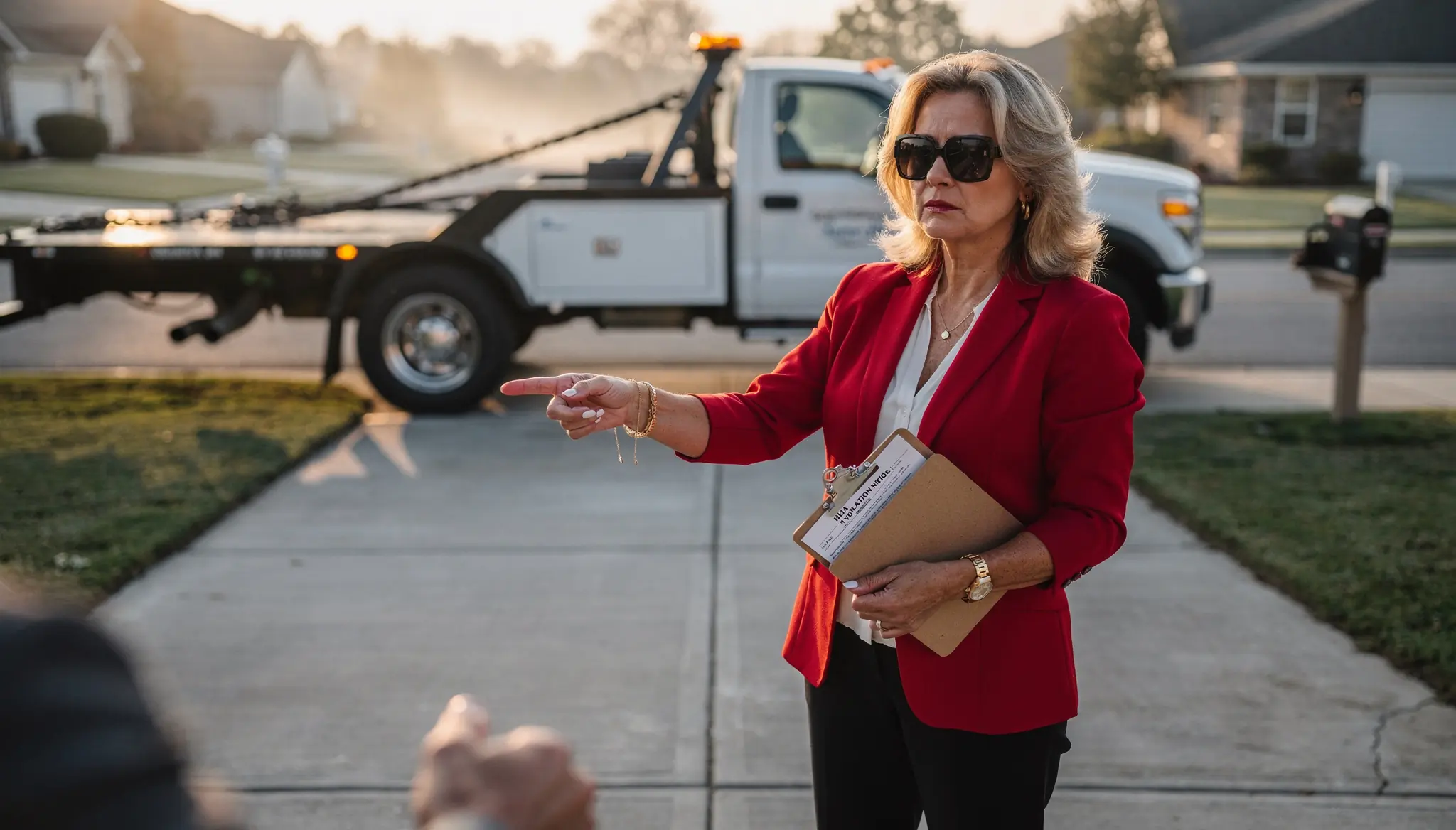 The engine was already rumbling loudly, parked sideways across the entrance like a barricade. Thick chains rattled against the metal bed while diesel fumes drifted through the quiet street. Standing beside the truck was Elaine Carter, the president of our HOA—clipboard in one hand, a printed notice in the other.She looked at me and announced, loud enough for half the neighborhood to hear, "Your driveway has been identified as an unauthorized HOA access violation." Then she pointed at the truck. "Leave it right there," she told the driver. "This driveway stays blocked until the board finishes reviewing it."My car was trapped inside the garage; I couldn't even leave my own property. A few neighbors had already stepped onto their porches, watching the scene unfold.The tow truck driver climbed down and walked toward the entrance of my driveway. As he got closer, he noticed the small metal sign mounted on the wooden post. He leaned forward and read it carefully: Recorded county easement. Private access.The driver paused, then he turned toward Elaine and said, "Ma'am, I can't legally block this driveway."Elaine didn't even glance at the sign. She crossed her arms and said, "You work for the HOA today. Keep the truck where it is."And that was the moment I realized something: Elaine thought HOA authority was the law.I'm thirty-eight years old, and until recently, my life in that neighborhood was about as quiet and predictable as it gets. I work with my hands for a living; I run a small woodworking and furniture restoration workshop out of the detached garage behind my house. Most of my days are spent sanding old oak tables, repairing antique chairs, or bringing beat-up cabinets back to life. It's quiet work, patient work—the kind where you measure twice, cut once, and try not to rush anything.The property itself is perfect for that kind of life. I bought the house about five years ago, right on the edge of a newer HOA subdivision. My lot was actually older than most of the neighborhood around it; the house and driveway had been there long before the HOA expanded and built the surrounding homes.That driveway is more important than it might look from the street. It's the only access to my garage workshop. Every delivery truck that drops off lumber uses it. Every client who comes to pick up a restored piece uses it. And when I move heavy equipment in or out, that driveway is the only way it happens.When I bought the place, I made sure to check everything carefully. County records showed the driveway had been built over twenty years before the HOA ever existed, and it was protected by a recorded county easement. In simple terms, it meant that driveway was legally recognized and couldn't just be shut down by neighborhood rules.For the most part, life there was easy. I got along well with the neighbors: we'd wave when we saw each other, help shovel snow in the winter, and occasionally chat while grabbing the mail. I wasn't deeply involved with the HOA, but they mostly left me alone, and that worked just fine.