The alarm went off at 11:00 p.m. Red and blue lights flooded the quiet street outside my window. Three patrol cars, six officers, all of them converging on my garage. Outside, a woman was sobbing, hand pointed directly at my face, voice cracking just enough to sound convincing. "That's him. He took my car."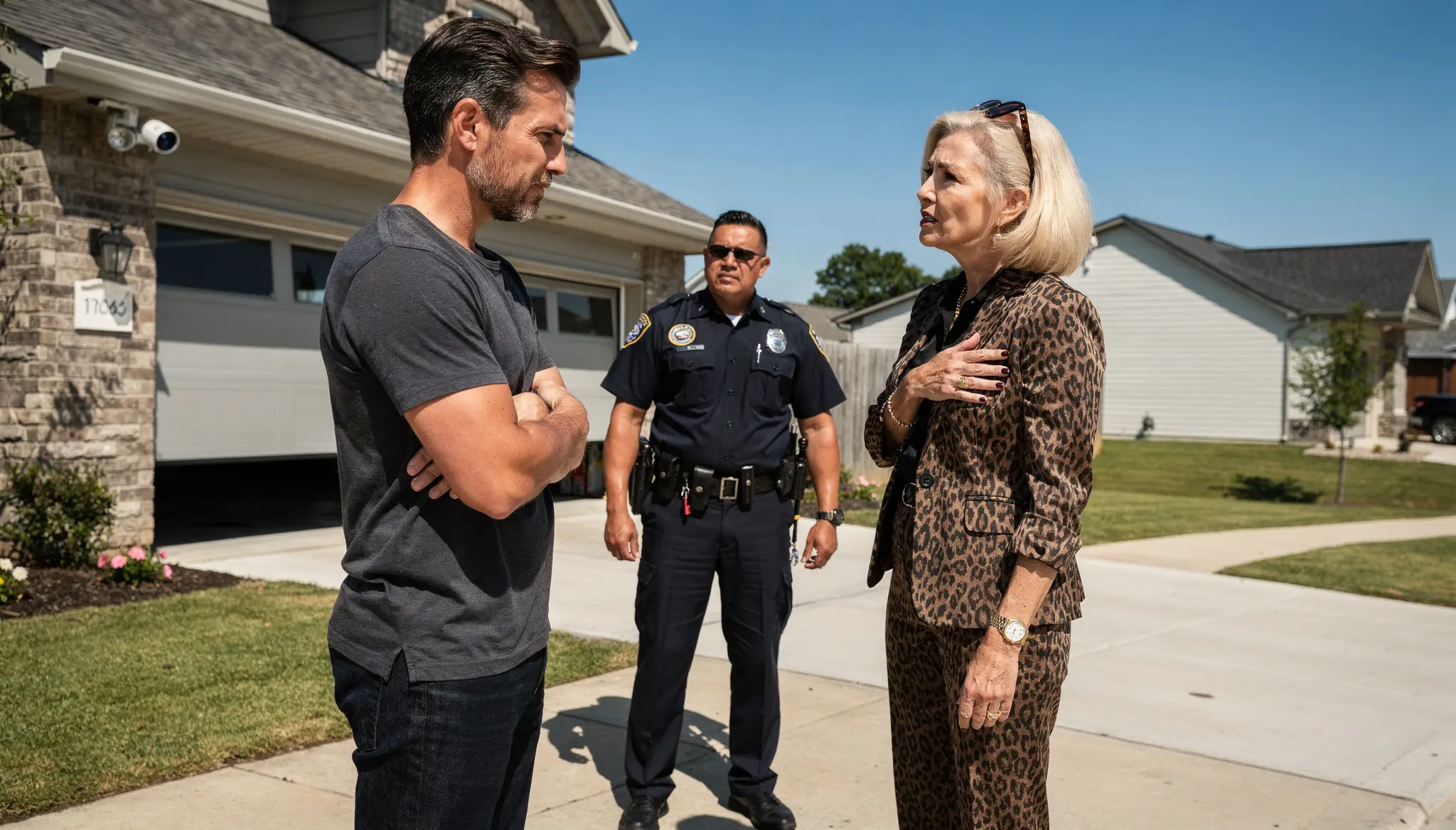
I stood still, arms crossed, eyes drifting up to the top left corner of the garage, exactly where I'd mounted a camera she had no idea existed. She had just made the most catastrophic mistake of her life.
Friday afternoon had that particular stillness that comes at the end of a long week, the kind where the air itself seems to exhale. I was in my garage, the one space in the world where everything made sense. Jack Mitchell, 38 years old, network security engineer, working remotely from a house I had spent three years making exactly the way I wanted. Number 14, Elmwood Circle, a private residential community managed by a homeowners association that, until recently, I had paid as little attention to as possible.
My garage was less workshop than command center. Three monitors on a steel desk, a local server rack humming in the corner, coiled cables sorted by gauge on pegboard hooks, and a floor coated in epoxy the color of wet concrete. I had spent the better part of two weekends on that floor. I was proud of it. That afternoon, I was on a video call with my friend Marcus while my hands worked through the wiring of a side project, a custom smart lock system I had been building from scratch. Marcus was leaning back in his chair on screen, coffee in hand, half listening.
"Sixteen channels running continuously?" he said, glancing at the NVR stack mounted near the ceiling. "Jack, man, you do know most people just get a Ring doorbell and call it a day."
I told him that most people also get their packages stolen off their porches. He laughed. I did not. I told him the garage had zero blind spots, every angle covered, every motion event logged with a hardware timestamp to an independent clock.
"You are genuinely paranoid," he said.
I adjusted a wire connector and told him I preferred the word thorough. The curbside door was rolled halfway up because I was moving equipment, letting in that low golden light that precedes a sunset. I did not hear her car pull in over the sound of the call. I heard the tires first, a soft compression against the epoxy, and then I looked up.
A Tesla Model Y in pearl white was rolling into my garage without invitation, without a knock, without so much as a text message. It stopped three feet from my workbench. The door opened. Diane Holloway stepped out, 52 years old, short blonde hair, precision cut, a blazer on a Friday, which told you everything you needed to know about how she moved through the world. Diane was the HOA president, six consecutive years in the role, and she wore that fact the way some people wear a badge, always visible, always forward. The community knew her car, pearl white Tesla Model Y, parked in front of her house like a personal monument. You did not miss it. And right now, it was sitting uninvited on my epoxy floor.
I ended the call with Marcus without explaining why. I set my laptop down on the workbench and looked at her, not at the car, at her.
"You just drove onto my private property without permission," I said. My voice was flat, not hostile, just accurate.
Diane did not retreat. She looked around the garage the way a property inspector looks at a condemned building, assessing, cataloging, and then her eyes moved to the Tesla she had just parked. Something crossed her face in that moment. It was not irritation, and it was not the self-righteous authority she usually wore like a second blazer. It was something I could not name immediately. Calculation, maybe, a quick internal arithmetic. Then it was gone, replaced by the performance I was more familiar with.
"I needed to speak with you about a Section 7.3 violation," she said, straightening the front of her blazer as if the conversation had already been decided. "Your garage door color does not match the approved palette on file. You have 48 hours to repaint, or the fine begins at $200 per day."
I watched her. I let the silence sit. Then I said it again, more slowly this time.
"Diane, you drove your car into my garage without asking."
She held my gaze for exactly two seconds, the duration of a woman deciding whether to acknowledge a line she has crossed, and then she turned and walked out on foot. The Tesla stayed. I watched her heels cross the threshold, heard the sound of the street, and then the curbside silence came back. The garage door was still halfway up. I considered closing it. Instead, I looked up at the top left corner mount where the fish-eye lens of camera one blinked its tiny green LED at me, and I exhaled through my nose. I rolled the door back down, picked up the laptop, and sat down at the desk.
I typed back, "Yeah, just something weird."
I put the phone down and stared at the monitors. The server fan cycled through a routine query. Everything in the garage was exactly where I had left it. Everything was normal, except for one thing I could not stop turning over: the way Diane had looked at her own car. Not the way you look at something that belongs to you, but the way you look at something you are not sure you are allowed to keep.
11:07 p.m.
I was asleep when my phone lit up the nightstand. Not a call, the NVR motion alert from the garage exterior camera. I opened the app with one eye still closed, and the thumbnail showed a figure standing at the closed garage door. I sat up. The figure was Diane Holloway, backlit by the streetlamp, phone pressed to her ear, face pointed at my garage like a compass needle finding north.
I pulled on a shirt and walked downstairs. By the time I opened my front door, the first police cruiser was already turning onto Elmwood Circle, and then a second, and then a third. Six officers total. The lights painted the whole block in alternating red and blue. Neighbors were appearing at windows. I stepped into my driveway in bare feet and stood still.
Diane moved fast. Before Sergeant Torres had fully stepped out of his vehicle, she was already at his door, shoulders shaking, one hand to her chest, voice pitched in the register of a woman barely holding herself together.
"That's the man," she said, pointing at me with the certainty of someone who had rehearsed the gesture. "He took my Tesla. It was gone when I came outside this afternoon, and I just found it. It's in his garage right now. I can prove it."
Torres was a broad-shouldered man in his mid-40s with a face that had heard every version of every story and had stopped being surprised by any of them. He looked at me the way a chess player looks at a board, not reacting, just reading.
"Sir, is there a vehicle inside your garage that isn't yours?"
I looked at him. Then I looked at Diane, who was dabbing at her eyes with the sleeve of a cardigan she had put on specifically for this. Then I looked up past Torres, past the cruisers, past all of it, at the top left corner of my garage, where camera one sat in the dark, recording everything with the patience of a machine that does not get tired.
A lesser version of me would have started talking. I could feel the words stacking up behind my teeth, the explanation, the timeline, the obvious truth. But I am an engineer. I know the difference between a verbal claim and verified data. One of those things holds up in a proceeding, and one of them creates noise that the other side can manipulate.
I unfolded my arms, looked Torres directly in the eye, and said in the most even voice I owned, "I want an attorney present before I say anything further, and I'd like any inspection of my property to follow proper legal procedure."
Torres nodded once, slowly. That was a man who respected the protocol. Diane, however, did not.
"He's deflecting." Her voice climbed a full octave. "Look at him. He's not even denying it. That's what guilty people do."
She turned to the growing cluster of neighbors now standing at the edge of their lawns in various states of pajamas and alarm. She was performing for them now. Torres put up one hand, not unkindly, but absolutely, and told her he needed to speak with me without the audience.
In the quieter conversation that followed, Torres confirmed he did not have grounds for immediate arrest. He told me he would seek a search warrant if necessary and return in the morning. Diane, overhearing this from eight feet away, pushed back with an urgency that had lost its theatrical precision and become something raw. She wanted action now. Torres told her the same thing he tells everyone who wants action now. The process exists for a reason, and he intended to follow it. I stood and said nothing while she argued.
At some point during the exchange, I slipped my phone from my pocket and opened an application I had not touched in months, the Tesla Fleet API client I had linked to my account back when I still owned the car. I looked at the screen for about four seconds, then I put the phone away. I did not show Torres. I did not explain what I had seen. I filed it in the same mental folder as the camera footage and closed the drawer.
Diane drove away in a separate car, a fact that seemed to produce a flicker of confusion in one of the younger officers, who looked at her vehicle, then at the garage, and then wrote something in his notebook.
The neighbors went back inside one by one until the street was quiet again. Torres gave me a card and told me his contact information was on the front. I thanked him. I went inside. I locked the door and sat down at my desk, opened my laptop, and typed the first command of what was going to be a long night.
2:00 in the morning.
The garage was locked and the street was dead. I sat at my desk with nothing on but the blue wash of three monitors and the small amber blink of the server status light in the corner. I was not upset. I was not scared. I was in a mode that people who do not work in security rarely understand, the same state I enter when a client's network has been breached and the first priority is not panic. It is methodology.
Someone had introduced a variable into my environment without authorization. My job was to document every parameter of that variable before it could be altered, disputed, or disappeared. The NVR system runs on a dedicated local machine, air-gapped from the home network, with footage written simultaneously to two redundant drives. I pulled up the timeline interface and typed in the date. The footage loaded in segments, each clip tagged with a hardware-generated timestamp that cannot be edited without physically modifying the device, a detail I had specifically chosen this system for.
I scrolled to 3:47 p.m. Camera one, the wide-angle mount above the garage entrance, showed the pearl white Tesla rolling across the threshold. Its front license plate centered perfectly in the frame: 7 Kilo Hotel Foxtrot 291. Crystal clear. I let it play. At 3:49 p.m. and 11 seconds, Diane stepped out of the driver's side, pushed the door closed with her hip, and walked toward the interior of the garage, directly toward me, directly toward the camera three angle. Her face was completely and unambiguously on record. At 3:52 and 44 seconds, camera seven caught her exiting through the side passage on foot. The car did not move, not one frame, not one pixel of drift.
I exported the relevant clips to an external drive, ran a SHA-256 hash on each file, and recorded the hash values alongside an independently generated timestamp in a plain text document. This is the digital equivalent of a wax seal. If even a single bit of those files is altered later, the hash will not match, and any competent forensic examiner will know it immediately.
I labeled the folder Evidence 001 and moved on to the second layer. I opened a terminal window and pulled up the Tesla Fleet API client on my local machine.
I want to be precise about what this was, because it matters legally. This was not an intrusion into Diane's account. The Tesla in my garage had previously been my vehicle. I had owned it for 18 months before selling it. When a Tesla changes hands, the outgoing owner is supposed to perform a full factory reset to revoke all prior access tokens. Diane, or whoever handled the transaction, had not done that. A legacy authentication token remained active inside my application. I had never used it after the sale, until now.
The location log was unambiguous. The vehicle had been stationary at the GPS coordinates corresponding to my address since 3:47 p.m. without interruption. The lock and unlock event history showed a single unlock at 3:46 p.m. using Diane's credentials, and a manual lock at 3:48 p.m. executed from outside the vehicle, meaning she was already standing on the ground when she pressed the fob. No unlock events occurred after that. The drive history showed zero miles logged since the vehicle arrived at my address.
I copied the full API response to a JSON file, exported it to a PDF through a formatting script, and added it to Evidence 001. That was the case: clean, timestamped, cryptographically sealed.
Then something else caught my eye, not in the camera data, not in the API log, but in the vehicle purchase record that was still visible through the legacy account access. The acquisition date shown for Diane Holloway was March 14th, three weeks after the HOA's February board meeting.
I stared at that date for a moment. Then I opened a second browser tab and navigated to the HOA's public document portal. Our state requires these records to be accessible to all dues-paying members. I found the February meeting minutes in under two minutes. I skimmed to the budget line items. There it was: a $94,000 infrastructure project for drainage and street lighting, approved unanimously. Diane's signature was on the authorization line.
I looked at the Tesla purchase date again. I looked at the project approval date. I closed the tab. Not now. One problem at a time.
But I opened my email client, found the address for my attorney, Rebecca Cho, and typed a subject line that I knew would get her attention by 8:00 a.m.: Urgent false police report. Need consult. Have documented evidence. I attached Evidence 001, closed the laptop, and lay back in the desk chair. The server fan ran its slow, indifferent cycle. Outside, Elmwood Circle was absolutely still.
7:15 a.m.
I had not fully slept. I was at the kitchen counter with a mug of coffee going cold in my hand when my phone started moving across the counter from the vibration of incoming notifications. Not calls, messages from neighbors I had exchanged perhaps three sentences with total across the past two years.
I set down the mug and opened the community group. The post was pinned at the top, posted at 6:42 a.m., already carrying 847 reactions: the angry face, the shocked face, the rare few hearts that had been left there either by mistake or by people trying to register a kind of helpless sympathy.
Diane's post read like a prepared statement with the formality stripped out just enough to seem spontaneous. She described herself as a victim. She described the previous evening as a traumatic incident. She named my address. She named me. She attached a photograph taken by someone in the neighborhood last night, the angle suggesting a second-floor window, showing three squad cars parked in front of my house in the dark, lights still running. The caption was a question: Do we know who we are living next to?
The comments were a document in mass psychology. The neighbor to my left wrote that she had always found me odd because I never came outside for the block parties. Someone with a display name I did not recognize alleged I was in a criminal database and invited others to check. One account with no photo suggested the HOA should invoke a residency termination clause from a subsection of the bylaws. Only one person, Marcus Webb, who I had not told about any of this, typed a single sentence: Has anyone verified any of this?
He was replied to within four minutes. The reply asked him whose side he was on.
Rebecca Cho called at 8:05 while I was still reading. I had met Rebecca through a colleague three years ago. She was meticulous, direct, and constitutionally unimpressed by bluster, which made her very good at her job.
"I've read your email and I've seen the group post," she said before I could speak. "You are not going to respond to that post. Not one word, not one emoji, not a reaction. Complete silence."
I told her I had no intention of doing otherwise. She told me to forward her the evidence folder, which I already had. Then I said, "Rebecca, I need you to look at something beyond the false report. I found a date discrepancy in the HOA financials. I think this runs deeper."
There was a pause on her end, not uncertainty. She was updating a mental framework.
"Send it to me," she said. "All of it. Give me an hour."
By 10:00 a.m., Diane had escalated through official channels. An email arrived in my inbox, forwarded from the HOA address, formally announcing an emergency community meeting for the following Friday. The language was careful enough to avoid direct accusation, but not careful enough to disguise its target: a serious conduct matter involving a current resident that required collective deliberation.
A copy had been sent to Sergeant Torres with a cover note from Diane's personal address, framed as evidence of community concern. Torres called Rebecca at 11:30. He told her a warrant application had been approved and that officers would arrive that afternoon to inspect the garage. Rebecca thanked him. She called me immediately after.
"2:00 p.m.," she said. "I'll be there."
They came at 2:00 as promised, Torres and two officers in a department SUV. Rebecca stood beside me in the driveway. The garage rolled open. The pearl white Tesla was exactly where it had been since 3:47 the previous afternoon, engine cold, not a mark on it.
Torres walked around it slowly, photographing the vehicle, the plates, the space. He asked me, in the neutral tone of a man doing his job, how the vehicle came to be in my garage.
Rebecca answered, "We have timestamped camera footage and vehicle telemetry data showing the registered owner drove this car into my client's garage and departed on foot. We will provide a complete evidentiary package within 24 hours."
Torres looked at me for a moment. I looked back. Neither of us said anything.
Across the street, Diane stood on the sidewalk with her phone against her ear. When the officers left without making an arrest, she posted again in the group within six minutes: The investigation is ongoing. Be patient. Justice will be served.
Did she believe that? I think she genuinely believed it. The only detail she had wrong was the direction it was coming from.
Tuesday night.
The false report documentation had already been submitted to Torres through Rebecca that morning. He had confirmed receipt and indicated the matter was under formal review. That should have been enough to occupy my attention. It was not.
The date on the vehicle purchase record, March 14th, had been sitting in the back of my mind like an open process running in the background, consuming memory without announcing itself. I closed my laptop, opened it again, and decided to follow the thread.
The HOA's public document portal was organized the way most bureaucratic archives are organized: technically accessible, practically hostile. I downloaded every set of meeting minutes from the past two years, 12 documents total, and opened them in order. The February meeting was the one I cared about.
The agenda item was listed under infrastructure maintenance, a drainage upgrade and street lighting replacement for the internal roads. Projected cost: $94,000. Motion carried unanimously. Authorization signed by Diane Holloway as president and countersigned by two board members.
I wrote down the contractor name listed in the project approval: Holloway and Sons Landscaping LLC. I ran a business registry search through the state's public database. The company had been incorporated eight months prior to the meeting. Listed director: Brett Holloway. I cross-referenced the surname. Brett Holloway was Diane's younger brother. I had not known that until this moment.
The incorporation date meant the company did not exist before Diane began structuring the project that would fund it. I pulled the HOA's quarterly financial statement, also publicly available, buried under three layers of PDF navigation, and found the line item: transfer of $94,000 from the community reserve fund to Holloway and Sons Landscaping LLC, dated February 28th.
Then I opened the Tesla purchase record, still visible through the legacy API account. Acquisition date: March 14th. Purchase price: $58,400. Fourteen days between the fund transfer and the vehicle purchase.
I sat with that for a long moment. Numbers do not editorialize. They simply sit there and wait for you to accept what they are telling you. I accepted it.
I drove a single loop around the neighborhood the following morning with my phone mounted on the dashboard. I was not looking for anything dramatic, just ground truth. The storm drains were the same cast-iron grates that had been there since the original construction, visibly original. No excavation marks in the surrounding asphalt. The street lights were the same amber sodium fixtures from the prior decade, not the LED arrays specified in the project's technical addendum.
I stopped at seven locations and photographed each one, letting the phone embed its GPS coordinates and timestamp automatically in the image metadata. I compared each photograph against the line items in the project scope document when I returned home. Thirty-one specific work items had been approved and budgeted. Zero of them had been performed.
I called Rebecca and walked her through what I had found. I heard her stop typing partway through the drainage detail. When I finished, she was quiet for three seconds. The thoughtful kind of quiet, not the uncertain kind. Then she asked me one question.
"Jack, why did she come after you specifically, out of everyone in that community?"
I told her to check my email history with the HOA. Two weeks before the garage incident, I had sent a formal written request to the board asking to review the prior quarter's financial report. I had sent it through the HOA's official contact address, which meant Diane received it. She had not replied in seven days.
Rebecca let that land.
"This is not a civil matter anymore," she said.
I told her I knew.
She told me we would need to go in two directions simultaneously: Torres for the criminal filing on the false report and trespass, and the FBI's financial crimes division for the embezzlement, because a homeowners association operating as a nonprofit entity and receiving any federal community development funding triggers federal jurisdiction the moment the theft clears $50,000. Ninety-four thousand dollars cleared that threshold by nearly double.
I built Evidence 002 that evening: the meeting minutes with the contractor name highlighted, the state business registry printout for Holloway and Sons, the bank transfer documentation from the HOA financial statement, the Tesla purchase record, the 31 photographs with embedded metadata, and a printout of my unanswered financial records request with its original send timestamp.
I saved the full package to three separate physical drives and one encrypted cloud archive with two-factor authentication on the account. I sat back and looked at the two folders sitting side by side on the desktop. Evidence 001 had been enough to clear my name. Evidence 002 was something else entirely.
Outside, the lights in Diane's front room were still on. A shadow moved behind the curtain, unhurried, unaware. I turned back to my desk and felt something settle in my chest that I had not felt since the first night the alarms went off. Not satisfaction, not yet. Clarity.
The Elmwood Circle Community Hall held 80 people at capacity. On Friday evening, it held 110, with the overflow standing three deep along the back wall and the side corridor. Word had traveled the way it always does in contained communities, through the group feed, through front yard conversations, through the specific electricity of a neighborhood that believes something significant is about to happen. They were not wrong about that part.
I arrived at 6:55. Dark blue shirt, khaki trousers, no visible preparation. Rebecca Cho sat beside me in the third row from the front, her black suit jacket buttoned, her laptop open on the folding table. We had spoken that morning for 40 minutes and agreed on the approach: minimum words, maximum precision, and let the room do the rest.
Diane stood at the head table in a deep red blazer, hair lacquered into authority, flanked by the two remaining board members like structural columns. She opened the meeting at 7:00 p.m., exactly, a woman who understood that punctuality reads as power, and delivered her framing in the measured cadence of someone who had rehearsed it enough times to sound spontaneous.
She described the events of the prior Wednesday evening as a violation of community safety. She described my refusal to cooperate with police as suspicious. She described the ongoing investigation as evidence of a serious pattern. She projected the photograph of the squad cars in front of my house, then a screenshot of selected community group comments that she had curated to reflect consensus, and finally a single-page document she introduced as a formal proposal: the invocation of Section 18.4 of the HOA charter, which permitted the board to recommend the revocation of a member's residency privileges under specific conditions of conduct.
The room produced a sound not quite applause, not quite agreement, but the ambient hum of a crowd being steered. Several people near the front nodded. Someone in the back clapped twice before the sound died.
I raised my hand. Diane looked at me the way a magistrate looks at a defendant who has spoken out of turn. I kept my hand up and said, quietly enough that the room had to settle to hear it, "Section 9.2 of our governing charter provides any member the right to address the assembly prior to a vote affecting their standing. I'd like my five minutes."
She could not refuse it. There was no mechanism by which she could refuse it. She looked at the two board members. Neither moved.
"Five minutes," she said, in the tone of someone granting a concession they will regret.
I stood. I did not carry notes. I did not look at Diane. I looked at the 110 people who had come out on a Friday night because they believed something had been taken from them.
I told them I was not going to contest Diane's account of the events of Wednesday night. I told them the evidence would address that on its own timeline and in the appropriate venue. I told them there was only one question I wanted to bring to the room before any vote was taken, one question about the community's own resources, not about me.
I asked them to think about the drainage and street lighting project that had been approved in the February meeting of the prior year, the infrastructure project. I asked them if they had noticed any work being done. I asked them if any of the drains had been replaced, if any of the street lights looked different to them this week compared to last year.
I let the question sit in the air without answering it. Then I said, "I checked yesterday. I have photographs."
I left it there and sat down.
The room fractured in the way that rooms do when a question lands that no one had thought to ask before. It started as a murmur and became overlapping conversations within 30 seconds. I heard someone open a browser on their phone.
Harold Park, 71 years old, gray cardigan, 20 years on Elmwood Circle, stood up from his seat in the fourth row without waiting to be recognized. His voice was not loud, but it had the particular steadiness of a man who has decided something.
"Diane," he said, "I want to see the financial report from last quarter, right now, tonight."
Diane started to say that this was not the appropriate agenda item. Harold said that Section 11.1 gave any member the right to request financial records at any duly convened meeting, and that this was a duly convened meeting that she herself had called. She had no procedural ground left to stand on, and the room knew it.
The revocation vote never happened. The meeting dissolved into a low, persistent argument between clusters of residents, with Diane at the center of it trying to redirect energy that had already moved past her.
I left first. When I reached the door, I glanced back once. Harold was still standing, Sandra Lee beside him, both of them looking at Diane with the expression of people who have just noticed a structural problem in a building they have lived in for years.
Rebecca caught up with me outside. She had not said a single word during the meeting. She looked at me and allowed herself a small, contained smile, the first one I had seen from her all week.
"8:00 a.m. tomorrow," she said.
I told her I would be there.
Saturday morning, 8:00 a.m.
The conference room at the district police station was smaller than it looked in procedural dramas. Fluorescent light, a folding table, four chairs on each side, a wall-mounted screen that Rebecca had already connected her laptop to before Torres and Lieutenant Kim arrived.
Kim was the senior officer on the case now. Late 40s, close-cropped gray at the temples, the manner of someone who had spent decades learning to read situations before committing to a position. Sitting along the near wall were Harold Park and Sandra Lee, who had contacted Rebecca independently the previous evening and asked if they could be present. They came as witnesses, not participants.
Diane arrived with her attorney, a man named Garrett. Gray suit, the practiced confidence of someone paid to project calm. He shook hands around the table as if this were a negotiation between equals.
Rebecca opened without preamble. She brought the footage up on the wall screen and let it run in real time.
3:47 p.m. and 23 seconds. The Tesla rolls across the garage threshold, license plate centered in the frame.
3:49 and 11 seconds. Diane steps out, closes the door with her hip, turns toward the interior.
3:52 and 44 seconds. Diane exits through the side passage on foot. The car does not move.
At 11:07 p.m. and 18 seconds, the exterior camera records Diane standing at the closed garage door with her phone in her hand. The Tesla is still inside, in the same position it has occupied for seven and a half hours.
Garrett shifted in his chair during the 11:00 p.m. clip. It was a small movement, a re-crossing of his legs, but I had been watching for it.
Rebecca moved to the API documentation without pausing. She projected the vehicle telemetry in a clean table format. Location log showing continuous stationary position at my address from 3:47 p.m. onward. Lock event at 3:48 p.m. executed from outside the vehicle. Zero miles logged after arrival.
Torres turned to Diane and asked what time she had reported the vehicle missing. Diane's answer arrived slowly, parceled out in syllables that were working hard to sound casual.
"Sometime in the afternoon."
Torres looked at his notes. He said the dispatch log recorded her call at 11:09 p.m. and that the vehicle telemetry showed no movement since 3:47. He asked her to reconcile those two data points.
Garrett put his hand on Diane's forearm. "My client has no further comment on this matter at this time."
The room registered that in silence.
Rebecca said there was one additional section of documentation she wanted to present, not related to the vehicle incident directly, but relevant to the question of why it had occurred at all.
She advanced to the next slide: the February HOA meeting minutes, the $94,000 infrastructure budget, the authorization signatures.
The next slide: the state business registry entry for Holloway and Sons Landscaping LLC. Incorporation date, listed director.
The next slide: the transfer record from the HOA reserve fund, $94,000, dated February 28th.
The next slide: the vehicle acquisition record, $58,400, dated March 14th.
The next slide: 31 GPS-tagged photographs, each one showing an unchanged drain grate or an original sodium streetlamp that the project funds had supposedly replaced.
The final slide: a screenshot of my email to the HOA board requesting the prior quarter's financial report, timestamped 14 days before Diane drove her car into my garage, and below it, a blank where the reply should have been.
The room was absolutely quiet for approximately five seconds. Harold Park exhaled through his nose and looked at the floor. Sandra Lee pressed her lips together. Kim was watching Diane. Diane was looking at the table. Garrett leaned close to her ear and spoke in a voice below audibility. She shook her head fractionally. Then she stood.
Her voice had lost the crafted quality it carried in every other setting I had ever witnessed her in. What came out instead was raw and, because of that, more honest about her actual state of mind.
"This is a setup," she said. "He has been targeting me since I fined him. He manipulated those records."
Torres cut across her without raising his voice. He told her to sit down. She said she was the HOA president and that she had rights in this proceeding. Torres said she had the right to remain silent and that he strongly recommended she exercise it immediately.
Garrett took her by the wrist. She sat. Her eyes found me across the table, and in them was something I had not expected to see in Diane Holloway. She was genuinely frightened.
I looked at Lieutenant Kim instead. "I only came here to document that I did nothing wrong," I said. "Everything beyond that I'm leaving with the people whose job it is to handle it."
Kim nodded once, closed the folder in front of him, and exchanged a look with Torres that required no words. Rebecca shut her laptop. Outside the conference room window, the morning light was coming in flat and clean and indifferent to everything that had just happened inside.
Three weeks later, the dominoes did not fall dramatically. They fell the way structural things fall when the foundation goes. One, then the next, then several at once, and then it is simply over.
The state criminal filing came first. Diane Holloway was formally charged with filing a false report with law enforcement, a Class A misdemeanor carrying a maximum sentence of 12 months and a fine of $2,500, and criminal trespass on private property, a separate misdemeanor carrying up to six months and an additional $1,000 fine.
Her attorney entered a not guilty plea on both counts. The judge, reviewing the body of documented evidence at the preliminary hearing, declined to consider a diversion program. The conduct, she said, had been deliberate, sustained, and had caused quantifiable harm to another person's reputation and standing in the community.
That phrase, quantifiable harm, landed differently in print than it might have in spoken conversation.
The FBI financial crimes unit had received the secondary evidence package through Lieutenant Kim's office and opened its own inquiry within 72 hours. What its forensic accountants found when they examined the full run of HOA financial records was not $94,000. It was $247,000, accumulated across 11 separate project authorizations over three fiscal years, each one routed through Holloway and Sons Landscaping or one of two related shell entities that Brett Holloway had incorporated under slightly different names.
None of the projects had been completed. Several had never begun.
The charges filed in federal court named violations of Title 18 of the United States Code, including wire fraud and Section 666, which covers theft from organizations that receive federal program funding. The HOA had participated in a county-level community development grant program. That single administrative fact elevated every transaction into federal territory. The maximum exposure on the wire fraud counts alone was 20 years per offense.
Brett Holloway was arrested at his home on a Tuesday morning and processed separately. The Tesla was seized under criminal asset forfeiture proceedings on the grounds that it had been purchased with funds derived from criminal activity. It was held in an impound facility for the duration of the legal process and subsequently liquidated at a county auction, with proceeds directed to the HOA's victim restitution fund, money that would eventually flow back to the residents who had unknowingly been paying for a car they never knew existed.
Harold Park and Sandra Lee convened an emergency board session and appointed an interim president from among the standing members. An independent auditing firm was engaged to review every financial record going back four years.
The community group went very quiet for about a week. Then Harold posted a single short message. He wrote that the community had judged someone incorrectly and that an apology was owed. The post received more reactions than anything Diane had ever published there.
The morning they came for her, it was an ordinary Tuesday. I was in the kitchen when I heard car doors from the street. Two vehicles, deliberate pace, no sirens. I looked out the window. Two federal agents in plain clothes and a uniformed officer were walking up Diane's driveway.
She came to the door in a green knit sweater, her hair not yet set, no blazer. She looked smaller than she ever had at a podium or behind a wheel.
I did not go outside. I did not record anything. I watched until the cars were gone and the street had returned to its Tuesday morning texture: a dog walker, a delivery truck, the ordinary movement of people who were not having the worst day of their lives.
Marcus sent me a message. "Did you see the news?"
I replied that I had.
He asked me what it felt like.
I looked at my coffee cup for a moment before I typed back, "Like a compile that finally ran clean. Not exciting, just correct."
That afternoon, I opened the garage for the first time without any particular purpose. I rolled the door all the way up and stood there, letting the afternoon light come in across the epoxy floor.
The space where the Tesla had sat was empty now, just gray floor and the faint ghost of a tire mark that would eventually fade.
I looked up at the top left corner. The small green LED on camera one blinked its slow, steady rhythm, the same as it always had. I picked up a wrench from the bench and went back to the smart lock project I had abandoned three weeks ago. There was still work to do.
Two hundred forty-seven thousand dollars, three years, 11 fake projects, and every single dollar of it unraveled because of a camera mounted in a garage that she never once looked up at. Diane did not lose because Jack was smarter than her. She lost because she was so certain of her own invulnerability that she walked into a space belonging to a network security engineer and assumed there was nothing watching. That is what unchecked arrogance costs, and justice, when it finally moves, turns out to be very, very patient.