The HOA president literally kicked down my cabin door while I was sitting inside with the state’s attorney general.
Wood splintered across the floor, broken glass scattered near her designer heels, and Delila Cromwell stormed into my grandfather’s cabin screaming about violations and jurisdiction as though she owned the place.
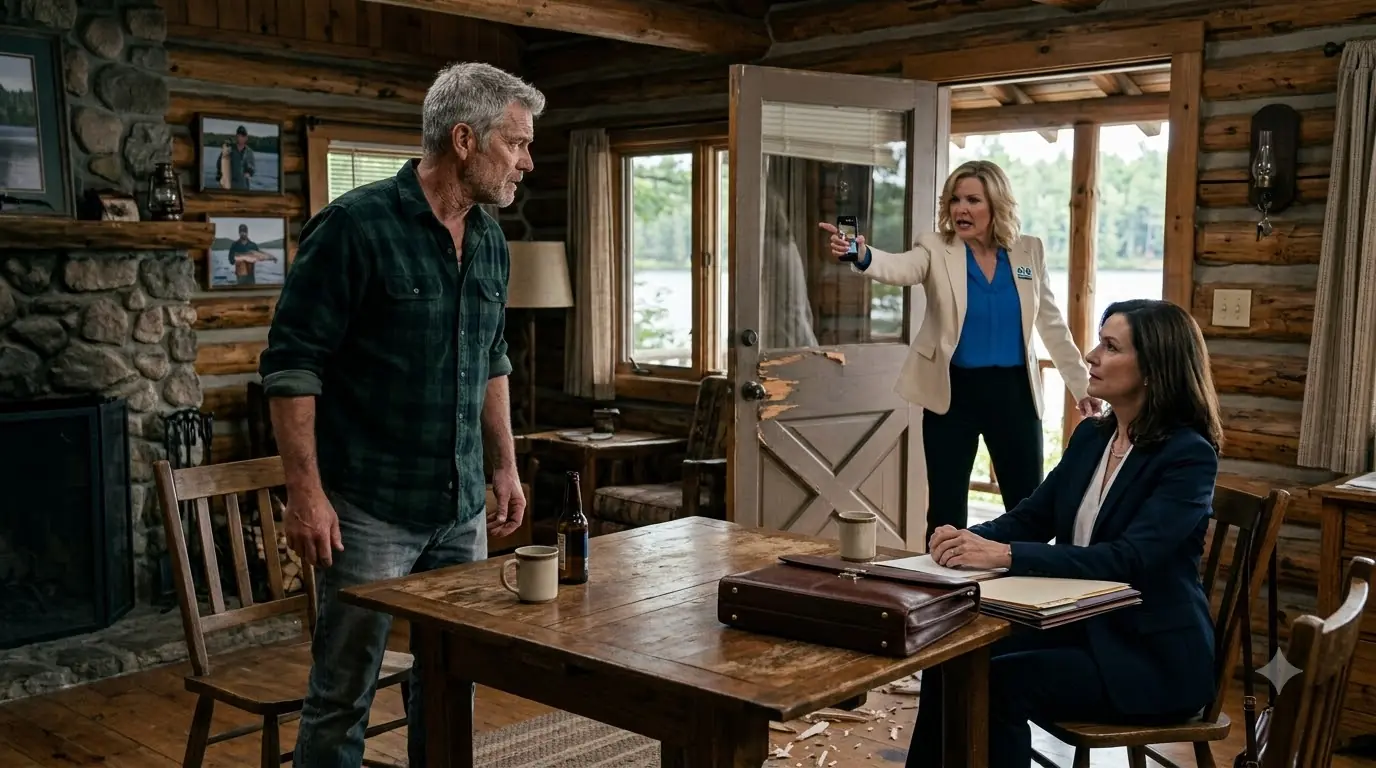
She had no idea who she had just barged in on, and she had no idea that the phone held high in her hand was live-streaming her own destruction to roughly 3,000 followers.
Six months earlier, I had thought Delila was simply another power-drunk neighbor. I had no idea she was sitting at the center of a multimillion-dollar embezzlement scheme, and I certainly had no idea that defending my grandfather’s fishing cabin would eventually help burn her entire operation to the ground.
My name is Marcus Henley. I’m 52 years old, and after 30 years of crawling through muddy trenches and installing power grids across three counties, I had finally earned my retirement. The crown jewel of that retirement was my grandfather’s fishing cabin on Clearwater Lake, two acres of pure heaven that Old Pop bought in 1963 for $800.
Eight hundred dollars for lakefront property that was now worth more than most people’s houses.
This wasn’t some fancy McMansion. We were talking about hand-hewn logs, a stone fireplace Pop had built with his own calloused hands, and a screened porch that creaked in all the right places. I had kept the property completely off-grid by choice, with solar panels humming quietly on the roof, well water that tasted like childhood memories, and a septic system that worked better than plenty of city setups I had seen.
The morning mist rising off the lake each day reminded me why Pop had chosen the place. He used to say, “The land picks you, not the other way around.”
Smart man.
He also used to tell me, “Marcus, when someone wants your land real bad, find out why. It’s usually worth more than they’re telling you.”
Then Delila Cromwell showed up.
Delila was 58, fresh from some California subdivision where apparently being a neighborhood dictator had been a full-time career. She rolled into our peaceful lake community like a tornado in designer clothing, driving a pearl-white Escalade with vanity plates that read RULE ONE. I’m not exaggerating. She also wore her HOA president badge on her blazer like it was a sheriff’s star.
The woman had one mission in life: transform our rustic lakefront into what she called an “upscale resort community.”
What I didn’t know then was that three elderly couples had already sold their cabins to interested buyers within two months of Delila’s arrival.
Funny coincidence.
Her first act of war came on a Tuesday morning. I was sitting on Pop’s porch drinking coffee and watching a pair of loons teach their babies to dive when I heard sharp clicking sounds on my wooden dock.
Designer heels.
At seven in the morning.
On my private property.
Ten minutes later, Delila was taping an official-looking notice to my screen door.
“Violation citation. Unsightly dock structure damaging community property values. Fine: $500. Compliance required within 72 hours or daily penalties will accrue.”
I had to read it twice.
My weathered dock, the same dock Pop and I had reinforced together when I was 12, was apparently an eyesore threatening the entire neighborhood’s real estate market. Being a reasonable guy, I walked over and explained that my property predated the HOA by about 40 years.
Delila planted her hands on her hips while standing in my own driveway.
“Everyone on this lake answers to me, sweetie. Ask the Hendersons how well fighting me worked out for them.”
The Hendersons were my elderly neighbors. They had mysteriously decided to “downsize” the previous month after living there for 23 years.
The pieces weren’t connecting yet, but something cold settled in my stomach.
That was when Delila began her photography session. She circled my cabin like a real estate appraiser, taking pictures of my solar panels, vegetable garden, dock, and even my grandfather’s hand-carved porch railings. The artificial air freshener drifting from her idling Escalade mixed with her perfume and made the entire encounter feel unreal.
By the end of the week, I had three more citations.
Each came with escalating fines. Each made it crystal clear that Delila Cromwell had declared war on everything my family had built on that land.
I figured I was dealing with a typical power-tripping neighbor.
Annoying, sure.
Manageable.
What I didn’t know was that I had just painted a target on my back in a game far bigger and more dangerous than petty HOA politics.
Pop’s words echoed in my head.
Find out why they want your land.
Three days after my compliance deadline expired, because I obviously wasn’t tearing down Pop’s dock for some wannabe dictator, a certified letter arrived that made my coffee taste like ash.
Cease and desist.
Violation of community waterway regulations.
The letterhead read Blackstone, Meyer, and Associates, one of those expensive law firms where the partners probably charged more per hour than I used to make in a month. The legal language claimed my dock extended illegally into a community waterway and that I owed $3,000 in retroactive violation fees.
They also threatened to place a lien on my property if I didn’t pay within 10 days.
My first instinct was panic.
These people had lawyers.
I had a toolbox and a bad attitude.
Then I remembered something Pop had drilled into me during those long fishing afternoons.
“Marcus, when someone’s trying to legal-talk you out of your land, the real truth is always in the county records. Never trust what they tell you. Go find the actual papers.”
So I drove to the county courthouse, down to the musty basement where all the important information gets buried beneath decades of bureaucratic dust. The clerk, a sweet woman named Betty who remembered Pop from his fishing tournament days, helped me pull the original property surveys.
I had learned something similar from my union days. Always check the source documents before some suit tries to buffalo you with fancy letterhead.
What I found made my blood boil.
My grandfather’s parcel didn’t stop at the water’s edge. According to the original 1963 deed, it extended 50 feet into the lake.
Stamped.
Recorded.
Official.
That dock wasn’t trespassing on community property. It was sitting squarely within my parcel rights.
Then came the real kicker.
The HOA had not been established until 1998, 35 years after Pop bought the land.
I remembered an old foreman explaining that older properties often carried rights that newer developments couldn’t simply erase. Whatever authority the HOA believed it had, it certainly hadn’t existed when Pop acquired that cabin.
Armed with copies of everything, I drove home feeling pretty proud of myself.
That satisfaction lasted until I tried to leave for groceries and found Delila’s Escalade parked sideways across my driveway.
Not beside it.
Not near it.
Directly across it.
She had positioned the vehicle like she was conducting a one-woman traffic stop.
When I knocked on her window, she lowered it just enough to speak through the gap.
“Oh, Marcus. I’m just reviewing the community parking regulations. This might take a while.”
The mechanical hum of her idling engine mixed with that sickly sweet air freshener and created a surreal little bubble of passive-aggressive insanity. Here I was, a grown man who had helped build half the county’s electrical infrastructure, being blocked inside my own driveway by an HOA president with a power complex.
Delila was only getting warmed up.
Within a week, she organized something called the Lakeside Beautification Committee. It sounded harmless until you realized it was essentially a pressure group aimed at anyone who didn’t fit her country-club vision.
Neighbors who had waved at me for years suddenly crossed the road to avoid eye contact.
Her Facebook posts became masterpieces of passive-aggressive warfare.
“Concerned about eyesore properties affecting all our home values.”
“Some people simply don’t care about the community.”
“Lakeside strong. Protect property values.”
The comment sections became feeding frenzies. People I had known for decades suddenly transformed into experts on property law, parroting Delila’s talking points like she was some kind of real estate prophet.
Three neighbors eventually apologized to me privately.
Tom and Susan Martinez pulled me aside during an evening walk and admitted that Delila had strongly suggested they complain about my property or face a citation blitz of their own. She had already targeted old Mr. Peterson over nonregulation window boxes and threatened a young couple with a baby because of what she called “unsightly playground equipment.”
“She’s got something on everyone,” Tom whispered, glancing around as though Delila might be hiding in the bushes with a camera. “Her husband works up at the state capital. Connected, you know. Political stuff.”
That hit me like a cold slap.
This wasn’t just neighborhood drama anymore.
Delila had reach beyond our little lake community.
That night, I found orange spray paint covering my mailbox.
COMPLY OR LEAVE.
My hidden solar-powered security camera had captured the vehicle that arrived during the night, including Delila’s license plate leaving the area around 2:30 a.m.
I called the sheriff’s office the following morning.
Guess who showed up?
Deputy Chad Cromwell.
Delila’s nephew.
He looked at the vandalism, shrugged, and said, “Probably just kids. You know how they are.”
The rough texture of dried spray paint under my fingers as I tried to scrub it away felt like sandpaper against my soul.
Pop used to say that sometimes a bigger fight required bigger help.
It was time to find some.
Delila’s next move came disguised as civic duty, which somehow made it even more infuriating. She had figured out that direct confrontation wasn’t working, so she decided to weaponize the entire county bureaucracy against me.
It started with a polite knock from building inspector Dale Morrison, a man I had actually worked with on several projects over the years. The awkward look on his face told me everything before he opened his mouth.
“Marcus, I’m real sorry about this, but I got a complaint about unpermitted structures on your property. You know I have to follow up.”
Three hours later, Dale had crawled through practically every inch of the cabin with his clipboard and measuring tape.
His conclusion was simple.
Everything was up to code, and much of it exceeded current safety standards.
Pop might have been old-school, but he built things to last.