Two officers were standing on my porch when I opened the front door, not knocking—standing, like they'd been there long enough to get comfortable with the situation. Behind them on the sidewalk stood Karen, arms folded, one finger aimed at my house like she was formally charging the building with something. 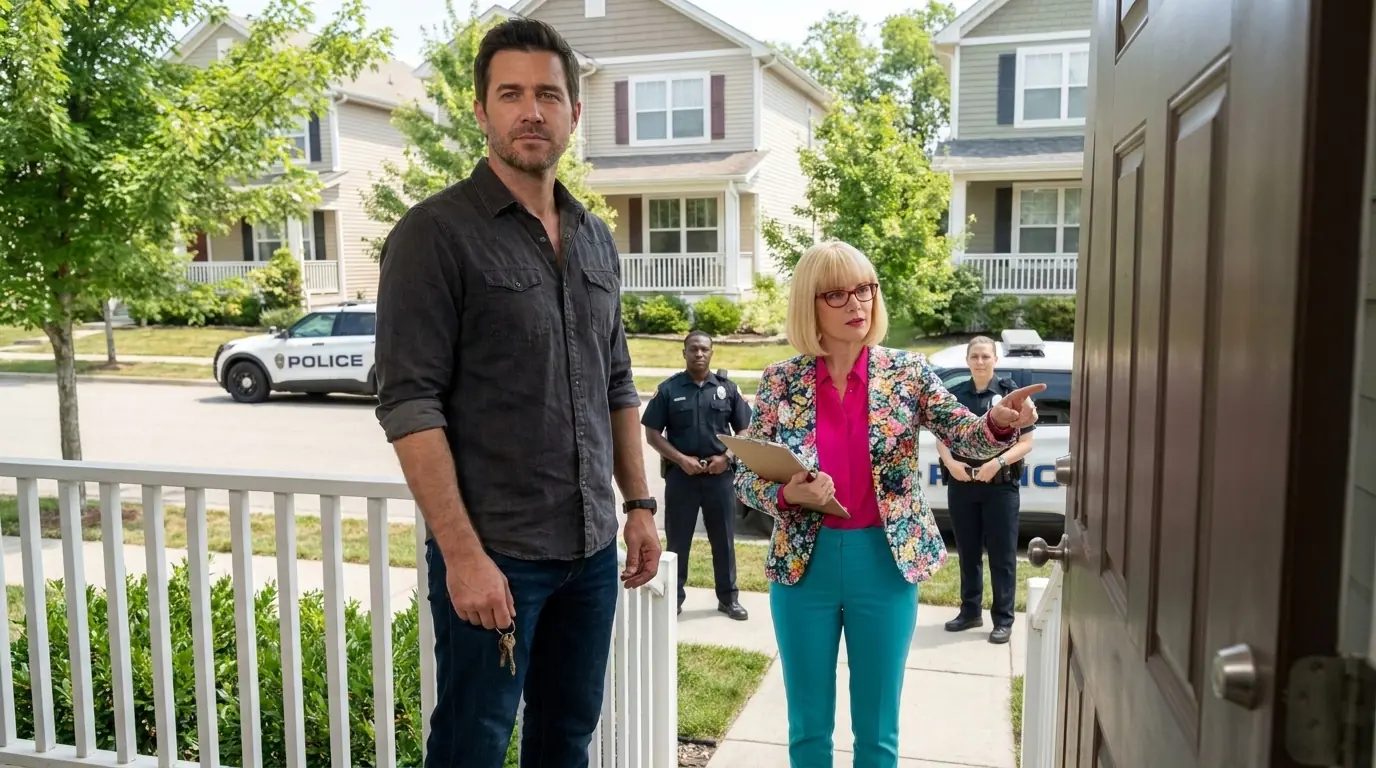
She was already mid-sentence: "He deliberately took down all of our security cameras. That is criminal tampering with community infrastructure. I want him cited."
I looked at the officers. One of them had the expression of a man who has driven somewhere and is quietly reconsidering the decision. I was holding a coffee mug. I had been watching something on my laptop. Forty minutes earlier, I had changed my Wi-Fi password during a routine security check—the same thing every IT guy on the planet recommends doing periodically.
That was it. That was the crime.
"Sir," the taller officer said, "would you mind stepping outside so we can ask a few questions?"
I stepped outside onto my own porch at the request of two strangers standing on it. Karen didn't lower her arm. She redirected it from the house to me, then to the door, covering all bases.
Four neighbors had stopped what they were doing. One was still holding a garden hose, water running quietly into the grass, forgotten. A woman two doors down had walked to the edge of her driveway and wasn't pretending she had a reason to.
"That router is connected to HOA property," Karen announced, not to anyone specific, just to the evening air and everyone standing in it. "He had no legal right to change the password without board approval."
She said it with the flat certainty of someone who has never been corrected in a room that had consequences. I didn't respond. I thought: *She is explaining my own router to two police officers, out loud, in front of witnesses, and she has absolutely no idea what's on it.*
The taller officer asked Karen what specifically had been affected. She said three HOA security cameras had gone offline at 6:47 p.m. She had the timestamp. She had a folder—an actual folder—which she opened with the practiced motion of someone who had planned this moment, and she produced a printed page. She had printed it before she called 911.
He turned to me. "Sir, did you change your network settings this evening?"
"I changed my Wi-Fi password," I said. "Routine update. The network is private residential property. My name is on the deed."
Karen came back immediately. "The HOA attorney has already been contacted. We are prepared to file a civil complaint, and I am formally requesting that this officer cite him under the state electronic interference statute for disrupting a lawfully installed security system."
The officer wrote something in his notebook. I watched Karen's face while his pen moved. She looked satisfied. Not angry anymore—satisfied. The way someone looks when the machine they built is running exactly as designed. Officers had arrived; a man was standing outside his own front door like a person being investigated; the folder had been useful. Everything was proceeding.
Through the open doorway behind me, visible on the hallway shelf, my router blinked green—steady and unhurried, the way it always did. Sitting inside a home Karen had no authorization to enter, connected to a network Karen had no authorization to use, storing a log file she didn't know existed.
The officer finished writing and looked up at me. "Sir, do you have any idea what devices might be connected to your network? Specifically, anything related to the HOA?"
I told him I'd check. I wrote down his name, Officer Daniels, and the case reference number he gave me when I asked.
Karen walked back across the street, folder under her arm, telling the officers she'd be following up with the HOA attorney and that this was far from over. She had called 911 to end my evening; she had no idea she had just handed me everything I needed to end her presidency.
The officers couldn't cite me. There was nothing to cite. One of them explained this to Karen with more patience than I could have managed. She received the information the way people receive things they've already decided are wrong. She thanked neither of them.
I went inside, closed the door, and stood in the hallway for a moment looking at the router on the shelf—still blinking, still steady. Then I sat down and opened the admin panel for the first time in months. What Karen had not considered, not for one second in all her timestamps and printed folders and interference statutes, was what would happen when the police asked to see the router logs.
The officers left without writing anything up. I watched the taillights of the patrol car disappear around the corner, then stood at the window for another minute. Karen's porch light was on. Her front door was closed. Somewhere inside, I imagined she was already composing a follow-up email to the HOA attorney.
I sat down at the kitchen table with my coffee, which had gone cold, and thought about how I had ended up here.
I had moved into this neighborhood fourteen months ago. Good school district, reasonable commute, the kind of quiet street where people wave from driveways without feeling obligated to stop and have a full conversation about it. The HOA had given me a moment's pause—it always does—but the fees were modest and the rules, when I'd read through them, seemed like the standard package of mostly harmless restrictions nobody takes particularly seriously.
And I had read through them. All of them. The full CC&Rs, the bylaws, the amendment history going back twelve years. Not because I was suspicious; I just read documents when I'm about to sign a mortgage. It's a habit, and it had served me well before.
What I noticed reading carefully was a gap. Several of the rules Karen enforced most aggressively didn't appear in the CC&Rs the way she described them. The language she cited in fine notices was loosely connected to real provisions—close enough that most people wouldn't catch it—but her interpretation stretched the original text well past anything a reasonable person would recognize. I had made a note of it on a yellow legal pad that I'd filed in a drawer in my home office. Fourteen months later, that legal pad was still in the drawer.
Karen had been board president for six years. The three-person board technically required for any enforcement quorum consisted of Karen, her husband Dale, and a woman named Patrice, who had been Karen's closest friend since childhood and who had never, as far as anyone could tell, voted against her on anything. Three separate votes: one decision made by one person, confirmed by two people who owed their board seats to her.
The neighborhood had ninety-four homes. Under Karen's tenure, the wrong mailbox color cost $250. A guest vehicle parked twenty-two minutes over the visitor limit got a fine notice taped—not mailed, taped directly to the windshield—so you came outside and found it waiting for you. Holiday lights left up one day past the board-approved January 7th takedown date generated a written warning, the first step on the formal escalation ladder.
I knew about the Garcias because I had met them at a block party six weeks after I moved in. They were in their mid-seventies, retired, warm—the kind of people who remembered the name of your dog and asked after it the next time they saw you. Nineteen years on this street. At some point in the last two, Karen had fined them $800 for a wind chime on their back porch. "Noise violation," she'd said, citing a specific bylaw number. Mr. Garcia had written it down, looked it up that evening, and found that the bylaw in question covered amplified music and outdoor speaker systems; it said nothing about wind chimes. He had written to Karen pointing this out politely, with the bylaw text copied in full. She had sent back a letter reaffirming the fine and noting that failure to pay within thirty days would result in additional fees. The Garcias had paid. Their attorney had quoted them a retainer that was more than the fine itself, they were retired on a fixed income, and Karen knew exactly what those numbers meant when she set the fine that high.
I knew about Kelsey because three separate neighbors had mentioned her to me, each time in that careful way people use when they're still trying to decide how they feel about something they witnessed. She was a first-year teacher, early thirties, who had bought her house two years back. There was a crack in her driveway—the normal kind, cosmetic, the result of two winters of freeze and thaw. Karen had fined her $450 and given her a thirty-day repair window. Every contractor Kelsey called was booked past the deadline. She'd written to the board asking for a sixty-day extension. Karen had denied it without explanation and placed a lien on her home. Someone had seen Kelsey standing at her own mailbox crying in the middle of the afternoon on a Tuesday, which meant she had left school during her lunch break to come home and deal with it. Three people had seen it. Every one of them had felt sick watching; none of them had known what to do about it.
Because that was the thing about Karen's system: it worked not just through fines, but through the certainty that fighting back cost more than giving in. She had built something that ran on that calculation.
That was the neighborhood I had moved into. What Karen called efficiency, the rest of the street called something else in careful voices to people they trusted.
As for my Wi-Fi, the actual cause of this evening's drama, the explanation was almost aggressively mundane. Two weeks earlier, I had noticed my connection running slower than it should. I checked the bandwidth logs, saw numbers that didn't match what I was doing, and ran a standard security update: new firmware, new network name, new password. The kind of thing every tech guide recommends doing every year, or whenever something looks off. I had done it in about twenty minutes while listening to the radio.
That evening, according to Karen, three cameras went offline.
I had not known those cameras existed. In fourteen months of living here, not one conversation, not one document, not one notice—nobody had mentioned a community camera system to me. No one had asked if HOA equipment could connect to my private residential network. No one had asked for anything.
My router had been logging every connected device since the day I moved in. Eighteen months of records auto-saved every thirty days to an external drive I kept for backups. I had glanced at those logs once or twice; I had never had a reason to look closely.
I had one now.
The question forming in the back of my mind wasn't yet fully shaped, but it had something to do with a simple fact Karen had stated out loud in front of two officers and four neighbors with complete confidence: that HOA cameras were connected to my private residential network. She had said it like it was normal, like it was authorized, like it was something that had simply been arranged. I wanted to know when, and by whom, and whether anyone else on the street had been asked.
The notice arrived three days later by certified mail. I signed for it at the door on a Thursday morning—a crisp white envelope with the HOA's letterhead printed in navy blue, the kind of formal packaging designed to feel official before you'd even opened it.
Inside was a single page. Karen had fined me $500 for "unauthorized interference with community infrastructure," citing Bylaw Section 7, Article 4.
I set the envelope on the kitchen counter and looked up Section 7, Article 4. It covered physical HOA equipment: entry gate motors, common area lighting fixtures, irrigation systems. It had been written to prevent homeowners from tampering with shared mechanical infrastructure. It said nothing in any sentence about private residential internet equipment. The word "network" did not appear in it. The word "router" did not appear in it. I read it twice to be sure.
Then I called Karen. She picked up on the second ring. That detail stayed with me afterward—the second ring. Not the fourth or fifth, the way you answer when you've been doing something else and your phone interrupts you, but the second ring, which is how you answer when you've been waiting.
"Karen," I said, "I received the fine notice. I'd like to understand the basis for it before I respond formally."
"The basis is clear in the notice," she said. Her voice was clipped and even—the voice of someone who had decided what the outcome of this conversation was going to be before it started. "You interfered with community infrastructure. The fine stands."
"The bylaw you cited covers gates and irrigation systems," I said. "I don't see how it applies to a private residential Wi-Fi network."
"Your network was connected to HOA security cameras," she said. "That makes it community infrastructure. You disrupted a system that protects ninety-four families."
She said "ninety-four families" the way you deploy a number you've preselected—not to inform, but to land; to make a password change sound like something a person had done to ninety-four other people.
"When you say the cameras protect the community," I said, "I want to make sure I understand what we're talking about. Can you tell me which cameras went offline and where they're installed?"
Two seconds of silence. Not the silence of someone thinking, but the silence of someone recalculating.
"That information is proprietary HOA property," Karen said. "You don't need to know."
I let that sit for a moment. She had just told me twice now, in two different conversations, that HOA cameras were connected to my private network. And when I asked where those cameras were, she told me the location was proprietary. Not the footage, not the data—the location. She didn't want me to know where they were pointing.
"I'll be reviewing the notice and responding in writing," I said.
"The deadline is ten days," Karen said. "If the fine is not paid by the fourteenth, the HOA attorney is authorized to move forward with a lien on your property." She paused. "Additionally, the board is formally requesting that you restore network access for the HOA security infrastructure. We need you to provide updated credentials for the cameras to reconnect."
I sat with that for a second. She was asking me formally, as a board action, to give the HOA permanent access credentials to my private home Wi-Fi network. Not a temporary fix, not a one-time reconnection—she was asking me to hand over my network password so that devices whose location she wouldn't disclose could continue running on my connection inside my home indefinitely as a condition of avoiding a property lien. She was asking for this like it was a reasonable request.
"I'll review the notice and respond in writing," I said again.
"The deadline—"
"Ten days," I said. "I heard you. Thank you, Karen." I hung up.
I sat at the kitchen table for a long moment looking at the HOA notice on the counter. Section 7, Article 4. Community infrastructure. Ninety-four families. Ten days.
Then I opened my laptop and pulled up the router admin panel. The log file went back eighteen months. The interface wasn't pretty—just raw data, timestamps, MAC addresses, connection durations—but it was complete. Every device that had ever connected to my network, the exact time it connected, and the exact time it disconnected, recorded automatically every thirty seconds it was live.
I started scrolling. Within the first few minutes, I found them: three MAC address sequences I didn't recognize. Not my phone, not my laptop, not the smart TV or the thermostat or any of the devices I'd set up myself. These three addresses had connection records going back fourteen months, running continuously twenty-four hours a day, seven days a week. They had connected to my network before I changed the password. They had connected before I moved in.
I cross-referenced the first six characters of each MAC address against the manufacturer lookup database—standard practice for identifying device type. All three prefixes came back the same: a commercial IP camera brand, mid-range, the kind used in small business and residential security installs.
Cameras. Three of them. Running continuously on my network twenty-four hours a day, seven days a week, for fourteen months—without my knowledge, without my consent, without a single sentence of disclosure in any document I had ever been given.
And then I looked at the timestamps more carefully. The earliest connection log for the first camera was dated sixteen days before I had moved in.
I sat back in my chair. These devices had been on my network before I had ever set foot in this house, before I had signed anything, before I had introduced myself to a single neighbor. Someone had connected them to this network while the previous owners were still wrapping up their move, or possibly after the house had already been vacated. Either way, they had been running, recording, and transmitting on my private residential connection from before the day I arrived.
I opened a new folder on my desktop. I took full screenshots of every log page, timestamped and sequential, all eighteen months. I saved them to a second external drive. I forwarded copies to my own email with the date and time in the subject line.
I was calm. I was very, very calm. I had fourteen months of logs. And somewhere in those logs was every device that had ever connected to my network, including whatever Karen was so desperate to keep proprietary.
The camera was on my fence post. I found it the morning after I pulled the logs, walking the full perimeter of my property in the early light, looking at every surface with the kind of attention you don't usually pay to your own fence.
It was on the back left post, the corner where my yard meets the common area walking path. Small, weatherproof, neutral gray—the color of something designed not to be noticed. Mounted with four screws I hadn't put there, angled in a way that gave it a clear sightline not just to the path, but straight to my front driveway. Someone had stood on my property with a drill, had measured the angle, had run a cable down the interior of the post and out through a small hole at the base, then buried the line. It was a clean installation, professional, the kind of job that takes about forty-five minutes if you know what you're doing.
I had walked past that post probably three hundred times. I stood there for a long moment without touching it. Then I took out my phone and photographed it from six angles: the mount, the screws, the cable routing at the base, the direction of the lens, and the surrounding area in both directions. I photographed the fact that there was no HOA notice anywhere near it. I photographed the section of fence it sat on, which was my fence on my property, listed by survey coordinates in the deed with my name on it.
Then I went to knock on Marcus's door.
Marcus had been on this street for eight years. He was the kind of neighbor who noticed things without making it a personality—methodical, quiet about it. He had mentioned once in passing that he still had every HOA notice he'd ever received filed in a binder by date. I had noted that detail about him the way you note things that might matter later.
He opened the door, and I held up my phone without saying anything. He looked at the photo for three or four seconds. Then he looked up at me.
"She put one on my fence post, too."
We stood in his doorway with that sitting between us for a moment.
"I asked her about it," Marcus said, "about two years ago. She told me it was part of a community security upgrade. She said all the homeowners had agreed to it in the annual meeting documents." He paused. "I never signed anything specifically. I figured the language was buried in something I'd skimmed. I let it go."
He stepped back and let me in. His router was an older model—no polished interface, just raw system logs in a text file he'd been auto-exporting every month. He'd started doing this, he explained, because his home office was a tax deduction and he'd read somewhere that network records could be relevant in an audit. He had never needed them for that. He needed them now.
I showed him what to look for. Same MAC address prefixes, same continuous connection pattern twenty-four hours a day, running across a timeline that matched almost exactly what I'd found in my own logs.
Marcus sat back in his chair and looked at the screen for a long time without saying anything. "I never gave anyone my password," he said finally. "Not Karen, not the HOA, not anyone."
"Neither did I," I said.
That landed differently than I expected. I'd known the logic of it since the night before: the only way those cameras could have been on my network was if someone had obtained my credentials without asking. But hearing Marcus say it in his kitchen, while his own logs showed the same pattern on his own screen—that was the moment it stopped being a theory. Someone had gotten into both of our networks, possibly others, and had been running devices on them continuously for years without a word to either of us.
We both understood what that meant. Neither of us said it out loud—not yet.
We went to the county's online permit portal next. It's publicly accessible, searchable by property address, covering every permit ever issued, including camera and surveillance system installations. Our county requires permits for permanent external camera installs on residential property before anything goes up.
I searched my address: no camera permits, ever. I searched Marcus's address: same result.
We pulled the HOA meeting minutes next. State law requires HOA boards to post minutes publicly within a set timeframe, and Karen's board had been compliant—four years of PDFs on the HOA website. We went through every one: no vote authorizing a camera installation program, no resolution, no homeowner consent process, no discussion of connecting security equipment to private residential networks. Four years of meeting minutes, and the program Karen had called "community infrastructure" didn't appear once.
She had installed cameras on private property, connected them to private residential networks without consent, and there was not one line in any official document that said the board had authorized it, discussed it, or told a single homeowner it was happening.
I went home and drafted my formal response to the fine notice. I disputed the $500 fine and quoted Section 7, Article 4 directly, word for word, showing why it didn't apply to private residential internet equipment. I formally requested written documentation identifying which devices had been connected to my network, the legal authority under which they'd been connected, and the board resolution authorizing the installation program. I gave a ten-day response deadline matching hers.
I printed two copies, signed both, kept one, drove to the post office, and sent it certified mail, return receipt requested. The clerk handed me the tracking slip, and I photographed it at the counter before I put it in my pocket. Fourteen months ago, I had read documents carefully and made a note on a legal pad. I was past note-taking now.
It was a quiet Tuesday afternoon. I drove home past the walking path behind my yard, past the fence post, and thought again about the angle of that lens—not toward the path, but toward my driveway.
That evening, Marcus texted me: *Two more neighbors just reached out. They heard something about cameras. Can they come by?*
I texted back: *Yes.*
This had stopped being about a Wi-Fi password some time ago. It had stopped being about a $500 fine. What it was about now was something Karen had built quietly over years on other people's property—with their fence posts, their connections, their electricity—without asking, without disclosing, without a single sentence in a single document that said she had the right. She had called it community infrastructure. The community was beginning to have questions about that.
Three days after my certified letter arrived at Karen's door, I received notice that she had filed a formal complaint with the county sheriff's office. I read it twice standing at the kitchen counter. Karen was alleging that I had intentionally disrupted a lawfully installed security system, citing a specific state statute that covered interference with electronic monitoring devices. She was asking the sheriff's office to investigate and pursue charges.
She was trying to get me criminally charged for changing my Wi-Fi password.
I set the notice down. I made coffee. Then I sat at the kitchen table and looked up the statute she had cited, word for word. The key phrase was in the second paragraph: the statute applied to systems that were *lawfully installed with the authorization of the property owner*.
*Lawfully installed. With authorization.*
I set my coffee down and read that phrase a second time. Because what it described—a system installed on someone's property using their credentials without their knowledge or consent—was not what I had done. I hadn't installed anything; I had changed a password on a network I owned. The phrase she had chosen as her legal weapon fit her situation considerably better than it fit mine. I didn't say that out loud yet, but I noted it.
Then I called Joel. Joel had spent twelve years doing network forensics and IT security consulting. I told him I had eighteen months of router logs and a criminal complaint, and asked if he had time to look at both. He came over that evening. He worked through the logs for about forty minutes, building a timeline. Then he gave me the plain-English version: the cameras had connected using the original network credentials—a password set before I ever moved in, obtained by someone who had access to this property or this account before I did. Under a separate state computer access statute, connecting devices to a private network without the owner's consent, regardless of what the device was, qualified as unauthorized access. The cameras had never been authorized by me. The statute Karen cited required lawful installation; these cameras had no authorization anywhere in the chain.
Joel said he'd have a written summary by Friday. I told him I'd need it notarized.
The following week, Diane knocked on my door. She lived three houses down. She'd heard through Marcus that people were finding cameras and had gone looking. There was one on her back fence—same model, same gray casing, same clean professional mount. The angle wasn't toward the common area; it was pointed directly at her backyard, where her kids played every afternoon.
She sat at my kitchen table with both hands around a coffee mug and said very little. She didn't need to. Two years of her children playing in the yard being recorded by a system she'd never been told existed, running on a network she'd never agreed to share. She had called her ISP twice in the past year trying to diagnose a persistent slowdown. Nobody had found a cause.
The Patels came by the next day: camera on their fence post, same story, slow internet, ISP calls, no explanation found until now.
Five households, five cameras—all on private property, all connected to private residential networks without permits, without consent, without a sentence in any official document.
It was Marcus who remembered the survey. We were all in his living room when he went quiet, with the particular expression of someone locating something they hadn't thought about in a while.
"The broadband survey," he said.
About fifteen months ago, Karen had sent out a community broadband assessment on HOA letterhead—a form asking residents to confirm their network names and speeds, framed as a study on whether the HOA should invest in shared infrastructure. It looked official. In the fine print at the bottom, in a paragraph about verifying signal quality for assessment accuracy, it asked residents to optionally include their current network password to allow for a direct speed verification test.
That was it. That was how she had done it. Marcus had included his password; he found the email in about two minutes. Diane checked her inbox; she had it, too. The Patels had theirs. Everywhere in the fine print was the word "optional" and the word "verification." Nowhere in the document—not in the body, not in the fine print, not anywhere—was there any mention of cameras, security systems, or connecting HOA equipment to private residential networks. She had collected their passwords under a stated purpose she had invented.
I formally requested Karen's documentation of the survey, its stated purpose, its data use, and any devices connected as a result, as part of my written response to the criminal complaint. I sent it certified mail. She did not respond.
The following morning, I called an attorney specializing in real estate and property rights. I laid out everything: the logs, the cameras, the survey, the criminal complaint, the statute, Joel's findings. He listened without interrupting.
"The complaint won't result in charges against you," he said when I finished. "The statute she cited requires lawful installation with your authorization. You have neither issue." Then he paused. "What you have on your end is worth a conversation with the county, specifically the detective assigned to her complaint. Because when they look into it—and they will look into it—what they're going to find is not what she expected them to find."
I thanked him and hung up. I sat with that for a moment. Not relief, exactly; I had known for days the complaint wouldn't hold. It was something quieter than relief: the recognition that the ground had shifted, and Karen didn't know it yet. Karen had filed a criminal complaint to stop me from asking questions. Instead, she had handed me a formal investigation and a detective who would eventually need to ask her, under documented inquiry, exactly which devices had been connected to my network and exactly how she had obtained the credentials to put them there.
The detective called me on a Wednesday. His name was Carraway, County Sheriff's Office, Civil Division. He was handling Karen's complaint and wanted a preliminary interview—standard procedure. Could I come in Thursday? I said yes.
I sat across from him for about forty minutes. He was methodical, unhurried—the kind of person who asked the same question two different ways, not to catch you in something, but to make sure he understood. He asked me to walk him through the evening of the password change and what I had found in the logs afterward. I told him I had eighteen months of router records. I told him I'd found unrecognized devices running continuously on my network for fourteen months. I mentioned Joel's written forensic summary, the permit portal search, the meeting minutes, and the broadband survey. I didn't lay out the full picture—not in a preliminary interview—but I gave him enough that when it ended, the question in the room was no longer about me.
As I was leaving, Carraway mentioned almost as an aside that Karen's 911 call wasn't the first contact his office had received from that address. I didn't ask him to expand on it, but I thought about it on the drive home.
Three days later, Karen sent an emergency meeting notice to all ninety-four households—*Mandatory Attendance* bolded, which wasn't standard. The topic: *Community Security Breach and Homeowner Non-Compliance.*
The community room in the clubhouse held about a hundred people with the chairs close together. I arrived six minutes early, and the room was already two-thirds full. People lined the back wall. Karen had set up the front the way someone does when they want the arrangement itself to say something: a folding table facing the chairs, Karen in the center, Dale on her right, Patrice on her left. In front of her was a printed map showing camera locations across the neighborhood, a timeline on HOA letterhead, and a manila envelope that I'd learn later held the HOA attorney's letter confirming the $500 fine as valid. She looked organized. She looked confident. She looked like someone who had already decided how this would end.
For the first four minutes, she had the room. She opened with the security angle: ninety-four families left unprotected because one homeowner had made a unilateral decision to change network credentials without board notification. She used the word twice. She called the criminal complaint a necessary step to protect community safety. She tapped the 6:47 p.m. timestamp on the printed timeline as if the time itself were evidence of wrongdoing.
I sat in the fourth row and watched her work. She was good at this: the posture, the rhythm, the practiced certainty. And I thought: *She built all of this on a network she never had the right to use. And she has absolutely no idea what's in those logs.*
Then Marcus stood up. He didn't raise his voice; he didn't wait to be recognized. He stood up in the third row and said, in the same conversational tone he used to talk about anything, as if he were asking about a parking rule: "Karen, can you show us the permits for those cameras?"
The room went quiet. Not the polite quiet of people waiting for an answer, but the specific quiet of ninety-four people having the same thought at the same moment, and nobody wanting to be the first one to say it out loud.
Karen said permits weren't required; the cameras were HOA property, a board decision covered under the security upgrade program.
Marcus said, "The camera on my fence post isn't HOA property. That's my fence post." Same tone, same even register—the kind of voice that doesn't need volume to land.
Two homeowners in the fourth row stood up. Then two more in the back. A woman named Harriet, who had been on the street longer than almost anyone, raised her hand and said she'd found a camera on her garage eave three days ago and wanted to know who had authorized that. Diane stood up. "There's one pointed at my backyard," she said, "where my children play every day."
The room did not go quiet this time. The room did the opposite.
Karen called the meeting to order. "Camera placement was a board matter," she said, "to be addressed in executive session at a future date. Homeowners with concerns should submit them in writing." She thanked everyone for attending and adjourned the meeting.
About forty people didn't move. They sat in their chairs and talked to each other in the way people talk when they've just realized that what they'd been accepting as normal wasn't. I saw two people photographing the printed map Karen had left on the table. I saw the Garcias talking quietly in the corner. Karen gathered her papers and left without looking at anyone.
I walked out to the parking lot. A man fell into step beside me—quiet, professional clothes, badge on his belt. "I thought I recognized you from the photo in the file," he said.
Detective Carraway. He had come to get community context; he hadn't expected the meeting to go the direction it went. He asked if I could come in this week and bring the router logs. I said Thursday worked. He nodded. Then, in the same measured tone: "The original 911 call that opened this complaint—it wasn't the first contact from that address. That's been a factor in how we're approaching this."
He said it like procedural context. He said it like it wasn't the most important sentence of the evening.
I drove home and sat in my car in the driveway for a moment before going inside. She had called that meeting to bury me in front of ninety-four witnesses. Instead, in front of those same ninety-four witnesses, she had been asked a question she couldn't answer. And the detective who was supposed to be investigating me had just asked to see my evidence.
I arrived at the sheriff's office on Thursday morning with a folder organized the way you organize something that needs to be understood by someone seeing it for the first time: chronological, labeled, nothing buried.
Carraway had a second person in the room—a junior attorney from the DA's office, introduced by first name only. They both had notepads; neither of them looked like they were expecting to be surprised.
I walked them through it in order. I started with the logs. I laid the screenshots across the table—eighteen months of records. The three MAC addresses isolated and highlighted, the connection timestamps running twenty-four hours a day without interruption for fourteen months. I showed them the manufacturer lookup: three commercial IP cameras, same brand across all five households. I showed them the first connection timestamp: sixteen days before I moved in. Carraway looked at that date for a moment without writing anything.
I gave him Joel's written forensic summary—four pages, notarized, the relevant statute cited at the bottom. The plain-English version was in the executive summary on page one: these cameras had been connected to a private residential network without the owner's knowledge or consent, using credentials that had never been provided to any HOA representative by the current homeowner.
Then I laid down the broadband survey. I let Carraway read the fine print paragraph himself. He read it twice. He passed it to the DA's attorney without comment. She read it, set it down, and pressed her pen flat against her notepad in the deliberate way of someone deciding not to react out loud.
Supporting receipts went down after that, one at a time, not to overwhelm, just to close doors: the county permit portal (zero permits at any of the five addresses); the HOA meeting minutes (four years, no vote, no resolution, no mention of the program); the physical camera photographs (my fence post, Marcus's post, Diane's backyard angle); and Karen's own cited statute highlighted at the phrase *lawfully installed with the authorization of the property owner*. I didn't explain that last one. I just set it down and let them read it.
Carraway capped his pen. "The complaint she filed against you is not going anywhere. I think you already knew that."
I said I had suspected as much. He nodded. Then he opened a manila folder of his own.
"When a complaint comes in citing a criminal statute," he said, "we run a standard background check on the filing party as part of due diligence. Call history, prior contacts, anything relevant to credibility." He turned the folder so I could see the first page.
Karen had called 911 five times in the past eighteen months. Every call had been HOA-related. Every call had been routed to the same district. Not one had resulted in a citation, a finding, or any action against any homeowner. Three of the responding officers' notes used variations of the same phrase: "No violation observed." The fourth call had a dispatcher flag: Karen had been verbally counseled regarding appropriate use of emergency services.
The fifth call was mine.
I looked at that for a moment: the number five, the date, the case reference that matched the notice I'd received in my kitchen three weeks ago. She had filed a criminal complaint against me, and in doing so, had handed investigators a reason to pull her full call history, which had been sitting in a file somewhere waiting for exactly this kind of reason to matter. Under state statute, a pattern of calls determined to be without reasonable factual basis, particularly following a prior counseling, met the threshold for a formal citation—a chargeable misdemeanor. Carraway had already processed it.
I sat with that for a moment longer than I needed to, just to let it settle. Karen had built a system of control on 911 calls, fourteen months of unauthorized cameras, and a fraudulent survey that collected people's passwords under false pretenses. And the thing that had finally pulled it all into the light, the one action that had given investigators a legal reason to look, was the criminal complaint she had filed against me for changing my own Wi-Fi password. She had handed the police a thread; they had pulled it.
I thanked Carraway, shook hands with the DA's attorney, and walked out into the morning. My phone rang before I reached the end of the block. Marcus. His voice had the particular quality of someone who is trying to stay level and mostly managing it.
"Karen got cited. The detective just left my house. He asked about my logs, confirmed my camera findings."
"I told him I knew."
"I told him what else had been in Carraway's folder."
There was a pause on the line. "Five calls," Marcus said. "Eighteen months."
"Five calls," I said.
That evening, the Garcias called me. Mr. Garcia had found the county HOA oversight office's complaint portal. State law gave homeowners the right to file grievance reviews when an HOA board was found to have engaged in unauthorized enforcement actions. He had scanned their $800 wind chime fine notice, attached the meeting minutes showing no bylaw authority, and submitted the complaint that afternoon. His voice was steady in a way that suggested he had been waiting two years for a reason to make that call.
Kelsey reached out through Marcus the following day. She had an appointment with a legal aid attorney—the first one she'd ever booked. She'd always assumed fighting the lien would cost more than it was worth. Now she had something to bring: a pattern of enforcement actions by a board president formally cited for misuse of emergency services. The attorney had said it changed the picture considerably.
By the end of the week, things were moving inside the board. Dale and Patrice had both retained their own attorneys—not to defend Karen. The HOA attorney sent a formal letter to all three board members advising that Karen should voluntarily step back from all enforcement actions pending resolution, and that the board's collective liability exposure had increased significantly. The HOA attorney had already withdrawn from Karen's personal representation. She had hired her own lawyer—a separate one, paid from her own pocket, not the association's. Her attorney sent Carraway's office a written response that raised procedural objections without addressing a single substantive finding.
Karen's husband, Dale, called me on a Saturday morning. His voice was flat and tired—the voice of a man who had been awake at night with something he couldn't put down. He said Karen "may have gotten carried away." He said it the way people say things they hope will function as an ending. He asked if there was any way to resolve this quietly.
I told him, as politely as I knew how, that the matter was with county authorities now, that I wasn't in a position to speak to what they would or wouldn't do, and that I hoped things worked out well for everyone. He thanked me and hung up.
I sat in my kitchen and thought about the word "quietly." It was always the word they reached for—the people who had been very loud for a very long time, right up until the moment when quiet stopped serving them.
The router was on the shelf in the hallway, still blinking green, still patient. It had remembered everything.
The formal citation arrived in my email on a Monday morning—a PDF from the county sheriff's office, three pages, addressed to Karen by her full legal name. Misuse of emergency services, a chargeable misdemeanor under state statute. The DA's office had reviewed the computer access file and declined to pursue criminal charges, citing an insufficient threshold for prosecution, but the cease-and-desist on the camera system was binding and immediate. All cameras had to be removed from private residential properties within thirty days. County code enforcement would conduct a verification sweep on day thirty-one.
I read it once, saved it to the same folder as the router logs, and closed my laptop.
The HOA attorney sent a letter to all three board members the following week: the $500 fine issued to me was not supportable under the cited bylaw and was formally voided. The board was also advised to reimburse my legal consultation fee—one documented billing submitted with a receipt. The letter did not use the word "apology" anywhere in its three pages.
The new board's first formal action, with a temporary quorum established by the three remaining members pending election, was to approve both reversals in a vote that took approximately twelve minutes. Dale abstained; Patrice voted yes. The third member, a homeowner named Gerald who had joined the board six months ago and had spent most of that time looking uncomfortable at meetings, voted yes without hesitation and with visible relief.
The Garcias' $800 wind chime fine went to county HOA oversight review within the week. The response came back in eleven days: the fine had no basis in the cited bylaw, enforcement had been improperly applied, and the amount was to be refunded in full. Mrs. Garcia called me when the check arrived. She said her husband had been in the garden when she opened the mail, and she had walked out and handed it to him without saying anything, and they had just stood there for a minute.
Kelsey's legal aid attorney filed a formal challenge to the lien the following month. The HOA, now operating without Karen's direction and with its own attorney pointing firmly toward settlement, did not oppose the challenge. The lien was removed. Kelsey sent me a text that said three words: *It's gone. Thanks.* I read it twice.
The total financial damage to the HOA—refunds, reimbursements, legal fees from the period when its attorney had to separate Karen's personal representation from the board's—came to somewhere around $4,000. Karen's personal exposure included the misdemeanor citation fine and her own attorney's fees.
Karen's resignation arrived by email on a Tuesday evening. Two sentences: she was stepping down from the board presidency effective immediately, and she thanked the community for the opportunity to serve. That was it. No acknowledgment of the cameras, no acknowledgment of the survey, no acknowledgment of the five 911 calls, or the Garcias, or Kelsey, or the fence posts belonging to people who had never agreed to have anything mounted on them. Two sentences, and then silence. I hadn't expected an apology, but I noticed its absence the way you notice when something that should carry weight simply isn't there.
The first genuinely open board election in six years drew eleven candidates for three seats. Marcus ran; Diane ran. The results came back on a Friday afternoon: Marcus won by a comfortable margin, Diane won by a larger one, and the third seat went to a retired civil engineer named Thomas, who had been fine-adjacent for two years and had apparently been waiting for exactly this moment.
The first meeting of the new board was scheduled for a Wednesday evening. It ran forty minutes.
Afterward, Marcus texted me from the parking lot: *40 minutes. We have donuts now.* HOA meetings had never had donuts. He sent a second text a minute later: *Half the street is still out here just talking. Hasn't happened after a meeting in six years.*
I was sitting on my front porch when I read both of them—the same porch where two officers had stood on a Tuesday evening while Karen pointed at my house from the sidewalk. The same boards, the same railing, the same quiet street.
I sat there for a while after it got dark, just listening. Someone three doors down had their windows open. A dog barked somewhere at the end of the block and then stopped. The neighborhood had a specific sound when people weren't afraid of it—unhurried, unguarded, the ordinary sound of people living inside their own evenings without calculating what it might cost them.
I thought about Karen's line—the one she had delivered to the officers in the street and everyone in earshot on that first evening with the flat certainty of someone who had never been told she was wrong somewhere it counted: *"That router is connected to HOA property."*
It wasn't. It had never been.
The router was inside my house on the hallway shelf where I had put it fourteen months ago, connected to a private residential network registered to my name and no one else's. It had been doing what routers do from the first day I moved in: logging every device, storing every timestamp, remembering every connection—patient and indifferent and thorough in a way that Karen had not anticipated when she pointed her finger at my door. She had been so certain of what she was saying that she hadn't considered what the device she was describing might tell anyone who looked at it closely.
I went inside. The hallway was quiet. The router was on the shelf blinking green—the same as it had been the night she called 911, the same as it had been every night before and after, recording everything, waiting for nothing in particular, doing exactly what it had always done.
In the backyard on the fence post where the camera had been, there was a small rust mark—four pale circles where the bracket screws had pressed into the wood for two years. I had looked at it a few times since the county contractor came with his tools on a Tuesday morning and took the unit down without ceremony. I hadn't cleaned it off. It was a reminder, not of what Karen had done, but of what documentation could do when someone finally decided to look.
The rust mark would fade eventually. Most things do. For now, it seemed like a useful thing to keep.