"This is our lake. You don't belong here." She said that to my face.
The woman had never met me, didn't know my name, but she looked me dead in the eye and told me I didn't belong. Standing on the shore of Mill Lake, deed in hand, my name on the title.
The woman had never met me, didn't know my name, but she looked me dead in the eye and told me I didn't belong. Standing on the shore of Mill Lake, deed in hand, my name on the title.
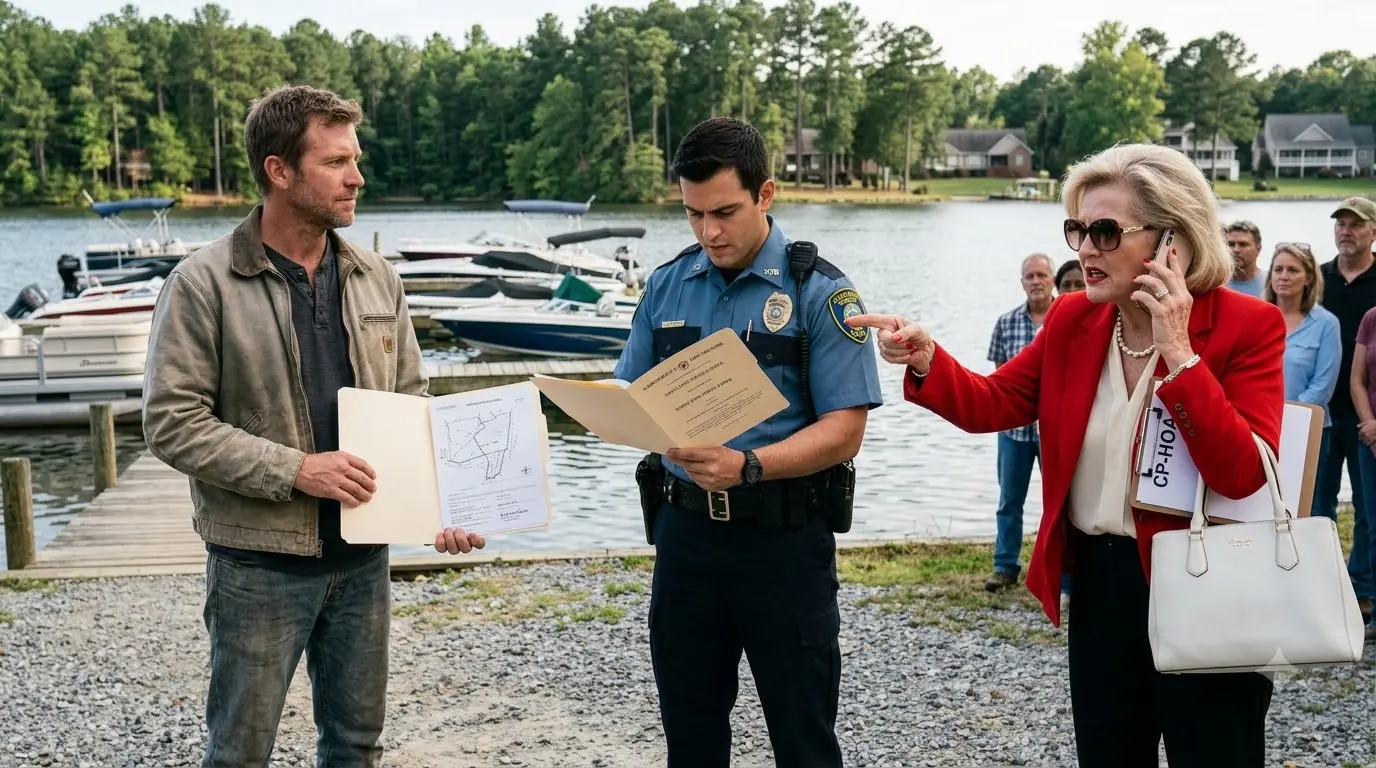
Behind her, 11 boats on my docks, 11 families, 11 summers free. No contract, no payment, not even a dollar. Dolores stepped closer, jabbed her finger at my chest, started waving the neighbors over. "Everyone, this man is trying to take our lake." People came out of their houses and started staring.
Then she dialed 911. "Officer, there's a man trespassing on our community property. He's refusing to leave. Please hurry." The officer came, read my deed, looked at her, said nothing.
24 hours later, 11 boats, zero docks. And Dolores? She did that to herself. You need to understand what Mill Lake actually is before you understand why any of this happened. It's not a glamorous body of water.
It's not the kind of lake that ends up on postcards. It's 6 acres of dark, cold fresh water tucked into a wooded corner of Clearwater Pines, a planned subdivision about 40 minutes outside of Fredericksburg, Virginia. The lake smells like pine resin and mud in the summer. In the morning, mist hangs low over it, and the frogs go absolutely insane.
There's a rusted boat launch on the east bank, and a short dock on the north side that's been repaired so many times with mismatched lumber, it looks like a Frankenstein project. I loved it immediately. I found it through an estate sale listing buried on the third page of a county property auction site. The owner, a man named Harlan Beaty, 81 years old, no heirs, had passed the previous winter.
The lake was listed as a separate parcel from the surrounding HOA land. It always had been. Harlan had owned it since 1987 and the subdivision had grown around it, the way a river grows around a stone. For years, residents had used the lake informally. The docks, the fishing, the Fourth of July pontoon parade, all with Harlan's quiet permission.
He'd never charged them. He was a generous man who liked being liked. I paid $47,000 for a 6-acre private lake with riparian rights, bottom rights, and a clear title. For context, the HOA had been paying Harlan exactly nothing. So had everyone with a boat on that dock.
I grew up in Zanesville, Ohio in a house where my father worked double shifts at a stamping plant and my mother clipped grocery coupons like it was her second job. I am not a man who is handed things. I got my GED, went into construction, worked my way up to foreman, got burned by a contractor who walked off a job with $80,000 of my money, and spent the following 2 years learning everything about property law, contracts, and what it means to actually own something. That experience was expensive.
It was also the best education I ever received. When I closed on Mill Lake, I felt something I hadn't felt in a long time. Quiet. Like the thing I'd been building toward finally had a shape.
I gave the HOA 1 week before they made their first move. The letter arrived on a Tuesday. HOA letterhead, clean and officious, signed at the bottom in aggressive blue ink. Dolores Schrank, board president, Clearwater Pines Homeowners Association. Dolores.
Let me paint you a picture. 64 years old, retired branch manager from a regional bank, the kind of institution that charges you $12 to use your own money. She'd been on the HOA board for 9 years and president for 6. Her front lawn looked like a putting green. She drove a white Cadillac SUV and was known in the neighborhood for leaving printed notes on people's doors when their trash cans weren't brought in by 6:00 p.m. on collection day.
The letter informed me, politely, in the way a threat is sometimes dressed in a blazer, that residents and guests accessing Mill Lake had historically operated under a community use arrangement and that the board would require me to submit a lake use permit application before continuing operations. The permit fee was $1,200, renewable annually, subject to board approval. Subject to board approval. For my own land. I read it twice.
Then I read it a third time. Then I set it on the kitchen table next to my deed, my riparian rights documentation, and my title insurance certificate, and I made a pot of coffee. The gravel crunched under my boots when I walked out to check the dock that evening. 11 boats, none of them mine. I started making calls.