The police cruiser rolled to a stop in front of my house at 9:14 on a Saturday morning. My wife Claire was in the driveway in a gray hoodie and jeans, crouched over the garden bed along the front walk pulling weeds. She had her old gardening gloves on, the green ones with the rubber grip. A small pile of dandelions sat beside her knee. Margaret Holden was standing six feet away holding an orange HOA violation notice in both hands like she was presenting evidence at a trial she’d already won. “You need to vacate this property immediately,” Margaret said. “This is not a request.”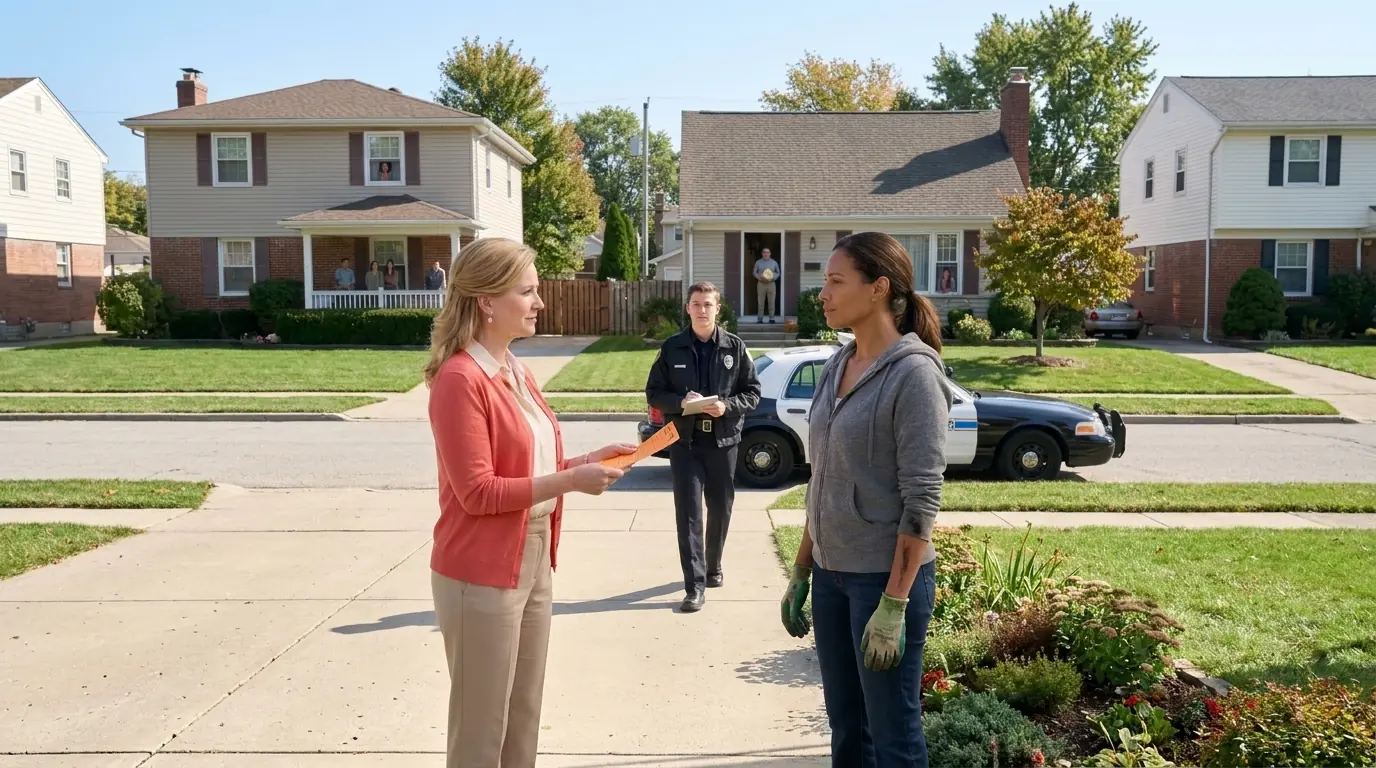
That was the first thing I heard when I opened the front door: “Vacate this property.” It was said to a woman whose name appeared on the deed, the mortgage, and the county property-tax record for the house in front of which she was kneeling. It was said by a woman who had none of those things.
I stood in my doorway and said nothing. I was thinking very clearly. The officer stepped out of the cruiser. He was young, in his early thirties, wearing a dark jacket, his hand already moving toward his notepad by reflex.
He walked toward the driveway with the steady, unbothered pace of someone who had handled HOA calls before and expected nothing more complicated than a noise complaint. Just another Saturday. Margaret turned toward him the moment his feet hit the pavement.
“Officer, thank you for responding. That woman right there does not belong here. She has been refusing to comply with repeated board directives. I have a signed removal order and a formal complaint, and I need you to have her escorted off this property immediately.”
She said “that woman” the way you would say “that vehicle” or “that obstruction”—a thing to be cleared. I want you to understand what Margaret believed in that moment.
She believed she had done this successfully before. She had. Three families in two years had been fined, pressured, and leaned on until they sold and left quietly. She had stood in this same neighborhood with similar pieces of paper and made similar calls and it had always worked. She had no reason standing there on a September morning with her orange notice and her certainty to think this time would be different.
The officer kept walking toward us. Then he stopped. Not slowed, stopped. His hand dropped away from the notepad and fell to his side. He looked at Claire.
Claire had stood up by now, gardening gloves still on, a faint streak of soil across her left wrist, and she looked back at him. Three full seconds. I counted them. I'm not sure why. Maybe because in seven months of watching Margaret Holden operate in this neighborhood, I had never once felt time behave the way it did in those 3 seconds.
Something shifting, something heavy finding its level. Margaret was still talking. “She has refused every notice, ignored the board’s formal vote, and I have documented this extensively. So what I need from you right now is—”
The officer straightened. It was a small adjustment, shoulders back, chin up, but it was unmistakable if you were watching for it.
The posture of a man who has just understood exactly where he is, who has just recalculated the entire situation in the span of one look. Margaret was not watching for it. She held the orange notice out toward him, expecting him to take it. He didn’t take it. He was looking at my wife the way you look at someone when the story you had in your head and the person standing in front of you are two completely different things.
I would later pull the recording of her 911 call. She had told the dispatcher that there was an unauthorized woman at this address, refusing to vacate a property under HOA jurisdiction, and she needed to be physically removed. Delivered with complete practiced confidence, the confidence of a woman who had done this before and always gotten the result she wanted. She had no idea she just called 911 on the woman who commanded those officers.
Let me take you back seven months, because what was about to happen in that driveway had been building since the day we moved into Meadowbrook Heights. And it started the first afternoon Margaret Holden looked at my wife and quietly decided she didn’t belong here. I want to tell this story the right way. I want you to understand exactly what kind of person Margaret was, what she had done to this neighborhood over eight years, why 14 of our neighbors showed up at a board meeting they'd never attended before, and why the moment that officer's hand came away from his notepad was the most quietly satisfying 4 seconds I've ever stood still for. She assembled every piece of this herself, every notice, every fine, every phone call.
She spent seven months trying to drive Claire out of our home through paperwork and pressure and two separate 911 calls. And when none of that worked, she picked up her phone on a Saturday morning in September and tried one more time. The officer's hand came away from his notepad and I saw something move across his face that I had never once seen in seven months of dealing with Margaret Holden, genuine, unavoidable recognition. She had called 911 on the wrong woman. She just didn’t know it yet.
Meadowbrook Heights was built in 2003. Ninety-six homes on curving streets with names like Willowbrook Lane and Crestfield Drive. Good school district, mature trees, the kind of subdivision where the lawns are always trimmed and the fences all match and everything looks from a distance like exactly the kind of place you'd want to raise a family. It took us about 3 weeks to understand what was actually holding it together. Claire and I had been looking for a house for almost a year.
Both our names on the deed, both names on the mortgage, a clean title and standard documentation. We moved in that weekend with a rented truck and the help of a couple of friends and by Sunday night, we had furniture in every room and a bottle of wine open on the kitchen counter. By Monday afternoon, there was an orange notice taped to our front door. Violation notice, unapproved commercial vehicle in residential driveway. The vehicle in question was Claire's work vehicle, a dark blue SUV state issued, parked on our own private driveway, not blocking the sidewalk or the street, not leaking anything, not making any noise, parked on our property.
I called the county zoning office the next morning. The woman I spoke to looked up our address, looked up the HOA's filed covenants, and told me clearly there was no restriction on state or government vehicles in private driveways, not in the county code, not in the HOA's own recorded documents. I wrote to the HOA explaining this. I was polite. I included the zoning office contact's name and the specific covenant section she had referenced.
I thought that would be the end of it. Four days later, a second notice arrived. Violation notice, failure to respond appropriately to HOA communication. I read that one twice. Then I set it on the kitchen counter next to the first one and went to make coffee.
That was the moment I understood what kind of neighborhood we had moved into. Not the first notice, that could have been a mistake, overzealous enforcement, a new resident getting flagged by an automated system. But the second notice, issued in direct response to a documented, factual, politely worded rebuttal that told me exactly who I was dealing with. Margaret Holden had been HOA president for eight consecutive years. She ran unopposed six of those years.
The two elections where she had a challenger, I would later pull the meeting minutes, both challengers withdrew before the vote. One withdrew the same week they received a $400 fine for a fence post that was allegedly one inch too tall. The other withdrew after receiving three violation notices in 10 days. The minutes recorded the withdrawals as voluntary. They probably were, technically.
That’s how Margaret operated. She didn’t force anything. She just made the alternative expensive enough that people chose the outcome she wanted. Her enforcement toolkit was straightforward. First came the notices.
Grass an eighth of an inch over the limit, holiday decorations left up three days past the HOA calendar, a trash bin visible from the street for more than 4 hours on collection day. Then came the fines. $200, $300, $500. Then for the ones who pushed back, the lien. A lien filed against your property is not a judgment, but it sits on your title like a bruise.
It complicates refinancing, complicates selling, and costs money to remove even if you win. Most people, when they saw a lien notice, did the math quickly and quietly. Sold. Three families in two years had done exactly that. The Petersons lived four houses down. They were a nice couple with two children who moved in around the same time Margaret started her sixth term. They pushed back on a fine. Margaret filed a lien. 14 months later they sold at $11,000 below market value and left. Ted, the retired man across the street, told me later that Margaret had watched them load the moving truck from her driveway.
“Like she was checking something off a list,” he said. The Wynns were on the other side of the development. Margaret called police on them twice in 6 weeks. Once for suspicious activity, once for unauthorized gathering. The responding officers found nothing actionable either time.
The Wynns had two elderly parents staying with them during a medical situation. They left after the second call, sold in 30 days below asking. Then there were the Garcias, an older couple on a fixed income, who couldn’t afford the attorney fees to fight the lien Margaret filed after they tried to add a wheelchair ramp without prior HOA approval. Their daughter told me about it later. She said her parents were too tired and too scared to fight.
They sold to a property company for a price nobody was happy about. Margaret sent them a formal goodbye letter on HOA letterhead. I thought about those three families the night I found the second violation notice. I thought about how each of them must have stood in their kitchen at some point holding a piece of paper that seemed absurd and feeling completely alone with it. Margaret's problem with Claire was not the driveway.
I understood that quickly. Claire doesn’t perform. She doesn’t do small talk at the Saturday morning coffee gatherings Margaret hosted. She works hours that don't fit the neighborhood's rhythm and she has a quality of stillness about her that some people find reassuring and others find threatening. When Margaret waved from her driveway the second week we were there, Claire was already walking back inside and didn’t see it.
Margaret noticed. I know she noticed because I watched her face. She had decided by some private internal accounting that had nothing to do with any written rule that Claire didn’t fit. And she had a documented 8-year record of making people who didn’t fit eventually disappear. What she didn’t know, what I had not told anyone in Meadowbrook Heights, not in passing conversation, not on the neighborhood app, not in any of my written responses to her notices, was anything at all about who my wife actually was. I had my reasons for that. So did Claire.
Six weeks after we moved in, Margaret Holden came to my front door on a Tuesday evening. She didn’t come alone. Two board members flanked her. A heavy-set man in his 50s named Dale who served as HOA treasurer and a younger guy, late 20s, whose name I later learned was Ryan. Dale had the expression of someone who had done this enough times to stop feeling anything about it.
Ryan had the expression of someone who had not yet done it enough times to stop feeling everything about it. Margaret stood between them with a clipboard pressed against her chest and the practiced composure of a person who had rehearsed what she was about to say. She rang the bell twice and then knocked anyway. I opened the door. Claire was still at work.
“Mr. Calloway.” Margaret’s voice was cordial in the way a final notice is cordial—technically polite, carrying its real meaning underneath. “We’re here because there is a matter that needs to be resolved, and we have been patient about it.”
I waited.
“There has been an inquiry,” she said, “regarding the woman who has been occupying your property. We need to establish whether she is a legal resident or an unregistered tenant. The HOA has a process for this. It is standard.”
I want to be precise about this moment because it matters. She called Claire—my wife, whose name appeared directly above mine on our county deed—“the woman who has been occupying your property.” She said it without any apparent awareness of how extraordinary that sentence was. She said it the way you might say the leak in the ceiling or the crack in the foundation: a problem to be classified and managed.
I kept my voice even. “My wife is on the deed and the mortgage. This is her home.”
Margaret’s expression did not change. “That may be the case with the county record, but we have our own verification process. The HOA requires documentation of all residents, and we have not received it.”
I pulled out my phone. I had the county assessor’s page bookmarked. I had saved it two weeks earlier, after the second violation notice, because I already understood that I was going to need records of everything. I pulled it up, turned the screen toward her, and showed her both our names on the property record—current, confirmed, linked to the parcel number, street address, and date of transfer.
Margaret looked at the screen for a moment, then looked away. “That is a county record. That is not HOA verification. We have our own internal process, and until that process is completed, the status of the occupant remains unresolved.”
“She is not an occupant,” I said. “She is a co-owner. Those are legally different categories.”
A pause.
“I understand your position,” Margaret said, in the tone of someone who did not intend to be influenced by it.
She reached into the clipboard and produced a printed notice—yellow this time, not orange. She held it out toward me with two fingers. “This is a formal fine for unauthorized occupancy, unresolved after two prior notices. The amount is $500, due within thirty days.”
I took the notice.
I looked at the violation category. It read, “Unauthorized occupant, unresolved after prior communication.” The prior communications she was referencing were the two vehicle notices. There had never been an occupancy notice. She had invented the category, attached it retroactively to the prior notices, and presented the result as a documented escalation.
It was, in its own way, almost elegant. A paper trail assembled to look like a process. I signed receipt of the notice, not acknowledgement of its validity, just confirmation that I had received it, and said nothing further. I was making a mental note to scan it within the hour, and logged the date, and the fine category, and the exact wording, every detail. Margaret turned to go.
Then she stopped. “Mr. Calloway.” Her voice dropped slightly—not to a whisper, but to something more deliberate, a register she reserved, I would come to understand, for the line she wanted to land. “I have had people removed from this community before. Good people who simply were not a fit. I do not enjoy that process, but I will use it if I have to. This neighborhood has standards, and it is my responsibility to maintain them.”
She held my gaze for exactly long enough, then turned. She and Dale walked back toward the street. Ryan, the younger board member, was last.
He moved a step slower than the other two. As he turned to follow them down the path, he glanced back at me just once, briefly, the way you glance at someone when you want to say something, but have calculated that this is not the moment to say it. Something in his face that wasn’t entirely comfortable with where he was standing, or who he was standing with. I filed that look away, not because I knew what I’d do with it, just because I was filing everything. I closed the front door and went to my desk and wrote down Margaret's exact words in my log.
I have had people removed from this community before. This neighborhood has standards and I intend to maintain them. I put the time, 7:22 p.m., and the date, and the names of both board members who'd been present. Then I scanned the fine notice and saved it in the folder I’d started labeling without any particular optimism at the time, H O A for later. Claire came home at 10:15.
She found the yellow notice on the kitchen counter where I had left it. Still wearing her jacket, she read it standing up, the way she reads anything handed to her in a professional context—quickly, without expression, taking it in and processing it simultaneously. Then she set it down.
“I’ll make a copy,” she said.
That was all.
She went to get a glass of water. I watched her move through the kitchen and thought about the tone of those four words. Not, “This is outrageous,” or, “Who does she think she is?” or even, “What are we going to do about this?” Just, “I’ll make a copy.” The reflex of someone who had spent her entire career understanding that documentation was not optional, that the record was the thing that the person who kept the better file almost always won. I had married, it turned out, exactly the right person for this particular situation. I just didn’t fully appreciate that yet.
The morning after Margaret's visit, I was in the front yard before 8:00 checking the mailbox for no particular reason, mostly just needing air and something to do with my hands, when I heard footsteps on the pavement across the street. Ted Garber was 71, retired from a career in civil engineering, and had lived at 17 Crestfield Drive for 11 years. He was the kind of man who moved deliberately and spoke the same way, no wasted motion in either. He crossed the street with his hands in his jacket pockets and stopped at the edge of my driveway. “You get a visit from the clipboard woman last night?” he said.
I looked at him. “We did.”
He nodded once slowly, the way you nod when you have been expecting something unpleasant and it has finally arrived. “I saw her car in front of your house and figured I should come over.” He paused. “You want to know what you are dealing with.”
I told him I did. He talked for forty minutes. The Petersons, he said, were a good family—two children, a dog, and a basketball hoop in the driveway that Margaret cited three separate times for aesthetic noncompliance.
The father, David, a software engineer, pushed back on a $300 fine for a grass height violation, sent a letter, cited the actual HOA measurement standards, showed photographic evidence that his lawn was within specification. Margaret filed a lien against their property within the month. Not because the lien was legally solid, it wasn’t, Ted said, and David apparently knew it, but because David had a mortgage payment, two kids and activities, and no budget for an attorney to fight it. He held on for 14 months. Then he sold, 11,000 under market to a buyer who made a fast offer and didn’t ask questions.
The morning they loaded the moving truck, Ted watched from his porch. Margaret stood in her own driveway the entire time, like she was checking something off a list, Ted said. Never went over to say goodbye, just watched. I wrote down everything Ted told me. Not on my phone in a small notebook I’d started keeping in my desk drawer after the second violation notice.
I wrote down the Petersons' timeline, the fine amount, the lien, the sale. I wrote down Ted's name and the date of our conversation and the fact that he was willing to put it in writing. He was, he said, when I asked. He'd been waiting for someone to ask. That afternoon Sarah Okonkwo knocked on my door.
She lived three houses down, 3two years old, a registered nurse, two kids of her own. She came with a manila envelope. Margaret had called police on her son twice. The first time Marcus was 15 and skateboarding on the sidewalk in front of their house. The sidewalk in front of their house.
Margaret told the dispatcher he was on HOA recreational property without authorization and was refusing to leave when asked. The officers who responded noted in their report residential sidewalk, no violation, no further action. Marcus had walked inside before they even got out of the car. The second call came 3 weeks later. Marcus was sitting on the front steps eating a sandwich waiting for a friend to pick him up for school.
Margaret called it in as loitering. Same result, officers responded, found nothing, noted it, left. Sarah had both reports. She’d filed a public records request at the precinct after the second call. Something her brother-in-law, a paralegal, had told her to do immediately.
She pulled the printed copies from the envelope and handed them to me with the particular steadiness of a person who has been angry about something for a long time and has learned to carry it flat. “I didn’t know what to do with them,” she said. “I didn’t think there was anything I could do. I just wanted to have them in case.” I told her I was glad she had them.
I asked if I could make copies. She said to keep the originals. That evening I sat at the kitchen table with everything laid out in front of me. Three of our own violation notices, the yellow $500 fine with Margaret's signature across the bottom, the printed county assessor confirmation of our deed, Ted's account which he’d written out by hand on two pages of lined paper and dropped off before dinner, Sarah's two police call logs, the HOA meeting minutes I’d pulled from the association's own website the previous week. Eight years of selective enforcement, challenger withdrawals, fine histories, all technically public record and never once assembled by anyone into a single document.
I started a spreadsheet. Every incident, every date, every amount, every name. I labeled the columns date/incident/action taken/documentation type/source. By 10:00 p.m., I had twenty-three rows. Claire came home at 10:30.
She stood behind my chair for a moment and looked at the screen without saying anything. Then she set her bag down on the chair beside me, opened it, and took out a folded piece of paper. “I've been meaning to give you this,” she said. I unfolded it. Her handwriting was clear, precise, and slightly compressed, the way it always was when she wrote quickly with purpose.
Two license plate numbers, a time, 8:47 a.m., a date from three weeks earlier, a morning I remembered vaguely as unremarkable, and a single line beneath the plates, “Board members photographing vehicle on private property without consent or notification.” I looked up at her. “The morning after the first notice,” she said. “Dale and another one were at the end of the driveway with their phones.” She sat down and pulled her laptop toward her. “I was in the kitchen. I wrote it down.” I added the entry to the spreadsheet. I added a column for witness and typed her name in the field. Then I looked at the growing list of rows on my screen and had the quiet clarifying thought of a person who has just realized they are no longer simply waiting for something to end. I was building a case.
The certified letter arrived on a Tuesday morning in week nine. I recognized the format before I finished reading the return address. Stiff envelope, legal weight paper, a law firm name I didn’t know in a city forty minutes away. The kind of letter that is designed to feel official and final before you've even opened it. I opened it at the kitchen counter.
Notice of lien filing, 14 Crestfield Drive. Margaret Holden, acting in her capacity as HOA board president, had filed a formal lien against our property through an HOA retained attorney. The stated basis, cumulative unresolved violations totaling $2,800. The violations listed were itemized across eight bullet points. I went through them slowly.
Three of the eight, I recognized the vehicle notice, the occupancy fine. A subsequent letter I had responded to in writing with documented rebuttals. All three had been disputed. All three had been marked in my spreadsheet as contested response on file. The other five, I had never seen before.
No dates that matched anything in my log, no prior notices, no warning letters, no fine amounts. They simply appeared fully formed in a legal document as though they had always existed. I set the letter down and called a real estate attorney. Not the first number I found a name a colleague had given me months earlier. Someone who specialized in HOA disputes and had a reputation I was told for being particularly uninterested in being impressed by HOA paperwork.
Her name was Linda Marsh. She called me back the same afternoon. I walked her through the timeline. The notices, the fine, the two disputed responses, the lien letter, the five violations I had no record of ever receiving. She listened without interrupting.
When I finished, there was a brief pause.
“The lien is thin,” she said. “Procedurally, they have problems. You disputed the violations in writing before the lien was filed, and they proceeded anyway. That is going to be an issue for them.” She paused again. “But thin does not mean harmless. The lien sits on your title until it is cleared. Fighting it could take three to six months at minimum, and it will cost money regardless of the outcome. They know that. That is why they filed it.”
I knew that too. I had known it since the Petersons.
“I want to fight it,” I said.
“Good,” she replied. “I will send you an engagement letter today.”
I put the phone down and looked at the lien document again. It contained $2,800 in fabricated violations, filed as a legal instrument against a property that was cleanly owned and fully paid. It was a weapon assembled from paper and process, aimed at the same outcome it had always pursued: making the cost of staying higher than the cost of leaving. The difference was that this time the math was not going to work the way Margaret expected.
Four days after the lien letter arrived, Margaret called 911. I wasn’t home. I know the details because Claire told me that evening and because I pulled the call log two days later through a records request that my attorney had already advised me to file on a rolling basis for anything originating from our address. Claire had been watering the front garden at 7:00 in the morning. Jeans, a gray sweatshirt, her gardening gloves, the green ones.
She had her back to the street. She didn’t notice Margaret at the end of the block until a police cruiser came around the corner. Margaret had told the dispatcher, “There is a suspicious woman at this address. I don't believe she's a legal resident. She's refusing to identify herself.” Claire had not been asked to identify herself by anyone. She had been watering plants. Two officers responded. They approached her politely, explained they'd received a call, asked if she could confirm her residence. Claire provided her ID without comment.
She was cooperative and calm. One of the officers apologized for the interruption. The other checked the address on his terminal, confirmed that she appeared on the property record, and wrote up the contact. Their report read, “Resident identified. No violation. No further action.”
According to Ted, Margaret watched from the far end of the block the entire time. When Claire told me about it that evening, she described the encounter in the same factual register she used for everything: where the officers had parked, what they had said, how long it had taken, and what the report note would likely say. She was not upset in the way I was upset. She was something quieter and more settled than upset.
She sat at the kitchen table with her hands around a mug of tea, looked into the middle distance for a moment, and said, “She is going to keep doing this until something stops her.”
“I know,” I said.
“Are you building something that can stop her?”
I turned my laptop toward her. The spreadsheet now contained twenty-nine rows.
Two call logs, Ted's written account, Sarah's originals, the lien document, Linda Marsh's engagement letter, the county deed, the HOA meeting minutes going back 6 years. Claire looked at the screen. She nodded once, the same small nod she’d given in the backyard of this house the first time we walked through it. Decision made. Comfortable with it.
That night I called Linda Marsh and asked her to do something specific. I told her I wanted her to look not just at the lien, but at the entire documented pattern. The fine history, both 911 call logs, the disputed responses, the fabricated violations. I wanted to know what all of it assembled together looked like to someone who knew what to do with it. She called back the next morning. “Potentially quite a bit,” she said. “Let me put something together.” I sent her the full file that afternoon, all twenty-nine rows, every attachment. I felt for the first time in nine weeks the specific calm of a person who has stopped waiting and started moving. Three days after Linda sent her first formal letter to the HOA board, Margaret Holden picked up her phone and made the call that would end her eight-year run as the ruler of Meadowbrook Heights.
The emergency HOA board meeting was called for a Thursday evening, six days after Linda Marsh sent her first formal letter to the association. The official notice distributed through the neighborhood app said the meeting was about community standards enforcement and ongoing compliance review. It did not mention our address. It did not need to. By the time the notice went out, every homeowner within three blocks of 14 Crestfield Drive had a reasonable idea of what the meeting was actually about.
The community center meeting room held forty chairs. When Claire and I arrived at 7:15, thirty-one of them were already filled. I recognized most of the faces. Ted was in the second row on the left, jacket on hands folded in his lap. Sarah was four seats down from him with her younger son.
She’d had to bring him because she couldn’t find a sitter on short notice, and she’d come anyway. I recognized the couple from the corner house who had received three violation notices in the past year and said nothing publicly about any of them. I recognized a woman named Patricia, who had lived on Willowbrook Lane for 9 years, and Ted had told me had been threatened with a lien twice and backed down both times. fourteen people in that room had never once attended an HOA board meeting before that night. I counted.
Claire and I took seats in the third row center. Claire was in dark jeans and a plain navy jacket, the same understated civilian clothes she wore on weekends when she wasn’t going anywhere in particular. She had a small notepad and a pen. She set both on her knee and sat with the particular stillness she always had in formal settings. Not tense, not performing, calm, just present, waiting.
Margaret stood at the front of the room behind a folding table with the other four board members arranged beside her. She had a printed presentation, actual printed slides paper clipped in the corner, which she distributed to the board members but not to the room. She had a laser pointer. She had clearly prepared for this with the thoroughness she applied to everything she considered a serious matter. She opened without preamble.
This meeting was called because this board has a responsibility to every homeowner in this community, and we have an ongoing situation that requires formal resolution. She clicked to her first slide, which was not visible to the audience, but which she narrated efficiently. There have been repeated violations at one address. There has been documented non-compliance with board directives. There has been repeated police involvement at this address over a period of nine weeks.
She paused on that last phrase, repeated police involvement, said as though it had simply materialized, as though it were a weather event or a pre-existing condition, and not the direct result of two phone calls she had personally made to 911. I wrote that sentence down in my own notebook, the exact phrasing. The time, 7:23 p.m. She spoke for eleven minutes. She cited the lien. She cited the fine history.
She presented what she called a documented pattern of non-cooperation that consisted almost entirely of our written rebuttals to her fabricated violations, which she characterized as refusals to engage. She did not mention that she had called police on a woman watering her front garden at 7:00 in the morning and told the dispatcher the woman was suspicious and possibly not a legal resident. She never looked at Claire once during those eleven minutes. When she finished, she opened the floor briefly, briefly being three minutes timed, which I noted and then called the vote. In favor of proceeding with formal legal action and issuing a notice of non- compliance with removal recommendation.
Dale, yes. The woman at the far end of the table, whose name I had never learned, voted yes. A board member named Gerald who had been present at two of our violation hearings, yes. Margaret herself, yes. Ryan voted no.
He said it quietly and without elaboration, looking at the table in front of him rather than at Margaret. She looked at him for exactly 1 second, a look I recognized as the beginning of a longer conversation that would happen elsewhere, and then moved on as though his vote were a clerical irregularity rather than dissent. Four to one. Margaret signed the notice at the table in front of the room, uncapped her pen deliberately, wrote her name in the careful, controlled cursive of someone who had signed a lot of official documents, and was aware each time of the weight of doing so. She slid the copy across the table toward me.
I took it. I read it fully standing there. Notice of non-compliance with removal recommendation 14 Crestfield Drive. Her signature at the bottom, the board seal beside it, the date printed at the top in the upper right corner. I handed it to Claire.
She took it, folded it in half along the center crease, and placed it in the inside pocket of her jacket. She did not read it. She did not look at it. She simply folded it with the precision of someone filing a document they already know the contents of and put it away. Margaret watched that.
I watched Margaret watch that. Something moved across her face, not doubt, not quite, but something adjacent to it, and then it was gone, replaced by the composed authority she wore like a uniform. The room cleared in about ten minutes. Most people left quietly, a few in clusters of two or three speaking in low voices. Patricia from Willowbrook Lane stopped at the end of our row and put her hand briefly on my arm without saying anything.
Ted was the last to go. He caught my eye from across the room, gave me a very small nod, the same nod he’d given me that first morning in the driveway, and walked out. I drove home through Meadowbrook Heights in the dark, past the lit windows and the trimmed hedges and the matching fences, and thought about the document Claire had folded into her jacket pocket. Margaret's signature. Margaret's seal.
Margaret's formal, witnessed, officially recorded order to remove my wife from our home. She’d signed it herself, her own name, her own pen, in front of 31 witnesses on a notice that was now in my attorney's email inbox before I’d even reached the end of our block. She had handed us everything we needed. She just didn’t know what she’d handed it to.
Three days after the board meeting, Margaret Holden picked up her phone and called 911 for the third time. I know exactly what she said because I pulled the recording. She told the dispatcher,There is an unauthorized woman at this address. She refuses to vacate. The HOA has issued a formal removal order.
I need her physically removed from the property.The dispatcher asked if there was any physical threat. Margaret said she thinks she lives there. She doesn’t. Two officers responded.
The younger one, mid-30s, drove. His partner sat in the passenger seat. I would later learn he had been with the state force for 9 years. I didn’t know that standing in my doorway that Saturday morning. What I knew was that Claire was crouched in the garden bed pulling weeds in her green grip gloves, and Margaret Holden was standing six feet away holding an orange violation notice in both hands like a passport she expected to be stamped.
The cruiser rolled to a stop. The younger officer stepped out. And here is where I take you back to the moment I described at the beginning of this story. Because this is where it happened. Not in a courtroom, not in a meeting room, not across a conference table with attorneys on both sides.
Here, on a concrete driveway on a Saturday morning in September with dandelion clippings on the ground and the smell of fresh soil in the air.
The officer walked toward us. Margaret turned immediately. “Officer, thank you for responding. That woman right there does not belong here. I have a signed removal order and a formal board complaint, and I need—”
The officer stopped walking.
He looked at Claire. Claire had stood up by then, her gardening gloves still on and a streak of soil across her left wrist. She looked back at him for three full seconds. I counted them the same way I had counted them at the beginning—the same pause, the same wait. Except this time, I could see the officer’s face clearly, and I watched the moment his expression changed.
It was not confusion. It was recognition—clean, immediate, and total.
“Colonel Calloway.”
His voice was not loud. It was the voice of a man who had said that name in briefing rooms, morning lineups, and incident reviews. It carried no surprise, only the particular certainty of someone who had just understood exactly where he was standing and whom he was standing before.
Margaret blinked. She was still holding the orange notice out toward him. Claire said, “Officer.” A single word of acknowledgment, professional and composed, the way she answered her name every time she entered a room where she was expected.
The officer’s posture shifted—shoulders back, chin level—the unconscious physical grammar of institutional hierarchy. He turned to Margaret.
“Ma’am,” he said, his voice different now, not unkind but clear. “This is my commanding officer.”
Five words.
Margaret’s arm lowered. The orange notice dropped an inch, then two. Her mouth stayed open for a moment around whatever she had been about to say next.
“I have documentation. The board voted. She has no right—”
The rest did not come out.
The officer’s partner had come around the front of the cruiser and now stood to his left. He pulled out his mobile terminal, entered the address, and read the screen. His eyes moved up to Margaret, then back to the screen, then back to Margaret.
“Ma’am,” he said. “Both homeowners appear on the county property record. This is their private residence.”
Margaret replied—and I want to be exact about this, because I wrote it down within the hour—“I do not care who she is. This is HOA-managed property, and that board order supersedes—”
She did not finish.
Claire spoke. Her voice was in the same register it always was: quiet, precise, and carrying the weight of someone who had spent a career saying things once and expecting them to land. She looked at the officer, not at Margaret.
“Please document this call in full. Please note for the record that this is my private legal residence, that I appear on the county deed and mortgage as co-owner, and that this is the third 911 contact in nine weeks originating from the same individual regarding this address.”
She paused.
“Please also note that Ms. Holden just claimed on a recorded call that this private residential property is under HOA jurisdiction. That claim is directly contradicted by the county deed and by the HOA’s own filed covenants, which I have reviewed.”
The officer was writing. Margaret was not speaking.
When he finished, the officer looked at Margaret with the expression of a man who had done this job long enough to recognize a specific kind of situation when it stood directly in front of him.
“Ma’am, I want to make sure you understand something before we proceed. Filing a false police report is a Class A misdemeanor in this state. Repeated false emergency calls made against the same address and the same individual can constitute criminal harassment under state statute.”
He let that sit for exactly one breath. “Do you want to formalize your complaint today?” Margaret looked at the notice in her hand, then at Claire, then at the officer, then at the mobile terminal in his partner's hands, still showing the screen with both our names on the property record. The color left her face the way light leaves a room when someone turns off the lights, not dramatically, just gone. The arithmetic had arrived, and it was not the arithmetic she had been running for eight years.
The math no longer worked. The officers did not belong to her. The woman in the gardening gloves was not removable. The orange notice she was holding was not an instrument of authority. It was a piece of paper.
That was all it had ever been. “No,” she said quietly to the ground. Ted was already on his porch. He'd come out when the cruiser arrived. I saw him in my peripheral vision, standing in his doorway with his jacket on, hands in his pockets, watching.
Sarah was across the street. She had her phone out held loosely at her side, not raised, just present. The couple from the corner house were on their front walk. I counted four other neighbors at their windows or front doors or sidewalk edges. Six households watching Margaret Holden stand in someone else's driveway holding a piece of paper that meant nothing, flanked by officers who reported to the woman she had spent seven months trying to erase from her own home.
I opened the folder I’d had in my hand since before the cruiser arrived. Three items organized by date. The 911 call log, three calls, one complainant over nine weeks, all against the same address. The board meeting removal notice with Margaret's signature and the board seal dated six days ago. The yellow fine notice for $500 with the fabricated violation category and Margaret's name at the bottom.
I handed the folder to the officer. He took it without comment and began reviewing it. Margaret was already turning. She walked back across the street and up her driveway without looking at anyone. She went inside.
The door closed. The officer's partner continued writing for another two minutes. Then they thanked us for our time, took the folder with the documentation, and told us we’d be contacted by their non-emergency liaison within a few days regarding the pattern of calls. The younger officer, the one who had said “Colonel Calloway” in the voice of someone who knew exactly who he was talking to, looked at Claire once more before he got back in the cruiser. There was something about it—professional respect—that had nothing to do with rank and everything to do with the seven months she had stood quietly in this neighborhood, letting a bully assemble her own case.
The cruiser pulled away. The driveway was quiet. Claire pulled off her gardening gloves and tucked them into her jacket pocket. She looked at the garden bed she’d been working on. “I didn’t finish the weeding,” she said.
I looked at the six households still watching from their doors and windows and sidewalks. Ted, still on his porch, gave me the same nod he always gave me. This one landed differently. “It’ll keep,” I said.
The precinct's non-emergency misuse unit opened a review within seventy-two hours. I know the timeline because Linda Marsh tracked it. The responding officers had filed their internal report the same afternoon they left our driveway, documenting the call, the location, the identity of the resident who had been the subject of the complaint, and the fact that this was the third contact in nine weeks originating from the same complainant regarding the same address. The report used the phrase “pattern of non-emergency misuse” twice. That phrase, Linda told me, was not accidental.
Officers who write that phrase know what they're starting. Margaret received a formal notice of inquiry three days after that, certified mail, heavy legal envelope, the kind of letter designed to feel official and final before you've even opened it. I allowed myself, when Linda told me, exactly one moment of recognition. Then I went back to work. The HOA's retained attorney, the firm in the city forty minutes away that had filed the lien, sent a letter to Linda five days after the driveway.
Four paragraphs. The operative sentence was in the third paragraph. “Our firm has determined that continued representation of the Meadowbrook Heights HOA in this matter presents an irreconcilable conflict of interest, and we are therefore withdrawing effective immediately.” Linda called me when she received it. She didn’t say anything for a moment.
Then she said, “They read the room.” The lien was vacated the following week. The HOA board, now operating without Margaret’s vote, without Margaret’s attorney, and with Ryan quietly running the procedural calendar, voted unanimously to withdraw the lien filing and absorb the administrative costs. Unanimous. The same board that had voted four to one to issue a removal notice eleven days earlier was now four to zero in the opposite direction.
The fourth member, the woman at the end of the table whose name I had never learned, submitted her vote by email and did not attend the meeting. Linda filed immediately for recovery of our legal fees under the HOA's own bad faith enforcement provision, a clause Margaret herself had helped draft during her third year as president, designed, I suspect, to threaten homeowners who challenged her with the cost of their own defense. The clause worked in both directions. Margaret’s personal exposure totaled $4,400 in fees and documented costs with the possibility of additional amounts pending the outcome of the misuse inquiry. Linda said the personal liability provision was unusual and clean.
She sounded for the first time in our professional relationship mildly delighted.
Six days after the driveway, Ryan chaired an emergency board meeting. Fourteen homeowners submitted written statements before it began. He read the number aloud at the start of the session. Fourteen statements from fourteen households documenting encounters with HOA enforcement over the past three years. Three of those statements specifically referenced police calls made against them or their family members.
Those three were forwarded directly to the misuse inquiry that same evening. The vote to remove Margaret Holden from the HOA presidency was four to zero. Ryan announced the result without ceremony. He simply read the tally, noted it for the record, and moved to the next item on the agenda, which was scheduling a general community meeting open to all residents for the following month. No laser pointer, no printed presentation, no one's name on a violation notice.
Ted read his statement aloud before the vote. He stood up without being asked, unfolded two pages of lined paper, and read every word he had written in his careful civil engineer's handwriting. He did not raise his voice. He did not editorialize. He simply read what he had seen and heard and documented across four years of living across the street from a woman who had made this neighborhood smaller every time she got what she wanted.
When he finished, he folded the pages, put them in his jacket pocket, and sat down. The room was quiet for a moment after that. The kind of quiet that isn’t empty. Sarah submitted her statement in writing. Her hands were shaking slightly when she handed it to Ryan.
I saw it from two rows back. She handed it over, and she stayed in her seat for the entire meeting. And when it was over, she looked like someone who had put something down that she had been carrying for a long time, without quite realizing how heavy it was. The Petersons and the Wynns, the families Margaret had driven out, the ones who had sold below market and left quietly and never had anyone assemble their paperwork into a single document, were not at the meeting. They didn’t know about it. But Linda had pulled the lien filings from both those transactions as part of her research into Margaret’s enforcement history, and she had made some calls.
Whether those files would become something legally actionable for those families was not yet decided when I'm telling you this story, but they were being reviewed by someone with the standing to review them. And everyone in Meadowbrook Heights knew it. That was enough. For now, it was enough.
The Saturday after the board meeting was the first Saturday in seven months when no one came to our door with a clipboard. I made coffee. Claire came downstairs in the same gray hoodie she’d been wearing in the garden the morning of the third 911 call. Her hair still damp from the shower. She poured a cup and we took them out to the front porch.
It was a quiet morning. It was the kind of Saturday Meadowbrook Heights had presumably always been capable of producing, yet rarely had—a stillness that wasn’t enforced or anxious or waiting for something to go wrong. Just a neighborhood in early autumn with its leaves beginning to turn and its residents moving through their morning in peace. Ted waved from his driveway across the street. Claire waved back.
We sat there for a while without talking. The coffee was good. The garden bed Claire had been working on when the cruiser arrived was nearly finished. Now she’d gone back out the morning after and completed it, pulling the last of the dandelions in the same methodical way she did everything, as though the interruption had simply been a pause and not the most consequential forty minutes of the previous seven months. At some point, looking out at the street, she said, “She picked a strange hill.”
I looked at her. She was watching a neighbor’s child ride a bicycle in slow loops at the end of the block. Her expression was the same one she always wore—composed and present, with a small quality of private amusement that surfaced only when something had resolved itself into its proper shape. I laughed, not loudly, but with the relief of a person who had carried something for a long time and finally set it down in the right place.
“She really did,” I said.
There is a corkboard at the entrance to Meadowbrook Heights, a small wooden structure with a roof, right where Crestfield Drive meets the main road. For eight years, it had been Margaret Holden’s bulletin board: violation schedules, fine reminders, seasonal rule updates, and notices printed on orange paper and pinned with thumbtacks in neat rows. I had walked past it more times than I could count and had never once seen it without something posted on it. The week after Margaret’s removal, someone cleared it—every notice, every reminder, every orange advisory.
The board was bare cork when I drove past it on my way to meet Linda to sign the final fee recovery paperwork. There was one new item pinned at the center, a single index card handwritten in plain blue ink, the date and time of the next general HOA meeting, open to all residents. No violation schedule attached, no fine language, no warning in the corner about non-compliance consequences, just a date. I drove past it slowly and thought about the first Monday we had lived here, when Claire’s car was in our driveway and an orange notice appeared on our door and the whole machine of Margaret Holden’s eight-year tenure had turned its attention toward us, the way it had turned toward the Petersons, the Wynns, and the Garcias and Sarah and Ted and everyone else who had not fit whatever private template she had built her authority around. I thought about Claire standing at the kitchen counter and saying, “I’ll make a copy,” in the same steady register she used for everything.
I thought about the look on the officer’s face during those three seconds, the hand coming away from the notepad. I thought about Margaret’s orange notice held out toward him with two fingers, and the moment it stopped being a weapon and became what it had always actually been, a piece of paper. That was all it had ever been.