The police cruiser rolled to a stop in front of my house at 9:14 on a Saturday morning.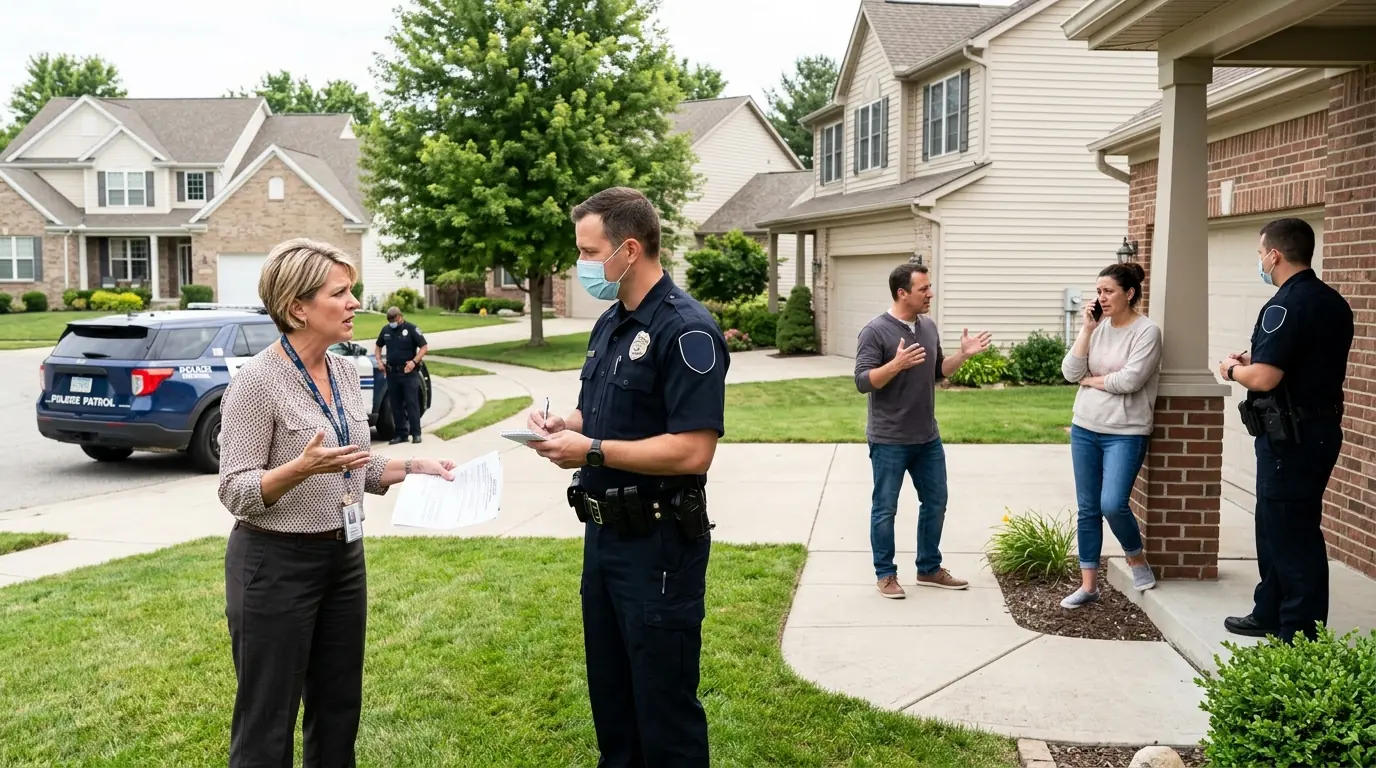
My wife, Claire, was in the driveway in a gray hoodie and jeans, crouched over the garden bed along the front walk pulling weeds. She had her old gardening gloves on—the green ones with the rubber grip. A small pile of dandelions sat beside her knee.
Margaret Holden was standing six feet away, holding an orange HOA violation notice in both hands like she was presenting evidence at a trial she'd already won.
"You need to vacate this property immediately," Margaret said. "This is not a request."
That was the first thing I heard when I opened the front door. Vacate this property. Said to a woman whose name was on the deed, the mortgage, and the county property tax record of the house she was kneeling in front of. Said by a woman who had none of those things.
I stood in my doorway and said nothing. I was thinking very clearly.
The officer stepped out of the cruiser. He was young, early thirties, dark jacket, hand already moving toward his notepad by reflex. He walked toward the driveway with the steady, unbothered pace of someone who'd handled HOA calls before and expected nothing more complicated than a noise complaint. Just another Saturday.
Margaret turned toward him the moment his feet hit the pavement. "Officer, thank you for responding. That woman right there does not belong here. She's been refusing to comply with repeated board directives. I have a signed removal order and a formal complaint, and I need you to have her escorted off this property immediately."
She said "that woman" the way you'd say "that vehicle" or "that obstruction." A thing to be cleared.
I want you to understand what Margaret believed in that moment. She believed she had done this successfully before. She had. Three families in two years fined and pressured and leaned on until they sold and left quietly. She had stood in this same neighborhood with similar pieces of paper and made similar calls, and it had always worked. She had no reason, standing there on a September morning with her orange notice and her certainty, to think this time would be different.
The officer kept walking toward us. Then he stopped. Not slowed—stopped.
His hand dropped away from the notepad and fell to his side. He looked at Claire.
Claire had stood up by now, gardening gloves still on, a faint streak of soil across her left wrist, and she looked back at him.
Three full seconds. I counted them. I'm not sure why. Maybe because in seven months of watching Margaret Holden operate in this neighborhood, I had never once felt time behave the way it did in those three seconds: something shifting, something heavy finding its level.
Margaret was still talking: "She has refused every notice, ignored the board's formal vote, and I have documented this extensively. So, what I need from you right now is—"
The officer straightened. It was a small adjustment—shoulders back, chin up—but it was unmistakable if you were watching for it. The posture of a man who has just understood exactly where he is, who has just recalculated the entire situation in the span of one look.
Margaret was not watching for it. She held the orange notice out toward him, expecting him to take it. He didn't take it. He was looking at my wife the way you look at someone when the story you had in your head and the person standing in front of you are two completely different things.
I would later pull the recording of her 911 call. She had told the dispatcher that there was an unauthorized woman at this address refusing to vacate a property under HOA jurisdiction, and she needed to be physically removed. Delivered with complete, practiced confidence—the confidence of a woman who had done this before and always gotten the result she wanted.
She had no idea she had just called 911 on the woman those officers answered to.
What was about to happen in that driveway had been building since the day we moved into Meadowbrook Heights. And it started the first afternoon Margaret Holden looked at my wife and quietly decided she didn't belong here.
I want to tell this story the right way. I want you to understand exactly what kind of person Margaret was, what she had done to this neighborhood over eight years, why 14 of our neighbors showed up at a board meeting they'd never attended before, and why the moment that officer's hand came away from his notepad was the most quietly satisfying four seconds I've ever stood still for.
She assembled every piece of this herself: every notice, every fine, every phone call. She spent seven months trying to drive Claire out of our home through paperwork and pressure and two separate 911 calls. And when none of that worked, she picked up her phone on a Saturday morning in September and tried one more time.
The officer's hand came away from his notepad, and I saw something move across his face that I had never once seen in seven months of dealing with Margaret Holden: genuine, unavoidable recognition. She had called 911 on the wrong woman. She just didn't know it yet.
Meadowbrook Heights was built in 2003: 96 homes on curving streets with names like Willowbrook Lane and Crestfield Drive. Good school district, mature trees—the kind of subdivision where the lawns are always trimmed, the fences all match, and everything looks from a distance like exactly the kind of place you'd want to raise a family. It took us about three weeks to understand what was actually holding it together.
Claire and I had been looking for a house for almost a year. We weren't in a rush; we'd learned to be patient. But when we walked through 14 Crestfield the second time, she stopped in the backyard and stood there for a moment looking at the garden beds along the back fence. She didn't say anything. She just nodded once very slightly, the way she does when she's made a decision she's comfortable with.