"Hand over the bags. My mom says you owe us."
The kid was 16, blocking my trunk with his arms crossed like this was already settled.
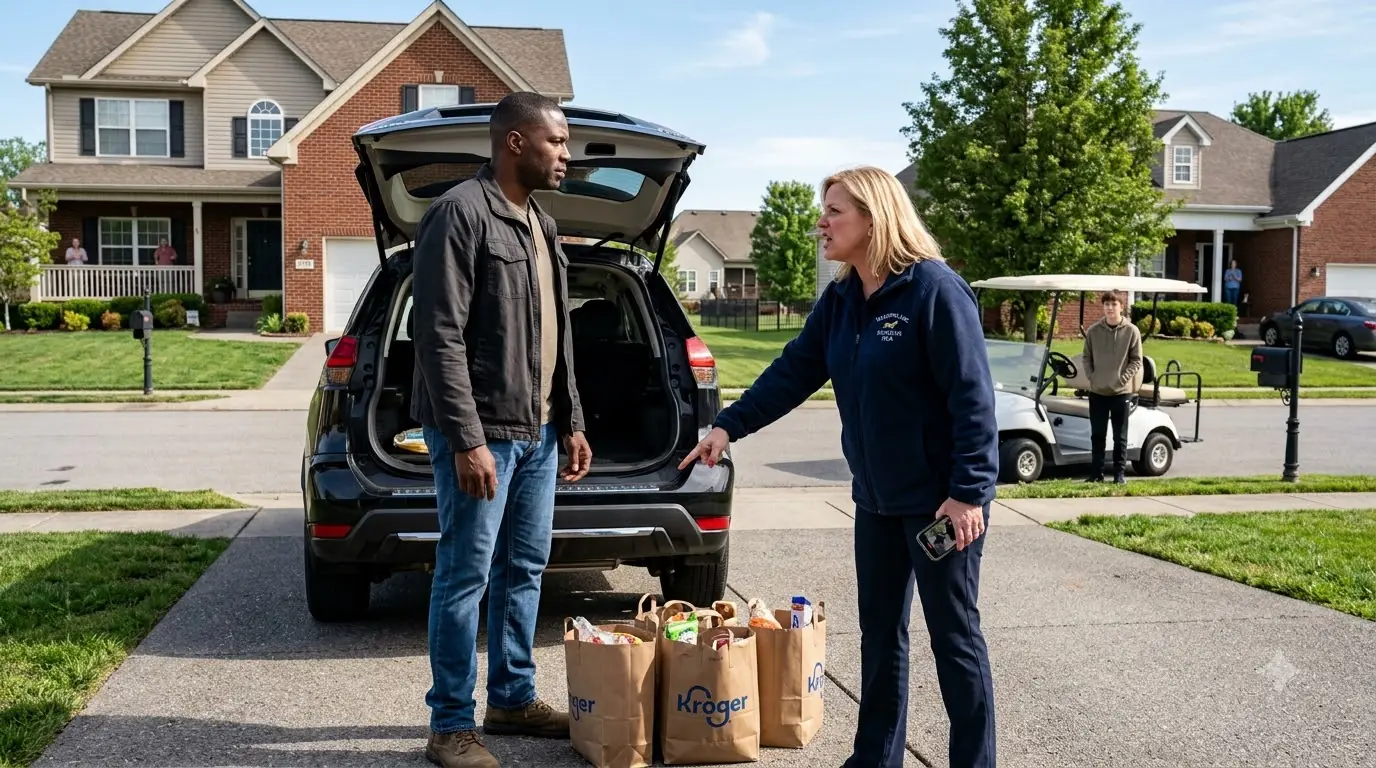
I set the groceries down slowly on my own driveway. "Son, you want to think very carefully about what you just said."
"Or what? You going to call the cops?"
I looked at him for exactly three seconds. "No, I won't."
His mother hit my porch four minutes later, phone already out, voice already raised. "I'm calling the police, and you will regret this. Do you understand me? Do you have any idea who I am in this neighborhood?"
I picked my groceries back up. "Ma'am," I said. "Make the call."
She did, confident and satisfied, not once stopping to ask who I was, only who she was. That was the last mistake Bettina Whitmore ever made in Meadowlark Estates.
About 14 months before that driveway moment, I was living a much quieter life. I'm Chief Darnell Okafor, though at the time nobody in Meadowlark Estates knew that. The development sat just outside the city limits of Ridgecroft, Tennessee, a mid-sized town, the kind of place where high school football still fills the bleachers and everybody eventually knows everybody's business.
I'd spent 22 years working my way up through the department: patrol, detective, lieutenant, and finally chief, appointed eight months before I moved into the neighborhood. The new role came with a modest bump in pay and a genuine desire to decompress somewhere quiet. My therapist had actually suggested it. "Get out of the apartment above the precinct parking garage, Darnell. Go somewhere with a yard."
So I bought 14 Brierwood Court, three bedrooms, a deck that needed refinishing, a dogwood tree that had been badly over-trimmed by the previous owner, and a homeowners association that I, stupidly, assumed would be a minor administrative footnote in my life. I kept my career to myself intentionally. After two decades in law enforcement, you develop a strong preference for not broadcasting what you do for a living. People act differently.
They either treat you like a personal security service, or they get weirdly defensive, like you're cataloging their jaywalking. I just wanted to be the neighbor who waves, mows on Sundays, and goes back inside. I introduced myself simply as a city employee. Nobody pressed further.
The smell of the neighborhood on the day I moved in is still vivid to me. Fresh-cut grass baked under a July sun, the faint chemical tang of someone running a pressure washer two houses down, and above it all, the sour odor of an overflowing garbage bin that someone had failed to roll back to the curb according to the HOA's very specific schedule. That bin, I would later learn, belonged to the household directly across the street, the Whitmore household.
Bettina Whitmore was 53, trim in the way of someone who treats exercise as a competitive sport, and she wore authority the way other women wore cardigans, permanently, without thinking about it. She had served as HOA board president for six consecutive years. She had personally drafted the amendments that established the landscaping color palette guidelines. Yes, that was a real thing, and yes, there was a laminated chart.
She had a habit of appearing at your property line at moments that were always technically accidental. "Just out for my walk," she'd say while clearly reading the brand name on your lawn fertilizer. Her son, Cody, was 16 and built like someone had taken a golden retriever's energy and stuffed it into a teenager who had never once been told to sit. He drove an HOA-permitted golf cart around the cul-de-sac with the territorial confidence of a much smaller animal who had no idea what the larger animals around him were capable of.
The first unfair act came three weeks after I moved in. I received a written HOA violation notice, hand-delivered with a little red sticker on the envelope like it was a summons, citing me for failure to maintain approved exterior paint integrity on my mailbox post. The post was white. The approved color was antique linen.
They were objectively the same color. I had a photograph. The fine was $40. I paid it, not because I thought it was right, but because I was tired, I had seven cases on my desk, and I had a department budget meeting on Thursday.
Pick your battles. I should have picked that one, because Bettina Whitmore read my payment as confirmation that she had found exactly the kind of neighbor she liked best: someone who would absorb whatever she handed out and write a check. She was already wrong about that. She just didn't know it yet.
The mailbox fine was just the warm-up act. By September, six weeks after I'd moved in, Bettina had escalated to a rotation system that I can only describe as impressive in its pettiness. Every Tuesday, a new notice. Gutters required cleaning, even though I'd cleaned them the previous weekend.
My recycling bins were placed three inches too close to the property line on collection day, a measurement she had apparently made because the notice specified "approximately three inches" in a font that suggested someone had typed it with genuine fury. Then came the notice about my decorative stone border around the dogwood tree, which she claimed violated HOA Bylaw 7, Section C, Paragraph 2, regarding unauthorized hardscape modifications. The decorative stones came with the house. The previous owner had put them there.
I had the inspection report to prove it. I drafted a response letter, polite and precise, with the inspection report attached, and slid it under the HOA management office door on a Thursday morning. The crunch of gravel under my boots as I walked back to my car felt satisfying in a small way. Evidence submitted, case closed, I thought.
That Friday, Cody Whitmore knocked on my door. I answered it in my off-duty clothes, jeans and an old department alumni T-shirt, the kind of outfit that screams, I am not working right now, please honor that. Cody was standing on my porch with the golf cart parked behind him, one hand on the doorframe like he owned the place, smirking the specific smirk of a kid who has been told repeatedly that his mother runs this neighborhood and that makes him adjacent to royalty.
"My mom says your letter has a lot of mistakes in it," he said.
I waited.
"She also says you have a leak under your driveway expansion joint that's violating the stormwater runoff code. She's going to file with the county."
The expansion joint. I actually had to look that up later. It's the small gap between a driveway and the public sidewalk, designed to allow concrete to flex without cracking. Mine was functioning perfectly, but "stormwater runoff code" sounds technical and threatening if you don't know anything about civil infrastructure, which Bettina had correctly guessed I might not.
She guessed wrong. Sixteen years earlier, I'd worked closely with the county public works department on a water contamination case that required me to learn, in exhaustive detail, exactly how municipal stormwater systems work. I told Cody to have his mother send me the specific code citation in writing.
He blinked. That was clearly not the response the script called for. "She'll just go to the county," he said again, as if repetition made it more threatening.
"Great," I said. "I'd love a written citation. Have a good afternoon."