“I am calling the police on you right now. Do you hear me? Right now!” My neighbor, a woman named Brenda Higgins, was screaming this into her iPhone with such ferocity that I could actually see the veins popping out on her neck. She was standing at the edge of my driveway, pointing a manicured finger at my wife while my wife was doing something incredibly threatening: unloading a box of books from a truck.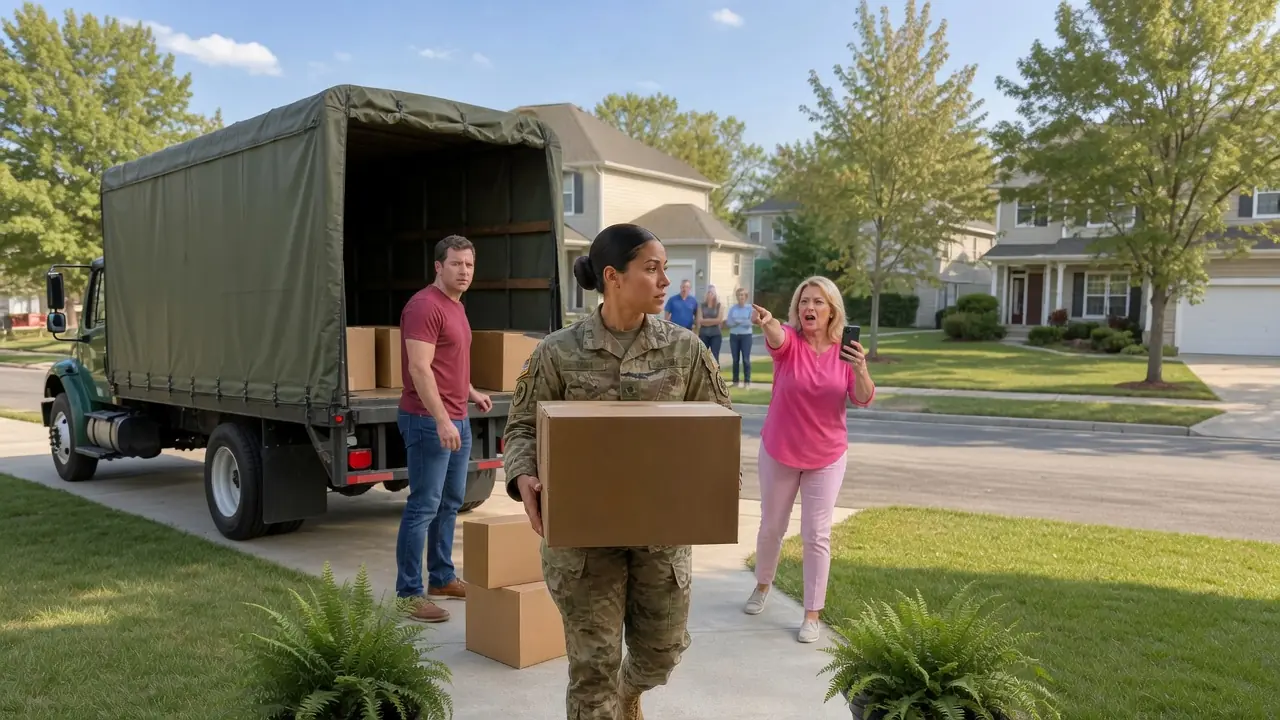
“Suspicious military vehicle. Possible stolen valor. They are endangering the community,” Brenda yelled to the dispatcher, her voice echoing off the suburban vinyl siding. Behind her, her husband—a man who looked like he had surrendered his soul about twenty years ago—was filming the whole thing with a shaky hand, looking terrified.
Within twenty minutes, three squad cars were rolling up to our curb as though we were running a cartel out of the garage. The wildest part of the whole circus was that we were not even part of her homeowners association. We had never signed the papers. We were not in the club.
Brenda did not care about jurisdiction. She cared about power. She had brought police, paperwork, and a camera crew to a property she did not control, convinced she had the right to shut us down because we did not fit her aesthetic. I stood there watching the red and blue lights bounce off the olive-drab paint of the truck and realized I was not dealing with a neighbor. I was dealing with a tyrant in the middle of a total psychological meltdown.
What Brenda did not know—what she could not possibly know—was who she was accusing of fraud. I watched her face go from smug, self-righteous satisfaction to absolute, frozen terror when my wife calmly reached into her back pocket. What she pulled out did not merely silence Brenda. It changed the entire power dynamic of the neighborhood forever.
My name is Lucas, and for the last two years, my marriage had been a series of FaceTime calls, pixelated “I love yous,” and constant low-level anxiety in the pit of my stomach. My wife, Elena, had been deployed overseas for two years. That was 730 days of waking up alone. When I finally got the call that she was coming home for good, rotating back to a desk assignment at the local base, I went into overdrive. I bought a house, a beautiful two-story colonial on a quiet street called Oak Creek Lane. I wanted everything to be perfect for her.
I spent three days scrubbing the floors. I landscaped the front yard. I even hung a massive WELCOME HOME banner across the porch. I wanted Elena to step onto that driveway and feel peace. I wanted her to feel safe.
I did not account for Brenda Higgins. Brenda lived three doors down in a house that looked as though it had been curated for a magazine nobody read. She was the self-appointed queen of Oak Creek Lane, the kind of woman who would measure your grass with a ruler and leave a passive-aggressive note if your trash can was still outside ten minutes after pickup. I had seen her lurking behind her blinds, but I figured that if I kept my head down, she would leave us alone. I was naive.
The day Elena arrived, the air was crisp, the sun was shining, and I was pacing the living room like an expectant father. Then I heard it: the deep, guttural rumble of a heavy diesel engine. I looked out the window and saw a massive surplus military transport truck turning the corner. Elena had borrowed it from a friend on base to move her heavier gear. It was loud, olive green, and stood out against the beige sedans of our neighborhood like a tank in a flower garden.
Brenda Higgins marched out. She was not walking. She was advancing. She wore a pink velour tracksuit and fuzzy slippers, but moved with the aggression of a front-line infantryman. She had her phone out instantly, snapping photographs.
Click. Click. Click. She stormed to the edge of our property, stopping exactly one inch from the driveway.
“Excuse me,” she said, her voice cutting through the reunion like a chainsaw. “Excuse me. I am Brenda Higgins, president of the Oak Creek HOA Compliance Committee. Section Four, Paragraph Two: no commercial or industrial vehicles are permitted to park streetside for more than fifteen minutes.”
I stepped forward and put on my best diplomatic smile. “Hi, Brenda. This is my wife, Elena. She just got home. We are unloading. The truck will be gone within the hour.”
Brenda did not even look at me. She stared at Elena, looking her up and down with pure disgust. “I do not care who she is. Rules are rules, and frankly, this display is disgusting. It lowers property values just by being here.”
Elena paused. She did not get angry. She did not shout. She turned slowly, looked at Brenda, and tilted her head as though observing a newly discovered species of insect.
“And another thing,” Brenda continued, emboldened by our silence. “I checked the registry. There are no active-duty personnel listed at this address. So this little costume party is stolen valor. It is fraud, and I will not have it in my neighborhood.”
“Costume party?” I said, heat rising in my neck. “Brenda, she just returned from deployment.” “Likely story.” Brenda scoffed. “I have been running this neighborhood for twelve years. I know a fake when I see one. I have forced three families out for less than this. The Millers—gone. The Trans—gone. I am the authority here.”
She was grandstanding now. Neighbors were peeking from behind curtains. Brenda was performing for an audience, establishing her dominance over the new residents. Elena finally spoke. Her voice was calm, low, and terrifyingly steady.
“Ma’am, you seem very concerned with authority. Do you know what real authority looks like?” Brenda laughed, a high, shrill sound. “Honey, I have county code enforcement on speed dial. I am the authority. Right now, I am calling the police. We will see how military you are when real officers arrive.”
She dialed 911 right in front of us, putting the call on speaker so we could hear her report suspicious persons and a military threat. Elena did not stop her. She simply reached into her pocket, pulled out her phone, and took one photograph of Brenda screaming. “Why did you do that?” I whispered as Brenda stormed back toward her porch to wait for the police.
“Evidence, Lucas,” Elena said with a cold, sharp smile. “In any conflict, you secure the evidence first.” Twenty minutes later, the cavalry arrived. Two cruisers were led by a man I would later learn was Chief Brody, a gray-haired officer with eyes that looked as though he had not slept well since the late 1990s. A younger officer, Officer Davis, followed behind him.
Brenda rushed them before they had fully stepped out of their cars. “Thank God you are here. These people are aggressive. They are impersonating soldiers. That truck is a hazard.”
She was vibrating with excitement. This was her moment. She was going to watch the new neighbors get handcuffed and humiliated. Chief Brody walked toward us, one hand resting on his belt. He looked at the truck, then at Elena.
“Ma’am, we received a disturbance call. Can you explain the vehicle?” “It is a transport for my gear, Chief,” Elena said. “I am unloading.”
Brenda interjected from the sidewalk. “Check her identification. Make her prove it. She is a fraud.”
Chief Brody sighed. “Ma’am, I need to see some identification.” This was the climax of Brenda’s little performance. Elena nodded. “Of course.”
She reached slowly and deliberately into her back pocket, pulled out her wallet, and produced her military identification. She held it up in the sunlight. The card did not merely say she was in the Army. It identified her rank: Colonel Elena Vance.
Chief Brody looked at the card. His eyes widened. Then he looked at Elena again, really looked at her this time, noticing the specific patches on her uniform and the way she stood. His entire demeanor changed.
He straightened, brought his heels together, and gave her a crisp salute. Officer Davis saw his chief move and immediately did the same. “Colonel,” Chief Brody said, his voice filled with genuine respect. “My apologies. Welcome home.”
Brenda, standing ten feet away, seemed to stop breathing. I watched her brain struggle to process what was happening. She had been waiting for handcuffs. Instead, the local police chief was saluting the woman she had called a fraud.
Her smugness evaporated. What remained was pure horror. “Officers,” Elena said, returning the salute. “No harm done, but this neighbor seems confused about the laws regarding private property and military transport.”
Chief Brody turned toward Brenda. The warmth vanished from his face. “Mrs. Higgins, did you knowingly file a false report regarding stolen valor?”
“I—I thought—” Brenda stammered, backing away. “You thought you could use my officers to harass a colonel?” Brody stepped closer. “Let me make this clear. If I receive another call like this, I will charge you with misuse of emergency services. Do you understand?”
Brenda nodded frantically, looking as though she might be sick. Then she turned and hurried back into her house, slamming the door behind her. “Keep an eye on her,” Brody said quietly to Elena. “People like that do not stop. They change tactics.”
He was right.
For three days, the neighborhood was quiet. Too quiet. We unpacked and settled in, but I could see Brenda’s silhouette in her window at all hours. She was watching. She was plotting.
On the fourth day, the counterattack began. It was not a frontal assault. It was bureaucratic guerrilla warfare. I came home from work to find five notices taped to our front door.
Violation One: Excessive noise at 6:00 a.m. Fine: $100. That was Elena’s morning run. Violation Two: Unauthorized vehicle placement. Fine: $50. My car was supposedly two inches too far from the curb.
Violation Three: Unapproved signage. Fine: $75. The welcome-home banner. Violation Four: Landscaping noncompliance. Fine: $150. Our hedges were allegedly one inch too high.
Violation Five: Trash receptacle visibility. Fine: $50. I did the math. More than four hundred dollars in fines in a single day.
It did not stop. The next morning, three more notices appeared: improper blind color, porch-light luminosity exceeding standards, and pet noise. We did not own a dog. Brenda was hitting us with everything she had. She was using the HOA bylaws as a weapon. She knew we were not technically members of the association, but she combined city ordinances with vague community-standard clauses and claimed a loophole in the original property deed gave the board authority over us. The legal ground was shaky, but it was enough to make our lives a nightmare.
She began stalking us. I would wake at two in the morning and see a flash outside. Brenda was photographing our windows and documenting what she called suspicious activity. She started a neighborhood email chain that excluded us, claiming Elena was unstable, suffered from severe combat trauma, and was stockpiling weapons. She poisoned the well before we had even met most of our neighbors. People crossed the street to avoid us.
I was breaking. I am a mild-mannered accountant. I do not enjoy confrontation. After two weeks of this, with fines totaling more than a thousand dollars and the sensation of being watched around the clock, I sat on the edge of the bed with my head in my hands.
“Maybe we should move,” I whispered. “It is not worth it, Elena. She is going to make our lives miserable.” Elena sat at her vanity, brushing her hair. She stopped and looked at me in the mirror. Her eyes were hard.
“Lucas, I have negotiated with warlords. I have managed logistics in combat zones. I am not going to be driven out of my own home by a woman in fuzzy slippers carrying a clipboard.” “What can we do?” I asked. “She controls the board. She controls the narrative.”
Elena turned around. “We do what we do in the military. We gather intelligence. We find the weakness. Then we strike.”
She opened her laptop and created a folder titled OPERATION NEIGHBORHOOD PEACE. “She wants to play surveillance state,” Elena said. “Fine. Let us play.”
For the next week, Elena became a ghost. She observed Brenda’s routine and noticed things I never would have seen. She documented Brenda’s car parked illegally beside a fire hydrant. She recorded Brenda’s dog leaving messes on other people’s lawns without cleanup. She measured Brenda’s own hedges, which were definitely above the regulated height.
Then Elena found the real weapon. She dug into the HOA financial records. They were public if you knew where and how to search. One night, she called me to the desk and pointed at her screen.
“Lucas, look at this. The HOA pays a landscaping company fifty thousand dollars a year.” I leaned closer. “The company is owned by Gary Higgins.”
“Brenda’s husband,” Elena said. “Exactly.” She opened another spreadsheet. “Now look at the violation fines. They do not go into the community fund. They go into an administrative processing account. Guess who has signature authority over that account?”
“Brenda.” Elena smiled without warmth. “She is not simply an overbearing neighbor. She is using the fines to enrich herself.”
“We have her,” I said. “Not yet,” Elena replied. “We have information. We need to expose it publicly. Her power comes from credibility. We remove that in front of the people who gave it to her.”
Brenda called an emergency HOA meeting for the following Tuesday. The agenda was essentially the eviction and legal prosecution of the residents at 124 Oak Creek Lane. She intended to seek authorization to sue us for lowering property values and creating a hostile environment. The community center was packed. Thirty neighbors filled the folding chairs. Brenda stood at the front beside a projector screen, looking triumphant. She had charts, photographs, and a stack of our alleged violations. She looked like a prosecutor presenting a closing argument.
“These people,” Brenda declared, pointing toward Elena and me in the back row, “are a cancer. They believe that because she is in the Army, they can ignore our laws. They intimidate. They harass. I have lived here for twelve years, and I have never felt so unsafe.”
She paused for effect. “I move that we authorize legal funds to place a lien on their home.” Several of her loyal supporters nodded. The room grew tense.
Elena stood. She did not shout. She used the command voice that could make an entire room instinctively sit straighter. “Madam President, before the vote, I would like to present a rebuttal. Under the bylaws, I am allowed five minutes.”
Brenda sneered. “Make it quick.” Elena walked to the front. She carried no poster boards, only a USB drive. She plugged it into the projector.
“You accuse us of violating standards,” Elena said to the room. “But standards must be applied equally. Let us examine the data.” She pressed a key. A grainy night-vision video filled the screen. It showed Brenda, clearly identifiable, dragging her own household trash bags across the street and dumping them into our bins at four in the morning.
The room gasped. “Violation: illegal dumping,” Elena said calmly. Click. The next slide showed Brenda’s car blocking a fire hydrant.
“Violation: safety hazard.” Click. The next video showed Gary Higgins using the HOA’s riding mower in his private backyard. “Misuse of community assets.”
Brenda’s face turned purple. “This is doctored,” she said. “This is a deepfake.” “And finally,” Elena continued, her voice dropping into a quiet, controlled register, “financial irregularities.”
She opened the spreadsheet and highlighted payments to Gary’s landscaping company, followed by transfers into the administrative account. “Mrs. Higgins has issued eighteen fines to us in fourteen days,” Elena told the room. “During that same period, she issued no fines to any other household. Over the last year, however, she collected thirty thousand dollars in fines from this neighborhood. Those funds are currently held in an account under her personal control.”
The room erupted. It was no longer whispering. People stood and shouted. “You fined me two hundred dollars for my fence!” one man yelled. “You kept that money?”
“That was my son’s tuition money!” a woman cried. Brenda backed away from the podium, both hands raised. “There is an explanation. It is a holding account. I keep the money safe.”
Elena looked toward the board members seated behind Brenda. They looked terrified. They understood that if they failed to act, they could be seen as complicit. “I suggest,” Elena said, “that the board call for an immediate vote of no confidence and authorize an independent audit.”
The board did not hesitate. They voted unanimously to remove Brenda from office. They froze the accounts and approved the audit. Brenda stood stripped of her title and surrounded by neighbors who looked ready to chase her from the building.
She stared at Elena, hatred burning in her eyes. “You ruined everything!” Brenda screamed. “I built this community!”
“You did not build it,” Elena said. “You occupied it. Your occupation is over.” Brenda stormed out. As she passed us, I heard her speaking frantically into her phone.
“I need to report corruption. No, they are the corrupt ones. I need to speak to the city manager.” She sounded small. She sounded frightened.
But the story did not end there. Nature hates a vacuum, and karma enjoys a sequel. Two weeks later, Brenda was a pariah. She rarely left her house. Then a FOR SALE sign appeared in the yard next door to hers. The neighbor she had failed to force out had sold his home.
We watched the moving truck arrive and wondered who the next unfortunate resident would be. A young woman stepped out. She was friendly, energetic, and perhaps in her early twenties. Her name was Mia. She immediately walked to Brenda’s house and knocked on the door to introduce herself.
Elena and I watched from our window. Brenda opened the door cautiously. The moment she saw Mia, her expression changed. She clearly believed she had found fresh prey. We watched her point at Mia’s flowerpots and begin lecturing. Mia simply smiled, nodded, and made a note on her phone.
Within a week, Brenda had returned to her old habits. She placed violation notices on Mia’s car. She photographed her through the fence. She tried to regain a sense of control by bullying the new neighbor.
Then came Sunday afternoon. I was gardening. Elena was reading on the porch. We heard Mia in her backyard speaking on the phone. She had the call on speaker, loud enough to carry over the fence.
“Hi, Dad,” Mia said. “Yes, the house is great. But the neighbor—yes, Mrs. Higgins. She is exactly like you said.”
A deep male voice answered through the phone. “Is she harassing you?” “Yes. She left three notes today. She is taking pictures of me again.”
“Keep documenting it, honey. I need a comprehensive file on her behavior. We are building the harassment case.” I froze. I knew that voice.
“Thanks, Dad,” Mia said. “Love you, Chief.” “Love you too, sweetheart. See you Sunday.”
Elena and I looked at each other. Mia was Chief Brody’s daughter. The chief of police had moved his own daughter into the house beside the woman he had warned. Mia was not merely a new neighbor. She was a walking, talking evidence-gathering operation with direct access to the head of local law enforcement.
I looked toward Brenda’s window. The curtain twitched. She had heard the conversation too. Her face appeared briefly in the gap between the drapes, pale and horrified.
She understood in that moment that she was trapped. She could not bully Mia. She could not summon the police against Mia. She was living beside the one person whose carefully documented complaint could bring serious legal consequences if Brenda stepped out of line again.
Mia looked up at Brenda’s window, waved, and smiled. It was a sweet smile, but there was steel behind it. “Beautiful day for neighborhood watch, isn’t it, Mrs. Higgins?” she called.
Brenda closed the curtains. We hardly saw her after that. The neighborhood held a block party the following weekend. Everyone attended. The improper fines were refunded. The accounts were audited. Brenda entered a repayment agreement to avoid criminal prosecution for the missing funds. Oak Creek Lane became quiet again, and the fear that had hung over the street disappeared.
I looked at Elena across the barbecue grill. “You know,” I said, “I think I like this neighborhood now.” She grinned and flipped a burger. “Mission accomplished.”
You can have every clipboard and bylaw in the world, but you never know who you are screaming at. You never know whether the person you are trying to bully is a colonel, and you certainly never know whether the new woman next door is the police chief’s daughter. Power is not about being loud. It is about knowing when to remain quiet.