"911. This is an emergency. She's carrying classified files. I can see the government seals on those boxes!"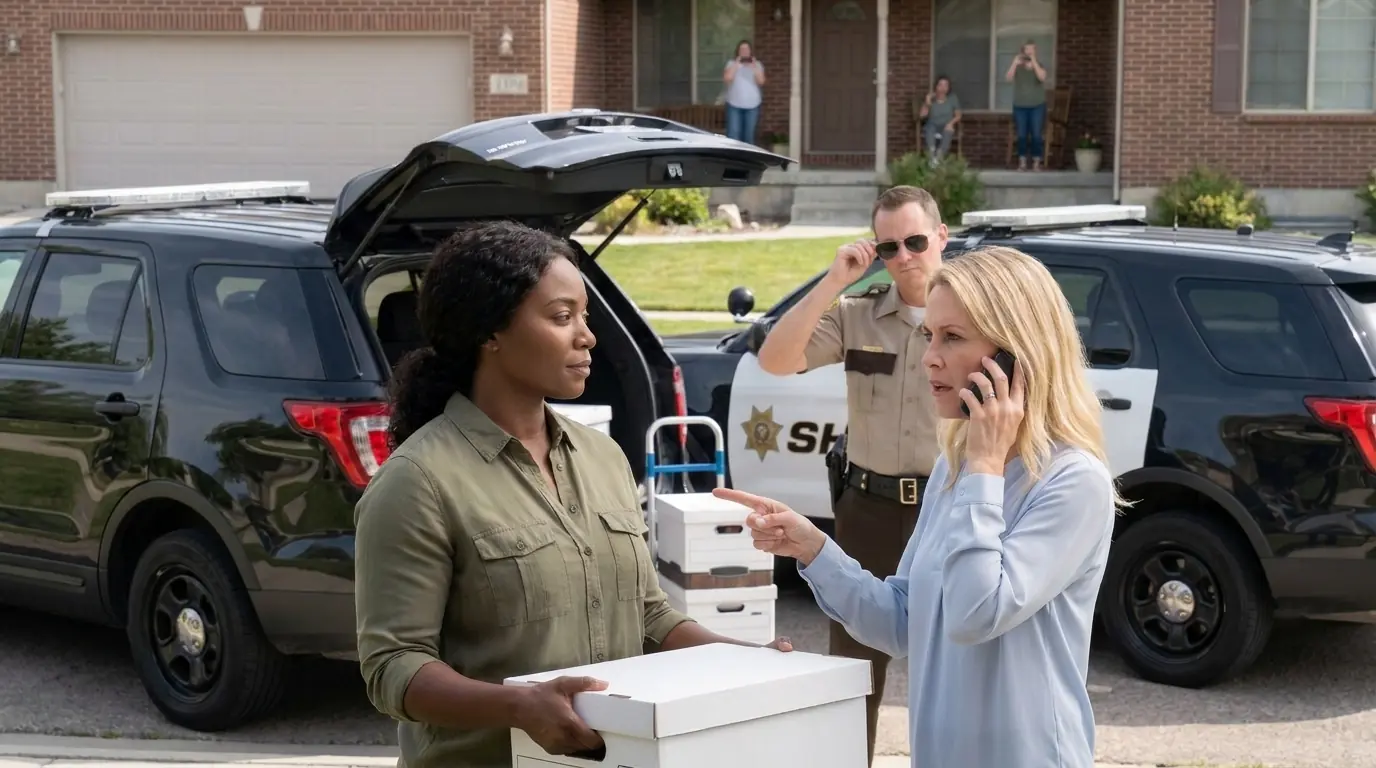
The shrill voice cut through the quiet Saturday morning like a siren of its own.
I froze on the porch, one hand steadying the moving dolly, the other gripping a box marked in thick black letters: *VA Records - Casework*. It wasn't me they were calling about. It was my wife, Sophia.
She stood beside the open trunk of our SUV, arms wrapped around another cardboard box, her hair pulled back with a few strands sticking to her cheek from the September breeze. She had carried heavier loads in her life; twenty years in uniform had given her that calm, undeniable strength. Still, even she looked puzzled when the voice of Leah Gray, our brand-new HOA president, shrieked across the cul-de-sac.
Neighbors peeked out from behind their blinds. A few, braver or nosier than the rest, stepped onto their porches. Phones came up, recording. The familiar hum of gossip spread before I could even set the dolly down.
Sophia adjusted her grip on the box and gave me a small shake of her head—her subtle way of saying, *Don't rise to it. Not yet.*
But Leah wasn't done. She marched to the end of her driveway, cell phone pressed tightly to her ear, her other hand pointing like a spear toward my wife.
"Yes, Officer. Right now, she's moving classified government documents into her house. I know what I saw! Official seals, top secret. You better get here fast before she hides them!"
My stomach dropped. We had lived in Willow Creek for three weeks—three quiet weeks. We had waved at neighbors, mowed our lawn, even baked a pie for the Dawson family next door. And now this circus.
The wail of a siren answered Leah's hysteria. A sheriff's cruiser rounded the corner, lights flashing against the tidy brick homes and neatly trimmed hedges. The neighborhood held its breath.
Sophia set her box down gently on the porch. She straightened, squared her shoulders, and waited with the same composed stillness I'd watched her display before deployments.
The deputy stepped out—a tall man with sandy hair and mirrored sunglasses. His hand hovered near his belt, not quite on the holster, but close enough. He scanned the scene, then looked from Leah to Sophia and back again.
Leah pounced. "That's her! She's the one. Look at those boxes! Evidence of something illegal, I'm sure of it. You need to search her house immediately!"
The deputy's eyes landed on Sophia, and something instantly changed in his posture. He tugged off his sunglasses, blinking once, then twice.
"Major Bowman. Ma'am," his voice carried clearly across the yard.
And then, in front of the whole neighborhood—in front of Leah, whose mouth hung open with her phone still glued to her ear—the deputy sheriff snapped to attention and saluted my wife.
A collective gasp rippled through the crowd. Phones shook as neighbors tried to keep recording, realizing they had just caught something they didn't fully understand, but couldn't look away from. Sophia returned the salute—crisp, measured, the kind of response that doesn't fade even years after you hang up the uniform.
I took a step forward, laid my hand on the box labeled *VA Records*, and spoke in the calmest voice I could manage. "Welcome to Willow Creek, honey. Looks like we've made an impression."
The deputy lowered his hand, gave Sophia a nod of respect, and turned to Leah. His tone was flat, official, but edged with cold authority. "Ma'am, I suggest you put that phone away now."
The cul-de-sac remained dead silent. Only the wind moved, rustling the flags on our mailboxes. And just like that, the war with Leah Gray had begun.
***
After that salute, Willow Creek was never quite the same. On the surface, things appeared to quiet down: neighbors trimmed their lawns, kids rode their bikes, and sprinklers ticked in the evenings. But I could feel a heavy static in the air. Leah Gray might have gone silent in that moment, but silence from someone like her didn't mean surrender; it meant she was planning her next move.
Sophia carried on with her work. Every night after supper, she'd disappear into the study. The desk light burned late, shining over stacks of government folders and thick case files. I'd bring her a cup of tea, stand in the doorway, and watch her type with steady, deliberate strokes.
One night, I caught a name on her screen, written in bold letters underlined as if carrying its own gravity: **Diego Morgan**.
The sound of it stopped me. "Morgan... that name rings a bell."
Sophia looked up, hesitating for a fraction of a second before nodding. "Diego Morgan was Leah's husband."
The air in the room grew heavy. I leaned closer. "You're telling me you're handling his case?"
"His death benefits, yes," she lowered her voice. "It landed on my desk at the VA. And Dean... things don't add up. Not at all."
I remembered Leah's hysteria on our moving day, screaming into her phone about classified files, government seals, and national danger. She hadn't been afraid of federal secrets; she had been terrified of what those specific boxes contained.
The next morning, while collecting the mail, I caught Leah standing on her porch across the street. She didn't wave or smile. She just watched me with sharp eyes and tight lips, daring me to look away first.
Later that day, Harold Dawson came by carrying a thick folder under his arm. Harold wasn't just our HOA treasurer; he was a reserve officer and a man who believed in order, in numbers that told an unvarnished truth.
"Dean," he said, his voice dropping low as he stepped inside. "There's something you ought to see. Three years' worth of HOA contracts—landscaping, maintenance, roof repairs—all signed by Leah. Prices doubled, no competitive bidding. The money is gone. And here's the kicker: those payouts line up almost exactly with the time she collected Diego's life insurance."
I flipped through the papers. Even to my untrained eye, the pattern was clear. Leah had turned the HOA into her personal checking account.
That night, Sophia closed the file on her desk, her hand resting on the cover where Diego's name was stamped. "Dean, I don't think Leah just stole from the HOA. I think she stole from the government—from the very memory of her late husband."
I nodded slowly as the realization sank deep. Leah Gray wasn't just a loud neighbor with too much time on her hands. She was sitting on a massive fraud scheme, and she would do anything to keep it buried.
***
If Willow Creek had a heartbeat, it was the monthly HOA meeting. The little clubhouse sat at the center of our development—beige siding, faded green shutters, and a cracked asphalt parking lot that buckled in the summer heat. Inside was where the real theater happened. Neighbors argued over grass height, mailbox paint, and holiday decorations. It was meant to be mundane, but once Harold laid those financial papers in front of me, I saw the HOA in a completely different light. It wasn't a harmless neighborhood committee; it was a vault, and Leah Gray held the only key.
That Thursday evening, I walked in with Sophia at my side. The room smelled of burnt coffee and lemon cleaner. A dozen folding chairs were lined up in two crooked rows. Leah sat at the front table, clipboard in hand, wearing the pinched, superior smile she reserved for when she felt untouchable.
Neighbors trickled in—the Bennetts, the Carlsons, Mrs. Gable with her terrier tucked into her purse. Most avoided eye contact with us. Rumors had been flying ever since Leah's 911 stunt. Some believed Sophia worked for a shadowy federal agency; others thought we had brought legal trouble with us when we moved in. Either way, people whispered, and Leah enjoyed every second of the spectacle.
Harold cleared his throat, adjusted his glasses, and began the treasurer's report. His voice was steady, but I could hear the tension underneath.
"Landscaping expenses this quarter: $32,600. Tree trimming: $14,000 even. Pest control: $9,200."
He let the numbers hang in the stale air. Mrs. Bennett frowned. "That seems extraordinarily high. Didn't we spend less than half of that last year?"
Harold glanced at Leah, then back to the room. "We did. Considerably less."
Leah's smile tightened. She tapped her pen rhythmically against her clipboard. "Costs are up everywhere. Inflation. You all know that."
Harold set down his papers, slow and deliberate. "Inflation doesn't double contracts overnight. Inflation doesn't cancel competitive bids." He looked straight at her. "But signatures do. Yours."
The room shifted. Chairs squeaked against the linoleum. Someone coughed.
I watched Leah's face carefully. She didn't flinch, not outwardly, but her jaw tightened and her knuckles turned white around her pen.
"That's enough, Harold," she said, her voice sharp and brittle. "You're completely out of line."
But Harold wasn't finished. He pulled out one more sheet and held it up for the room to see. "Three years of the same vendors, the same inflated rates, and yet the money trails lead nowhere. Bank records show withdrawals that don't match our maintenance schedule. Funds are missing, and every single authorization bears your name."
A low murmur rolled through the room. People leaned toward one another, whispering.
Leah slammed her hand onto the table. "You think you're some kind of detective? I've done everything by the book! If you don't like the way I run this community, you're welcome to find somewhere else to live!" Her eyes darted toward Sophia, then toward me. A flash of raw desperation crossed her features.
Harold remained completely calm. "This community isn't your personal wallet, Leah," he said firmly. "We deserve answers."
The silence that followed was heavier than any argument. Finally, Mrs. Bennett whispered, "Where did the money go, Leah?"
Leah forced a smile that failed to reach her eyes. "Repairs, maintenance, emergency funds. You wouldn't understand the complex paperwork."
She thought she was projecting confidence, but Sophia and I saw the truth. It was fear, barely disguised.
Later that night, as we walked home under the yellow glow of the streetlamps, Sophia said quietly, "She's bleeding money. The HOA is her cover. But Dean," she paused, her voice dropping, "it doesn't just tie to neighborhood dues. It connects to Diego's file. I can feel it."
I squeezed her hand, looking at the rows of manicured houses. To anyone else, Willow Creek looked like paradise. But Leah Gray wasn't just mismanaging a neighborhood; she was running a cover-up. And the walls were beginning to close in.
***
It didn't take long for Leah to strike back.
The very next week, I found flyers tucked under doormats, slid into mail slots, and taped to the community bulletin board. Printed on cheap paper in bold type, the headline asked: **DO YOU KNOW WHO YOUR NEIGHBORS REALLY ARE?**
Beneath it was a grainy, cropped photo of Sophia carrying a box up our front steps. The caption read: *Federal surveillance? Military investigations? Classified secrets in a residential zone.*
My fists tightened around the paper. Sophia took it from me, read it once, and set it on the kitchen counter without a word. She poured herself a glass of water, as calm as ever, though the muscle in her jaw twitched.
"She's trying to isolate us," I said.
"She's trying to scare us," Sophia corrected. "There's a difference."
By that evening, the rumors had spread like wildfire. I overheard hushed conversations at the grocery store and in line at the post office. One neighbor crossed the street rather than walk past our driveway. Another, someone I had shared coffee with just days earlier, kept his head down and pretended not to see me at all. Leah's smear campaign was working.
Then came an email blast sent from the official HOA account:
*Certain residents may be involved in activities outside the scope of our community values. Please remain vigilant. If you notice unusual behavior, late-night visitors, excessive paperwork, or government vehicles, report them immediately to HOA leadership.*
No names were mentioned, but none were needed. Everyone knew who Leah meant.
That night, Sophia sat at her desk flipping through Diego's file. "She thinks if she paints me as a threat, the neighborhood won't question her accounting. It's a distraction. Classic misdirection."
Two days later, I found a manila envelope on our porch. Inside were printed screenshots of old, redacted service records—some clearly altered—with a message written across the top in thick marker: *How much does your wife really tell you?*
I carried it inside and tossed it onto the table. "She's trying to break us from the inside."
"Not going to happen," Sophia said softly, meeting my gaze. And I knew she was right.
Still, the social pressure grew. Neighbors stopped inviting us to block gatherings. Parents pulled their kids inside when we walked by. The development that had seemed so welcoming now felt like a staged set—bright facades hiding suspicion behind every curtain.
Then, on Friday evening, Harold showed up at our back door with a flash drive. "Dean, Sophia, you need to see this."
On the drive were email exchanges between Leah and an outside contractor. The contractor had complained about artificially inflated invoices. Leah's reply was blunt: *Just process it. No questions. The funds are covered.*
"Covered by what?" I asked.
The evidence was mounting, but Leah's lies had bought her time. That night, as Sophia locked her desk drawer, she looked out the window toward Leah's house across the street. Leah's porch light burned late into the night. Her silhouette moved back and forth behind the blinds, restless, pacing like a trapped animal.
"She's desperate," Sophia murmured. "And desperate people make catastrophic mistakes."
***
The paper trail in our study grew thicker by the day. Stacked high in cardboard boxes marked with VA seals, the documents were silent witnesses to a crime Leah Gray thought she had safely buried.
Late on a Tuesday night, Sophia called me into the room. "Dean, look at this."
She pointed to an official VA record. At the top of the form, stamped in red, were the words: **TREATMENT DENIED - PTSD THERAPY - PATIENT REFUSED**.
"Okay..." I said slowly.
Sophia pulled a handwritten letter from another folder—a personal letter written in shaky but determined handwriting, signed by Diego Morgan himself weeks before his death.
She read a passage aloud: *"The therapy sessions are working, Maria. For the first time in years, I can see a way forward. I'm starting to believe I can come home."*
I looked from the official form to the personal letter. My stomach turned. "The official record says he refused treatment. The personal letter proves he was actively attending and improving."
"Exactly," Sophia said. "Someone altered his master file. Someone erased his medical progress."
The implications hit me like a physical weight. "If his treatment was recorded as successful or ongoing, the expedited lump-sum survivor payout would have been delayed or audited," I realized. "But if it appeared he refused help and was deemed beyond rehabilitation, the high-tier insurance claim processed immediately."
"She faked his medical refusal," Sophia's voice dropped. "She didn't just steal from the HOA or the government, Dean. She stole his fight to heal. She turned his memory into a lie just to cash a check."
Rage simmered hot in my chest. "She can't get away with this."
"She won't," Sophia said firmly. "But we need undeniable proof of the forgery before we take this to the federal prosecutor."
Over the next two days, Sophia cross-referenced the altered records with archived progress reports from Diego's actual therapist. The therapist's original notes confirmed steady improvement. The copies filed in the master claim, however, had entire paragraphs crossed out and replaced with fabricated statements. Even the signatures were clunky imitations.
Leah had rewritten her husband's final months on earth, line by line, to secure her payout.
When I took the trash out that evening, I saw movement across the street. Leah's curtains twitched shut the moment I stepped onto the porch. She was watching us, sensing that the net was closing in.
I walked back inside and stood beside my wife at her desk. "Those boxes are dangerous to her," I said.
"They're dangerous because they contain the truth," Sophia replied, closing the folder. "And it's time we let the truth speak."
***
It started with a subtle noise—not loud, but enough to break the quiet of our backyard. A faint rustle of leaves, a metallic scrape against the fence.
I muted the television and listened. Nothing. Then the sound came again, closer this time.
I walked down the hallway to the study, where Sophia was working under the glow of her desk lamp. "Did you hear that?"
Before she could answer, my phone vibrated in my palm. *Motion Detected - Backyard Camera.*
I opened the security app, my thumb trembling slightly. The night-vision feed showed two grainy silhouettes moving stealthily near our back porch. One was tall and broad-shouldered; the other was shorter, hunched, and instantly recognizable even in black and white.
Leah Gray.
My jaw clenched. The HOA president was trespassing on my property in the middle of the night.
Sophia stepped beside me, staring at the phone screen. Her voice was ice-cold. "She's looking for the boxes."
On the screen, the tall man produced a small pry bar from his jacket and moved toward the study window. Leah gestured frantically, pointing at the glass.
"That's attempted burglary," I whispered. "I'm calling the police."
"Not yet," Sophia placed her hand on my arm. "If we call now, they run, and it's a minor trespassing charge. We need them to commit fully. We need intent. We set a trap."
We watched in silence as the man tried the window latch. It was locked tight. He shook his head, whispering something to Leah. She gestured angrily toward the side gate, frustrated, before the two of them retreated back into the shadows and vanished over the fence.
Sophia exhaled slowly. "She's reached her breaking point. She'll try again soon."
The next morning, we brought Harold into the loop. He watched the security footage on my laptop, folded his arms, and let out a low whistle. "She broke the cardinal rule of criminals—getting caught on camera. This is great leverage, but Sophia's right; we can nail her for far more than trespassing."
"What's the plan?" I asked.
Harold smiled grimly. "We give her an opening she can't resist. We secure the real files in a safe location, place decoy folders where she can easily see them from the window, and wait for her to make her move. I'll coordinate directly with Deputy Russell—a officer I trust who won't leak a word to anyone."
"We give her just enough rope," Sophia added, "and let her walk right into it."
***
By noon the following day, the trap was set.
Sophia spread decoy files across our dining room table—official-looking documents stamped with fabricated seals and medical headers. To anyone glancing through a window, they looked like the exact VA files Leah was terrified of.
"Are you certain she'll take the bait?" I asked, looking out at the quiet street.
"Desperate people don't think logically, Dean," Sophia said. "She knows an investigation is looming. She won't run; she'll try to destroy what she thinks is the evidence."
That afternoon, Harold returned, wearing his reserve deputy badge clipped to his belt. "Deputy Russell will be staged two blocks away in an unmarked car, radio open. The moment she steps onto your property, we move."
By dusk, our house felt like a stage set. Every lamp was positioned intentionally; every shadow served a purpose. I could feel my pulse steady and heavy in my chest.
At 9:00 p.m., I sat in the living room pretending to read a book. Sophia was upstairs, her desk lamp casting a soft glow through the banister rails. The house was dead quiet.
Then came the crunch of gravel outside—slow, deliberate steps.
I glanced out the side window. A silhouette moved through the shadows near the porch. Leah was alone this time, clutching a heavy plastic tote bag to her chest.
"She's here," I whispered into my collar mic.
In the kitchen, out of sight, Harold adjusted his radio. *"Target on the porch."*
The front door latch jiggled once, twice, and then clicked open. She had used a bump key on the lock.
The door opened an inch, illuminating Leah's face in the soft light of the hallway lamp. Sweat glistened on her forehead; her breathing was shallow and ragged. She slipped inside, her eyes locking instantly onto the banker's box resting on the table near the study entrance.
"I have to fix this," she muttered to herself, dropping to her knees and tearing off the box lid. "I have to destroy it before they find out."
She grabbed the decoy papers, her hands shaking violently as she scanned the top sheets. "They can't know... Diego's file... it was never supposed to surface!"
Sophia stepped smoothly out from the hallway shadow, her voice calm and absolute. "And yet, here you are, confessing in our hallway."
Leah spun around, wild-eyed, clutching the fake papers to her chest like a shield. "You don't understand! They would have cut off everything—the insurance, the accounts! I had no choice!"
Harold emerged from the kitchen, his badge held high. "Leah Gray, stay right where you are."
Leah panicked, trying to shove the documents into her bag. "Diego was never supposed to get better! I had to make sure the records showed he refused treatment! I needed the money!"
Her words echoed loudly off the hard walls of the entryway.
From outside, the sudden flash of red and blue lights illuminated the living room windows as Deputy Russell's cruiser pulled into the driveway. Headlights washed through the front door glass.
Leah froze. Her chest heaved as her eyes darted from Harold's badge to Sophia's unwavering gaze. The fight drained out of her all at once. Her shoulders slumped, and the fake papers fluttered from her hands to the floor.
"I just wanted to survive," she whispered, sinking back against the wall. "It just got out of control."
Deputy Russell stepped through the open front door, his hand resting on his holster. "I've heard more than enough. Ma'am, stand up and place your hands behind your back."
Leah offered no resistance as the cuffs clicked around her wrists. As Russell guided her toward the door, she looked at Sophia with hollow, glassy eyes. "You don't know what it's like carrying the weight of bad choices."
Sophia met her gaze quietly. "You're right. But you don't get to ruin other people's lives to lighten your own."
As the cruiser pulled away into the night, Harold gathered the scattered decoy papers and stacked them neatly. He turned to us, his jaw set. "We've got her statement, we've got the breaking-and-entering on tape, and we've got her caught red-handed. She's done."
***
The night Leah was arrested felt like the end of a long storm, but Sophia knew we needed to solidify the evidence for the federal prosecutor.
The next morning, Harold returned with a forensic document examiner from the state police—a colleague he knew from his reserve service. Together, they examined the altered VA forms alongside verified samples of Leah's handwriting taken from HOA records and checks.
The examiner didn't take long. "It's an exact match. The alterations on the VA refusal forms were written by the same hand that signed these HOA checks. It's an open-and-shut forgery case."
Leah was held on federal fraud, forgery, and grand larceny charges. With her bond set high, she remained in custody.
Six weeks later, the formal proceedings began at the federal courthouse in Denver. The courtroom was packed with Willow Creek residents, local veterans, and representatives from the Department of Veterans Affairs.
When the prosecutor called the case, the paper trail was laid out in devastating detail: the HOA bank statements showing diverted funds, the forged medical refusal forms, and the security footage of her break-in.
The most powerful moment of the trial came when Diego's sister, Maria Morgan, took the witness stand. She held a small bundle of letters Diego had sent her during his time in therapy.
Reading through tears, Maria quoted her brother's own words: *"I'm working hard every day, Maria. The doctors are helping me see a future again."*
She looked directly at Leah across the courtroom. "My brother fought to recover. He wanted to live. Leah didn't just steal money from the government—she erased his fight so she could collect a check."
The jury deliberated for less than two hours.
The verdict was guilty on all counts: Federal Wire Fraud, Forgery of Government Documents, Grand Larceny, and Commercial Burglary.
At sentencing, the judge spared no severity: "Mrs. Gray, your actions represent a profound betrayal—of your community, of the federal government, and most egregiously, of a vulnerable veteran who trusted you. You manipulated a system designed to help heroes for personal gain."
Leah was sentenced to sixty-six months in federal prison, ordered to pay $315,000 in restitution to the VA and the Willow Creek HOA, and permanently barred from managing financial assets or holding administrative positions.
As the marshals led her out in handcuffs, she didn't look up. The reign of Leah Gray was officially over.
***
The months that followed brought a profound shift to Willow Creek.
Harold was unanimously elected as the new HOA president. His first official act was to institute total financial transparency: opening the books, establishing an open-door policy for all accounting, and reducing annual dues by thirty percent once the stolen funds began to be recovered.
Our neighborhood transformed from a place of quiet suspicion into a true community. People walked their dogs, chatted over fences, and gathered for weekend block parties without fear of arbitrary fines or vindictive surveillance.
Near the community clubhouse, on a sunny plot of land beneath a spreading oak tree, the neighborhood built the *Sergeant Diego Morgan Memorial Garden*. Complete with stone benches, blooming perennials, and a bronze plaque honoring local veterans, it became a quiet place of reflection for everyone.
One evening, as the sun dipped low over the horizon, casting a warm golden light across the neighborhood, Sophia and I sat together on one of the garden benches.
She leaned her head against my shoulder, her hand resting warmly in mine.
"It's quiet now," I said softly.
"It's the right kind of quiet," she replied, looking out over the blooming garden. "The kind that happens when things are finally made right."
I looked down at my wife—Major Sophia Bowman—a woman who had stood her ground against corruption, protected the memory of a fallen soldier, and brought integrity back to the place we called home.
The storm had passed, the truth had prevailed, and Willow Creek was finally at peace.