“You don’t have the right to lock us out of our own neighborhood.”
That was what Diane Wexler screamed at me through a bullhorn while standing on my property, 10 feet past my fence line, in front of 30 witnesses, being recorded by cameras she didn’t know were running.
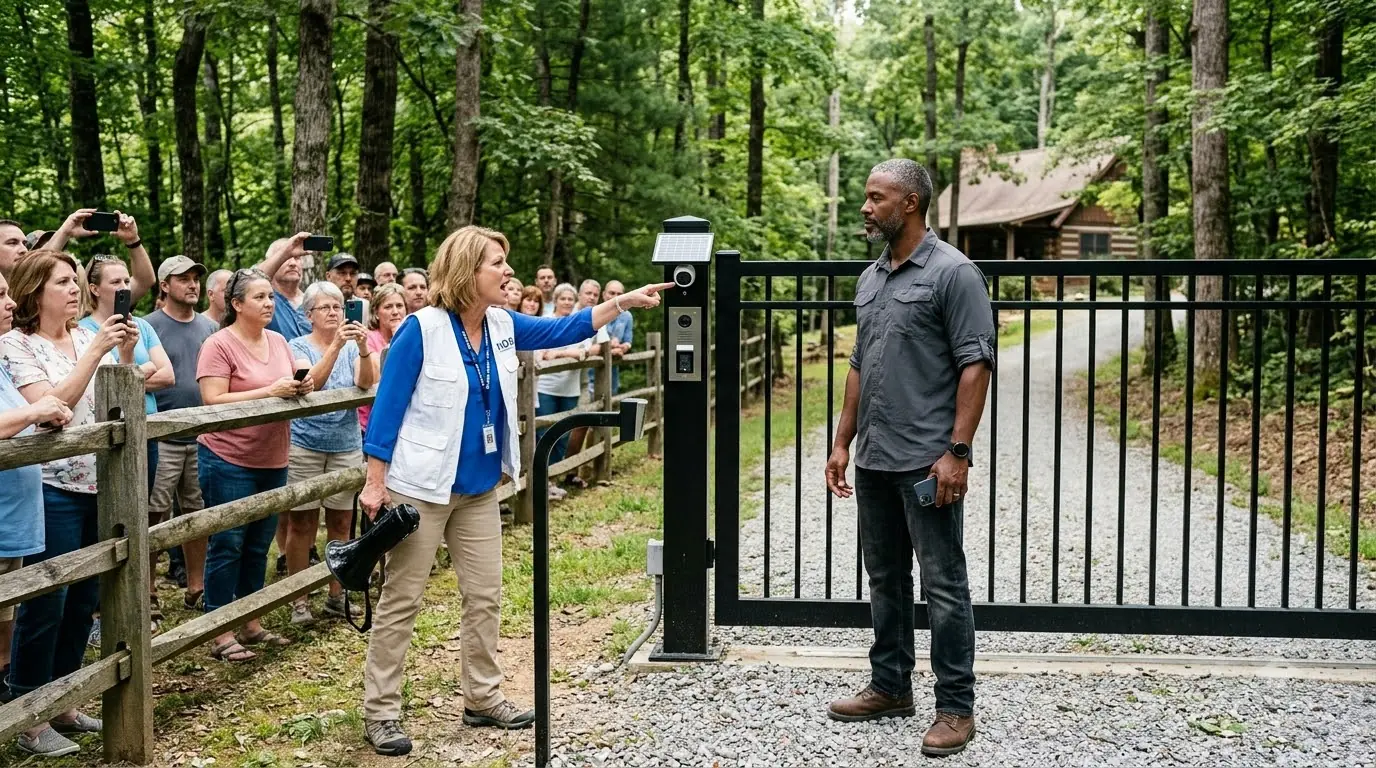
She had organized the community safety watch to protest the fact that I had installed a biometric security gate on my own private driveway. A gate with no key, no keyhole, no code, nothing she could demand, copy, or send someone to cut in the middle of the night, which, by the way, she had already done twice with my old padlocks.
“We need to have access to our property.”
What she was actually doing was committing criminal trespass on camera in front of a newspaper photographer she hadn’t noticed parked on the county road behind her.
My name is Curtis Bain. I’m 47 years old, and I work as a cybersecurity consultant out of Asheville, North Carolina. Before that, I spent 12 years in the Air Force working signals intelligence and electronic security systems. I know locks. I know access control. I know how to keep people out of places they don’t belong, and I know how to document every single attempt they make to get in.
My father, Earl Bain, bought 26 acres on the western slope of Pisgah Ridge back in 1989. It was dense hardwood forest, oak, hickory, and poplar, with a seasonal creek running through the northeast corner and a gravel access road that connected to County Route 9. He built a cabin there in 1991. Nothing fancy, just 1,200 square feet of post-and-beam construction with a metal roof, a stone fireplace, a wraparound porch, and a view of the Smokies that would stop your heart on a clear morning.
He used that cabin every weekend for 25 years. He hunted deer from it in the fall, fished the creek in spring, and sat on the porch in summer reading Louis L’Amour novels until the lightning bugs came out. When the Ridgecrest Meadows subdivision went in around 2008, the developer bought 100 acres east of Dad’s property and carved it into 62 residential lots. Cookie-cutter houses on half-acre parcels, a community pool, a walking trail, the whole suburban package.
The HOA was formed the same year. Dad’s land was never part of the subdivision and never part of the HOA. The properties shared a boundary line, about 400 feet of split-rail fence along the eastern edge, and that was the extent of the relationship.
Dad passed in 2016 from pancreatic cancer. I inherited the property free and clear. The cabin became my retreat, my decompression chamber after long consulting contracts. I’d drive up on Friday afternoons, turn off my phone, and spend two days doing nothing but splitting wood, grilling steaks, and sitting on the porch watching the ridge change color.
Diane Wexler moved into Ridgecrest Meadows in 2019. She was 54, divorced, originally from Charlotte, and had the kind of energy that fills a room the way a smoke alarm fills a hallway. She ran for HOA president within three months of moving in and won unopposed because nobody else wanted the job. That should tell you everything.
Within six months, she had rewritten the landscaping guidelines, hired a new management company, and started sending violation notices to homeowners about mailbox height, fence stain color, and whether basketball hoops were architecturally compatible.
The first time I met her was at a community yard sale that spilled over onto the road near my property line. She walked up my driveway uninvited, knocked on my cabin door, and introduced herself as though she were presenting credentials at an embassy. She told me my gravel driveway was visually inconsistent with the neighborhood aesthetic and asked if I’d consider paving it.
I told her my property wasn’t part of her neighborhood.
She smiled the way a cat smiles at a mouse it hasn’t decided to chase yet and said, “Well, we’re all neighbors here, aren’t we?”
I should have recognized that smile for what it was, a declaration of intent.
The trouble started with the gate. My property has a single access point from County Route 9, a gravel road that runs about 300 yards through the trees to the cabin. Dad had installed a basic tube gate at the entrance with a padlock, more to keep ATVs out than anything else. It had been there since the 1990s. Nobody had ever complained about it.
In March of 2022, I got a letter from the Ridgecrest Meadows HOA on official letterhead, signed by Diane Wexler, informing me that my gate impeded emergency access to the surrounding community and that I was required to provide the HOA with a key to the padlock within 30 days. The letter cited something called the Ridgecrest Community Safety Initiative and referenced a section of the HOA bylaws about emergency preparedness and access coordination.
I read it twice. Then I checked my property records.
My land was not part of Ridgecrest Meadows. My gate was on my property. The gravel road behind it led exclusively to my cabin. There was no public easement, no shared access, and no emergency route that ran through my land. The nearest fire hydrant was half a mile away on the subdivision’s internal road.
My gate impeded nothing except uninvited visitors.
I wrote back a polite letter explaining that my property was private, not subject to HOA governance, and that no key would be provided. I included a copy of my deed and a survey map showing the property boundaries.
Two weeks later, I got a second letter. This one was less polite. It stated that the HOA board had voted to classify my gate as a community safety obstruction and that failure to provide a key within 15 days would result in fines and corrective action. The fine was $300.
I didn’t respond to the second letter. I pinned it to my refrigerator and went fishing.
The following Saturday, I drove up to the cabin and found my padlock had been cut. Clean bolt-cutter job. The lock was on the ground, the gate was open, and there were fresh tire tracks on my road.
I checked the trail camera I keep mounted on a pine tree near the gate. Standard practice. I’d had cameras running since 2018 and found footage from the previous Wednesday showing a white pickup truck pulling up to the gate at 2:47 p.m. A man got out, cut the lock, swung the gate open, and drove through.
He came back out 11 minutes later. The truck had no plate visible from the camera angle, but I could see a Ridgecrest Meadows parking sticker on the rear window.
I replaced the padlock with a heavier one, with a hardened-steel shackle and a more resistant core. I also added a second trail camera at a different angle to catch license plates.
The following Wednesday, the new lock was cut, too. Same kind of clean removal. This time the camera caught the plate. The truck was registered to a man named Glenn Furlow, who I later learned was the HOA’s contracted maintenance supervisor.
My camera also caught something else.
Diane Wexler’s silver Lexus pulled up behind the truck and waited at the road while Furlow opened the gate. Then she drove through behind him. She was inside my property for 22 minutes.
I sat on my porch that evening looking at the footage on my laptop. The sun was setting behind Pisgah Ridge, painting the sky in shades of copper and violet. The air smelled like pine resin and wood smoke from someone’s chimney down the valley. I listened to the creek running through the trees and thought about the fact that a woman I barely knew had just sent someone to remove my lock twice and then driven onto my land like she owned it.
I didn’t call the sheriff that night. I should have, but I was still thinking like someone who believed this could be resolved with reason.
That was about to change.
The next week, I installed a proper gate. Not the tube gate Dad had put up, but a real security gate. It was a six-foot welded-steel frame with a reinforced crossbar, set in concrete footings and secured with commercial-grade hardware. It cost me about $2,000 in materials and a full Saturday of work.
I mounted two additional cameras, one aimed at the gate from the front and another from a tree about 30 feet back covering the entire approach. Both were solar-powered and uploaded their footage to cloud storage.
Three days after the new gate went in, I got a knock on the door of my house in Asheville. Not the cabin, my primary residence.
A Buncombe County sheriff’s deputy stood on my front porch with a complaint report. Diane Wexler had filed a formal complaint alleging that I had installed an unauthorized security barrier on a shared access road and that the installation constituted a public safety hazard and obstruction of emergency services.
The deputy was a young guy, maybe 25, clearly uncomfortable. He said he was obligated to investigate the complaint and asked if I’d be willing to discuss the situation.
I invited him in, showed him the deed, the survey, the trail-camera footage of Furlow removing my locks, and explained that the gate was on private property with no public easement. He took notes, thanked me, and left.
The complaint was closed the same day. No violation.
But Diane wasn’t finished.
She had discovered something that gave her a new angle of attack. The gravel access road from County Route 9 to my cabin ran along the western edge of my property. There was a short section, about 60 feet, where the road came within roughly a dozen feet of the Ridgecrest Meadows property boundary.
This section ran alongside Lot 62, the last lot in the subdivision, which happened to be common area maintained by the HOA.
Diane seized on this proximity and began arguing that my road constituted a shared boundary access corridor that fell under the HOA’s jurisdiction. She hired a surveyor. His first name was Keith. I never got the last name.
He placed survey stakes along the boundary line near Lot 62 and sent a report to Diane claiming that a three-foot strip of my road might encroach on the HOA common area. I say might because the report used the phrase “within the margin of measurement uncertainty.”
In surveying, that means the surveyor isn’t sure. It’s the equivalent of a doctor saying, “Could be a bruise, could be something else,” and Diane treating it like a confirmed diagnosis.
She took that report and sent letters to the county road department, the fire marshal, and the county planning office alleging that my gate was blocking a shared access corridor and requesting an emergency review. She copied me on all three letters.
I read them sitting at my kitchen table in Asheville, eating leftover chili. My blood pressure was normal.
My response was going to be devastating.
I hired my own surveyor, a licensed professional land surveyor named Richard Goss, who had 32 years of experience and whose name carried weight in every county office in Western North Carolina. Richard came out, performed a full boundary survey using GPS-verified monuments, and produced a certified plat.
It showed, beyond any doubt, that my road was entirely on my property. Not close to the line. Not within a margin of uncertainty. The nearest point of my road to the HOA boundary was 14.3 feet, well within my property and well outside any legitimate encroachment claim.
Richard also reviewed Keith’s survey and noted in his professional opinion that the stakes had been placed using outdated reference points and that the methodology was inconsistent with current NCBELS standards.
In plain English, the original survey work was unreliable.
I sent Richard’s survey to all three agencies Diane had contacted, the road department, the fire marshal, and the planning office, with a cover letter from my attorney. Each agency closed its file within two weeks. The fire marshal actually called me to apologize for the inconvenience and said the complaint had no factual basis.
But I wasn’t just playing defense anymore. I was watching the pattern.
Lock cutting. False complaints. Questionable survey work. Repeated attempts to involve government agencies.
This wasn’t a neighbor with a concern. This was a campaign.
In June, Diane escalated from paperwork to politics. She called a special HOA meeting and placed a single item on the agenda, a vote to authorize the HOA to pursue legal action against me for obstruction of community access and refusal to comply with safety coordination requests.
She presented it as a matter of public safety, arguing that if there were ever a fire, medical emergency, or natural disaster affecting the western boundary of the subdivision, my locked gate would prevent first responders from using my road as an alternate access route.
This was nonsense. The subdivision had two dedicated entrances on the east and south sides, both connected to county roads and both meeting fire-code requirements. My private road on the western boundary was never designed, designated, or required as an emergency route. The county fire marshal had already confirmed this.
But Diane presented the issue with the kind of theatrical urgency that makes people vote with their stomachs instead of their brains.