I knew the day was about to go sideways the moment I heard her shriek: "911, there's a gang of dangerous men in my neighbor's backyard!"
And by gang, she meant me, standing in my own yard drinking a beer with three of my closest friends.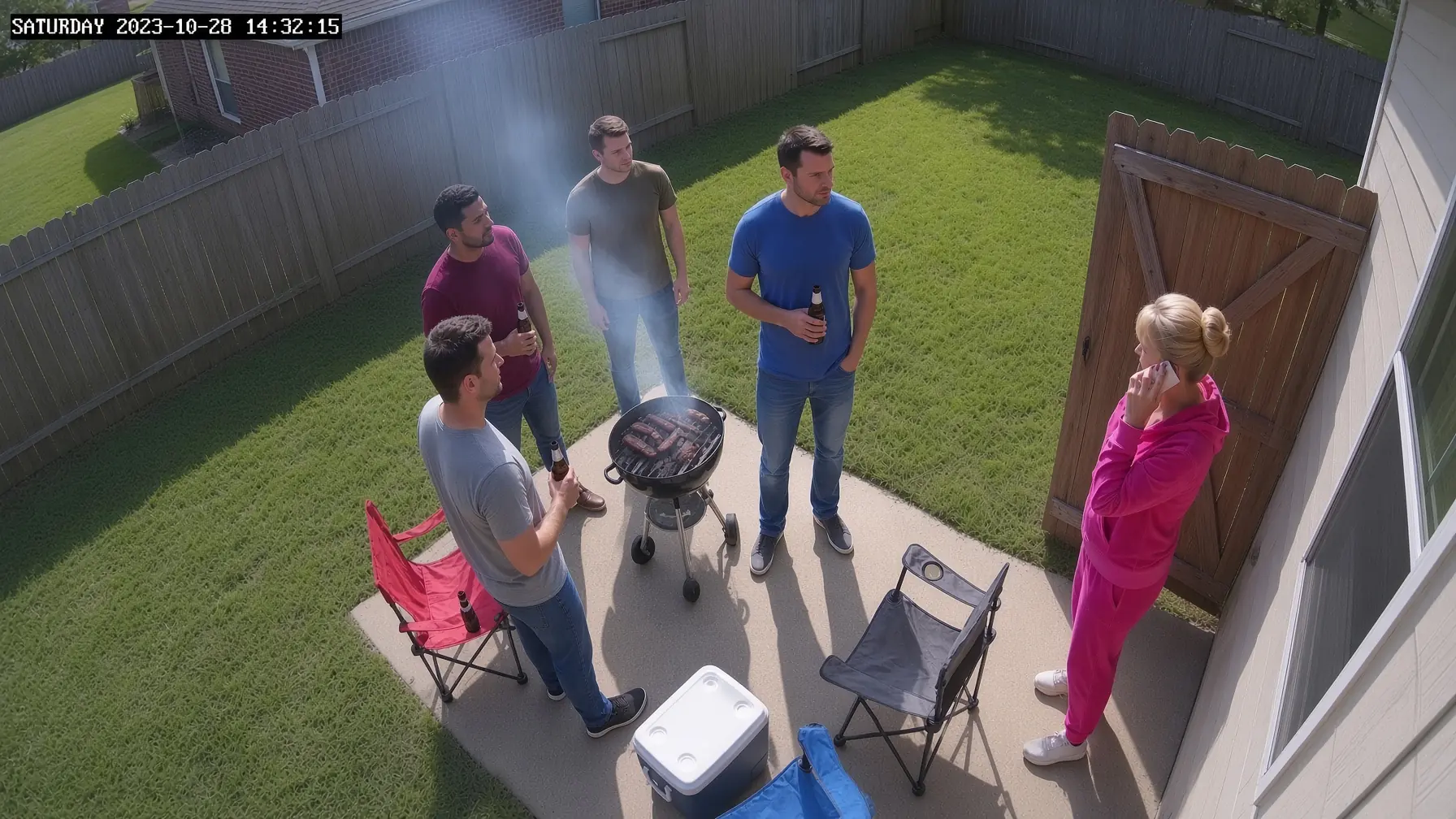
What our dear HOA president Linda Carver, self-appointed guardian of Maple Ridge Estates, didn't know was that the four aggressive criminals she was breathlessly describing to the dispatcher were all off-duty cops, including me.
One minute we were debating whether Die Hard counts as a Christmas movie. The next minute, Linda was trespassing through my gate, pointing at us like she'd uncovered a cartel operation, and dialing 911 with the confidence of someone who had never been wrong in her entire life.
By the time the patrol car rolled up, lights flashing across my fence, I realized this wasn't going to be a funny misunderstanding. It was the opening shot of a war I never asked for—one that nearly cost me my career, my reputation, and my peace.
It really had been the perfect Saturday, one of those rare golden days that feel borrowed from a better life—the kind of day you spend all week daydreaming about but never actually get. The sun was warm but not oppressive. The air smelled like cut grass and charcoal, and for the first time in months, all four of us—me, Tyler, Ramon, and Chris—had synced days off. That alone felt like a miracle. Getting four cops on the same schedule is nearly impossible.
I'd spent years scraping and saving for this house on Maple Ridge Lane, and every time I stepped into the backyard, it felt unreal: the big oak tree casting wide, lazy shadows, the wooden fence enclosing my little sanctuary, a grill that had seen more hot dogs than actual cooking. But it was mine. My first real home after 15 years of cramped apartments and roommates who treated cleaning supplies like mythical artifacts.
Chris was already in rare form, cracking jokes between sips of his beer. He was the tech guy, the kind of cop you wanted when someone's laptop held more secrets than a suspect's mouth. Ramon sat back, peeling the label from his bottle like he always did when he was relaxed—strategic, calm, always analyzing. And then there was Tyler: tall, broad, gym-sculpted, intimidating until you heard him laugh. To strangers, he was a tank; to us, he was a teddy bear with a bad temper that only appeared when someone truly deserved it.
We'd thrown a pile of burgers on the grill, argued about movies, talked trash about each other's terrible aim during last month's qualifications, and joked like we hadn't done in far too long. It was one of those rare moments when I wasn't Officer Reed; I was just Marcus, a guy with a cold beer and good friends.
But even during perfect days, there's a moment, almost imperceptible, when the air shifts—a prickle down the back of your neck, a whisper in the part of your brain trained by years on the job. It's the same instinct that makes you slow your patrol car at 2:00 a.m. because something feels off in a parking lot, even if you can't immediately pinpoint what. That instinct quietly tapped me on the shoulder.
At first, I brushed it off. A bird, maybe. A neighbor walking by. Nothing unusual. But then I saw Ramon narrow his eyes slightly—not enough to alarm anyone else, but enough for me to notice. Tyler and Chris were still arguing loudly about whether the Yankees were washed this season, oblivious to everything except their own nonsense.
I let my gaze drift casually toward the fence line. It was subtle: just a flicker of movement, a sweep of blonde hair dipping below the wooden slats. Someone was watching us.
Now, look, I get it. Neighbors peek; people are curious. But there's a big difference between glancing out your kitchen window and full-on surveillance mode. I turned back to the guys, deciding not to ruin the vibe. If it was someone being nosy, it wasn't the first time. And if it was someone being rude, well, also not the first time.
But the feeling didn't go away. If anything, it got stronger. The breeze carried the faint rustle of leaves overhead. The grill popped softly as grease dripped into the fire. Somewhere down the street, a lawnmower hummed. It was peaceful, familiar, safe.
And yet...
"Anyone else feel like we've got eyes on us?" I finally murmured.
Ramon just nodded once. "Yep."
That was enough for me. I didn't stand or react dramatically; I didn't want to escalate a situation that might not even exist. But my senses sharpened in that slow, steady way you never really lose after enough years in uniform.
Then it happened.
The gate latch on the side of my yard rattled. Barely a second later, the gate creaked open, slow but deliberate. Stepping inside my yard like she owned the land beneath her shoes was the woman I had only glimpsed earlier.
She was maybe 5'4", maybe older than she wanted people to know, with bright blonde hair pulled into a bun so tight I was shocked she could blink. She wore a pink velour tracksuit that looked like it had been bought two sizes ago but forced into service anyway, and a posture so rigid she resembled a drill sergeant who had lost her whistle but not her authority issues. She planted her feet a good 20 feet away from us, hands on hips, chin up, like she was about to issue citations for simply existing incorrectly.
The conversation died instantly. Four grown men, four trained police officers, fell silent in our own backyard.
I tried to be the responsible adult. "Uh, hello. Can we help you?" I asked.
Her eyes didn't soften. They sharpened, like she was scanning for violations only she could see. Her glare danced over our beers, our clothes, our faces—assessing, condemning.
"I knew it," she hissed. "I heard you people from my kitchen: loud music, rude language, carrying on like this is some kind of party!"
Chris blinked. "We don't even have music on."
Ramon stepped in with that smooth negotiator voice of his. "Ma'am, we're just talking. It's a quiet afternoon. Nothing illegal happening here."
She whipped toward him so fast I thought she might sprain something. "Don't you lie to me!" she snapped. "I know what kind of people you are!"
That one landed heavy. We all felt it. Years on the job teach you to hear the things people don't say, and she wasn't hiding the subtext. Her tone dripped with prejudice—a familiar, ugly kind.
Tyler stood so quickly his chair scraped the patio, his jaw tightening. I raised my hand subtly, signaling him to stay calm. The last thing we needed was to match her energy.
"Ma'am," I said, voice steady but firm, "you're on private property. My property. You need to leave."
A normal human being would have realized they'd crossed a line. She wasn't a normal human being.
"This neighborhood has rules!" she barked. "Standards! We don't allow gatherings like this!" She waved broadly at us—the grill, the cooler, the chairs, all of it.
Chris muttered, "It's called a barbecue, ma'am. People do it. It's legal."
Wrong move. She spun on him, eyes bulging. "Don't you get smart with me, hoodlum!"
That word. That word lit the fuse.
Tyler took a step forward. "Hoodlum? You walk into his yard and call us—"
"Ty," I warned quietly.
He inhaled sharply and stepped back, barely.
I turned back to her. "This is your last warning. Leave now."
Her expression shifted just for a moment; something like calculation slid behind her eyes. Then her mouth curled into the smuggest smirk I had ever seen. She reached into her pocket, pulled out her phone, and declared with triumphant glee, "I'm calling the police. We'll see who's right when they get here!"
She began pacing across my lawn—my lawn—fake-crying into the phone as she told the dispatcher a masterpiece of fiction about aggressive men, threats, and being in fear for her life. And as the distant wail of sirens drifted toward Maple Ridge Lane, all I could think was: She has no idea who she's messing with.
The sirens grew louder, crawling up Maple Ridge Lane like a slow-moving storm, their echo bouncing off the quiet houses that lined the street. There's a strange, almost surreal feeling that settles in your stomach when you hear police responding to a call about you. Even when you know without an ounce of doubt that you've done nothing wrong, training kicks in: your pulse quickens, your body braces, your mind runs through scenarios. It's instinct, muscle memory forged from years of walking into the unknown.
Linda, meanwhile, was giving a performance worthy of a daytime drama award. She paced in frantic little circles, one hand on her chest as she wailed into the phone: "Yes, they're still here! They're staring at me! I'm terrified! Oh, please hurry, I don't feel safe!" She kept glancing at us between fake sobs, making sure her imaginary danger was being properly communicated.