The first thing I noticed was the silence.
Every morning for nearly three years, I had stepped onto my back porch with coffee and listened to sparrows hopping through the young maple trees along my fence. They were not enormous old oaks or hundred-year-old landmarks. Most of them were barely taller than a person, thin-trunked trees I had planted myself after buying the house. There were twelve in all—young red maples, two flowering dogwoods, and three small magnolias arranged along the side and rear boundary of my property. They had cost money, but that was not why I cared about them. I had spent weekends digging holes, replacing clay soil, staking them through storms, watering them during Atlanta summers, and watching each new season add a little height.
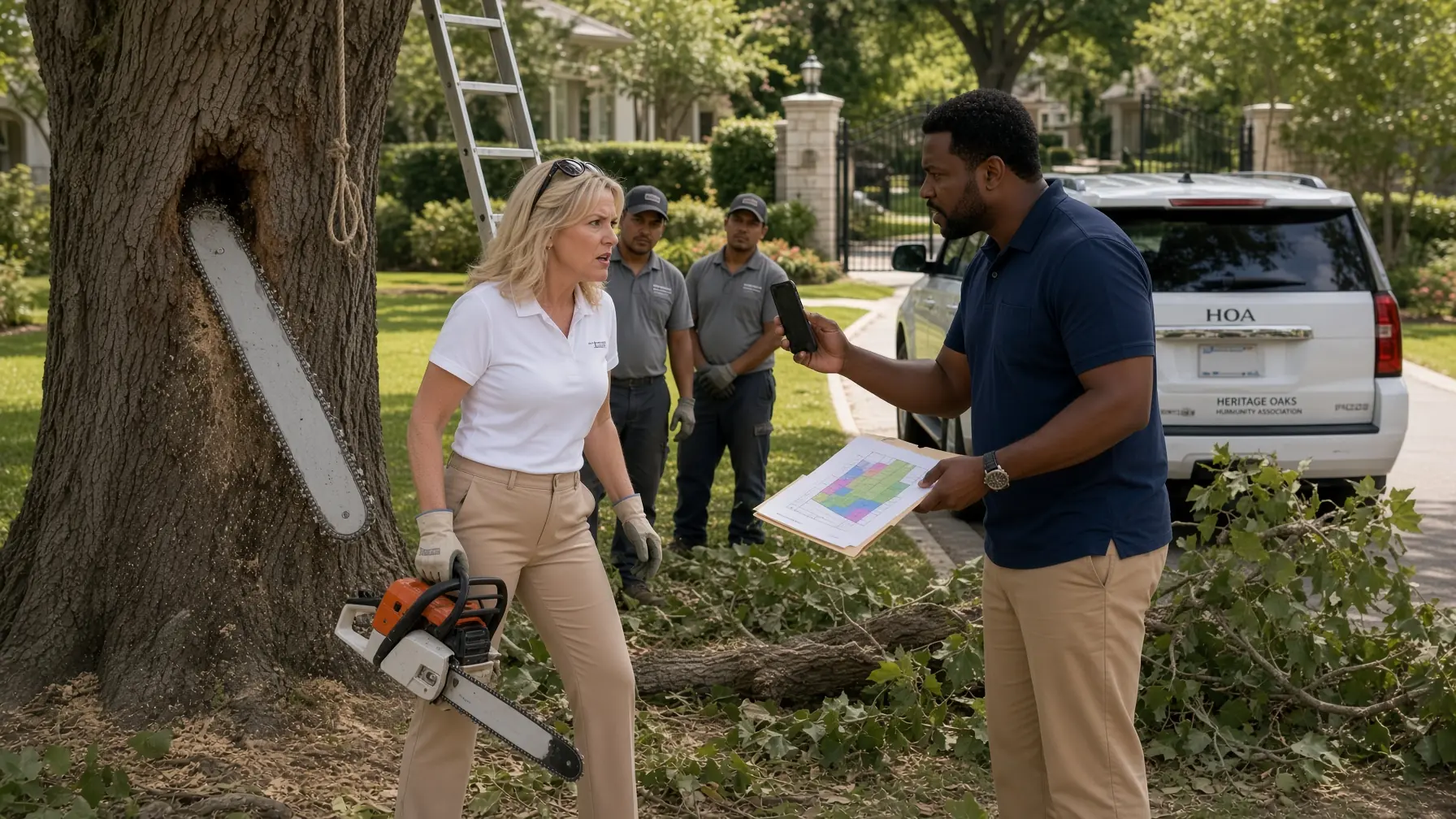
That Thursday morning, half of them were lying across my grass.
Some had been cut completely through about three feet above the ground. Others had been hacked low enough that the remaining trunks looked like broken posts. Branches were scattered everywhere. Leaves covered the lawn. One magnolia had been dragged toward the alley and abandoned because whoever cut it apparently decided it was too heavy to move. The small grove I had spent years building looked as though someone had walked through it with a chainsaw and simply stopped caring where things fell.
I stood there holding my coffee for almost a full minute.
Then I saw the orange ribbon.
It had been tied around the remaining trunk of one maple.
Printed across it in black letters were the words:
HOA LANDSCAPE CORRECTION.
That was when I knew exactly who had done it.
Her name was Brenda Whitmore, president of the Hawthorne Ridge Homeowners Association, and she had been trying to get those trees removed for six months.
Brenda did not live next door. She lived four houses down in the largest house on our street, a two-story brick place with white columns, decorative shutters that had never once been opened, and a circular driveway polished so clean you could probably eat breakfast off it. She was sixty-one, always dressed as if a neighborhood inspection might unexpectedly become a television interview, and possessed the unusual ability to make holding a clipboard feel like a threat.
Our first disagreement had started over leaves.
Not actual leaves.
Potential future leaves.
She stopped me one afternoon while I was pulling weeds and pointed toward the young maples. “Those are going to become a maintenance problem,” she said.
I looked at the trees.
“They’re six feet tall.”
“Eventually they won’t be.”
“That is usually how trees work.”
Brenda did not appreciate that.
She told me the HOA had landscaping standards designed to maintain “visual consistency” and that my trees might eventually block sightlines, shade common landscaping, or create debris near the walking path beyond my rear fence.
I asked her to show me the rule.
She promised she would.
Three days later, I received an email citing Section 8.4 of the neighborhood covenants.
I read it.
Section 8.4 prohibited homeowners from planting trees within designated utility easements without prior approval.
Reasonable enough.
Except my trees were not inside the utility easement.
I knew because I had paid for a boundary survey before building the fence two years earlier. The easement ran along the opposite side of the lot, where power and telecommunications lines entered underground. The trees were between four and nine feet inside my property line.
I sent Brenda the survey.
She responded:
The Architectural Committee maintains discretion over landscaping that may affect community aesthetics.
I asked which approved standard the trees violated.
No answer.
Two weeks later, I received a violation notice stating that “multiple unapproved woody plantings” needed removal.
That phrase almost impressed me.
Woody plantings.
As though calling a tree something bureaucratic made it easier to cut down.
I appealed.
The HOA board reviewed the matter.
Three of the five directors agreed the notice had no clear basis and suspended it.
I assumed that ended things.
I underestimated Brenda.
For the next four months, she inspected my yard with religious devotion.
A branch extending six inches beyond the fence generated an email.
Mulch touching the base of a tree generated another.
A wooden support stake leaning after a storm somehow became an “unsafe visible structure.”
Then Brenda began telling neighbors that the trees had been planted on HOA property.
That was simply false.
I showed anyone who asked the recorded survey.
Eventually, even people who normally avoided HOA disputes began joking about Brenda’s obsession.
Maybe that embarrassed her.
Maybe she genuinely believed the association possessed more land than it did.
Maybe she simply could not tolerate losing a disagreement in a community where she had spent twelve years being the person everyone eventually gave in to.
Whatever the reason, she escalated.
At 7:18 on that Thursday morning, I took photographs before touching anything.
Every stump.
Every fallen trunk.
Every orange ribbon.
Every tire mark in the grass beside the alley gate.
Then I walked around the side of my house and looked at the camera mounted beneath the eave.
Six months earlier, after somebody dumped construction debris near our fence, I had installed three ordinary exterior security cameras. One covered the driveway. Another covered the rear porch. The third covered most of the side yard.
I opened the app.
The activity timeline showed motion at 6:06 a.m.
I tapped it.
Brenda walked into frame wearing white pants, a navy blouse, and gardening gloves.
Behind her were two men in fluorescent landscaping shirts carrying chainsaws.
I watched the entire thing without moving.
Brenda pointed at my trees.
One worker hesitated.
The camera microphone was not perfect from that distance, but his voice could still be heard.
“You sure these are association trees?”
Brenda answered immediately.
“Yes. Owner’s been notified repeatedly.”
The worker pointed toward my fence.
“These look inside his lot.”
Brenda held up a clipboard.
“I’m HOA president. I have authorization.”
Then she turned toward the trees.
“Everything marked gets cut.”
The worker asked, “To ground level?”
Brenda replied, “No. Just cut them enough that he can’t keep them.”
I stopped the video.
Then replayed that sentence.
Just cut them enough that he can’t keep them.
That was when my anger changed.
Before that sentence, I could imagine incompetence.
A mistaken work order.
A contractor given the wrong lot number.
A property-line misunderstanding.
After that sentence, the situation became different.
She had not been trying to perform landscaping.
She had been trying to win.
I downloaded the original video to two separate devices, exported the relevant clips, and saved the camera system’s activity log.
Then I called the landscaping company.
The number was printed clearly on the workers’ shirts.
A manager named Hector answered.
I introduced myself and asked whether his crew had performed work at Hawthorne Ridge that morning.
He paused.
“Yes, sir. HOA job.”
“Who authorized it?”
“Association president.”
“Did she give you a work order?”
“Yes.”
“Can you preserve it?”
There was another pause.
“Is something wrong?”
“You cut twelve trees on private property.”
The silence changed.
“What address?”
I gave it.
He asked me to wait.
When he returned, his voice sounded different.
“Mr. Carter, I’m going to have our operations manager call you.”
“My name is Daniel Mercer.”
“Sorry. Mr. Mercer.”
“Before anyone calls me, please do not alter the work order, texts, dispatch notes, crew GPS, photographs, or invoices.”
Now he sounded genuinely alarmed.
“Are you an attorney?”
“No.”
That seemed to worry him more.
I was an estimator for a commercial construction company. I spent my working life reading plans, checking measurements, documenting change orders, and learning exactly how expensive mistakes became when nobody wrote down what happened.
I had no intention of screaming at Brenda.
I had something better.
Records.
My next call was to an arborist.
Not a landscaper.