I learned the hard way that there are two things you should never casually interfere with in a quiet American neighborhood.
The first is another person’s property.
The second is anything that even remotely touches critical communications infrastructure.
At the time, I understood the first rule perfectly well.
The second one?
Not so much.
Neither did Linda Barrett, president of the Alder Ridge Homeowners Association, who had apparently convinced herself that a clipboard, a title, and several years of neighbors avoiding arguments with her amounted to unlimited jurisdiction over everything visible from the sidewalk.
By the time she discovered otherwise, my quiet suburban street had become a temporary parking lot for utility vehicles, investigators, government sedans, and neighbors pretending to check their mail while watching the biggest scandal Alder Ridge Lane had seen since someone painted a garage door the wrong shade of beige.
But I’m getting ahead of myself.
My name is Daniel Mercer.
I was thirty-six when all of this happened, and I had bought my house on Alder Ridge Lane three years earlier after spending most of my adult life renting apartments where every wall seemed thin enough to hear someone else’s alarm clock.
The house was nothing impressive.
A narrow two-story built in the late 1980s.
Three bedrooms if you were generous about the tiny room upstairs.
One and a half bathrooms.
A detached garage that leaned slightly to the left if you looked at it from the alley.
The porch steps creaked.
The siding had faded from pale blue to something closer to tired gray.
And an enormous sycamore tree in the front yard dropped enough leaves every autumn to bury a small vehicle.
I loved it immediately.
It was mine.
That mattered more than granite countertops or vaulted ceilings.
I had spent twelve years moving wherever work demanded.
Denver.
Phoenix.
Dallas.
Then back to Ohio, where my mother still lived about forty minutes away.
When my employer permanently approved remote work, I decided I was done treating apartments like temporary storage units between moves.
I wanted a garage.
A backyard.
A kitchen where I could drill into the wall without wondering whether a landlord would charge me three hundred dollars for it.
Most of all, I wanted quiet.
Alder Ridge seemed perfect.
The subdivision sat twenty minutes outside Columbus, close enough to the city for convenience but far enough that nights were still genuinely dark. Kids rode bicycles in the street. Neighbors walked dogs after dinner. People waved when passing each other’s driveways even when they had no intention of stopping to talk.
The HOA fee was reasonable.
Seventy-eight dollars a month.
It covered snow removal, maintenance of the small entrance monument, landscaping around the retention pond, and upkeep of a playground near the back of the development.
The rules seemed irritating but manageable.
Trash cans needed to be behind the house by the evening after collection.
Grass could not exceed six inches.
No commercial vehicles overnight unless enclosed.
No major exterior changes without approval.
Fine.
I wasn’t planning to paint the house neon green or keep goats in the backyard.
Then I met Linda Barrett.
Linda lived three houses down on the corner.
Early sixties.
Perfect silver-blonde bob.
Perfectly pressed walking clothes.
Perfect front lawn.
Her flowers seemed to bloom according to a schedule.
She changed the decorative flag beside her porch every month.
Snowman in January.
Hearts in February.
Tulips in April.
American flag in July.
Pumpkins in October.
Every season represented exactly when expected.
Linda had been HOA president for four years when I moved in.
At first, she seemed helpful.
She introduced herself my second afternoon in the neighborhood.
“Daniel Mercer?”
“That’s me.”
She smiled.
“Linda Barrett. HOA president.”
She offered her hand.
I shook it.
“Welcome to Alder Ridge.”
“Thank you.”
“We take a lot of pride in the community here.”
“I can see that.”
She looked briefly toward the stack of moving boxes sitting near my garage.
“Garbage pickup is Tuesday. Containers should not be visible from the street outside the permitted collection window.”
I thought she was joking.
She wasn’t.
“Got it.”
“The architectural guidelines are available online.”
“I’ve read them.”
Her eyebrows lifted.
“All of them?”
“I’m weird like that.”
That actually seemed to earn me some approval.
For several months, Linda and I had no problems.
Then I replaced my mailbox.
The old one was rusting at the bottom.
I bought a nearly identical black metal model.
Installed it on Saturday.
Monday morning, an email arrived.
SUBJECT: ARCHITECTURAL MODIFICATION NOTICE
Apparently, changing one black mailbox for another required approval.
I sent photos.
Filled out the form.
Three days later, the modification was approved retroactively.
Annoying.
Not worth fighting.
Then she complained that my recycling bin was visible from the sidewalk through a narrow gap between my garage and fence.
I moved it six inches.
Then there was the time a utility contractor parked in front of my house for forty-five minutes while servicing an underground junction.
Linda photographed the truck and posted in the neighborhood app asking whether “unauthorized commercial activity” was occurring.
I explained it was the internet provider.
She deleted the post without apology.
That became our pattern.
Linda noticed something.
Linda asked questions.
I explained.
Linda moved on.
Until the fiber line arrived.
For most residents, the new fiber build was simply better internet.
For me, it mattered significantly more.
I worked as a systems reliability analyst for Halcyon Aerospace Systems, a large subcontractor that supported several commercial aviation and government-adjacent programs.
Whenever I told people what I did, they imagined something much more exciting than reality.
No, I didn’t design missiles.
No, I didn’t monitor satellites.
No, I did not know whether aliens existed.
I spent most days staring at dashboards.
Latency charts.
Error rates.
Performance logs.
Network health.
Distributed computing environments.
My job was to notice boring technical problems before they became expensive technical problems.
That meant my home connection was essential.
I had backup access.
Encrypted corporate hardware.
A secondary cellular connection.
Company security requirements.
Nothing secret was casually running through my personal router.
But stable internet was still how I earned my living.
A fifteen-minute outage was inconvenient.
Several hours could become an incident.
A day could affect deadlines, monitoring responsibilities, and contract obligations.
So when MetroLink Communications ran fiber through our alley, I paid extra for the best residential-commercial hybrid package available.
The installer looked at my garage setup and laughed.
“You planning to run NASA from here?”
“Spreadsheets.”
“That’s disappointing.”
I had converted one corner of the garage into a small network cabinet.
Nothing exotic.
Wall-mounted enclosure.
Patch panel.
Battery backup.
Firewall.
Fiber terminal.
Everything labeled.
Every cable tied neatly.
The conduit from the exterior termination point ran straight, painted to match the siding.
Most people would never notice it.
Linda noticed it within a week.
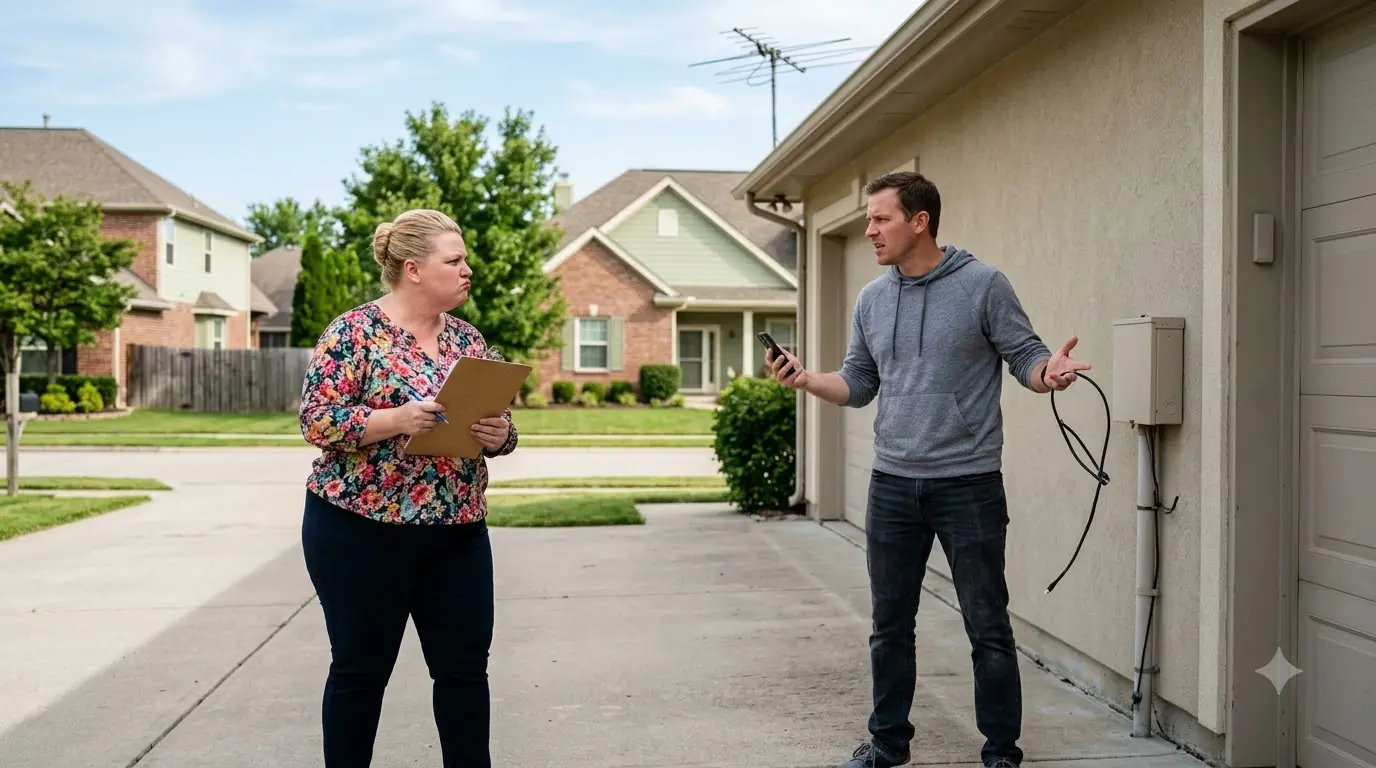
She knocked on my door on a Wednesday evening.
I was halfway through making pasta.
When I opened the door, she pointed toward the side of the garage.
“What is that?”
“Conduit.”
“For?”
“Internet.”
She frowned.
“You already had internet.”
“Now I have better internet.”
“Did the HOA approve that installation?”
“The utility provider installed the external drop.”
“That wasn’t my question.”
I almost smiled.
“Linda, utility service doesn’t require HOA approval.”
“Exterior modifications do.”
“Utility access is specifically exempted in the covenants.”
Her expression shifted slightly.
“You’re certain?”
“Yes.”
“I’ll verify.”
“Please do.”
She did.
Two days later, she sent a message saying the matter was “resolved.”
Again, no apology.
Then she noticed the antenna.
It was a small directional wireless antenna near the rear ridge of my roof.
Part backup link, part hobby equipment.
Barely visible.
Legal.
Professionally mounted.
The neighborhood app notification arrived at 8:13 p.m.
“Friendly reminder: rooftop installations require architectural approval. Residents should refrain from modifying rooflines without authorization.”
She did not tag me.
She didn’t need to.
Three minutes later, I received a private message.
LINDA:
Daniel, please submit documentation regarding the device currently attached to the rear roofline.
ME:
It predates my ownership and is not structurally modifying the roof.
LINDA:
Any active telecommunications installation may still require review.
ME:
It doesn’t.
LINDA:
I’ll check.
ME:
Please do.
She responded with a thumbs-up emoji.
I cannot explain why, but from Linda, that emoji felt threatening.
After that, she started paying attention to my house differently.
I would see her slowing down during her morning walk.
Sometimes she looked toward the utility pole.
Sometimes toward the garage.
Once I found her standing in the alley photographing the exterior fiber termination box.
“What are you doing?”
She turned calmly.
“Documenting neighborhood infrastructure.”
“Why?”
“We’ve had complaints.”
“From who?”
“I don’t disclose residents.”
“About my internet box?”
“About visual clutter.”
The box was gray.
Six inches wide.
Mounted behind my garage.
Not visible from the street.
“Linda.”
“Yes?”
“Please stop photographing my property unless there is an actual HOA matter.”
Her smile tightened.
“If something is visible from common access, residents are permitted to document it.”
“Then enjoy your photo.”
I went inside.
That interaction bothered me more than I admitted.
Not because I thought Linda was dangerous.
Because she seemed obsessed with proving there must be something wrong.
For people like Linda, uncertainty itself was intolerable.
If she didn’t understand something, it became suspicious.
If she couldn’t control it, it became a violation.
Still, life continued.
Then came the Monday everything changed.
I remember that morning clearly because it started beautifully.
October.