I never imagined a sleepy suburban lane could turn into a battleground over a car.
Not a parking dispute. Not noise. Not someone blocking a driveway.
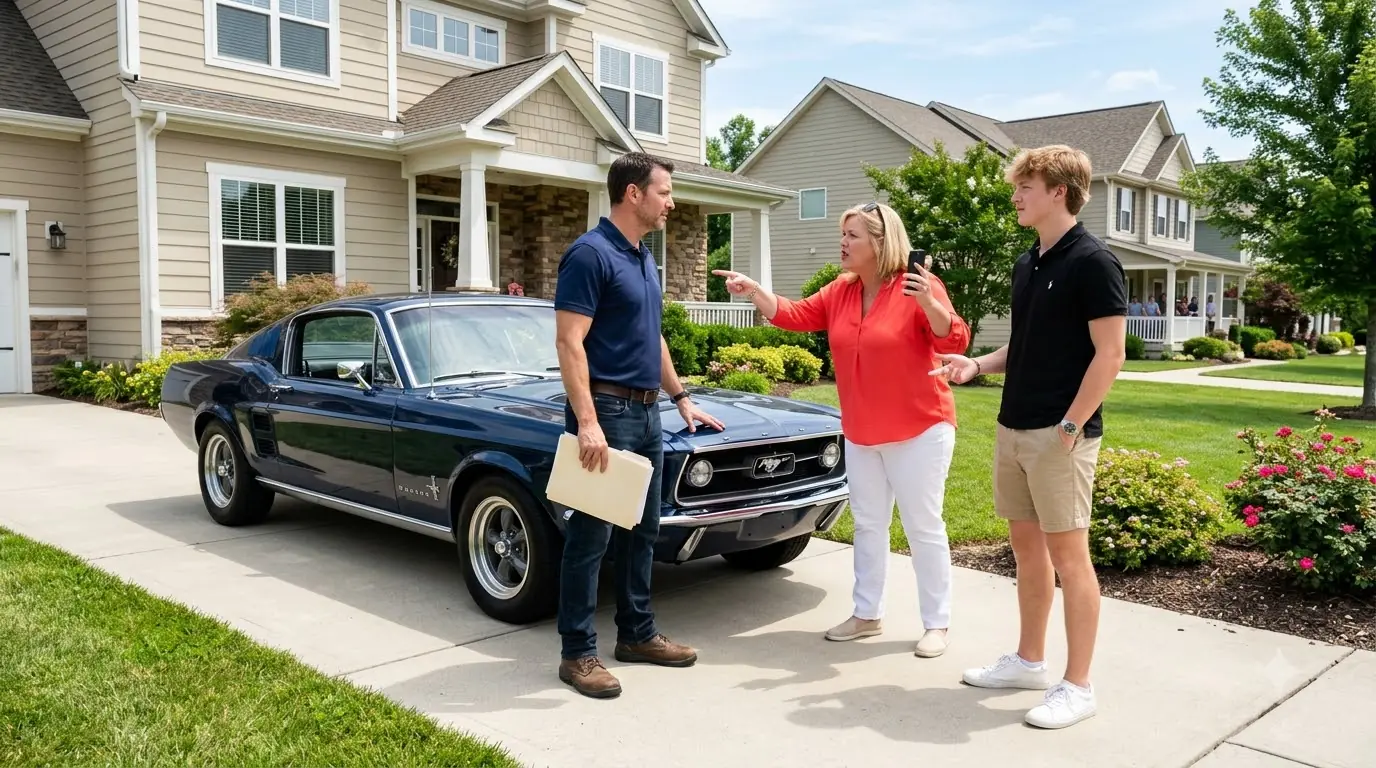
A car that had belonged to me for more than twenty years.
It happened on a bright Saturday morning in early June, the kind of morning when our neighborhood looked almost unreal in its perfection. Freshly cut lawns stretched between identical sidewalks. Sprinklers clicked rhythmically behind white fences. Somewhere two houses down, someone was grilling breakfast sausages, and the smell drifted lazily across the street.
I was standing in my driveway with a mug of coffee in one hand and a microfiber cloth in the other, admiring the sunlight bouncing off the deep red paint of my 1967 Ford Mustang Fastback.
That car was more than transportation.
It was twenty years of my life sitting on four tires.
I bought it when I was twenty-two from an elderly mechanic named Frank Delaney who had kept it behind his garage beneath a torn blue tarp. At the time, calling it a Mustang was generous. The engine barely turned. Rust had eaten through part of the rear quarter panel. The seats were split. One headlight was missing, and mice had somehow converted the trunk into real estate.
My father thought I had lost my mind.
“You paid actual money for this?”
“Seven hundred dollars.”
“You got robbed.”
That was the first conversation we ever had about the Mustang.
The second conversation happened three weekends later when he showed up at my apartment carrying a toolbox.
My father, Robert Cole, had spent thirty-five years working maintenance at a manufacturing plant. He knew engines, electrical systems, welding, plumbing, and approximately ten thousand ways to tell me I was doing something incorrectly.
We spent the next six years restoring that Mustang together.
Not continuously.
Life got in the way.
Jobs changed.
I got married and divorced.
My father developed arthritis.
There were months when nothing happened except the car collecting dust beneath a cover.
But we always returned to it.
We replaced rusted panels.
Rebuilt the suspension.
Pulled the engine twice.
Spent an entire winter arguing about whether to preserve the original transmission.
My father insisted authenticity mattered.
I insisted reliability mattered.
He won.
Eventually.
When the Mustang finally rolled under its own power for the first time, my father stood beside the garage pretending there was dust in his eyes.
He died eight years later.
Cancer.
Fast.
The Mustang became something different after that.
Every time I turned the key, I remembered his hands tightening bolts.
Every time I heard the engine settle into that uneven idle, I heard him telling me I had adjusted something wrong.
I had turned down offers far above what I paid restoring it.
People never understood.
To them, it was an old car.
To me, selling it would have felt like selling a piece of my father.
So every Saturday when the weather was good, I washed it.
Polished the chrome.
Checked the fluids.
Sometimes I took it through the hills outside town.
Sometimes I simply parked it in the driveway and drank coffee while looking at it.
That was what I was doing the morning Karen Whitmore arrived.
Karen lived four houses down.
She was fifty-four, president of the Brookfield Estates Homeowners Association, and possibly the only person I had ever met who could make carrying a clipboard look threatening.
Her entire identity seemed built around enforcement.
Trash cans left visible seventeen minutes after collection?
Karen noticed.
A basketball hoop slightly too close to the sidewalk?
Karen photographed it.
Wrong shade of beige on a mailbox?
Expect an email before dinner.
The HOA itself had never bothered me much before she became president.
Brookfield Estates was a fairly normal middle-class suburban neighborhood built in the late 1990s. The association maintained landscaping around the entrance, coordinated snow removal, handled the small community playground, and made sure nobody turned their front lawn into a junkyard.
Reasonable enough.
Then Karen joined the board.
Within two years, she became president.
Suddenly the monthly newsletter sounded like legislation from a tiny authoritarian government.
Residents received violation notices for flowerpot colors.
Holiday decorations had approved display periods.
Karen once tried to fine Mr. Henderson across the street because his grandson had drawn dinosaurs in sidewalk chalk.
That particular fine disappeared after half the neighborhood complained.
Karen never apologized.
She merely said the rule had been “misinterpreted.”
My own conflict with her had begun four months earlier.
I had replaced a section of fence along the rear edge of my property after a windstorm damaged it.
The fence followed exactly the same footprint as the old one.
Same height.
Same material.
Same color.
Karen nevertheless claimed I needed retroactive HOA approval and threatened a daily fine.
I challenged it.
That led to three letters.
Two meetings.
A conversation with an attorney.
Eventually, because some of the HOA’s claims involved whether its architectural rules could override recorded property rights, I contacted a state attorney’s office that had previously investigated homeowner association complaints.
They reviewed the documents I provided and made one thing very clear.
The HOA had authority over specific covenant matters.
It did not have unlimited authority over my private property.
The fence issue disappeared almost immediately after the HOA received a formal letter.
Karen did not forgive me.
I knew that.
I simply underestimated how ridiculous her next move would be.
That Saturday morning, I heard her before I saw her.
Heavy footsteps.
Fast.
Purposeful.
I looked toward the sidewalk.
Karen was marching toward me wearing white capri pants, oversized sunglasses, bright sandals, and a coral blouse that somehow matched the aggressive energy of her clipboard.
Behind her, a teenage boy stood near the sidewalk.
Her son, Evan.
I knew him only vaguely.
He was seventeen or eighteen, thin, quiet, usually wearing headphones. Unlike Karen, he seemed capable of going through an entire day without publicly correcting another human being.
Karen entered my driveway without invitation.
I took another sip of coffee.
“Morning, Karen.”
She stopped beside the Mustang.
Her eyes traveled across it.
“Beautiful car.”
That should have warned me.
Karen had never complimented anything I owned.
“Thanks.”
“My son loves these.”
I glanced toward Evan.
He looked at the car.
Then at me.
Then immediately at the ground.
“Good taste.”
Karen smiled.
It was not a friendly smile.
“I’ve been thinking.”
“That sounds dangerous.”
She ignored the comment.
“Evan needs a car.”
I waited.
Karen continued.
“He’s graduating next year. He’ll need reliable transportation for school, activities, eventually college.”
I nodded slowly.
“There are plenty of used cars online.”
“I know.”
She placed one hand against the Mustang’s roof.
I immediately looked at it.
Karen noticed.
She removed her hand.
Then she said the sentence that started everything.
“I think you should give him this one.”
For a moment, I honestly believed I had misunderstood.
“The Mustang?”
“Yes.”
I stared.
Karen’s expression remained completely serious.
“You want me to give your son my car.”
“Yes.”
“For free.”
“Well, obviously.”
I actually looked toward Evan.
He had turned red.
“Mom.”
Karen raised one hand toward him.
“Let me handle this.”
I put my coffee on the workbench.
“Karen, are you joking?”
“Not at all.”
“Then I’m going to need you to explain how you arrived at this idea.”
She looked almost offended that explanation was necessary.
“You hardly drive it.”
“I drive it.”
“Occasionally.”
“It’s my car.”
“And Evan would get much more practical use out of it.”
I laughed once.
I couldn’t help it.
Karen’s eyes narrowed.
“This isn’t funny.”
“It’s a little funny.”
“No, it isn’t.”
“Karen, you walked onto my property and told me to give your teenage son a restored 1967 Mustang.”
“Because it makes sense.”
“To whom?”
“To the community.”
That word caught my attention.
“The community.”
“Yes.”
She tapped the clipboard.
“The HOA encourages residents to consider community benefit when maintaining highly visible assets.”
I blinked.
“Highly visible assets.”
“Exactly.”
“It’s a car.”
“It’s a collectible vehicle frequently displayed in an open driveway.”
“I park it at my house.”
“Which creates a visual association with the neighborhood.”
I stared at her.
For several seconds, neither of us spoke.
Then I said, “No.”
Karen blinked.
“What?”