She stood at my gate in a silk dress and gold-rimmed glasses, speaking like she was reading a resolution into the official record.
"You will sign the transfer papers next week.
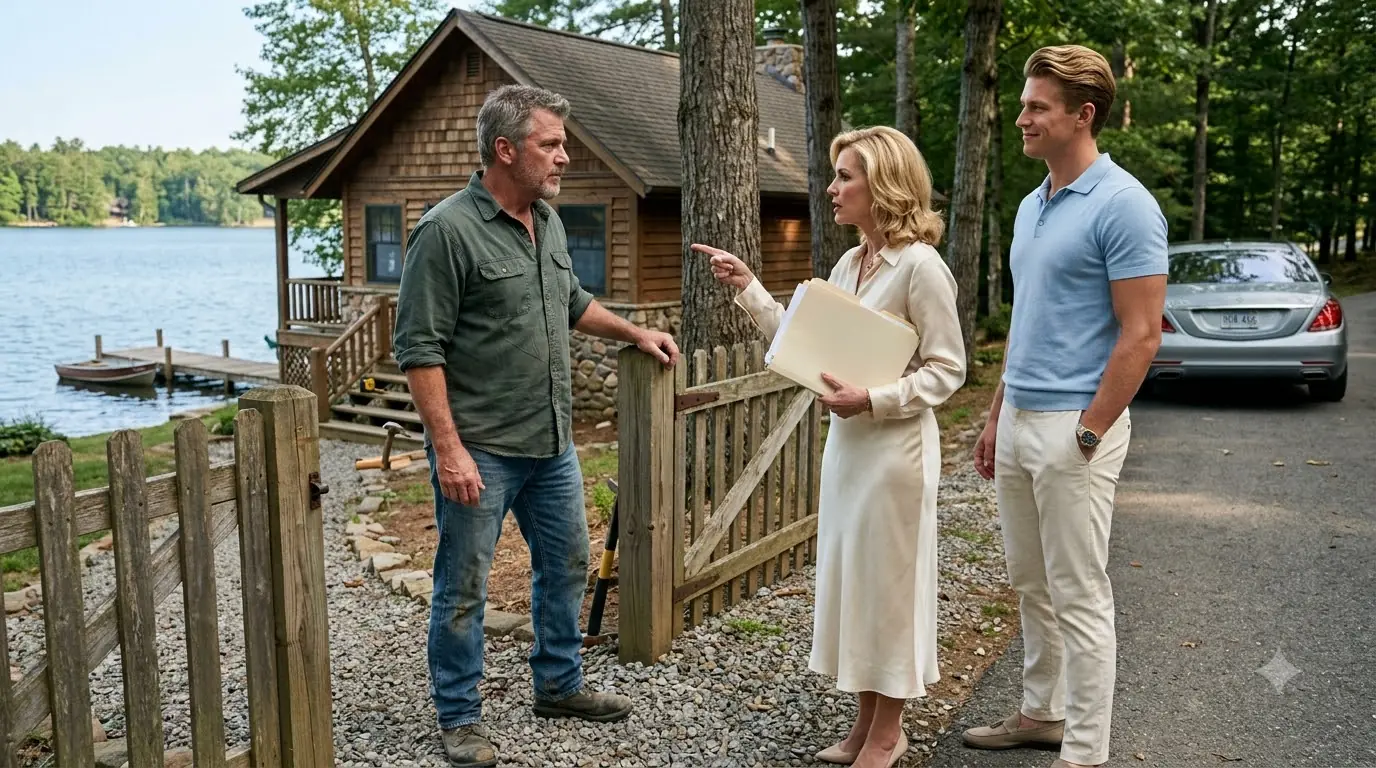
My son needs a recovery space." I looked at her, looked at the lake, looked back at her. "No." She tilted her head like the word was in a foreign language.
"You don't understand who you're talking to." "I do," I said. Then I turned toward my front door. "You're standing on my land." Marian Chadwick had no idea those five words would be the beginning of the end for her.
I was fixing the third wooden step on my dock when I heard heels on gravel. Not the sound of a neighbor passing through. These were deliberate footsteps, the kind made by someone who already believes they belong where they're going.
My father built that cabin in the 1970s with his own hands. Every beam, every uneven floorboard, every window facing Cedar Lake meant something to him. He chose that lot for the morning light. When I inherited it 11 years ago, I maintained it the way he would have wanted. I replaced dock planks, repaired siding, and never once imagined I'd have to defend the place from someone trying to take it.
Inside, near the front door, my father had hung a framed land survey from 1973, yellowed at the edges, county-stamped, precisely measured. At the time, I thought it was just one of his retired engineer quirks. I didn't know it would become the most important thing in the house. Marian had brought her son, Bryce, with her, 30 years old, and carrying the expression of a man who had never once been told to wait.
He barely looked at me. He was already studying the porch, the dock, the shoreline, the tree line, like he was mentally rearranging the property. Marian started speaking without even pretending this was a conversation. She said she was presenting a community reallocation proposal under HOA guidelines. She talked about Bryce needing a recovery-oriented living environment.
She used the phrase equitable redistribution of underutilized community assets like that meant anything in plain English. I asked her which article in the HOA documents gave her that authority. She told me the board had already reviewed the framework. I said, "Which article, Marian?" She said it wasn't productive to get into the weeds.
So, I went inside, brought back my deed and the official HOA governing documents I'd gotten from the county recorder's office months earlier, and laid them on the porch rail between us. I pointed to the property boundary. Then, I pointed toward the tree line where that boundary ran.
She never looked down. She stared past the papers at the lake, as if legal ownership was just an obstacle to her preferred view. I told her the conversation was over and went back inside.
Through the side window, I watched her and Bryce return to their car. She was already on the phone before they reached the gate. I wrote down the time, 2:14 p.m. Then I started a second notebook dedicated entirely to Marian Chadwick.
The next morning, I called the surveying company I trusted from my years in construction engineering. I wanted fresh boundary verification. That night, while looking over county parcel maps, I noticed something I had somehow never checked before. A 30-foot strip of land along the northern side of the HOA office complex. Everyone assumed it belonged to the association.
It didn't. The parcel was registered to Douglas Scott, my father. I stared at the screen for a long time. Then I wrote down the parcel number and underlined it twice.
A week later, after I had survey stakes placed along my property lines, Marian retaliated. A notice appeared under my front door before sunrise printed on HOA letterhead. It cited article 14B and claimed my survey markers were unauthorized construction. It ordered me to remove them within 72 hours or face daily fines.
There was only one problem. Article 14B didn't exist.
I checked the recorded HOA documents. I checked the amendments on file with the county. Nothing created an article 14B. Nothing gave the HOA authority to stop a landowner from placing survey markers on their own titled property.
By 11:40 that morning, I had written confirmation from the county clerk saying exactly that. So, I drafted a response letter. No emotion, no speeches, just the facts. The real governing document, the clerk's written statement, and a side-by-side comparison showing the discrepancies in Marian's notice. I mailed it certified and kept the receipt.
That afternoon, she called my cell. I let her get through two sentences before I told her all future communication had to be in writing and I hung up. That evening, she posted in the neighborhood group about a disruptive property owner creating hostile boundaries and undermining the community spirit.
She didn't use my name, but she posted a photo of my survey stakes. Everyone knew who she meant. I screenshotted everything and said nothing.
Then Eleanor Voss called. Eleanor was 71, lived near the HOA office, and looked exhausted in the particular way people do when they've been confused and intimidated for so long. They begin to doubt themselves. She slid a folder across her kitchen table and told me she thought there were others.
14 months earlier, she had signed what she believed was a consent form to plant hedges near her fence. 3 months later, she received an invoice from maintenance on land she no longer owned. Buried in the paperwork was a transfer of a 4,000 sq. ft. strip of her backyard into a private maintenance trust. She had signed away part of her property without knowing it.