The first thing I remember is the color.
Red and blue emergency lights kept flashing across my living-room windows, turning the white curtains purple, then black, then purple again.
Firefighters were shouting in my front yard.
A police officer stood near the curb with one hand raised toward me as if he were stopping traffic.
Except I was the traffic.
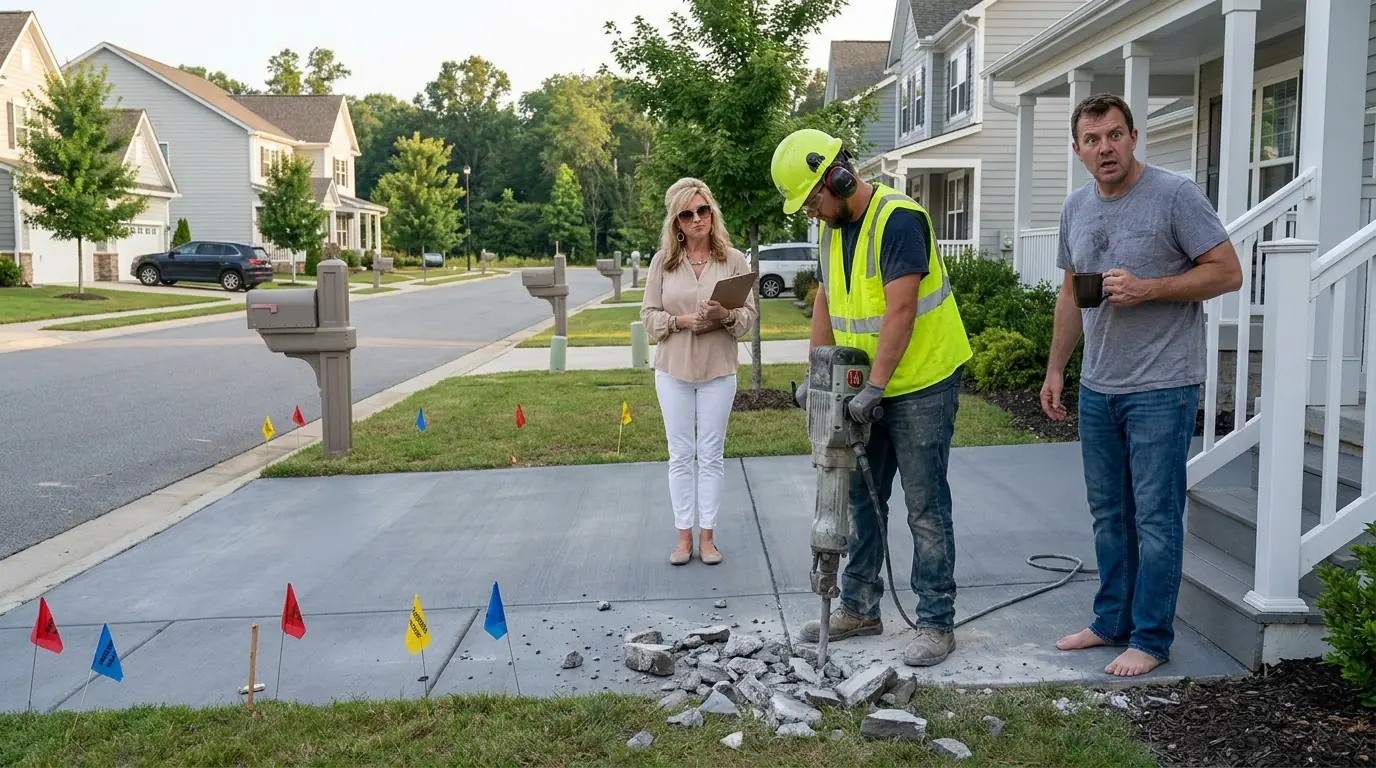
Barefoot.
Standing on my own lawn.
Coffee cooling in my hand.
“Sir, stay behind the engine!” he shouted. “We have an active gas leak.”
I stopped.
Then I looked past him.
At what used to be my driveway.
Three hours earlier, it had been smooth gray concrete.
Brand-new.
Flat.
Clean enough that I had spent the previous weekend warning delivery drivers not to turn around on it.
Now it looked like somebody had attacked it with heavy artillery.
Broken slabs lay across the grass.
Concrete dust covered my hydrangeas.
A jagged trench cut down one side like an open wound.
Firefighters had stretched yellow tape across the entrance.
And somewhere beneath the wreckage, gas was still hissing from a line that should never have been touched.
Then I looked across the street.
Karen Stevenson stood beside a police cruiser clutching her clipboard against her chest.
That was the part my mind could not process.
Not the fire trucks.
Not the possibility of an explosion.
Not the fact that half my street was being evacuated.
Karen had caused all of it.
Over concrete.
My name is Nate Harris.
And until that morning, the most dangerous thing I thought an HOA could do was ruin somebody’s weekend.
I was wrong.
I bought my house in Maple Court because it was boring.
That was a compliment.
The neighborhood sat twenty-five minutes from my office and fifteen from downtown. There were sidewalks, old oak trees, a small playground, and houses built close enough that people knew when you got a new car but far enough apart that nobody should have known what you ate for breakfast.
The homeowners association called the development Willow Creek Estates.
Most residents called it Willow Creek.
I called it home.
The HOA itself had always been mildly annoying.
Someone cared too much about mulch.
Someone else complained every December about inflatable decorations.
A committee once spent forty minutes debating whether dark navy counted as an approved shutter color.
Normal suburban nonsense.
Then Karen Stevenson became chair of the architectural review committee.
Karen lived directly across from me.
Her house looked less lived in than maintained.
The grass had perfect diagonal mowing lines.
The shrubs were clipped into identical shapes.
Her white garage door never had a smudge.
Even her trash cans seemed embarrassed to remain outside longer than absolutely necessary.
Karen was in her late fifties, always dressed as though she might be photographed for a real-estate brochure, and almost never left the house without oversized sunglasses and a clipboard.
She loved rules.
More specifically, she loved being the person who explained rules to other people.
Visible hose reel.
Wrong flower-pot color.
Holiday wreath displayed too late.
Car parked in driveway longer than she considered tasteful.
She wrote everything down.
Nobody had officially given her much power.
That never stopped her from acting as though the neighborhood charter began:
Karen Stevenson shall decide.
Most people avoided her.
So did I.
Unfortunately, my driveway gave her a reason to stop avoiding me.
It was old.
Original concrete, as far as I knew.
A large crack ran from the sidewalk almost to the garage, branching in two places like lightning frozen into the slab.
Every morning, when I backed my truck out, my tires crossed it with a dull thunk.
I hated that sound.
Eventually I hired Carlos Mendoza, a local concrete contractor who had done work for three houses in the neighborhood.
The plan was simple.
No expansion.
No decorative pavers.
No change in color.
No new shape.
We were resurfacing the existing driveway in plain gray concrete.
Before doing anything, I checked the HOA handbook.
Driveway maintenance was specifically allowed.
Architectural approval was required only if the dimensions, materials, color, drainage pattern, or footprint changed.
None of mine would.
I also pulled the required city permit.
And because Carlos insisted on doing everything properly, we called 811.
Utility crews marked the area.
Little flags appeared along the property.
Red.
Blue.
Yellow.
Orange.
Gas.
Water.
Electrical.
Communications.
The markings showed where existing lines ran.
Nothing interfered with the resurfacing work because we were not excavating deeply.
We were removing damaged surface material and pouring replacement concrete over the existing prepared base.
Straightforward.
Carlos arrived Tuesday morning.
Karen arrived approximately forty seconds later.
I had barely walked onto the porch with coffee when I heard:
“What is going on here?”
Carlos looked toward me.
I looked toward the road.
Karen stood at the edge of my lawn wearing sunglasses and holding her clipboard.
“Good morning, Karen.”
She ignored that.
“Why is there construction equipment in front of your home?”
“I’m resurfacing the driveway.”
“You do not have HOA approval.”
“I don’t need approval for maintenance.”
Her lips tightened.
“I am chair of architectural review.”
“I know.”
“Then you know exterior modifications require approval.”
“This isn’t a modification. Same driveway. Same size. Same color.”
I gestured toward the crack.
“Just fewer geological features.”
Carlos looked away to hide a smile.
Karen tapped her pen against the clipboard.
“You are setting a dangerous precedent.”
“For smooth concrete?”
“For disregarding community standards.”
I walked down the porch steps and held out copies of the HOA section and the city permit.
“City approved it. Utilities were marked. The handbook says maintenance is allowed.”
Karen did not take either paper.
“You have been warned.”
“About what?”
She wrote something on her clipboard.
Then she turned and marched back across the street.
Carlos waited until her front door closed.
“Is she in charge?”
“No.”
He nodded toward her house.
“She seems pretty sure.”
“She just hasn’t discovered the difference between confidence and authority.”
The job went perfectly.
By Thursday afternoon, the new surface was smooth and level.
Carlos blocked the driveway with tape and told me when I could walk on it and when I could drive on it.
Saturday evening, I stood near the garage admiring the finished slab.
There is something deeply middle-aged about admiring concrete.
I accepted that.
Three days later, I found a notice taped to my front door.
Not mailed.
Not in an envelope.
Taped.
Three pages.
Bold headings.
Multiple underlined phrases.
NOTICE OF VIOLATION
UNSANCTIONED DRIVEWAY MODIFICATION
PENALTIES TO FOLLOW
At the bottom:
Acting on behalf of the HOA: Karen Stevenson
I laughed.