Brenda Vance thought my trash bin was weak because it fell every time she kicked it.
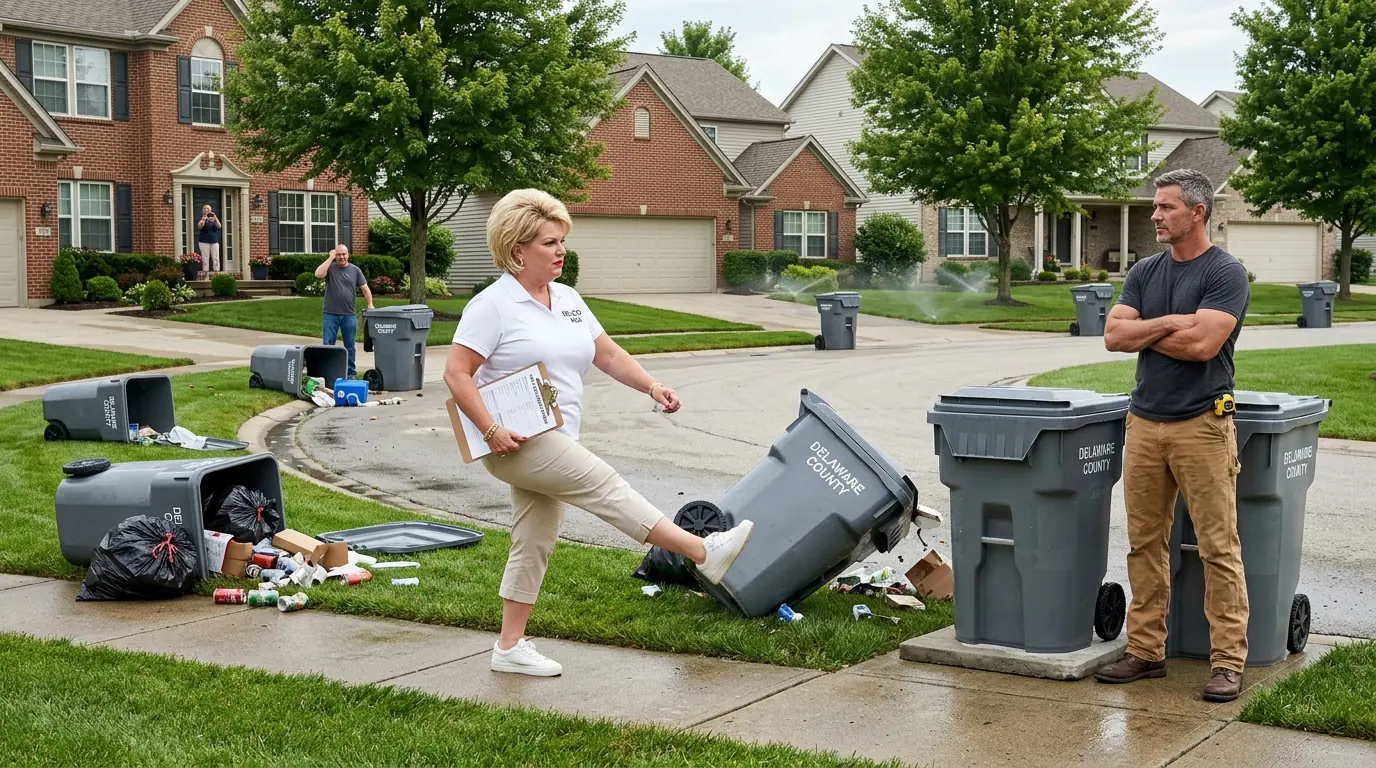
She thought my silence meant I was scared, my cameras were decorative, and my father’s confusion made my house an easy target. For almost four months, she would walk past my driveway before sunrise on trash day, glance up and down Larksburg Court, and put one sharp kick into the side of my city-issued bin. Then she would photograph the mess she had created and upload the pictures to the Sutton Ridge compliance portal as proof that I was “failing to secure household waste.” She had done it so many times that eventually I could tell whether Brenda had been there by the sound alone.
Then one Thursday morning, she wound up harder than usual.
Her foot hit something that did not move.
Ninety pounds of precast concrete sat where she expected a plastic bin to give way, part of a city-approved anti-tip restraint I had installed after weeks of documenting the problem. The plastic container flexed. The anchor stayed exactly where it belonged. Brenda stumbled backward, screamed loud enough to wake half the cul-de-sac, and in the confusion that followed, she did something far more damaging than hurting her pride.
She started explaining why she had kicked it.
Every camera on my property was recording.
So was the one across the street.
My name is Owen Whitaker, and I pour foundations for a living.
Footings. Retaining walls. Garage slabs. Basement walls. Precast pads. The boring things nobody photographs once the landscaping is finished but the entire structure depends on anyway. I had spent twenty-two years working around concrete, and concrete had taught me something useful about people: what is visible rarely tells you whether something is strong. Strength usually lives underneath, where nobody bothers looking until the load arrives.
Measure twice. Set your forms. Check your lines. Read the soil. Respect frost depth. Calculate the load. Wait for cure. Concrete is patient, but it is not forgiving. Rush it and the weakness comes back later. Ignore what lies underneath and eventually the crack appears where everybody can see it.
By forty-six, I had learned people were not so different.
The loudest person on a job site was rarely the person holding the real plan.
Brenda Vance was very loud.
I lived on Larksburg Court in Sutton Ridge, a planned community in Delaware County, Ohio, a little north of Columbus. From outside, Sutton Ridge looked like somebody had washed the American dream, trimmed the edges, and stapled it to an HOA handbook. Brick mailboxes lined curved streets beneath young maple trees. Two-car garages opened at almost identical angles every weekday morning. Sprinklers ticked before sunrise. Kids drew chalk galaxies on driveways and rode bicycles in loops around the cul-de-sacs until somebody’s mother called them inside.
It was a good neighborhood.
Mostly.
I had moved there for two people.
My daughter Hazel was nine, missing both front teeth and convinced bedtime was an opening position in a negotiation rather than an actual time. My father, Raymond Whitaker, was seventy-eight, a retired machinist, collector of Korean War history books, lifelong believer that every engine made after 1985 contained “too much thinking,” and a man slowly losing pieces of himself to dementia.
Dementia does not steal a person all at once.
It steals in coins.
Dad forgot where we kept coffee filters.
Then the word for mailbox.
Then the route from his bedroom to the downstairs bathroom one night, even though he had walked it for eleven months.
The worst mornings were when he forgot my mother had died six years earlier. He would look toward the staircase and ask why she was taking so long to come down for breakfast. I had learned there was no perfect way to answer. Sometimes I told him gently. Sometimes I redirected him. Sometimes his mind found the truth again before I had to.
Every time he lost her, I watched him grieve her again.
That teaches you to protect quiet like medicine.
Dad needed routine. Same chair near the window. Same blue mug. Same oatmeal with brown sugar. Same game show after breakfast. Same slow walk with me toward the mailbox when weather allowed. Sudden noise could pull him out of the day like somebody yanking a plug from a wall.
That was how Brenda entered our lives.
Not with a welcome letter.
With a crash.
Trash collection in Sutton Ridge happened Thursday mornings. City rules allowed bins at the curb after six Wednesday evening, and I followed them almost embarrassingly well. Wednesday after dinner, I rolled the gray city-issued container to the curb beside the maple tree. Lid shut. Wheels toward the house. Handle accessible for collection. Thursday afternoon, I brought it back.
That should have been the full relationship between my household and organized garbage.
The first time I heard the bin hit the pavement, it was 6:08 on a Thursday morning in late May.
Dad was sitting at the breakfast table.
The crash came from outside.
He jumped so hard his spoon hit the floor.
“What was that?”
“Probably the trash truck.”
His face changed.
“Somebody hit the house.”
“No, Dad.”
He tried standing.
I crossed the kitchen quickly.
“Sit down. I’ll check.”
When I opened the front door, the truck had not arrived.
My trash bin lay on its side.
Two bags had spilled through the open lid. A cereal box, coffee grounds, a milk carton, and something Hazel had created from construction paper were scattered across my front lawn. The container itself was undamaged.
I figured wind.
Except there was almost none.
I cleaned everything up.
Dad watched from the front window.
By breakfast he had forgotten the noise.
I did not.
The following Thursday, it happened again.
5:57 a.m.
This time I looked through the upstairs window before going outside.
The bin lay sideways near the curb.
Trash had spilled into the street.
I checked my doorbell camera.
Its field of view covered the porch and part of the driveway, not the curb. At the far left edge of one clip, I caught the back of somebody in a pale jacket walking away.
Not enough to identify.
I moved an exterior camera slightly.
The third Thursday, nothing happened.
The fourth, the bin fell again.
Camera feed showed static for approximately forty seconds during the relevant period.
That got my attention.
The camera was connected through Wi-Fi. Temporary interference could have come from any number of ordinary things. Signal loss was not proof somebody was jamming it. I knew enough from construction security systems to avoid pretending every technical glitch had a villain behind it.
I upgraded the access point.
Checked the power.
Added local storage.
Then I received my first HOA notice.
IMPROPER WASTE PRESENTATION / UNSANITARY CONDITION.
Attached was a photograph of my tipped bin.
I stared at it.
The image had been taken before I cleaned the yard.
The notice came from Brenda Vance, Chair of the Sutton Ridge Neighborhood Standards Committee.
I knew Brenda vaguely.
White woman, fifty-nine, short blond hair, immaculate yard, silver crossover, always wearing clothes that looked ready for either gardening or a city-council meeting. She lived three houses down on the opposite side of the street. Her husband Greg seemed friendly enough. He waved from his driveway. Brenda rarely waved unless she expected something in return.
I emailed.
My bin appears to have been knocked over before collection. Please identify the provision I violated.
Brenda replied eleven minutes later.
Residents are responsible for maintaining their waste containers in an upright, sanitary condition while placed curbside.
I opened the HOA handbook.
There was a sanitation provision requiring closed containers and cleanup of spills. Nothing said homeowners were strictly liable if a third party deliberately tipped a bin.
I wrote back.
The container was upright when placed. Someone appears to be knocking it over. I will continue monitoring. Please waive the violation.
Her response:
Homeowners remain responsible for conditions originating from their property. Consider securing your container appropriately.
That word bothered me.
Appropriately.
How?
The city sanitation department required free access for the automated collection arm. I could not chain the bin to a tree. Permanent structures were prohibited within part of the right-of-way. The bin had to remain movable and correctly positioned.
I asked Brenda what approved securing method she recommended.
No answer.
The fifth incident happened two weeks later.
This time the local-storage camera caught her.
Not perfectly.
Enough.
At 5:49 a.m., Brenda walked down the sidewalk wearing black exercise pants and a yellow jacket. She slowed near my curb, looked toward my house, then extended one leg.
The bin moved.
Unfortunately, a parked pickup blocked the moment of contact.
The video showed Brenda approach an upright container.
Then Brenda’s body made a kicking motion behind the truck.
Then the bin appeared on its side as she walked away.
Compelling.
Not perfect.
I saved it.
Did not confront her.
That surprised my daughter.
“You know it’s her.”
“I think it’s her.”
“The video literally shows Mrs. Vance doing karate at our garbage.”
I looked at Hazel.
“Where did you learn to say that?”
“Dad.”
“Yes?”
“Don't change the subject.”
Nine-year-olds are terrifying negotiators.
I showed her the obstruction in the video.
“We can prove she walked up. We can prove she moved her leg. We can prove the bin was down afterward.”
“So she did it.”
“Probably.”
“She did.”
“Probably isn't the same as proving exactly what happened.”
Hazel rolled her eyes.
“You're exhausting.”
“My clients say that.”
“What clients?”
“People who want buildings not to crack.”
She walked away muttering something about adults making everything harder than necessary.
Dad had started noticing Brenda too.
That worried me more.
One afternoon he stood by the living-room window and watched her cross the street.
“That woman keeps coming here.”
“She doesn’t come here much.”
“Yes, she does.”
I looked at him.
Dementia changes your relationship with testimony. Some memories become unreliable while others remain painfully precise. You do not dismiss everything. You also cannot treat certainty as accuracy.
“What does she do?”
Dad pointed.
“Mess with your garbage.”
My stomach tightened.
“You’ve seen her?”
He nodded.
“When?”
“Morning.”
“Which morning?”
He looked confused.
“Thursday.”
“Today’s Monday.”
His expression collapsed.
“I know what day it is.”
“I didn't say you didn’t.”
“Yes, you did.”
He walked away angry.
I hated myself for asking too hard.
That night he forgot the conversation.
I did not.
The following month produced three more notices.
One for spilled trash.
One for “container obstruction,” even though the bin had been moved from the correct pickup position after I placed it.
One because the lid was supposedly not fully closed at 6:22 a.m.
Attached photographs were always taken before the city truck arrived.
Almost always from approximately the same angle.
Brenda’s.
I attended a board meeting.
Brenda sat at the end of a folding table with three binders arranged in front of her like exhibits.
The actual HOA president was a man named Harold Finch, sixty-seven, retired insurance executive, polite in the tired way of someone who had volunteered for something that gradually became a second job.
I explained.
“My bin is upright when I set it out.”
Brenda said, “Then perhaps animals are disturbing it.”
“We don't have raccoons wearing running shoes.”
Harold coughed into his hand to hide a laugh.
Brenda did not.
“Is this amusing to you?”
“No.”
“You've repeatedly failed sanitation standards.”
I put printed screenshots on the table.
“These are still frames from my camera. That is you beside the container before one incident.”
Brenda glanced down.
“I walk every morning.”
“The bin is upright when you approach.”
“Yes.”
“Then down when you leave.”
“That proves nothing.”
She was right.
Technically.
I hated how much she enjoyed being right about it.
Harold looked at the photographs.
“Brenda, did you touch his bin?”
“No.”
Flat.
Immediate.
I watched her face.
No hesitation.
That mattered emotionally.
It did not matter evidentially.
I asked the board to suspend fines until they could determine whether someone was interfering with the container.
Harold agreed.
Brenda objected.
“Then every homeowner can blame phantom vandals for violations.”
I looked at her.
“I’m blaming a fairly specific phantom.”
Her jaw tightened.
The fines were paused anyway.
The harassment became more deliberate after that meeting.
My bin started moving to the wrong side of the driveway.
Once it ended up partially blocking a neighbor’s mailbox.
Another morning, it was turned ninety degrees so the automated arm could not grab it.