The first time my trash can got knocked over, I blamed the wind.
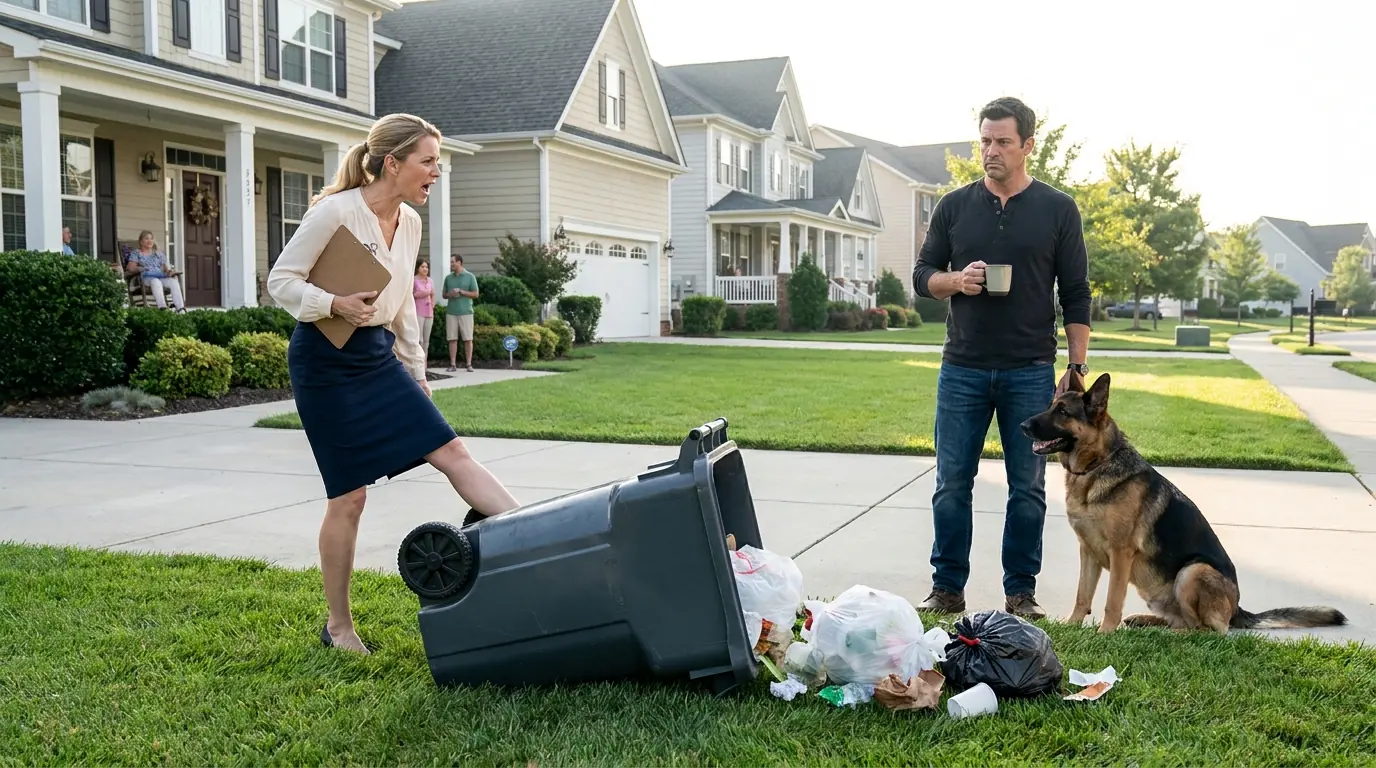
It was a tall city-issued bin, dark green, serial number stenciled on the side, the kind that had survived winter storms, loose dogs, one delivery truck clipping it, and a teenager on a skateboard who once used it as an emergency brake.
So when I walked outside one Tuesday morning and found it lying on its side in the grass, lid open, coffee grounds spread across the curb, I figured a gust had caught it at exactly the wrong angle.
I cleaned it up.
My coffee went cold while I picked up paper towels and food wrappers.
Bear, my eighty-pound shepherd mix, investigated a banana peel with the seriousness of a homicide detective.
Nothing about it seemed important.
Three nights later, it happened again.
This time I blamed raccoons.
Raccoons were everywhere in Briar Glen. Bold little criminals with hands, masks, and apparently no respect for private property.
But the third time changed everything.
I came outside before seven on a Friday morning and stopped halfway down the porch steps.
The bin had not merely fallen.
It had been cracked down one side.
Two trash bags had been pulled apart.
Garbage was spread across my front lawn in a wide arc, almost evenly spaced from the sidewalk to the hydrangeas.
Nobody could convince me an animal had done that.
Bear came down beside me.
Usually he sniffed everything.
That morning he sat.
Ears forward.
Eyes fixed toward the corner.
Then I heard the heels.
Click.
Click.
Click.
Certain people announce themselves before they appear.
Melissa Whitcomb was one of them.
Nobody in our neighborhood called her Melissa.
Among the residents who had dealt with her long enough, she was simply Karen.
Not to her face.
Usually.
She turned the corner carrying a clipboard under one arm like a field marshal carrying battle plans.
Blonde hair pulled into a severe ponytail.
Cream blouse.
Navy skirt.
Pointed heels entirely inappropriate for walking across wet grass.
Melissa was president of the Briar Glen Homeowners Association.
She had held the position for four years and behaved as though she had been elected governor of a small sovereign nation.
She stopped beside the wreckage.
Looked at my lawn.
Then looked at me.
“Well,” she said. “This is exactly the sort of thing we’ve been discussing.”
I stared at her.
“What sort of thing?”
“Visible refuse.”
“Somebody knocked over my trash can.”
“The community doesn’t care about excuses, Daniel. The community cares about appearances.”
The community.
Melissa loved that phrase.
She could tell one resident to repaint a mailbox and make it sound like two hundred families had risen in unanimous protest.
I stepped onto the lawn.
Bear stayed beside me.
“Were you out here last night?”
She smiled.
“Excuse me?”
“You do inspections Thursday evenings.”
“I conduct compliance reviews.”
“My trash can only gets destroyed after your compliance reviews.”
Her smile sharpened.
“That sounds like an accusation.”
“It sounds like an observation.”
She laughed softly.
“Prove it.”
Then she took out her phone.
For one second, I assumed she was photographing the mess.
Instead she called the police.
Right in front of me.
Her voice changed instantly.
Smaller.
Shaky.
Fragile.
“Hello? Yes, I need an officer at Briar Glen. There’s a man here destroying HOA property.”
I actually looked behind me.
Surely there had to be another man.
Melissa continued.
“He’s aggressive. He’s refusing compliance. I’m alone and I feel threatened.”
Bear stood.
His hackles lifted slightly.
I held one hand low.
“Stay.”
Bear stayed.
Melissa watched that and took half a step backward for effect.
“Oh God, and he has a large dog.”
I closed my eyes for half a second.
When I opened them, she was still performing.
I did not yell.
Did not approach.
Did not give her anything useful.
I looked at my cracked bin and felt something colder than anger settle into place.
Because this was not about garbage.
It had never been about garbage.
Melissa Whitcomb had been circling my house for nearly six months.
My wife, Sarah, and I had lived in Briar Glen for seven years.
Until Melissa became HOA president, I barely thought about the association.
We paid dues.
Kept the property clean.
Attended the occasional meeting if something important came up.
That was it.
Then Melissa took over.
Suddenly everything became an issue.
My grass was allegedly half an inch too tall.
My mailbox leaned two degrees.
I am not exaggerating.
The violation letter actually mentioned an angle.
The curtains in our front room were “insufficiently neutral.”
My pickup truck, legally parked in my own driveway, was described as creating “commercial visual clutter.”
It was a Ford F-150.
No logo.
No ladder rack.
Nothing commercial about it.
Then there was the basketball hoop.
My son, Ethan, had used it constantly until he left for college.
Melissa sent me three notices demanding removal because it was “not currently in active recreational use.”
I responded with the bylaws.
She responded with silence.
She fined us anyway.
I appealed.
She claimed the appeal had missed the deadline.
I produced the certified-mail receipt showing it arrived four days early.
She said the office had never received it.
The post office had a signature.
Melissa said the signature was unreadable.
Eventually I hired an attorney to send a letter.
The fine vanished.
No apology.
No explanation.
Just gone.
After that, Melissa seemed to take my existence personally.
Not dramatically.
Never enough at first to justify anything larger.
She simply found something every week.
Trash placement.
Hedge height.
Holiday decorations.
Driveway discoloration.
Once she cited me because a garden hose was visible from the street for approximately three hours on a Saturday afternoon.
The HOA bylaws contained no rule about visible garden hoses.
I knew because I had started reading them the way some people read detective novels.
Every time she sent a notice, I answered.
Every time I answered, she became more irritated.
People like Melissa do not hate disagreement as much as they hate documentation.
Documentation limits the ability to rewrite yesterday.
Then the trash can started falling over.
Two patrol cars arrived nine minutes after Melissa’s call.
Lights flashing.
One officer approached me while another moved toward Melissa.
The first was Officer Ruiz.
Mid-forties.
Calm face.
Hand resting near his belt but not gripping anything.
“Sir, what’s going on?”
I opened my mouth.