The first tire went across my lawn at 4:17 on a Saturday afternoon.
I know the exact time because my doorbell camera caught the whole thing.
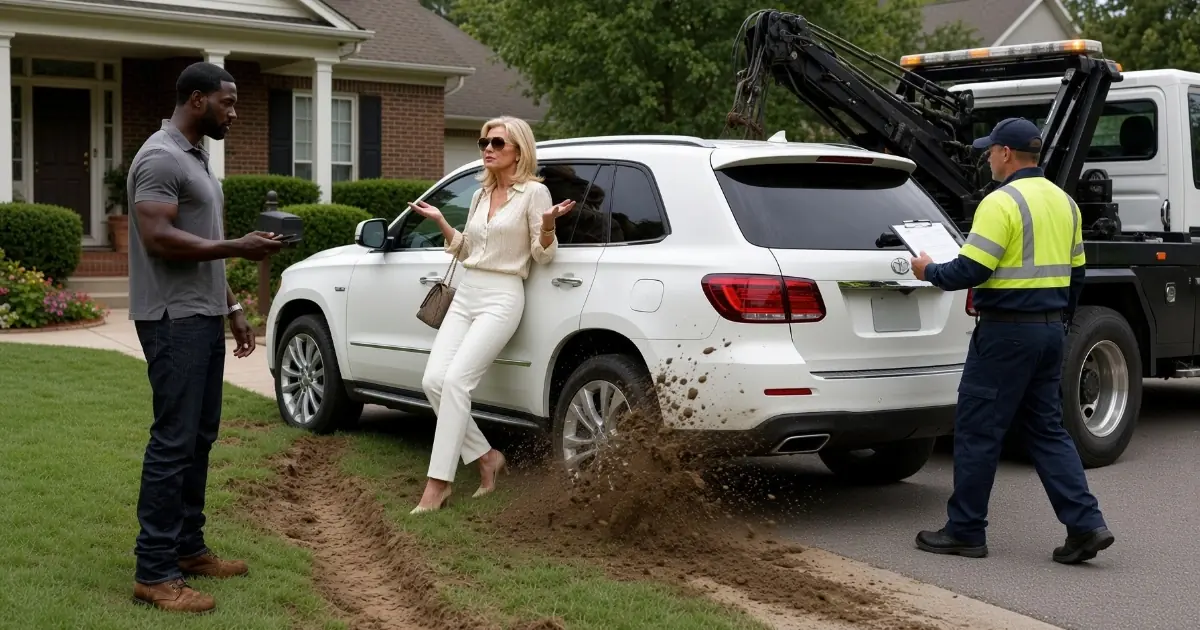
A white luxury SUV slowed in front of my house, stopped beside the curb, then turned sharply enough that both passenger-side tires climbed over the edge of the pavement and onto grass I had spent nearly two years bringing back to life. The driver kept going. Ten feet. Fifteen. Twenty. Then she straightened the vehicle until almost the entire SUV was sitting across the front corner of my yard.
I was standing inside my garage holding a bag of fertilizer when I heard the engine.
By the time I stepped outside, Patricia Doyle was already opening her door.
Patricia lived three houses down.
Mid-fifties. Blonde bob that never seemed to move no matter how hard the wind blew. White linen pants. Expensive sunglasses. The permanent expression of a woman who believed inconvenience was usually something other people created for her.
She was also president of the Hawthorne Ridge Homeowners Association.
That fact had become the organizing principle of her personality.
I looked at the SUV.
Then at my lawn.
Then at Patricia.
“Patricia.”
She smiled as if we were meeting at a grocery store.
“Hi, Owen.”
“Why is your car in my yard?”
She glanced down.
Not embarrassed.
Not surprised.
Almost confused by the question.
“There’s nowhere else to park.”
Across the street, her daughter’s engagement party had already filled half the cul-de-sac with vehicles. Caterers were unloading trays. A rental company had erected a white tent in Patricia’s backyard. Somebody had placed small gold balloons beside her mailbox.
I pointed toward the asphalt.
“That doesn’t make my lawn a parking lot.”
Patricia pushed her sunglasses higher.
“It’s just for a few hours.”
“No.”
She stared at me.
“No?”
“Please move your car.”
Her smile disappeared.
“Owen, don’t be difficult. Everyone’s trying to make today nice for Madison.”
“I hope Madison has a great party.”
I pointed again.
“Move the SUV.”
Patricia looked toward the lawn as if trying to find the catastrophe I was pretending to see.
“It’s grass.”
“Yes.”
“It’ll be fine.”
“No, it won’t.”
She laughed.
“You landscape people are ridiculous.”
I was not technically a landscaper.
I owned Barrett Site & Drainage, a small company that handled residential grading, drainage correction, retaining walls, and stormwater work. We restored lawns after jobs because tearing up ground was easy. Putting it back properly was the part customers remembered.
My own front lawn had become a personal project after years of drainage problems.
The soil on the lower corner stayed waterlogged every spring. Previous owners had thrown seed over compacted clay and wondered why nothing survived. I had removed damaged soil, corrected the grade, installed a shallow drainage system, added topsoil, overseeded twice, and spent two summers building a dense stand of turf without drowning it in fertilizer.
It was not Augusta National.
It was simply healthy.
And I liked it.
Patricia knew that.
She also knew it had rained nearly two inches the previous evening.
Which meant the ground under her five-thousand-pound SUV was soft.
“Please move it now,” I said.
Her face changed.
Not dramatically.
Just enough to tell me she had stopped hearing the request as a request.
“You know the first section along the road isn’t really yours anyway.”
I looked at her.
“What?”
“The county right-of-way.”
“It’s still my property.”
“Not exactly.”
“Exactly enough that you can’t park on it.”
She folded her arms.
“Owen, I’m HOA president. I know the neighborhood plat.”
That sentence should have warned me how the next three weeks were going to go.
I said, “A public right-of-way is not permission for you to use somebody’s lawn as private party parking.”
Patricia smiled again.
“You always have to turn everything into a technical argument.”
“No.”
I looked at her SUV.
“I’m trying to get a car off my grass.”
One of her guests came walking over carrying a gift bag.
“Everything okay?”
Patricia immediately changed tone.
“Fine. Owen’s just very particular about his yard.”
The guest laughed.
I did not.
Patricia looked back at me.
“I’ll move it after the toast.”
“No. You’ll move it now.”
Her eyes narrowed.
“Or what?”
That was the moment I made a decision that probably saved me a lot of trouble later.
I did not answer.
I took out my phone.
And photographed the SUV.
Front plate.
Rear plate.
Both tires.
The position relative to my mailbox.
The wet grass.
Patricia watched me.
“What are you doing?”
“Documenting where the vehicle is.”
“Oh, for heaven’s sake.”
I photographed the left rear tire sitting less than three feet from one of my irrigation heads.
Patricia stepped toward me.
“You’re seriously taking pictures?”
“Yes.”
“You’re being creepy.”
“No.”
“You’re photographing my car.”
“On my property.”
She looked toward the party.
Then back at me.
“You know what? Fine.”
She climbed into the SUV.
For one second, I thought the problem was over.
Then she started the engine.
The front wheels turned.
She pressed the accelerator.
Nothing happened.
The right tires had sunk farther into the wet soil than either of us realized.
She pressed harder.
The wheel spun.
Mud sprayed backward.
“Stop,” I said.
Patricia accelerated again.
The tire dug down.
A strip of turf peeled loose and folded backward like carpet.
“Patricia, stop.”
Instead of backing out slowly along the tracks she had entered on, she turned the steering wheel sharply and gave the SUV more gas.
Both rear tires spun.
My front lawn exploded.
Mud sprayed across the driveway.
Grass ripped out in thick chunks.
One irrigation head snapped beneath the tire with a sound I could hear from fifteen feet away.
Water began bubbling through the torn ground.
Patricia finally got traction.
The SUV lurched forward, crossed another section of lawn, dropped off the curb, and stopped in the street.
For a moment, nobody said anything.
My lawn looked like somebody had driven a farm tractor through it during a storm.
Two ruts ran across the front corner, one nearly eight inches deep.
Torn sod was scattered behind them.
Water from the broken irrigation line began filling the lowest rut.
Patricia stepped out.
She looked at the damage.
Then at me.
And said the sentence I remembered more clearly than anything else.
“Well, now it looks worse because you made me move.”
I stared at her.