The first thing I ever recorded on my phone inside Saguaro Bend was a pool. Not a person, not a fight, not a car parked on the wrong side of a line. Just the community pool at seven in the morning, the water a flat, poisonous-looking turquoise, a white haze lying on the surface like breath on a mirror. I recorded it because my son had stopped breathing in it the afternoon before, and nobody believed me about the smell.
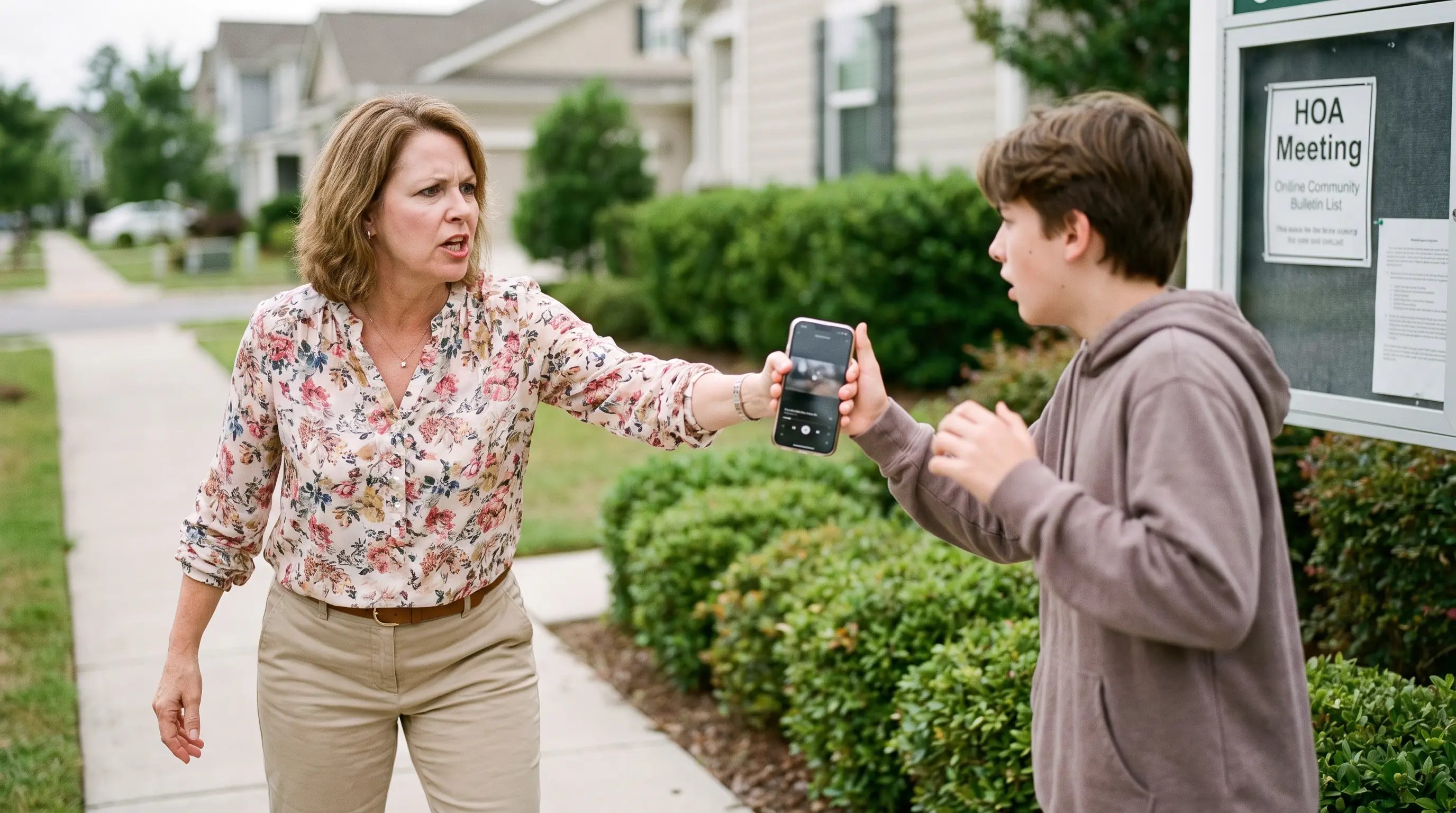
That was the summer before. By the time Glynis Hollister reached out and took my phone out of my hand, I had forty-one videos of that pool, a spiral notebook full of dates and temperatures, and a fine from the Saguaro Bend Homeowners Association for one thousand eight hundred dollars, payable in installments, for what the letter called "repeated false reports and harassment of volunteer staff." I am telling you this up front so you understand that I was not a woman who wandered into anything. I had been standing at the edge of it for a year.
My name is Mireya Kallas. I am forty-six years old, and I am a respiratory therapist at Cholla Springs Regional Medical Center, which means I spend three nights a week helping people do the one thing most people never think about until they can't. I set up ventilators. I suction airways. I stand at the head of beds during codes and squeeze a bag in time with somebody else's hands on a stranger's chest. My mother was from Hermosillo and my father was from a village outside Thessaloniki, and they met in a chemistry lab at Arizona State, which is a story they told so often that my son can recite it in both accents. The name on my badge is my father's. The temper is my mother's. The lungs I worry about most belong to Nico.
Nico is fourteen. He has had asthma since he was three, the kind that sits quietly for months and then shows up all at once like a bill you forgot about. He carries an inhaler in the left front pocket of every pair of shorts he owns, because I sewed a little elastic loop into each one when he was six and he has never once let me stop. His father, Kostas, lives in Tucson now with a woman who sells real estate and a golden retriever named Pistachio, and he is a decent father at a distance of a hundred and twenty miles. When we divorced, I kept the house. When I kept the house, I kept the HOA.
Saguaro Bend is two hundred and twelve homes on the far east edge of Cholla Springs, Arizona, built in 2004 on what used to be a cotton field and before that was desert. Every house is one of four models in one of three colors, all of which are called something like Adobe Whisper. There is a clubhouse with a gym nobody uses, a playground with a shade sail that blew off in a monsoon and was never rehung, a retention basin that turns into a lake twice a year, and the pool. The pool is the reason people buy in Saguaro Bend instead of the subdivision across the road. In July, in Cholla Springs, when the asphalt goes soft by noon and the air smells like hot metal, the pool is not an amenity. It is the reason the neighborhood exists.
My back wall faces the common area. If I stand on the step stool I keep by my orange tree, I can see over the block wall, across forty yards of gravel and two palo verde trees, to the pool's back fence and the low tan building behind it that everyone calls the pump house. It holds the filters, the pumps, the heater nobody turns on, and the chemicals. There is a sign on the door that says AUTHORIZED PERSONNEL ONLY in red letters, and a second sign under it, smaller, that says DANGER: DO NOT MIX CHEMICALS. I noticed that second sign a long time before anyone else did. I noticed it because I had to.
Here is what happened the summer before. It was the second Saturday in June. Nico went to the pool with two friends from his eighth-grade class at about two in the afternoon. The water had been "shocked," as they say, the night before, which I didn't know at the time. By three-fifteen, one of the friends' mothers was calling me because Nico was sitting on the pool deck with his head between his knees making a sound I have heard in the emergency department more times than I can count, a high whistle at the end of every breath like a kettle being taken off the stove too slowly. He had used his inhaler twice. It wasn't touching it. I drove the three hundred yards to the clubhouse because running would have been slower, put him in the back seat, and took him to my own hospital, where a doctor I'd worked with for nine years gave him nebulized albuterol, a steroid, and a look that I understood without words: this one was close.
He was fine by evening. He was fine by the next morning. But a little girl named Alma Sotelo, seven years old, who had been in the shallow end at the same time, went home that day with eyes so red and swollen that her mother, Yesenia, took her to urgent care, where they flushed them for twenty minutes and wrote "chemical conjunctivitis" on the discharge paper. Two other kids complained of burning skin. A grandfather from the house behind the clubhouse said he'd smelled bleach in his garage.
I wrote to the HOA that evening. I was polite. I am usually polite in writing, because I've learned that people can only quote you accurately when you've given them nothing to quote. I said I was a respiratory therapist, that I believed the pool had a chemical imbalance, possibly a chlorine level far too high, possibly something worse, and that the board should have the pool service company test the water and check the chemical feed before anyone else swam.
Glynis Hollister answered me in under an hour. That was the first thing I learned about Glynis: she is always faster than you think she is going to be.