I wasn't even planning to stop by the marina that morning. I only swung by to drop off a spare part for Seabreeze before heading to work. But the moment I turned the corner and saw a crowd gathered at the edge of the dock, phones out, pointing toward the water, I felt that familiar HOA-induced dread settle in my chest.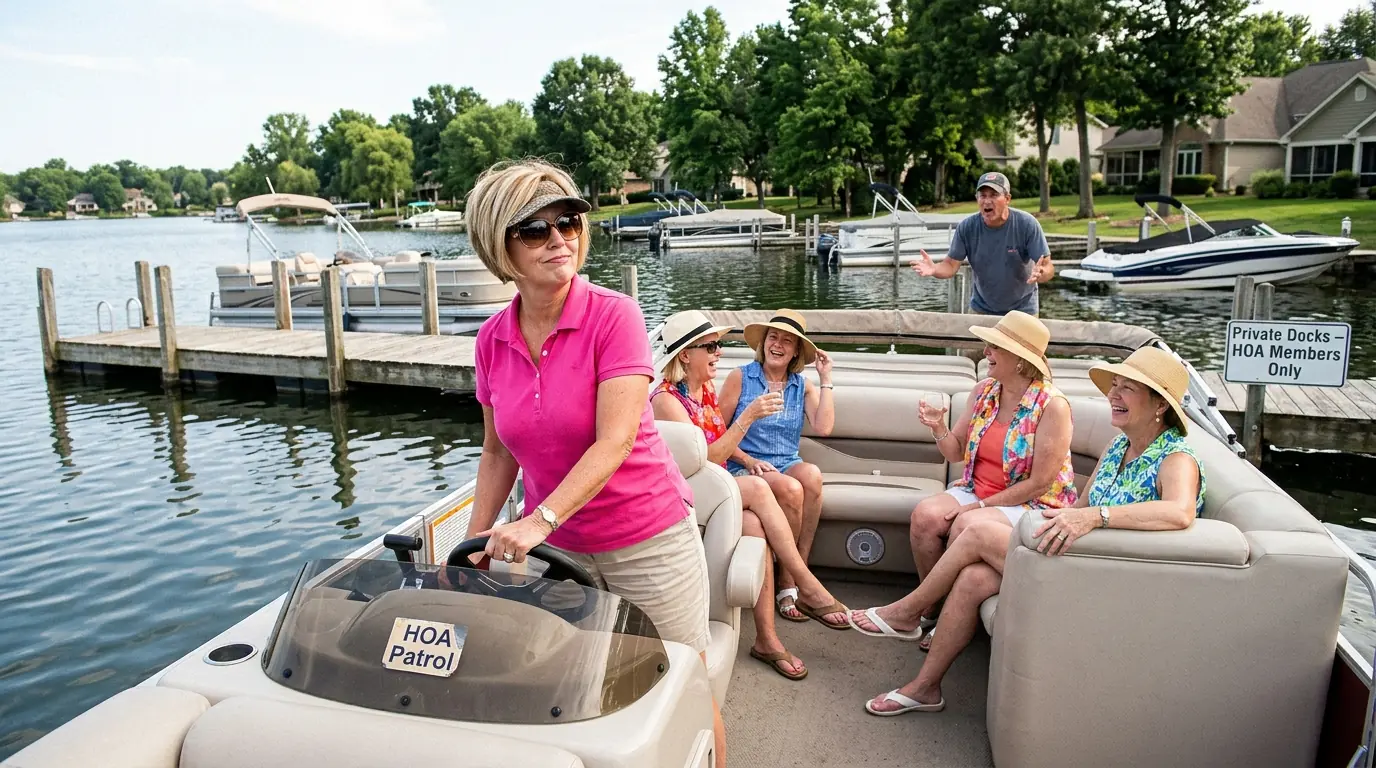
People weren't just watching; they were laughing. And when I followed their gaze, my heart stopped.
My boat, my Seabreeze, was cruising out of the marina, music blasting so loudly I could feel the bass from shore. A group of women danced on the deck, spilling drinks and taking selfies like they were filming a music video.
And at the helm, there she was, HOA Karen: pink sunhat, smug smile, shouting, "Girls' day out, baby!" As if she owned the ocean.
I didn't know whether to scream or faint, but one thing was certain: she had just stolen the wrong man's boat because she had no idea I worked with the Coast Guard.
I wish I could tell you that this was the first time Karen had crossed the line, or even the second, but if you've ever dealt with an HOA Karen, you already know they don't have lines. They have opinions—loud ones, entitled ones—and somehow those opinions always seem to rewrite reality inside their heads.
The drama had actually started months earlier, long before she ever set foot on my boat. Karen lived just a few houses down from me in our waterfront HOA community, an expensive, well-kept neighborhood that really should have been peaceful—the kind of place retirees imagined when they pictured quiet sunrise walks by the water.
That was before Karen moved in and began enforcing her own personal version of maritime dictatorship. Her first complaint about my boat came the week she noticed me polishing the chrome rails on a Saturday morning. She strutted down the walkway in her bright pink blazer—the same one she wore to every HOA meeting, like it was a superhero cape—and said, "You know, it's really unfair that some people have boats and some people don't."
I looked up, confused, because I honestly thought she was joking. She wasn't.
"Boats," she continued, hands on her hips, "should be considered a shared amenity for our community. It's selfish to keep yours tied up all the time."
Mind you, I paid full price for Seabreeze. I paid for the slip, I paid insurance, maintenance, upgrades, fuel, everything. Karen didn't contribute a penny. But in her world, fairness meant redistribution of other people's property.
That was the beginning. Over the next few weeks, she escalated things like only an HOA Karen could. She left notes on my door saying I should schedule community boating days. She cornered me outside my garage and said her nephew really wanted to try a luxury boat ride at least once. She even complained to the HOA board that my refusal to lend her my boat created division within the neighborhood.
To the board's credit, they told her, "That's not how boats work."
But Karen wasn't deterred. She had this uncanny ability to twist logic like a pretzel and still act offended when people didn't agree with her.
Meanwhile, I did what any sane person would do: I ignored her, or tried to.
Lucky for me, I had Jim, my next-door neighbor and best friend. Jim was the kind of guy who showed up whenever there was chaos because he somehow knew it would be entertaining. He always had two things on him: his iced coffee and his phone camera. If HOA drama was a sport, Jim would have been an Olympic documentarian. Every time Karen confronted me, Jim somehow wandered out from behind a hedge or appeared on his porch like a wildlife photographer waiting for a rare bird to misbehave.
"She's going to explode one day," he'd whisper, sipping his coffee.
I didn't know he meant it literally, but nothing—and I mean nothing—prepared me for what she did that morning at the marina.
Seabreeze wasn't just a boat; she was practically a member of my family. I'd spent years restoring her: new teak decking, custom upholstery, modern navigation, upgraded engine, the works. She was the kind of boat that turned heads—not because she was flashy, but because she was beautifully maintained.
Karen knew this. She'd admired the boat often, but in that passive-aggressive way where she'd sigh dramatically and mutter things like, "Some people have all the toys," loud enough for me to hear.
And yet, despite all that, despite every warning sign, I still somehow didn't imagine she'd be bold or stupid enough to actually steal it. But when I saw her earlier that morning, dancing on my deck with her gaggle of friends, everything suddenly made sense.
This wasn't spontaneous. This wasn't an impulse. This had been planned.
Karen finally got what she wanted: a community boat day. Except the community was just her and three HOA friends who enabled her every delusion. One of them was live-streaming as Karen shouted, "Girls' day out on the HOA yacht!"
Another yelled, "Woo, Karen, you're the queen of the marina!"
My eye twitched. What really stunned me was how pleased Karen looked—like she had conquered a nation and was now parading through her new territory. She stood with one hand on the wheel, like some kind of discount cruise captain, and the other waving to strangers who looked more confused than impressed.
For a moment, I just stood there, frozen. My brain couldn't wrap itself around the scene. It was too surreal.
Jim, of course, appeared right beside me out of nowhere. He took one look at the boat, choked on his iced coffee, wiped his mouth, and said, "Bro, tell me this is a prank."
I didn't even answer. I just kept staring at the floating circus act that used to be my peaceful weekend vessel.
Jim lifted his phone. "Okay, but this is already going viral."
The crowd at the dock grew as more people noticed the commotion. Karen's music echoed across the marina. And honestly, I think people stayed because it felt like watching a slow-motion train wreck: you didn't want to see it, but you couldn't look away.
Then Karen spotted me. Her smile widened into something triumphant, and she shouted across the water, "Don't worry, I'm only taking her out for a quick spin."
A quick spin with four people, with drinks, with zero boating experience, with my boat.
Jim muttered, "Buddy, I think you're legally allowed to pass out right now."
But I didn't pass out. My mind snapped into a very different kind of clarity. There was no reasoning with Karen, no polite conversation, no HOA complaint form. This was a stolen vessel, and I knew exactly who to call.
I pulled out my phone, not hesitating for a second—not because I wanted revenge, but because I saw the way Karen was handling the wheel. She was jerking it too hard, overcorrecting her turns, drifting dangerously close to another boat's wake. She was going to hurt someone.
Jim leaned in. "You're calling the HOA?"
I shook my head. "No, I'm calling the Coast Guard."
He blinked. "Oh. Oh, this just got good."
As I dialed, I kept watching Karen steer my boat like it was bumper cars. Her friends stumbled, grabbing the rails to avoid toppling over. Drinks spilled. Someone shrieked. Someone else laughed like they were immune to consequences.
And that was Karen's whole problem: she always thought consequences were optional. But not today, because today she had stolen a boat belonging to someone she believed was just a regular homeowner. She didn't know my other uniform. She didn't know my badge. She didn't know who I worked alongside every week. She didn't know she had just messed with the Coast Guard.
And as the call connected and I reported my stolen vessel, and the officer on the line immediately understood the seriousness of the situation, I felt something I hadn't felt in months: relief. Because for the first time ever, someone besides me was finally going to put a stop to HOA Karen.
The call connected with a sharp click, and I heard the calm, clipped voice of a Coast Guard dispatcher on the line.
It was strange. My blood pressure was skyrocketing, adrenaline pumping through me like I'd run a marathon. Yet the voice on the other end sounded like someone reading a weather report—steady, neutral, completely unaware that my morning had just turned into a maritime soap opera.
"United States Coast Guard, what's your emergency?"
I swallowed hard and forced my voice to stay steady. "My vessel has been stolen."
That got a reaction. I heard typing, rapid and precise. "Stolen, understood. Do you have a visual on the vessel?"
"Oh, I have a visual," I said, staring out at the spectacle on the water. "It's a 24-ft cruiser named Seabreeze, white hull, teak deck, currently being operated by—" I paused, because how exactly do you describe what I was seeing? "—by a blonde woman in a pink sunhat who appears to believe she's the queen of spring break."
Jim snorted so loudly beside me the dispatcher might have heard it.
"I'm sorry, sir," the dispatcher said. "Could you repeat that?"
I closed my eyes for a second, regaining my composure. "A woman has taken my boat without permission. She has three passengers. She is operating the vessel recklessly, and she does not have boating experience."
A quiet beat, more typing. "Understood. Do you know the individual?"