It was 2:47 on a Tuesday afternoon when I watched Karen Pruitt commit a federal felony in broad daylight wearing a navy blazer and an HOA pin.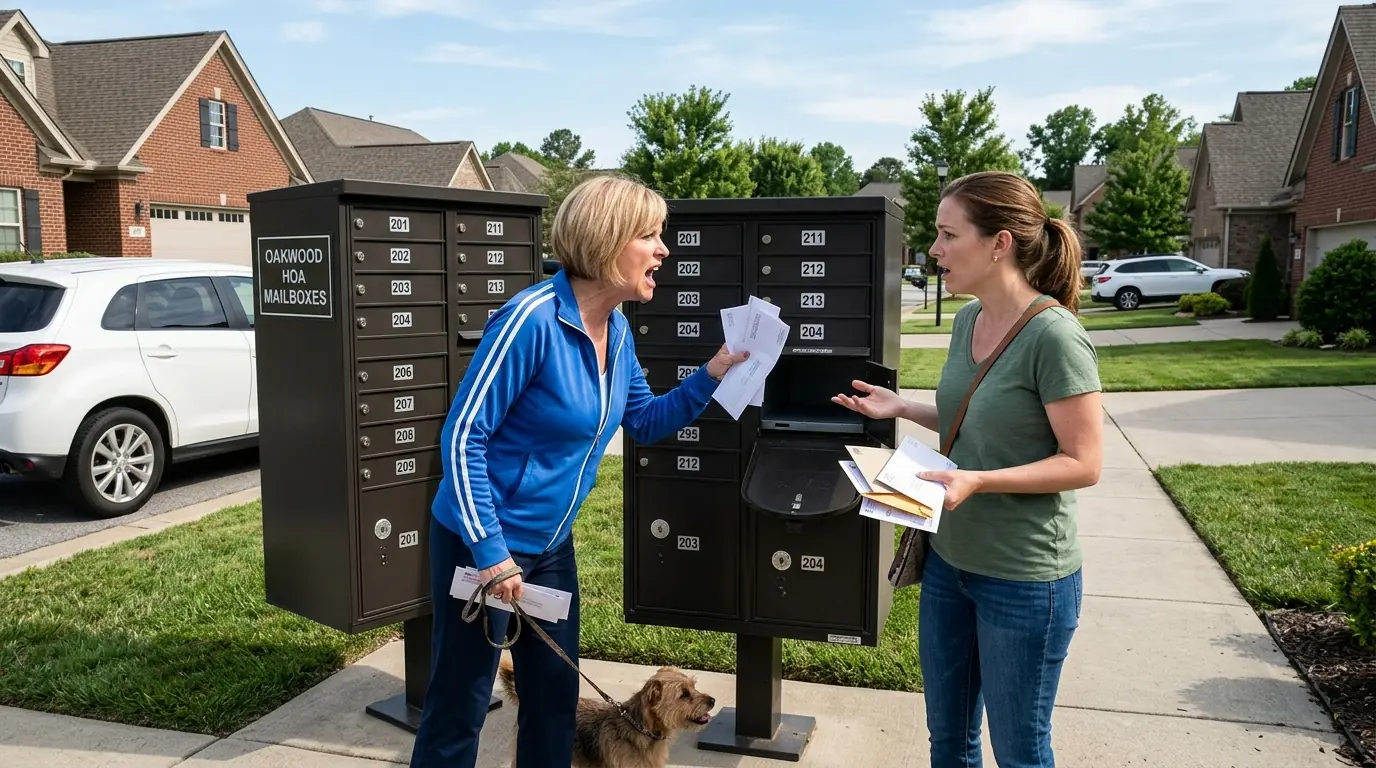
She was at my mailbox. The flap was open. My mail was in her left hand. She looked up, saw me on the porch, and did not flinch. She tucked a manila folder higher under her arm—black marker on the front, two words in her own handwriting: HOA Inspection—and said, calm and clipped, the way she had said it to half the widows on this street:
"HOA business. Your mailbox is community property until I clear it."
She pointed at my front door, where her fresh orange notice was still taped to the wood. $250 a day in fines for obstructing mailbox compliance review, her signature at the bottom.
I took one slow sip of coffee because I wanted to remember her sentence word for word. She had no idea she had just said it to the one man on this street who used to put people exactly like her in federal prison.
That was the third Tuesday in a row.
Karen Pruitt was 61 years old, president of the Maple Ridge Estates Homeowners Association for 11 years running. Her husband was rarely home. Her children were grown. The HOA was, by any honest reading, the only thing she still ran. And so she ran it the way other people run small countries.
She flipped through my envelopes like a TSA agent working a suspicious carry-on. She held one up to the sunlight to read through the paper. She slid three pieces into the manila folder under her arm and turned back toward me with a faint, satisfied tightness around the mouth.
I did not raise my voice. I have never been the kind of man who raises his voice when something already belongs to me.
"Ma'am," I said, "may I ask which envelope you took from this box last week?"
She smiled. It was the kind of smile a person gives a cashier when they're about to say something cruel.
"I don't track every piece of correspondence I review. I review on behalf of the community." She lifted her chin. "You moved here eight months ago. I run this neighborhood."
There is no such thing as a mailbox compliance review. Karen had invented it. She had typed it onto HOA letterhead she had designed herself and printed it at the clubhouse on a community printer the rest of the homeowners had paid for.
There is, however, such a thing as Title 18, United States Code, Section 1708: theft of mail, up to five years federal. I had spent 28 years of my life enforcing that one. I had trained federal agents to recognize the exact body language she was using on my porch: the clipboard, the casual confidence, the absolute certainty that no one in a quiet suburb would ever check the actual statute.
Karen pointed again at the orange notice on my door. "That fine is active. You're at $250 a day until I clear your inspection."
I let the sentence sit. Behind her, just over her left shoulder, my Ring camera blinked above the doorframe. She had never once looked up at it. Not today. Not last Tuesday. Not the Tuesday before. For six weeks, that camera had been streaming in the background to a federal inbox. She didn't know that yet.
"I'll take that under advisement," I said.
She turned, manila folder under her arm, my mail still inside it, and walked back across the cul-de-sac toward her own front door the way a person walks when they believe the matter is closed.
I watched her go. I did not chase her. I did not call out. I did not pull out a phone.
Inside, my coffee was still warm. I set the mug on the counter beside the small black logbook I had been keeping since the first envelope went missing. Six weeks, 43 entries: three other houses, one Social Security letter, one IRS notice, 11 wedding cards, one bank statement, one mortgage stub from an 81-year-old widow who had not missed a payment in 23 years.
I opened the logbook to the next clean line and wrote the date, the time, and the words: Subject removed three pieces. Manila folder marked HOA Inspection. Repeated prior statement verbatim.
Then I closed the book.
The doorbell camera blinked once, the way it always did when motion ended on the porch. I thought about the federal inbox. I thought about the colleague I had not formally called in six years who had read every single one of those 43 entries within 20 minutes of receiving them. I thought about a phrase he had used the last time we'd spoken on the phone: "Set the trap. Get us a clean catch."
The trap had been set 10 days ago. The catch... I checked the time on the kitchen clock: 2:51 p.m. The catch had just walked across the cul-de-sac with a manila folder full of marked decoy mail, holding it against a navy blazer that was about to be photographed under federal lighting.
That was the thing about Karen Pruitt: she had been watching this street for so long that it had genuinely never occurred to her that someone, finally, was watching back.
I had not moved to Maple Ridge Estates to fight anyone; I had moved there to retire. Eight months earlier, I had signed the deed on a small ranch house at the end of a quiet cul-de-sac: two bedrooms, a covered porch, a magnolia in the front yard, and a garage just deep enough for a fishing boat I'd been promising myself for 30 years. My wife had passed four years before. My daughter lived two states away. My granddaughter was nine, played striker on a Saturday morning soccer team, and called me every Sunday at 7:00.
That was the life I had been planning: coffee on the porch, tackle box in the trunk, no badge, no case file, no phone ringing at 3:00 in the morning about a postal employee who had been intercepting checks from a nursing home.