The first thing Daniel Carter heard when he came home was laughter.
Not the kind of laughter that comes from a family gathering or a few friends stopping by after work. This was louder. Comfortable. The kind of laughter people make when they believe they have every right to be somewhere.
Daniel sat in his truck for a moment with the engine still running, listening to the voices coming from behind his house. He had owned the property on Willow Creek Drive for less than two weeks, and the only people who knew the address well enough to come and go were the contractors who had helped him move in. He lived alone, had no family nearby, and had spent years saving for the backyard pool that finally made the house feel like a reward instead of another obligation.
Then he heard splashing.
His stomach tightened.
Daniel grabbed his keys and walked around the side of the house expecting the worst.
A broken window.
A forced door.
A stranger inside.
What he found somehow felt even more disrespectful.
Six women were in his backyard.
In his pool.
Drinks sitting on his patio table.
Music playing from a speaker plugged into his outdoor outlet.
His towels were folded over chairs.
His outdoor furniture had been rearranged.
And in the center of it all was a woman wearing oversized sunglasses, floating comfortably on an inflatable chair like she had been invited.
Daniel stopped at the gate.
“Can someone explain what is happening?”
The woman opened her eyes.
“Oh.”
She smiled.
“The new homeowner.”
Daniel stared.
“You know who I am?”
“Of course.”
She sat up slowly.
“I’m Linda Prescott.”
She said the name like he should recognize it.
Daniel waited.
Nothing.
Linda seemed slightly offended.
“I’m the president of the Willow Creek Homeowners Association.”
Daniel looked around his own backyard.
“Okay.”
Linda smiled.
“This is actually a perfect opportunity to welcome you.”
“Welcome me?”
“Yes.”
She waved toward the pool.
“The neighborhood has always shared amenities.”
Daniel looked toward his pool.
Then back at her.
“This is not an amenity.”
Linda laughed.
“Oh, honey.”
That word immediately bothered him.
Not because it was rude by itself.
Because it was the same tone people used when they wanted to explain something to him that they believed he was too inexperienced to understand.
“This is my private property.”
Linda removed her sunglasses.
“You’re new here, so I understand why you’re confused.”
Daniel stayed silent.
“The HOA has always had access to community spaces.”
Daniel pointed toward the water.
“This is my backyard.”
Linda tilted her head.
“You bought in Willow Creek.”
“Yes.”
“Then you bought into the neighborhood.”
Daniel looked at the fence.
“I bought a house.”
A few women in the pool exchanged uncomfortable looks.
Linda climbed out slowly.
She wrapped a towel around herself.
“You’ll learn how things work here.”
“No.”
Daniel’s voice remained calm.
“You’ll learn how things work with me.”
The smile disappeared.
“I’m sorry?”
“You need to leave.”
The silence changed.
Not because she was embarrassed.
Because she was surprised.
Linda was not used to being told no.
Especially not by someone she had already decided would be easier to control.
“I think you misunderstand my position.”
“I understand perfectly.”
“I am responsible for maintaining harmony in this community.”
“Then start by not entering someone’s backyard without permission.”
Linda stepped closer.
“Careful.”
Daniel looked at her.
“With what?”
“Tone.”
There it was.
The invisible line.
The one where disagreement became disrespect.
Daniel recognized it immediately.
“I’m asking you and your friends to leave my property.”
Linda looked toward the others.
Nobody moved.
She smiled again.
“Fine.”
“We were actually leaving anyway.”
The sentence was unnecessary.
Everyone knew it.
She was not leaving because she was asked.
She was leaving because she wanted the story to belong to her.
As they walked through the gate, Linda stopped.
“We should talk about your attitude toward the association.”
Daniel said nothing.
“And your misunderstanding of community expectations.”
Daniel looked directly at her.
“There is no conversation needed.”
Linda smiled.
That smile stayed with him.
The kind of smile that meant the argument had not ended.
It had only changed locations.
The next morning, Daniel replaced every lock on the backyard gate.
He installed commercial-grade latches.
Added cameras.
Placed private property signs around the pool area.
Not because he wanted a fight.
Because he had learned something early in life.
People who ignore boundaries once usually test them again.
And Linda Prescott looked exactly like someone who believed rules applied differently depending on who was enforcing them.
For four days, everything was quiet.
No messages.
No visits.
No complaints.
Daniel started believing maybe he had misjudged her.
Then Thursday afternoon happened.
He came home and heard music again.
Same pool.
Same voices.
Same laughter.
Daniel closed his truck door slowly.
The combination lock on the gate had been cut.
His signs had been pulled from the ground.
Linda was sitting in the shallow end holding a drink.
She looked up.
“Daniel.”
She smiled.
“You’re home early.”
He stared.
“You cut my lock.”
Linda shrugged.
“I had it removed.”
“You broke into my property.”
“Don’t exaggerate.”
Daniel looked around.
Six women.
A broken lock.
His private pool.
His furniture.
His home.
Linda floated backward.
“You need to relax.”
“No.”
She looked surprised.
“I’m serious.”
“So am I.”
Linda stood.
“You know what your problem is?”
Daniel almost laughed.
“No, but I’m sure you’re about to tell me.”
“You moved here and think money gives you control.”
Daniel looked around.
“This is my house.”
“You think because you signed papers, you’re separate from everyone.”
“No.”
“I think because I own something, I own it.”
Linda stepped closer.
“You don’t understand this neighborhood.”
Daniel looked at her.
“No.”
“I understand exactly.”
She crossed her arms.
“This community existed before you arrived.”
“And my property existed before you entered it.”
Her expression changed.
“You people always think everything is a personal attack.”
The sentence landed differently.
Daniel noticed the silence afterward.
Even some of Linda’s friends looked uncomfortable.
But Linda kept going.
“You buy one nice house and suddenly you think you’re above everyone.”
Daniel stared.
“I bought a house.”
“Yes.”
“In a neighborhood where I’m apparently not allowed to own my own backyard.”
Linda laughed.
“You’ll regret making this difficult.”
Daniel said nothing.
She picked up her phone.
“Saturday afternoon.”
“What?”
“We’re coming back.”
“No.”
Linda smiled.
“See you then.”
Daniel watched them leave.
This time he did not argue.
He did not raise his voice.
He did not threaten.
He simply closed the gate.
Then he made three phone calls.
Not to police.
Not to the HOA.
To people who understood documentation.
His attorney.
A licensed pool service company.
A security installer.
Daniel had spent twelve years working in corporate compliance.
He understood something most people learned too late.
The strongest response was rarely the loudest.
It was the one that left no room for interpretation.
The pool company arrived Friday morning.
The technician, Marcus Reed, inspected everything and listened carefully.
“So she’s coming back?”
“She said Saturday.”
Marcus nodded.
“We can help you document unauthorized access.”
Daniel looked at him.
“I want everything legal.”
“Good.”
Marcus smiled.
“Those are usually the people who win.”
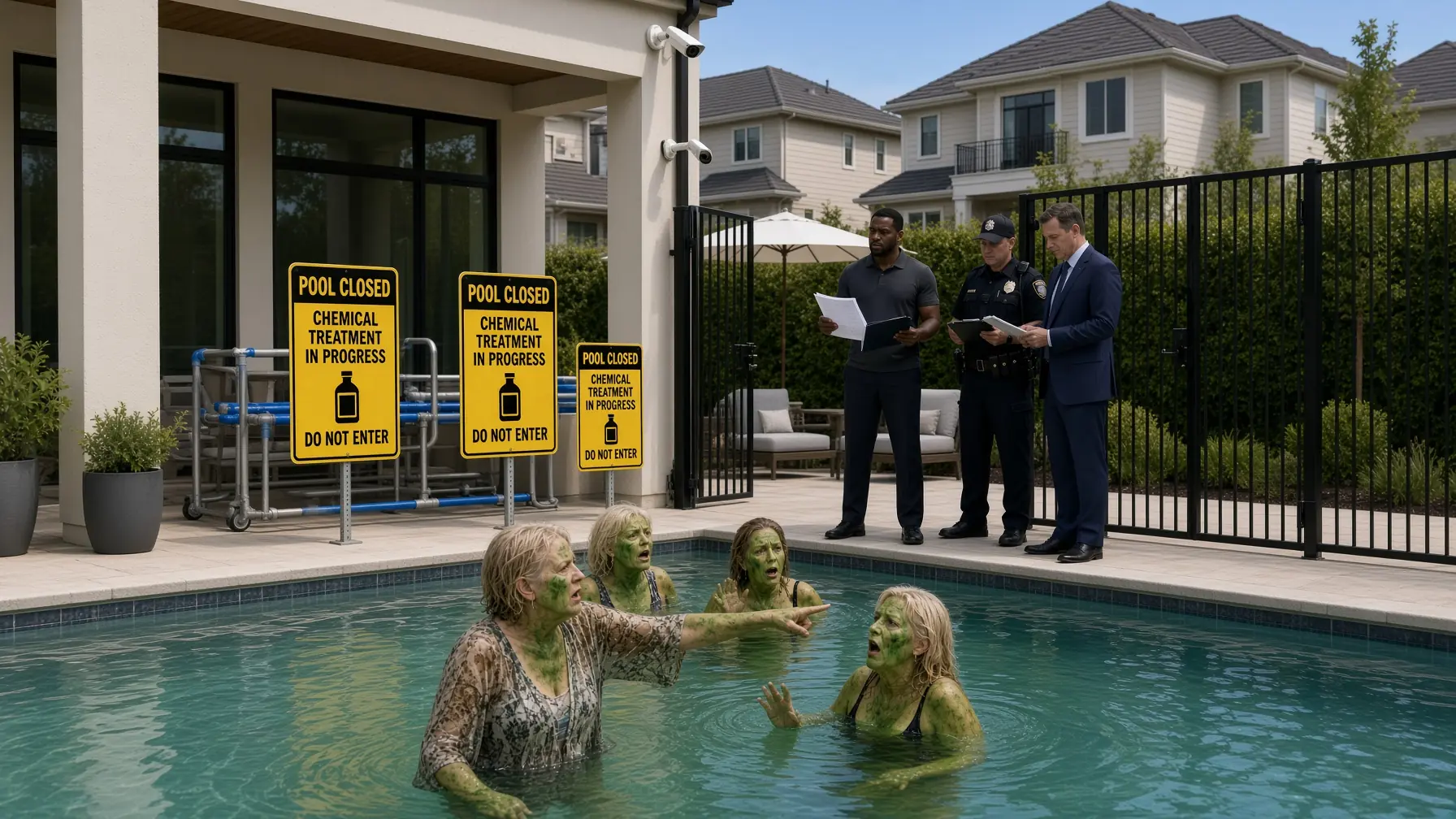
They performed a standard maintenance treatment.
Nothing dangerous.
Nothing harmful.
A harmless diagnostic dye used by professionals to identify contamination patterns and track water conditions.
Everything was documented.
Every chemical.
Every measurement.
Every service note.
Then Daniel upgraded the cameras.
Six angles.
Gate.
Pool.
Patio.
Side entrance.
Back door.
Every movement recorded.
Saturday arrived.
At 1:30 p.m., Daniel checked the cameras.
Empty.
1:47.
Movement.
Linda.
Five friends.
Pool bags.
Drinks.
Confidence.
They stood at the gate.
Read the warning sign.
Paused.
Then Linda laughed.
A man with bolt cutters appeared minutes later.
The lock fell.
They entered.
Daniel watched from inside.
Linda stepped into the pool.
“This is what happens when people overestimate themselves.”
Her friend laughed.
“He really thought a sign would stop you.”
Linda smiled.
“He’s new.”
“He’ll learn.”
Daniel waited.
Ten minutes.
Then twenty.
The cameras recorded everything.
The signs remained visible.
The broken lock remained visible.
The trespass remained visible.
Then one of the women looked down.
“What is that?”
Linda turned.
“What?”
“My hand.”
A faint green color covered her fingers.
Another woman lifted her arm.
“What the hell?”
Within seconds, panic spread.
Green stains appeared across skin where sunscreen, lotion, and natural oils reacted with the harmless diagnostic treatment.
Linda climbed out of the pool.
“What did you do?”
Daniel stepped into the backyard.
“You entered a closed pool.”
“You poisoned us!”
“No.”
He held up the service report.
“Licensed maintenance.”
“Documented.”
“Approved.”
Linda stared.
“You planned this.”
Daniel shook his head.
“No.”
“I planned to maintain my pool.”
“You planned to ignore my signs.”
“You cut my lock.”
“You entered my property.”
“You did everything else yourself.”
Linda’s face turned red.
“I will destroy you.”
Daniel looked toward the cameras.
“You might want to lower your voice.”
She froze.
“What?”
“Everything today was recorded.”
The confidence disappeared.
For the first time, Linda looked around.
Really looked.
At the cameras.
The signs.
The evidence.
The fact that she had walked directly into every piece of documentation Daniel needed.
Police arrived twenty minutes later.
Not because Daniel wanted revenge.
Because trespassing, property damage, and unlawful entry were no longer neighborhood disagreements.
They were documented facts.
Linda tried explaining.
She was the HOA president.
She was protecting the community.
She misunderstood the rules.
The officers listened.
Then watched the footage.
The story became very simple.
A homeowner had asked strangers to leave.
They refused.
They returned.
They destroyed property to enter.
They ignored posted warnings.
The title of HOA president did not change that.
Linda Prescott was charged with criminal trespass and property damage.
The HOA removed her from leadership pending review.
But the bigger story came later.
During the investigation, residents came forward.
Linda had done this before.
Not with pools.
With driveways.
Gardens.
Guest parking.
One elderly couple had received repeated fines until they sold their home.
A young Black family had been questioned repeatedly about whether they belonged in the neighborhood.
A Hispanic contractor had been accused of “loitering” while repairing a roof.
Linda had not just believed she controlled the neighborhood.
She had spent years proving she thought she owned it.
Daniel eventually attended the HOA meeting where residents voted on new leadership.
The room was tense.
Some people apologized.
Some admitted they had ignored things because Linda made their lives easier.
That was the uncomfortable truth.
Power survives when enough people benefit from pretending not to see it.
The new HOA president asked Daniel if he wanted to speak.
He stood.
“I don’t want anyone removed because they were rude to me.”
The room went quiet.
“I want people to understand something.”
“A neighborhood is not built by controlling who belongs.”
“It is built by respecting the people who already do.”
He looked around.
“The rules mattered when they protected everyone.”
“They failed when they became a weapon against certain people.”
Nobody applauded immediately.
Daniel preferred it that way.
Some lessons needed silence before they became change.
Months later, his pool was peaceful again.
No strangers.
No unexpected parties.
No cut locks.
Just water.
Sunlight.
Quiet.
One evening, Daniel sat outside watching the sunset.
His neighbor from across the street walked by.
“Pool still private?”
Daniel smiled.
“Very.”
The neighbor laughed.
“Good.”
Daniel looked at the fence.
The same fence Linda once walked through like it belonged to her.
A fence was a simple thing.
Wood.
Metal.
A boundary.
But sometimes a boundary was the only thing standing between someone’s peace and someone else’s entitlement.
And Daniel Carter had learned something important.
You do not always win by fighting louder.
Sometimes you win by standing still.
By keeping records.
By letting people reveal themselves.
And by making sure that when someone crosses the line, the line is already waiting with evidence.