Marcus Hale knew Vanessa Whitmore was going to be trouble before she opened her mouth.
It was the folder that gave her away.
People who came to a neighbor’s driveway to have a normal conversation did not usually arrive carrying a thick black binder stuffed with highlighted pages, printed photographs, and color-coded tabs. Vanessa held hers against her chest as she marched across the sidewalk that Saturday morning, her pale champagne-pink blouse and matching shorts looking absurdly polished beside the black pickup parked halfway inside Marcus’s open garage.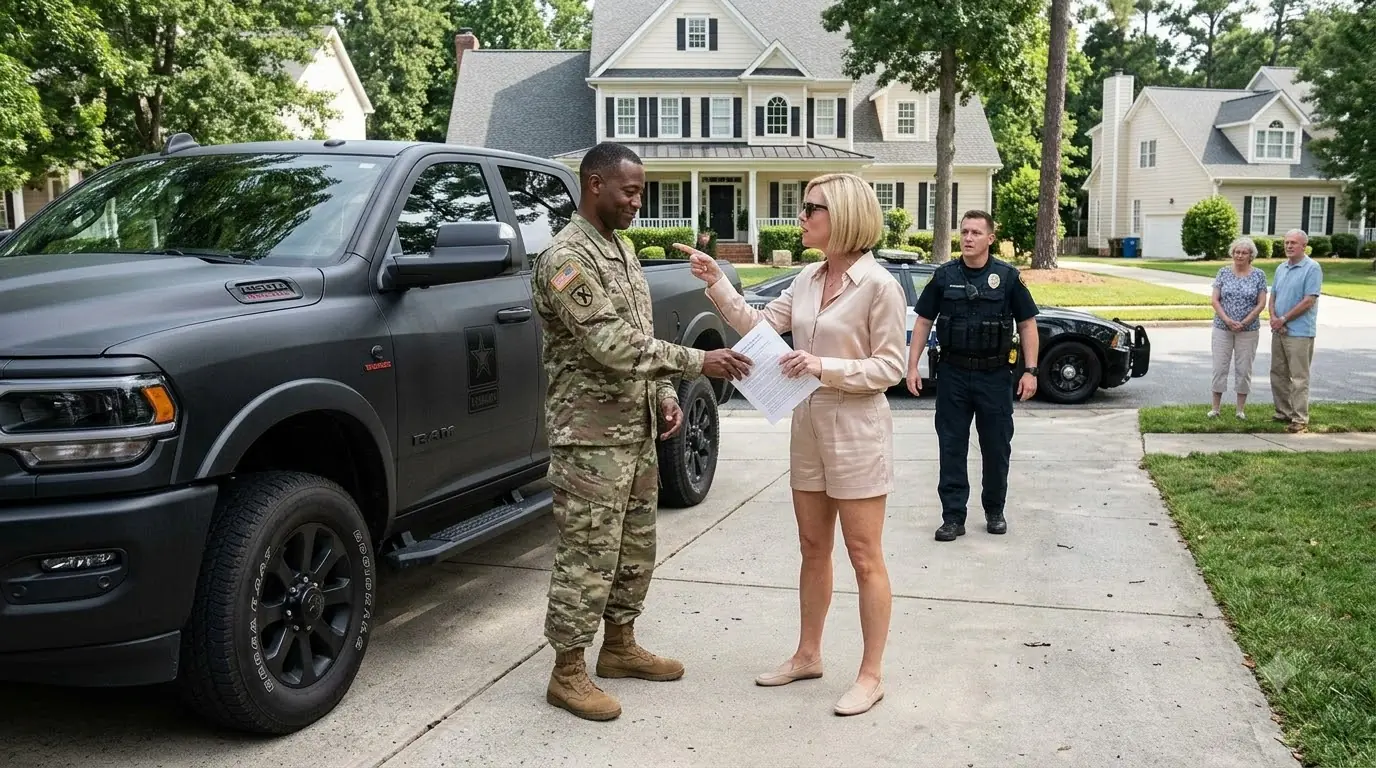
Marcus was forty-four, broad-shouldered, disciplined, and normally difficult to irritate before breakfast. He had spent the previous hour checking the truck after a long week away, wiping dust from the windshield and making sure the tires were ready for Monday, and he had expected the rest of his morning to involve coffee, scrambled eggs, and absolutely no conversations about neighborhood politics.
Vanessa stopped at the edge of his driveway.
“That has to go.”
Marcus looked at her.
Then at the truck.
Then back.
“Good morning to you too.”
Vanessa’s lips tightened. “I’m serious.”
“So am I about good mornings.”
She ignored that.
“The truck.”
Marcus leaned one shoulder against the garage frame. “What about it?”
Vanessa opened the binder with the satisfaction of a prosecutor about to introduce devastating evidence.
“This community has standards.”
Marcus waited.
“That vehicle violates them.”
“Which standard?”
Vanessa blinked.
“The appearance standard.”
Marcus folded his arms.
“Which section?”
Her irritation increased immediately.
“You always do this.”
“Ask what rule you’re enforcing?”
“Challenge every instruction.”
“That sounds like a different complaint.”
Vanessa pulled out a printed photograph.
It showed Marcus’s truck.
The picture had apparently been taken from across the street sometime the previous evening.
Marcus looked at it.
“Nice angle.”
“This is not funny.”
“I didn’t say it was.”
“You cannot park a vehicle that looks like that in an exposed driveway.”
Marcus turned toward the truck.
Large.
Black.
Clean.
Completely within the concrete boundaries of his property.
Nothing hanging from it.
No commercial signage.
No trailer.
No leaking fluids.
No oversized equipment.
It was simply a truck Vanessa disliked.
“Looks like what?”
“Tactical.”
Marcus stared at her.
“Tactical?”
“Yes.”
“That is not a covenant category.”
“It is threatening.”
“To whom?”
“Residents.”
“Which residents?”
“I have received complaints.”
“Names?”
“You know I cannot disclose confidential communications.”
Marcus nodded.
“Convenient.”
Vanessa snapped the binder closed.
“You don't get to mock the association.”
“I’m not mocking the association.”
He pointed toward the truck.
“I’m asking you to show me a written rule that prohibits a legally registered vehicle from being parked in my driveway.”
Vanessa stepped closer.
“The board is empowered to preserve neighborhood character.”
“Correct.”
“And property values.”
“Also correct.”
“So move the truck.”
“No.”
The answer came so quickly that Vanessa seemed not to understand it.
She stared.
Marcus did not repeat himself.
He had lived in Cedar Ridge Estates for fourteen months. It was an attractive neighborhood outside Fayetteville, North Carolina, with brick-and-stone houses, carefully maintained lawns, walking trails, and exactly the sort of homeowners’ association that could function well when responsible people treated its authority like a tool instead of a throne.
Marcus had no philosophical objection to associations.
He liked predictable maintenance.
He liked clean common areas.
He liked knowing the retention pond was inspected and the neighborhood pool properly insured.
He did not even mind architectural approvals when the rules were written clearly and enforced evenly.
What he disliked was improvisation disguised as governance.
Vanessa Whitmore specialized in improvisation.
She had been association president for two years.
At first, Marcus had assumed residents exaggerated when they described her.
Then he received an email because his garbage container remained visible from the street for forty-three minutes after collection.
The covenant allowed until 8:00 p.m.
The email arrived at 1:17.
He replied with the section number.
No answer.
Two months later Vanessa told him his porch light was “too industrial.”
Marcus asked for the approved fixture standard.
She never produced one.
Then his lawn service parked with one tire touching the curb.
Vanessa photographed it.
Marcus corrected the crew because that request was reasonable.
That seemed to convince her that all future demands would work the same way.
They did not.
Vanessa pointed at him.
“You have until tonight.”
Marcus almost smiled.
“Or?”
“The vehicle will be towed.”
“No, it won’t.”
“You don’t make that decision.”
“Neither do you.”
“I’m president.”
“And?”
Her mouth opened.
Marcus continued.
“Private towing from residential property requires actual authority. You do not have permission to enter my driveway, take possession of my vehicle, or authorize a towing company to do it because you personally dislike its appearance.”
Vanessa’s face reddened.
“You think you know everything.”
“No.”
“I know enough about my driveway.”
“You people always think rules do not apply to you.”
The sentence changed the air.
Marcus’s expression became colder.
Vanessa seemed to realize she had said something dangerous.
She recovered quickly.
“I mean difficult residents.”
“Of course.”
Marcus straightened away from the garage.
“Vanessa, unless you have a written violation notice citing an actual covenant, this conversation is over.”
She raised the binder again.
“I have a violation notice.”
“Show me the citation.”
She pulled out one sheet.
Marcus accepted it.
At the top:
CEDAR RIDGE ESTATES VEHICLE APPEARANCE NOTICE
That was interesting.
He had never heard of such a form.
He scanned the page.
No covenant section.
No board resolution.
No management-company reference number.
Just language about “military-style or tactical vehicles inconsistent with community aesthetics.”
Marcus looked up.
“When did the board approve this policy?”
Vanessa’s jaw tightened.
“It falls under executive interpretation.”
“There is no executive interpretation provision.”
“You are not an attorney.”
“No.”
“You are not on the board.”
“No.”
“Then stop pretending you understand association administration better than people who actually run it.”
Marcus handed the paper back.
“I understand enough to know you invented this.”
Vanessa stepped forward.
“You’re calling me a liar?”
“I’m saying the document cites no authority.”
“That is not the same sentence.”
“You are impossible.”
“I've been told.”
She shoved the paper back into the binder.
Then looked past him into the garage.
On the wall hung a framed photograph from Marcus’s promotion ceremony.
He saw her eyes pause.
She could not read the plaque from the driveway.
Good.
Marcus did not particularly advertise his work around the neighborhood.
Some neighbors knew generally.
Most assumed he worked at Fort Liberty in administration because he frequently left in uniform.
He preferred it that way.
Home was supposed to be home.
Vanessa looked at his clothing now.
Marcus was wearing his camouflage uniform because he had stopped home briefly after an early command meeting and had not yet changed.
She examined it as though it strengthened her argument.
“That is part of the problem.”
Marcus looked down at himself.
“My clothes?”
“The entire presentation.”
He stared.
Vanessa gestured toward the truck.
“You come and go in that vehicle wearing that.”
“That?”
“You know what I mean.”
“No.”
“Then explain.”
Her frustration sharpened.
“This is a residential neighborhood.”
“Yes.”
“Families live here.”
“Yes.”
“We do not want children thinking armored-looking trucks and uniforms are normal suburban decoration.”
Marcus’s eyebrows lifted.
The truck was a factory-production black pickup with off-road tires.
Nothing armored.
Nothing mounted.
Nothing unusual beyond styling.
He almost asked whether she intended to regulate occupation-specific clothing next.
Instead he said:
“My job exists whether you like how it looks from your window.”
Vanessa laughed.
“There.”
“What?”
“That attitude.”
Marcus glanced at his watch.
“Vanessa, I am going inside.”
“No.”
He looked at her.
She seemed surprised by her own word.
Then committed to it.
“No, we’re finishing this.”
“We are finished.”
Marcus walked toward the garage.