When I first saw the car, it didn’t even look like a Rolls-Royce. It was more like a rusted relic from a forgotten junkyard, the kind of thing most people would haul off for scrap metal without a second thought. But not me. I saw past the grime and decay to the graceful lines hidden beneath the classic 1959 Silver Cloud, a car that had once been the pinnacle of luxury.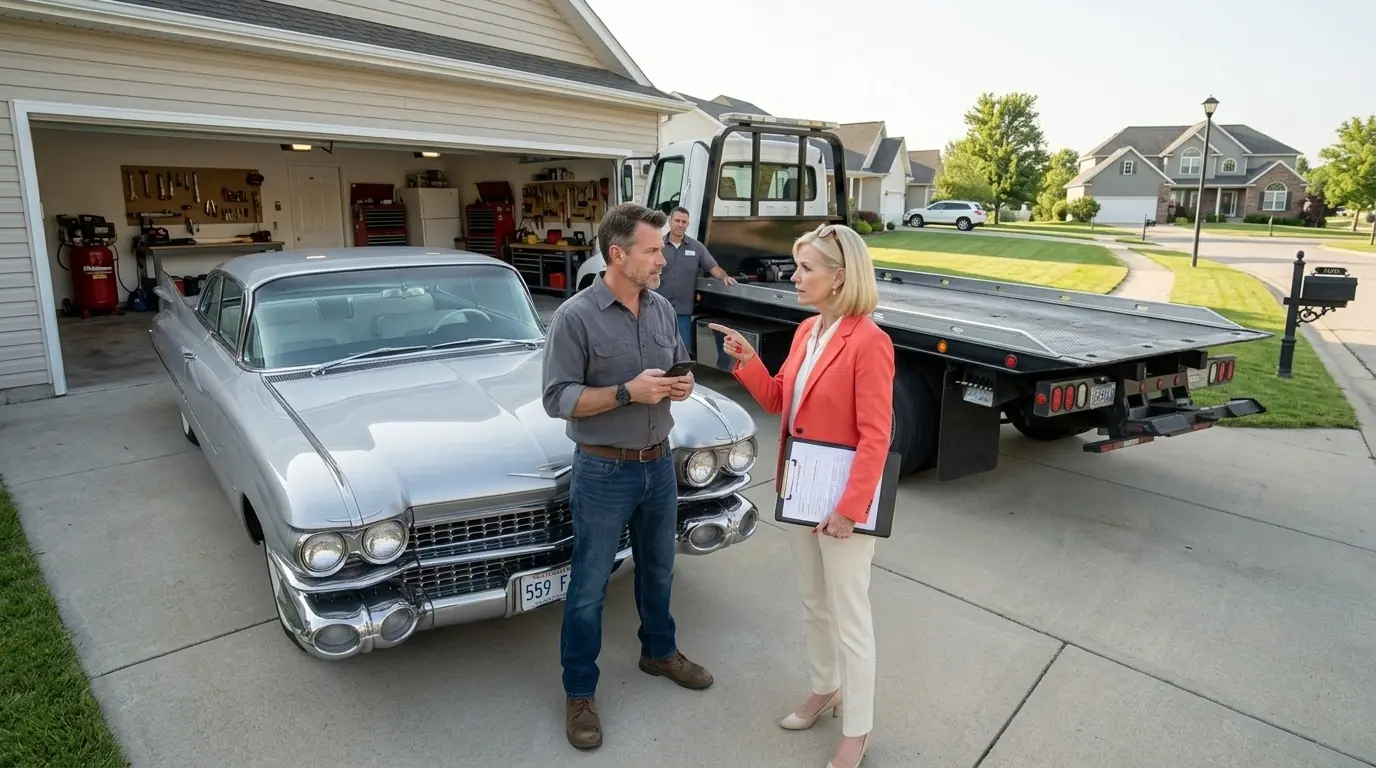
I’d always been fascinated with restoring history, and when a local collector offered it to me for next to nothing, I knew I had to bring it back to life. My garage wasn’t fancy, but it had everything I needed: patience, tools, and a dream. The only problem was my new neighborhood’s HOA, and more specifically, my next-door neighbor, Karen. From the moment I moved in, she’d been watching everything I did like she was running her own private security operation.
If I watered the lawn a minute past curfew, she’d snap a photo. If my trash bins were two inches from the curb line, I’d get an email about it. So when she saw that I’d towed in a vintage car that looked like a pile of rust and dreams, I could practically feel the outrage radiating from her pristine front porch. The next morning, there was already a note taped to my garage door: “Unapproved vehicle on property. Immediate removal required.”
I chuckled when I saw it, knowing full well that the HOA guidelines only prohibited non-operational vehicles parked on the street, not on private driveways, and certainly not inside someone’s garage. But logic and rules didn’t mean much to Karen. She thrived on confrontation, feeding off the drama like it was her morning coffee. At first, I tried to ignore her.
Every day after work, I’d roll up my sleeves and work on the car, stripping off layers of rust, sanding the panels, and ordering authentic parts from collectors across the country. I even had a small tented workspace beside my driveway to keep it shaded. But that didn’t stop Karen from pacing the sidewalk, pretending to walk her dog while filming me on her phone. “That eyesore violates community standards,” she’d shout, her voice carrying across the cul-de-sac like an alarm bell. “You can’t turn this place into a junkyard.”
I’d just smile and wave, telling her it was a restoration project, a piece of history being reborn. Of course, that only made her angrier. She started filing complaints to the HOA board, citing false claims that the car was leaking oil, that it was attracting rodents, and even that it was lowering property values. When that didn’t get the reaction she wanted, she escalated to the local bylaw office, insisting my property was a mechanical hazard.
The city inspector showed up one morning, clipboard in hand, clearly annoyed to be there. After a brief look around, he nodded and said, “You’re all good, sir. Everything’s up to code.” Karen was standing across the street during the inspection, arms folded, face twisted in disbelief. When she realized I wasn’t getting fined or ordered to stop, she stormed off, muttering something about not being done yet.
What Karen didn’t know was that I wasn’t just restoring the car for myself. I was restoring it for my late father. He’d owned a Silver Cloud back in the day before life got hard and the family business collapsed. That car had been his pride, the last tangible memory of a time when things were simpler and happier.
Restoring it wasn’t just about metal and paint. It was about legacy. So no matter how much Karen harassed me, I wasn’t going to stop. I spent months meticulously rebuilding it from the ground up.
I re-chromed the bumpers, replaced the leather interior with hand-stitched seats, and carefully restored the wooden dashboard to its original walnut glow. The smell of oil and polish became my therapy. Even the neighborhood kids would sometimes stop by, curious about the old car. I let them help polish the chrome now and then, which gave them something fun to do, and honestly, I liked the company.
It became almost a game: Karen trying to find new ways to stop me, and me quietly staying within every single rule she tried to weaponize. When I finally got the engine rebuilt, I remember the moment I turned the key. The Silver Cloud came to life with a deep, dignified purr, the sound of engineering perfection. Even after all these years, that Rolls engine sounded like royalty.
I couldn’t help grinning as I revved it lightly, proud of the work I’d done. But of course, the moment that sound echoed down the street, the curtain from Karen’s window shot open. She came rushing out in her bathrobe, phone in hand, yelling something about illegal noise violations and unauthorized vehicles. I shut off the engine calmly, wiping my hands on a rag as she approached like an outraged queen.
“You can’t have that here,” she screeched. “That car is not street legal. It’s a hazard. I’m calling the HOA.”
I tilted my head, smiling. “You do that, Karen. But maybe you should take a closer look before you call something a hazard.”
She glared at me, refusing to step closer. So I walked around the car, opening the hood with a polished flourish. The engine gleamed under the sunlight, every component spotless and new. “That,” I said proudly, “is a perfectly restored 1959 Rolls-Royce Silver Cloud, fully registered, insured, and legal.”
She blinked, speechless for the first time since I’d moved in. “You’re lying,” she snapped. “Seriously, no one in this neighborhood owns something like that.” I shrugged. “Guess you’ll have to get used to it.” Then I closed the hood with a gentle click, the sound of victory.
For a few blessed days afterward, things were quiet. I thought maybe she’d finally moved on. Then one morning, I walked outside and saw her standing next to my car with two strangers in suits. At first, I thought they were HOA board members again, but then one of them flashed a card and introduced himself as a police officer.
My stomach dropped as Karen smirked. “There,” she said triumphantly. “That’s the stolen vehicle I told you about.” The moment the officer said the words “stolen vehicle,” my heart skipped a beat, not out of guilt, but sheer disbelief. Karen had truly outdone herself this time.
She wasn’t satisfied with harassing me. Now she was trying to accuse me of grand theft. The two officers, one older and composed, the other younger and visibly uncertain, stood beside her as she dramatically waved her arms, recounting her discovery.
“I saw him bring this car in a few months ago,” she insisted. “It had no plates, no registration, and he’s been working on it ever since. Then I checked online and found a listing for a missing Rolls-Royce Silver Cloud. It’s the same color, same model. It has to be the one.”
The younger officer scribbled something on his notepad, glancing at me apologetically. I could tell even he thought she was overreaching, but procedure was procedure. “Sir,” the older one said, “would you mind showing us the ownership documents for this vehicle?” I didn’t hesitate.
“Of course,” I replied, walking calmly to my garage. Karen followed close behind, already smirking like she’d just exposed some criminal mastermind. I opened the neatly organized folder that held every record of my restoration journey: the bill of sale from the collector, the title transfer, the restoration receipts, and even the photos showing how wrecked the car was when I bought it. I laid them all out on my workbench for the officers to inspect.
The older officer nodded as he flipped through the paperwork. “Everything seems in order,” he said, glancing at Karen. “This car was legally purchased and registered. There’s no record of it being stolen.” Karen’s smirk faltered.
“But that’s impossible. I saw that missing car listing online,” she sputtered. “He must have forged those papers or something.” The younger officer exchanged a look with his partner, clearly trying not to laugh. “Ma’am,” the older one said patiently, “these documents are notarized and match the DMV database. This gentleman owns the car.”
Karen’s voice rose, desperate now. “He’s lying. He probably changed the VIN number.” The officer sighed. “Ma’am, I can assure you the VIN on this vehicle matches the title. Unless you have further evidence, there’s nothing criminal here.”
But Karen wasn’t done. She crossed her arms and turned her nose up. “Well, if you won’t do anything, then I’ll take it to the HOA. That car belongs to the neighborhood now. It’s been on display in plain view for months, which makes it community property under HOA aesthetics laws.”
I couldn’t help it. I burst out laughing. “Community property?” I repeated, wiping a tear from my eye. “Karen, this isn’t a communal playground. You can’t just claim someone’s car because you don’t like looking at it.”
That comment made her face turn crimson. “You think you’re so clever,” she snapped. “But you’ll see. The HOA will make you move it or they’ll fine you until you do.” I shrugged. “They’re welcome to try.”
With that, the officers thanked me for my cooperation and left, clearly eager to get away from the circus. Karen, however, stayed rooted to the spot, glaring at my car as if it had personally insulted her. The moment she stormed off, I knew this wasn’t over. Sure enough, that evening, I got a formal letter from the HOA.
It claimed that aesthetic violations had been reported concerning the unregistered vehicle visible from the street. They demanded it be relocated or covered within 48 hours. The letter was signed not by the HOA president, Jim, but by acting chairperson Karen. Apparently, she had badgered her way into a temporary leadership position while Jim was away on vacation.
I almost admired her persistence. She had turned her obsession into an administrative crusade, but she had made one crucial mistake. She assumed I didn’t know the rules better than she did. I printed out the HOA bylaws and highlighted the relevant sections.
There it was, clear as day. Personal restoration projects on private driveways were permitted for up to six months, provided the vehicle was registered and not leaking fluids. Mine met every single condition. I drafted a formal response complete with photos and the inspection report from the city officer and emailed it to the entire HOA board, not just Karen.
Within hours, my phone rang. It was Jim calling from vacation. “I heard about the incident,” he said with a weary chuckle. “Karen’s been driving everyone crazy in my absence. Don’t worry, you’re completely in the clear.”
I thanked him, but I also warned him that she wasn’t going to back down easily. “She’s already told the cops the car is stolen,” I said. “I wouldn’t put it past her to escalate further.” He sighed. “Unfortunately, you’re probably right. Just keep everything documented, and we’ll handle her when I’m back.”
The next week, I thought things might finally calm down. The car was nearly finished, gleaming silver with black trim, polished to perfection. I’d even booked it for a local charity auto show to honor my father’s memory. But then one morning, I woke up to the sound of metal scraping and muffled voices.
My stomach clenched as I rushed outside. There, under the dawn light, was a tow truck backing into my driveway and Karen standing beside it, clipboard in hand, directing the driver like she owned the place. “Stop right there!” I shouted, sprinting toward them. The driver froze mid-motion.
“Ma’am said this vehicle was community property under HOA orders,” he explained nervously. “She signed the release form.” I couldn’t believe it. “She’s not the HOA president,” I said firmly. “And this car belongs to me. Move that truck off my driveway immediately.”
Karen crossed her arms, smug as ever. “You’re obstructing official HOA business,” she declared. “We’re removing this eyesore permanently. Once it’s towed, we’ll store it until a proper owner can be verified.” That was it.
I pulled out my phone, already recording. “Karen, I’m giving you a chance to step away from my property before I call the police for trespassing and attempted theft,” I said calmly. “You’re not authorized to touch this vehicle. I have full documentation, and you’ve already been warned by law enforcement.”
She scoffed. “You wouldn’t dare.” But when she saw me dialing, her confidence wavered. Within minutes, the same two officers arrived, clearly not amused to be back on my street. The older one sighed when he saw the tow truck.
“Ma’am, what did we just discuss last week?” he asked. Karen tried to spin a new story, claiming the car was an abandoned hazard. The officer turned to me, shaking his head. “I’m sorry you’re dealing with this again. We’ll handle it.”
Then he looked at the tow driver. “Sir, if you move that truck one more inch, you’ll be charged with unlawful towing.” The driver didn’t need to be told twice. He jumped back into his cab and drove off immediately. Karen, however, kept yelling about HOA rights and citizen authority until the officers finally warned her to go inside or face a citation.
As she stomped away, she muttered under her breath, “You haven’t seen the last of me.” I watched her disappear into her house, still shaking my head. The neighborhood had gathered by then, quietly watching the drama unfold. A few of them came over afterward, patting me on the back.
“We’re with you,” one of them said. “She’s been a nightmare to everyone for years.” For the first time, I realized I wasn’t the only one tired of her reign of control. What I didn’t know yet was that the next step in her crusade wouldn’t just involve the HOA. It would drag me into a full-blown property-rights battle that would make national headlines.
After the tow truck fiasco, I thought Karen might finally realize she’d overplayed her hand. But people like her don’t quit. They double down. For a few days, the street was quiet, eerily so.
There were no barking commands from her porch and no fake complaints to the HOA inbox. It almost felt peaceful until I noticed something strange: a stack of fresh flyers slipped under everyone’s doors. In bold print, they read, “Community Alert: Fraudulent vehicle owner in violation of HOA property laws.” My name was on the bottom alongside a grainy picture of my restored Rolls-Royce.
She had printed and distributed defamatory notices accusing me of hiding a stolen car, running an illegal restoration business, and threatening HOA leadership. My phone started buzzing nonstop, neighbors calling, some angry, others confused. I could feel my blood pressure rising as I read through the lies. She had even forged an HOA letterhead and signed it with a fake acting president title.
It was one thing to gossip, but outright forgery was a whole new level. I immediately called Jim, who had just returned from his trip. The moment he picked up, I could hear the exhaustion in his voice. “Oh, I’ve already seen it,” he said grimly. “Half the neighborhood forwarded it to me. Karen’s in deep trouble now.”
Jim called an emergency HOA board meeting that same evening, and for once, I actually looked forward to it. The small clubhouse filled quickly, neighbors murmuring, curious, some even amused. Karen sat up front, chin raised proudly like she was expecting applause. When Jim arrived, he didn’t waste time.
He held up one of her flyers and dropped it on the table. “Karen, did you distribute these?” he asked flatly. She crossed her arms. “Of course I did. Someone had to protect the neighborhood from fraud.”
“And did you forge my signature on this document?” His tone was razor sharp now. Karen scoffed. “It’s not forgery if it’s in the community’s best interest.” A collective gasp rippled through the room.
Jim’s expression didn’t change. “Actually, that’s exactly what forgery is,” he said. “And it’s a criminal offense.” For the first time, Karen looked unsure. “You can’t be serious,” she said. “I’m the only one enforcing the rules around here.”
“No,” Jim replied calmly. “You’re abusing them.” He then turned to me. “Would you like to share your side of the story for the record?” I stepped forward, holding a folder of my own: proof of ownership, restoration records, and the police reports from both incidents.
I laid them on the table for everyone to see and took a deep breath. “This car,” I said, “belonged to my father. I restored it in his honor, on my property, within every rule this HOA has. Karen has filed false claims, harassed me, and even tried to have it stolen by a tow truck.”
A few neighbors nodded, some muttering in agreement. “And now,” I continued, holding up the flyer, “she’s forged HOA documents and spread lies about me. I could sue her for defamation and fraud right now and win.” Karen’s eyes widened, her confidence finally cracking.
But before she could speak, Jim leaned forward. “You won’t have to, Mr. Mason,” he said firmly. “This board is officially removing Karen from her position effective immediately. Furthermore, we’re opening a formal inquiry into her conduct and reporting the forged documents to local authorities.”
The room erupted into murmurs and whispers. Karen shot to her feet, slamming her hand on the table. “You can’t do that! I am the HOA!” she shrieked. Jim stood too, his patience clearly gone.
“No, Karen. You’re a member just like everyone else, and you’ve just violated half the bylaws you claim to protect.” She glared at me with pure venom before storming out of the room, muttering curses under her breath. The moment the door slammed shut, the tension eased like air leaving a balloon. A few neighbors even applauded quietly.
Jim looked at me apologetically. “We’ll file the report first thing in the morning,” he said. “And I’ll personally make sure she doesn’t come near your property again.” I thanked him, but I knew this wasn’t over. Karen had too much pride to let things end like that.
Sure enough, the next morning, a squad car pulled up in front of her house. I watched from my porch as two officers, one of whom I recognized, walked up her driveway with a warrant in hand. Within minutes, they emerged carrying a box of files and her computer. Word spread fast.
Karen was being investigated for document forgery, impersonation of an HOA official, and filing false police reports. The neighborhood buzzed with gossip all afternoon. Some felt sorry for her; most didn’t. But just when I thought the story was finally closing, something unexpected happened.
One of the officers who had handled the initial stolen-car complaint came over to my place later that day. “Mind if I come in for a minute?” he asked. “There’s something you might want to see.” He handed me a printed report.
“Turns out Karen’s little missing Rolls-Royce listing wasn’t just random internet gossip. She’d actually submitted it herself to a vintage car database to make your vehicle look stolen.” I blinked in disbelief. “You’re telling me she created the report?” He nodded.
“She uploaded photos of your car while it was still under restoration, claimed it was her late father’s, and listed it as missing. Then she used that same post to justify calling the police.” My jaw tightened. That explained everything: the fake listing, the false accusations, her insistence that it had to be the same car. She had orchestrated the entire thing.
“So what happens now?” I asked quietly. “Well,” the officer said, “once the district attorney reviews this, she’s likely facing multiple charges: fraud, filing a false report, and attempted theft by deception at the very least.” I felt a strange mix of relief and disbelief. For months, she had tried to ruin me, and now her lies had finally caught up with her.
“One more thing,” the officer added. “You might want to lock that car up tight. There’s a rumor she’s been bragging online about taking back what’s hers.” I nodded grimly. That night, I installed new security cameras and reinforced my garage door.
I even parked my truck in front of the driveway just in case. I wasn’t taking any chances. A few days later, I received an unexpected invitation to display my Rolls-Royce at the city’s annual heritage car gala. The organizers said word of my restoration had spread and they wanted the Silver Cloud as the centerpiece of the show.
I accepted with pride. On the morning of the event, I drove the car out of the garage for the first time since finishing it, the silver body gleaming in the sun. Neighbors stepped out to watch, cheering and clapping as I rolled by. It was a surreal moment, vindication in motion.
Even Jim came by, giving me a thumbs-up from his porch. But as I turned the corner, I spotted someone standing across the street near a parked sedan. Karen. She was no longer the confident, commanding woman from before.
Her hair was disheveled, her eyes wild, and she just stood there staring at the car like she’d seen a ghost. Then she shouted something I couldn’t quite make out, and the sedan screeched away. For a moment, I wondered if that was the last I’d ever see of her. I was wrong.
That night, after the gala, after the applause, after the judges called my restoration a masterpiece of modern craftsmanship, I came home to find my garage door slightly open. Inside, something glittered under the dim light. I stepped closer, my stomach turning cold. Someone had keyed the word “THIEF” into the side of my Rolls-Royce.
For a long moment, I just stood there in the dim light, staring at the deep scratches running across the flawless silver paint. The word had been carved with something sharp, maybe a key or screwdriver, cutting through the lacquer like a wound. My hands trembled, not from fear, but from a slow burn of disbelief giving way to fury. Months of patience, labor, and love had been poured into that car, all to honor my father’s memory.
Now it had been defaced by a woman who simply couldn’t stand losing. I took a deep breath, forcing myself to stay calm. This wasn’t just vandalism. It was escalation, and I had the proof.
The garage camera’s small red light blinked steadily from the corner, meaning every second of what had happened was caught on tape. I opened the feed on my phone and watched, my jaw tightening as the footage showed Karen sneaking across my driveway just after midnight, wearing dark clothes and gloves, gripping a metal object in her hand. She hesitated for a second, looked around, then etched her rage into the car’s perfect body. When she finished, she stood there for a moment, admiring her work with a twisted little smile before slinking away into the night.
That was all I needed. I forwarded the footage directly to both Jim and the local police department. Within an hour, the officer I’d spoken to before called me back, his voice hard. “We’re issuing a warrant,” he said. “She’s finally crossed the line.”
By morning, the entire neighborhood knew. A pair of patrol cars pulled up to Karen’s house just as the sun rose, their flashing lights painting the sleepy cul-de-sac red and blue. Neighbors peeked from their windows as officers led her out in handcuffs, still shouting her familiar chorus of denials. “He stole it! It’s mine! You’re all blind!” she screamed as they placed her in the back seat.
But no one defended her, not this time. The same people she had tormented for years with complaints, fines, and fabricated violations now stood at their fences, whispering with relief. It was like the spell she’d held over the neighborhood had finally broken. I watched silently from my porch, not gloating, not smiling, just finally at peace, knowing the nightmare was ending.
The officers gave me a nod as they drove off. Justice, I thought, had a way of catching up, even to those who thought they were untouchable. Later that afternoon, Jim came by with a few other HOA members. “She’s officially been removed from the board,” he said, handing me a formal notice.
“We’re pressing charges on behalf of the HOA as well. Apparently, her little reign of terror didn’t stop with you. She’s forged multiple documents over the years, even pocketed some fine money that never reached the community account.” My eyebrows shot up. “So she was running a scam the whole time?”
Jim nodded grimly. “Looks like it. But thanks to that footage you had, the DA’s office is taking the case seriously. She’s looking at jail time, restitution, and a record she won’t be able to clean.” I thanked him, though part of me still couldn’t shake the sadness of it all.
It didn’t have to end this way. If Karen had just minded her own business, or even tried to talk like a normal person, none of this would have happened. But she had built her identity around control, around being the queen of the cul-de-sac, and losing that had broken her completely. Over the next few weeks, things slowly returned to normal.
The police came by for follow-up statements. Insurance adjusters inspected the damage, and neighbors began stopping me on walks to share their own Karen horror stories. Apparently, she’d fined one couple for having the wrong color garden hose, another for improper mailbox alignment, and had even tried to get a family evicted for hanging Christmas lights too early. Now people seemed lighter, more neighborly.
They organized a small block party to celebrate freedom from the HOA Queen, and for the first time since moving there, I felt part of the community. A few of the neighborhood kids even helped me buff and sand the scratched panels of the Rolls under my watchful eye. “It’s just a car,” I told myself as I worked. Though deep down, it felt like so much more.
The vandalism wasn’t just damage to metal. It was the final act of a bitter war that had tested every ounce of patience I had. A month later, I received a letter from the court confirming that Karen had taken a plea deal. She admitted to vandalism, forgery, and filing false reports in exchange for a reduced sentence and mandatory psychiatric counseling.
Part of the agreement required her to pay full restitution for the car’s repair and damages, which, given the Rolls-Royce’s value, wouldn’t come cheap. I couldn’t help but smile when I read that. Justice wasn’t always swift, but it was thorough. With the settlement money, I decided to go beyond just fixing the scratches.
I hired a professional restorer to give the Silver Cloud an entirely new coat of paint matching the original Dawn Silver finish it had when it left the factory in 1959. When it was done, it gleamed like liquid moonlight. I stood there one evening, running my hand along the smooth metal, remembering my father’s old saying: “Some people see rust, son. Others see history waiting to shine.”
That weekend, I entered the car into a regional vintage showcase, a much larger event than the local gala. When the judges came by, they admired the craftsmanship, the authenticity, and the emotional story behind the restoration. One of them, a collector from England, was so impressed he made me an offer that nearly made me drop my coffee, a six-figure sum for the car. But I shook my head and smiled.
“This one’s not for sale,” I said softly. “It’s family.” The story of the car and Karen’s madness ended up spreading across social media after one of the judges posted about it. The headline read, “Neighbor Restores Vintage Rolls-Royce. HOA President Tries to Steal It, Ends Up in Jail.”
The post went viral. People from around the world commented, praising patience over pettiness and passion over control. Even local news outlets came by to film a short feature about the restoration and the neighborhood drama behind it. In the interview, when the reporter asked me what lesson I’d learned from all of it, I didn’t have to think long.
“Sometimes,” I said, “the real restoration project isn’t just about cars. It’s about people, and not everyone can be fixed.” She laughed softly, but I meant it. Some people like Karen were too consumed by their need to dominate, too afraid to lose control of the world around them. And when they finally did, they lashed out like a cornered animal.
But in the end, truth had a way of shining through just like polished chrome. Months later, life in the neighborhood was peaceful. Jim retired as HOA president, handing the reins to a younger couple who valued community over control. We started hosting weekend BBQs, outdoor movie nights, and car shows in the cul-de-sac, turning the once-hostile neighborhood into something genuinely friendly.
Sometimes, when I pulled the Silver Cloud out of the garage, its engine purring like a sleeping lion, I’d catch a reflection of my father in the windshield, smiling, proud. Karen’s old house eventually went up for sale, bought by a quiet family with two young kids who planted flowers instead of complaints. The street that had once been tense and divided now bloomed with life again. On the anniversary of the restoration’s completion, I drove the Silver Cloud along the coast, the same stretch my father used to take me on when I was a kid.
The sky was golden, the waves soft against the cliffs, and for the first time in a long while, everything felt right. As the sun dipped below the horizon, I parked at an overlook, stepped out, and whispered to the car, “We did it, Dad.” The wind carried the words away. But I swore I could almost hear his laughter echo in return.
Because in the end, the car wasn’t just metal and memory. It was proof that grace, patience, and persistence outshine even the darkest kind of pettiness. And as the Rolls-Royce Silver Cloud purred softly under the twilight, I realized that some victories don’t come from fighting. They come from enduring, and that was the kind of legacy worth restoring.