6:30 Tuesday morning, I'm heading out for a sunrise ride with my coffee still hot. The air smells like wet grass and peace. Suburban perfect, right?
Then I see my Harley. 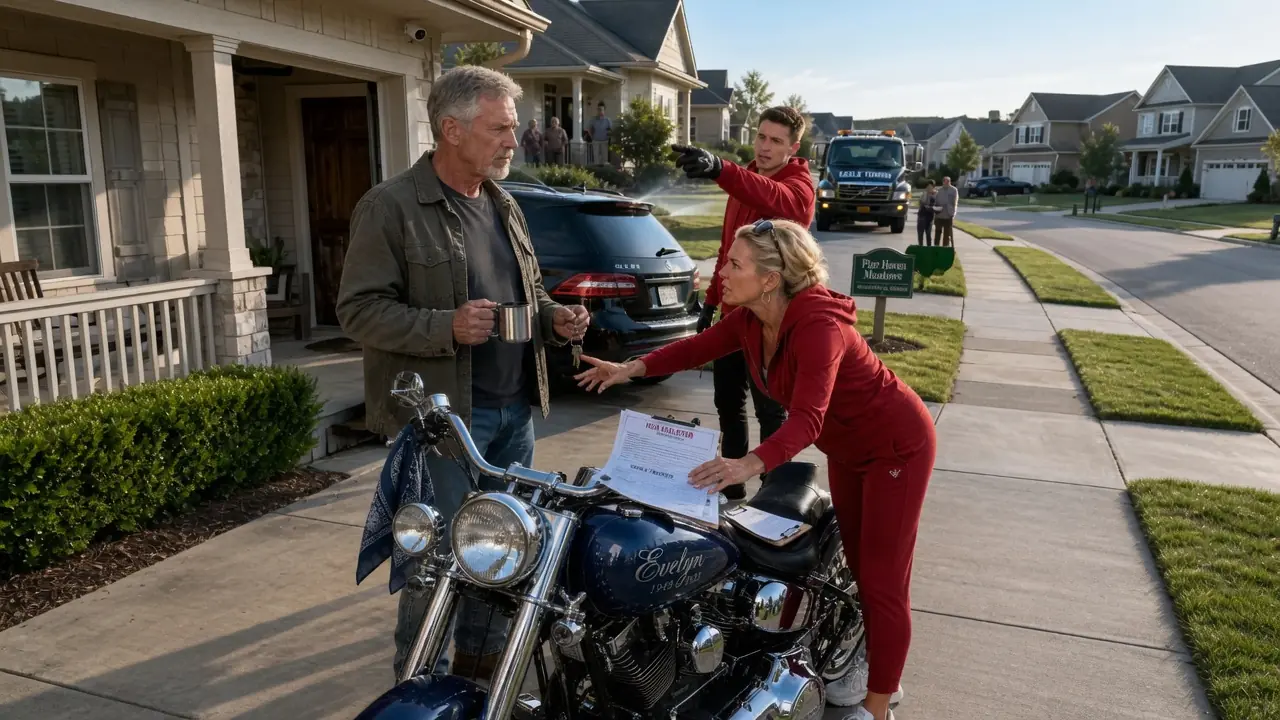
Fifteen years restoring her. Twenty-eight grand invested. My late wife's name was airbrushed on the tank, now gouged through with deep, jagged scratches. The ignition is punched completely out, and gasoline is dripping onto the concrete. That sharp, chemical stink hits me like a slap.
Before I can even process it, this kid strolls over from across the street. He is twenty-three, smirking like mommy just told him he was special.
"Shouldn't park your trash out here, old man," he says. His phone is already at his ear. "Yeah, 911? A guy at 42 Larkspur just threatened to kill me."
In the distance, sirens begin to wail, getting closer by the second. The kid thinks he won. He has no idea I spent twenty-two years making punks like him regret that exact smile.
My name is Garrett Trudeau. I'm fifty-nine years old, a retired ATF special agent out of the Chicago Field Office. I spent over two decades wearing a federal badge, tracking gun trafficking, infiltrating cartel money laundering operations—the kind of work where you learn to read people in milliseconds and stay freezing cold when things go sideways.
I retired three years ago when my wife, Miranda, died. Cancer took her in eleven months, erasing thirty-one years of marriage. After the funeral, I realized I didn't want to spend my remaining time chasing heavily armed felons through Chicago's worst blocks. So, I took my pension, sold our place, and moved out here to Pine Haven Meadows—a planned community forty minutes outside Indianapolis. It was supposed to be peaceful and quiet, the kind of place where sprinkler disputes are your biggest headache.
The Harley was ours. Miranda and I bought that 1995 Heritage Softail when we were young and dumb enough to think we'd ride cross-country someday. Life got in the way—jobs, mortgages, her mother's failing health. The bike sat unused in our garage for fifteen years. After she passed, I started restoring it. It was therapy, I guess. I'd spend hours surrounded by the smell of Bel-Ray oil and the weight of chrome wrenches in my hands, treating each tightened bolt like a promise kept to her.
Pine Haven looked immaculate on paper: 140 homes, tree-lined streets, and a small community center. My ranch house at 42 Larkspur Lane was nothing fancy, but the lawn was clean and I could see the sunsets from the back porch. The first four months went smoothly. I kept to myself, mowed every Saturday morning at 8:00 a.m. sharp out of old military habit, and helped my elderly neighbor, Mrs. Kowalski, carry her groceries when I saw her struggling.
Then I met Deandra Calloway.
Deandra lived across the cul-de-sac in a colonial twice the size of mine. She was fifty-two, divorced, with a face like a hatchet and a personality to match. She drove a leased Audi Q5, wore expensive athleisure everywhere, and treated the entire neighborhood like her personal kingdom. You could always hear her coming during homeowners association meetings, her long acrylic nails clicking against her phone screen while she scrolled through a list of minor violations. Deandra was the HOA treasurer, but she acted like the president, sheriff, and judge combined.
Her son, Jackson, lived with her. He was twenty-three, unemployed, and drove a modified Charger with an aftermarket exhaust that sounded like flatulence echoing through the suburbs at 6:00 a.m. I would later learn the kid had a extensive juvenile record: two DUIs, petty theft, and disorderly conduct—the kind of punk who had never faced a single real consequence because mommy always brought a lawyer and a checkbook to the precinct.
Week two of living there, I parked my Harley in my driveway. It was perfectly legal per the bylaws I had read cover to cover before signing the mortgage. The next morning, there was a printed notice tucked under the seat: *Motorcycles must be garaged. Diminishes community property values. $150-a-day fines start Monday.*
I checked the bylaws again. Section 7C explicitly allowed motorcycles in driveways; only RVs and boats required prior board approval. She was inventing rules out of thin air. I sent a polite email to the board with a screenshot of the actual text, figuring that would be the end of it.
Three days later, Deandra called an emergency meeting. She proposed a "visual blight" amendment. Under the new rule, motorcycles now required written board approval for driveway parking. It was a five-member board, and she controlled two of them through pure intimidation. The vote passed three to two. My legal parking spot became illegal overnight.
That evening, I sat on my porch watching her house across the street, the lights blazing behind her closed blinds. The cicadas were buzzing in the warm air, and that old, familiar itch started between my shoulder blades—the one I used to get before a tactical raid when I knew someone dangerous was close.
The Harley wasn't just metal and chrome to me. Miranda's bandana was still tied to the handlebar, and her name was airbrushed on the tank. It was the last tangible piece of her I had left. I didn't survive cartel stakeouts and federal corruption investigations just to get bullied by a suburban tyrant with a clipboard and a power complex.
Deandra Calloway had just made a critical tactical error. She had picked a fight with someone who had spent his entire adult life making people like her face reality.
---
The harassment started five days after that board vote.
At 6:00 a.m., I was dead asleep when an ungodly roar shook my bedroom windows. I bolted upright, my hand instinctively reaching for the nightstand where I used to keep my service weapon. But it wasn't gunfire; it was Jackson's modified Charger. That cheap exhaust sounded like a dying water buffalo, revving right outside my window before screaming off down Larkspur Lane.
The next morning, it was the exact same thing: 6:00 a.m. sharp.
By day three, a heavy trash bag appeared at the edge of my lawn. It was technically on the public easement, so I couldn't definitively prove ownership, but inside were Taco Bell wrappers and an energy drink can with the name *Jackson* sharpied across the side. The kid wasn't exactly a criminal mastermind.
By day seven, I had everything fully documented. I had installed a high-definition 4K security system the day after the board meeting—four discreet cameras positioned legally, covering my property lines and the public street. Nothing was aimed at their windows; everything was entirely within Indiana statute. The footage was pristine. Every morning at 6:00 a.m., there was Jackson doing his drive-by revving. Every few nights, the same build, the same gait, dumping trash near my mailbox.
I created a master spreadsheet: timestamps, license plates, and decibel readings captured from a phone application. Back when I was building federal cases against international gun traffickers, my supervising attorney used to say that comprehensive documentation wins trials, not theories. Turns out the same metric applies to neighborhood wars.
Then I ran a routine background check through public records on the county clerk's website. It took twenty minutes. I had forgotten how much people assume is completely hidden when it is actually sitting right there in the public domain for anyone to find. Jackson Calloway's file was a gold mine. Two DUIs from ages nineteen and twenty, both pleaded down to reckless driving. There was a sealed juvenile record I couldn't access, but the arrest dates were public: disorderly conduct, theft, and criminal mischief.
And the beautiful part? His driver's license had been suspended six months ago for unpaid court fines totaling $4,200. A suspended license meant he was committing a misdemeanor every single morning outside my front door.
The information went straight into a secure folder. I wasn't playing that card yet. You don't show your hand until you are entirely ready to take the pot; that's another lesson I learned watching interrogations go sideways when young agents got impatient.
On day thirteen, I was at the highway grocery store parking lot, loading my saddlebags on the Harley, when Jackson's Charger whipped in tightly behind me, completely blocking my exit. He climbed out of the driver's seat with his phone already recording, that smug smirk plastered across his face.
"My mom says you're making her life hell with your complaints," he said, stepping into my space.
"Son," I said quietly, "I haven't called an attorney yet. When I do, you'll know."
He stepped closer, his phone extended toward my face. "This is harassment. I'm recording you threatening me right now."
I finally looked at him, delivering the exact smile I used to give suspects in federal holding rooms—the one that tells them I've already won and they just haven't realized it yet. "Good. Make sure you get the part where you're currently parked illegally in a marked fire lane." I nodded toward the bright yellow curb under his rear tire. "That's camera three up there by the entrance. Great angle."
His eyes flicked up to the commercial security camera, then widened slightly. He threw himself back into his car and peeled out before the store manager could even reach the curb, his tires squealing loudly against the asphalt. I finished loading my bags, waved to the concerned manager to assure him it was just a misunderstanding, and headed back to the house.
That evening, I found a certified letter waiting in my mailbox. Official HOA letterhead. It demanded $600 in accumulated fines for illegal motorcycle parking, due in ten days, or they would place a formal lien on my property.
Here is where Deandra got incredibly sloppy: the signature block listed her as the HOA president. She wasn't the president; she was the treasurer. The actual president was Gregory Matsuno, a retired schoolteacher who hadn't spoken a single word at the recent meetings. She was actively forging her administrative authority. In the state of Indiana, that isn't a simple neighborhood squabble—it edges directly into corporate fraud territory.
I had seen this pattern before back in Chicago: small-time operators who got completely drunk on tiny amounts of localized power. They start cutting corners, assuming nobody will ever check the paperwork. They always make the same fundamental mistake underestimating how much documentation matters.
I photographed the letter, scanned the pages, and saved copies to three separate drives. Then I started calling the other board members, extending casual coffee invitations, nothing aggressive.
Gregory Matsuno agreed to meet immediately. He looked utterly exhausted and quietly terrified. The other two board members openly worshiped Deandra, repeating her pre-packaged talking points verbatim. But Yolanda Wu, a retired accountant in her mid-sixties, hesitated significantly when I brought up the community's finances.
"Between you and me, Mr. Trudeau," she said quietly, looking over her shoulder, "something doesn't add up in the monthly ledger. I asked to review the bank statements last month, and Deandra shut me down hard. She told me it wasn't my concern as a regular board member."
I thanked her for her time and hung up. The cracks in the wall were showing now. Deandra had built her entire little empire on pure bluff and intimidation, confident that nobody would ever look close enough to see the foundation crumbling. It was time to start applying tactical pressure.
---
At 2:47 a.m. on day nineteen, my phone buzzed with a sharp motion alert. I pulled up the live camera feed, still half-asleep. There was a hooded figure crouched right beside my Harley, and before he even looked up, I knew from the physical build it was Jackson.
He was dragging a heavy key across the fuel tank—long, deliberate gouges tearing through the midnight blue paint, cutting right through Miranda's name in silver script. Then he pulled a heavy screwdriver from his pocket and started punching the ignition cylinder, the sound of metal scraping metal cutting through the silent pre-dawn air.
Every single instinct in my body told me to throw open the front door and neutralize him on the spot, but the smarter part—the veteran agent part—told me to let him complete the act. Make it completely undeniable. He looked directly up at camera two, grinned widely, flipped it off, and walked back across the street like he had just finished taking out the trash.
I waited until he was safely back inside Deandra's house before stepping outside. The physical damage hit me harder than I had anticipated. Seeing those jagged silver scars cut right through Miranda's name, the ignition cylinder completely destroyed, and the gasoline pooling on the concrete made my throat tighten. I stood there breathing in the chemical stink, feeling that old, dangerous anger trying to rise—the kind that gets federal agents in trouble when a case turns personal. I pushed it down. Anger makes you sloppy, and sloppiness gets you killed. I went back inside and waited for dawn.
At 6:30 a.m., right on schedule, Jackson strolled across the cul-de-sac with that smug smile. "Morning, neighbor. Something wrong with your bike?" His voice was full of fake concern. "Real shame when property gets damaged like that. Maybe you should park it in the garage like my mom says."
I took a slow sip of my coffee. "You looked right at the lens, Jackson."
He stopped dead on the pavement. The smirk faltered.
"2:47 this morning," I continued calmly. "You keyed the tank, punched the ignition cylinder, and smiled right at camera two. You even flipped it off." I took another sip. "In the state of Indiana, that constitutes felony criminal mischief. Property damage exceeding three thousand dollars carries a baseline sentence of two to eight years."
His face drained to paper white, then flushed a dark red. He pulled out his phone, his hands visibly shaking. "You're threatening me. I'm calling the police right now."
"Good," I said. "Save me the administrative trouble."
He actually dialed, his voice pitching high with panic. "Yeah, 911? A guy at 42 Larkspur is threatening me over his motorcycle. He's got illegal surveillance cameras. I think he's about to attack me."
Eight minutes later, two county squad cars arrived on the scene, their tires crunching against the gravel. Sergeant Nyland—a professional officer in his mid-fifties—climbed out of the lead car, accompanied by a younger officer named Perez.
Jackson immediately began performing for the uniform. "Officers, thank God you're here. This man has been harassing me for weeks, threatening to kill me over some scratches he's trying to blame on me."
"Sergeant," I said calmly, keeping my hands fully visible on the porch railing. "I have high-definition 4K footage of the incident. The suspect's face is clearly visible, time-stamped, and verified. It's a clear case of felony criminal mischief." I handed him the secure USB drive I had prepared inside.
Nyland took the drive, squinting at me for a second. "Wait a minute. Trudeau? ATF Trudeau? From the Bridgeport Task Force?"
"Retired," I nodded. "I just want to file formal charges."
Recognition changed the entire dynamic of the scene instantly. Nyland took the drive, turning his attention to Jackson, whose confidence completely evaporated. The kid pulled out his phone again, desperately calling his mother.
Deandra arrived seven minutes later in a silk bathrobe, barefoot, her hair uncombed. She screeched into my driveway like an invading army.
"Officers!" she screamed, pointing an acrylic nail at my face. "This man has been stalking my son for weeks! I have a formal log! I have independent witnesses!" She waved a stack of printed papers in the air.
Nyland's tone was completely exhausted. "Ma'am, we have direct video evidence of your son destroying three thousand dollars worth of property."
"That camera is illegal!" she shrieked, pointing at the housing. "It's pointed at my property! It's a privacy violation!"
"The camera's field of view records property lines in a public space, Mrs. Calloway. It is completely legal under Indiana statute," Nyland countered.
I stayed quiet, letting Nyland run his scene.
"But he's been threatening us!" she hissed. "Stalking my son, making our lives hell because we're simply maintaining community standards!"
Nyland cut her off cleanly. "Your son is under arrest for felony criminal mischief."
Officer Perez turned Jackson around and slapped the cuffs on his wrists. The smirk was entirely gone from the kid's face; he was looking at Deandra with genuine terror, and she was staring at me as if I had just torched her entire world.
"This isn't over, Trudeau," she hissed, her teeth clenched. "I will completely destroy your life."
I took another slow sip of my coffee, looking her dead in the eyes. "I'm looking forward to it, Deandra."
The squad cars pulled away from the curb, with Jackson sitting in the rear bay. Deandra stood in my driveway, shaking with pure rage, before storming back across the cul-de-sac.
The blinds were moving all down the street. Mrs. Kowalski was watching from her front window, and several other neighbors were out on their porches. The entire cul-de-sac had just witnessed Deandra's golden boy being led away in steel restraints.
Sergeant Nyland paused by his driver's side door before leaving, lowering his voice. "She's got significant political pull with the township supervisor, Garrett. Watch your back."
I nodded. "I'm already planning on it, Sergeant."
The sun was fully up now, the birds were chirping, and the automated sprinklers were starting their morning cycles. The smell of hot coffee and leaking gasoline mixed in the warming air. I looked down at the Harley. Miranda's name was scarred, but it was still entirely visible.
"Not done yet," I said quietly to the empty driveway. "Not even close."
---
On day twenty-three, I found a thick certified letter waiting in my mailbox, much heavier than the last one. It detailed an "Emergency Special Assessment" of $5,800 per household for immediate road repairs and executive legal consultation. The text stated payment was due within twenty-four hours, and non-compliant properties would be subject to an immediate administrative lien.
Twenty-four hours. Under Indiana property law, an HOA is strictly required to provide thirty days' notice for any special assessment exceeding five hundred dollars. This wasn't bending the rules—it was breaking them wide open.
I called the township public works office. A woman named Susan answered the line. She sounded genuinely confused when I inquired about the scheduled road repairs for Larkspur Lane.
"There are no permits filed for that quadrant, sir," she confirmed after checking the system. "Your HOA hasn't requested any municipal clearance or road maintenance orders in eighteen months. No road repairs are scheduled."
So where exactly was the capital going?
I spent two hours fighting through bureaucratic red tape to access the association's tax-exempt bank statements. Indiana statute dictates that tax-exempt HOAs must make their financial ledgers available to members upon request, but Deandra had made the process deliberately difficult. Three formal requests later, I was finally analyzing the digital records.
There was a series of transfers totaling $47,000 to an entity called *Callaway Consulting LLC* over the span of eighteen months. I ran a quick business registry search on the Secretary of State's website—an old habit from tracking cartel funds through shell operations back in Chicago.
Callaway Consulting LLC was registered directly to Deandra's residential address. The sole proprietor: Deandra Marie Calloway. She had been paying herself massive corporate fees for services that didn't exist.
I had seen this pattern in federal fraud investigations: someone secures a small amount of localized authority, realizes nobody is actively watching the ledger, and starts moving funds into their personal accounts. They always think they're too clever to get caught; they never are.
My phone rang, an unknown local number appearing on the screen. "Mr. Trudeau? My name is Sloan Beckett, I'm an investigative reporter with the *Indianapolis Star*. I cover suburban corruption tracks, and I heard you might have an HOA story worth looking into."
Word travels exceptionally fast in a small township. "Possibly," I said. "What are your metrics looking like? Coffee tomorrow morning?"
"I've been tracking HOA embezzlement tracks for three years," Sloan said. "You bring the hard documentation, and I'll bring the front-page placement." We set a time.
That evening, Deandra executed a strike on the community's private social media page at 8:00 p.m.
> *“Concerned about an aggressive newcomer threatening our children's safety. Use extreme caution near 42 Larkspur Lane. This individual has made multiple verbal threats against long-time residents and shows clear signs of psychological instability. Protecting our community baseline remains paramount.”*
Attached was a clear photograph of my house, with my veteran license plates clearly visible. The comments flooded in immediately from her insular circle, clearly coordinated:
*"I heard he threatened a child at the corner."*
*"Is this a PTSD issue from his background?"*
*"My kids play right down that lane. Terrifying."*
I screenshotted every single line, printed the copies, and added them to the mounting folder. But three comments broke the established pattern:
*"Wait a minute. Isn't this the guy whose motorcycle was vandalized in his own driveway?"*
*"The Calloway kid was arrested on video, right?"*
*"The police had direct video evidence. Maybe there's a different story here."*
*"Didn't you fine him for a legal parking spot, Deandra?"*
Not everyone in Pine Haven was buying her narrative anymore. I didn't respond to the post, and I didn't engage; that was exactly what she wanted—a public, emotional altercation she could screenshot as legal proof of my aggression.
Instead, I made quiet calls to the residents. I called Mrs. Kowalski, whose automated sprinkler I had repaired last week. I called the Brunellis down the street. I called Rick Haverson, a local contractor.
Turns out I wasn't operating alone. Mrs. Kowalski had paid $3,400 in arbitrary landscaping fines over two years, despite her yard being completely immaculate. She had stopped fighting the orders because Deandra threatened a foreclosure lien, and she was living on a fixed income with mounting medical bills. The Brunellis had been fined $800 for an "unapproved pool structure"—it was a plastic inflatable kiddie pool for their three-year-old son. Rick Haverson had paid $1,200 in commercial vehicle fines before giving up and parking his work truck at his brother's commercial yard.
By midnight, I had documented eight separate households totaling $28,600 in fraudulent fines. Combined with her $47,000 in self-payments, Deandra Calloway was looking at over seventy-five grand in systematic financial fraud.
The next morning, I met Sloan Beckett at the Highway 52 Diner. She was a sharp reporter in her late thirties, her digital recorder set flat on the table. The place smelled of burnt coffee and bacon grease, the red vinyl booths slightly sticky under my forearms. I slid the thick folder across the table. Bank statements, fake corporate invoices, victim affidavits, Facebook screenshots, and police reports.
She read through the documents slowly, her expression transforming from professional detachment to genuine shock. "This is criminally prosecutable, Garrett. You know that, right?"
"I do," I said.
"Do you want this fully public?"
"I want every single homeowner who paid a fraudulent fine to understand they can get their capital back," I told her, my voice level. "And I want her to understand that actions have permanent consequences."
Sloan smiled slightly, packing the files into her bag. "Give me two weeks. I'll vet every single transaction, clear it through our legal department, and interview the sources. Then we go big."
"Two weeks," I said. "I can wait." We shook hands.
When I drove back into the cul-de-sac, Deandra was standing in her driveway, her arms crossed tightly over her chest, glaring at my vehicle. She didn't speak; she just watched me park and walk inside. She knew something had shifted; she could feel the ground moving beneath her feet. Good. Let her worry.
---
On day thirty-one, late in the evening, my dining room table was completely covered in files that Gregory Matsuno had dropped off earlier. He had brought three years of internal HOA documents he had been too terrified to share while Deandra was managing the board. Gregory looked as if he had aged a decade; his wife's oncology treatments were bleeding their savings dry, and he finally admitted that Deandra had threatened to create problems with his local insurance coverage if he didn't vote her way on the panel. It was classic intimidation.
I was on page forty-three of the original 2006 HOA charter when my eyes stopped on a specific paragraph. Section 12C, buried in dense legal terminology: *No amendment to parking, vehicle, or storage regulations shall be valid without the explicit approval of 75% of the total homeowner membership via a verified mailed ballot. Board votes alone are legally insufficient.*
I read the text three times to verify the parameters. My coffee had gone completely cold in the mug. Deandra's motorcycle ban, pushed through with a simple three-two board vote in a private room, was completely illegal from its inception. She needed seventy-five percent of all 140 homeowners; she had simply utilized three people in an executive session. Every single fine she had issued under that amendment was legally void.
I called Marcus Feinstein, a sharp pro bono property attorney I had located through legal aid. He answered the line despite it being nearly 10:00 p.m.
"Marcus, I found the baseline. A specific charter clause that completely invalidates the parking amendment."
"Send me a high-res photo of the text immediately," Marcus said.
I snapped the page and texted it over. Thirty seconds of absolute silence followed on the line.
"Holy hell," Marcus breathed. "This isn't just voidable, Garrett—this is clear grounds for a harassment suit and punitive damages. Every fine she collected under that rule constitutes a fraudulent extraction. What about the embezzlement angle?"
"It's trickier," I admitted. "Bank transfers alone aren't enough if she claims she performed administrative work. We need proof she provided zero actual services, or better yet, get her to admit to it on the record."
"On the record would be game over," Marcus agreed.
We strategized for fifteen minutes, mapping out the timeline. The plan crystallized perfectly: let her think she was winning, bait her into one final public power play at the upcoming meeting, and then detonate everything simultaneously—media exposure, class-action litigation, and a public community confrontation.
The timeline was tight. Sloan required two weeks to run her piece, and Marcus could file the injunction and the class-action suit simultaneously, but court dates required a minimum of three weeks to clear the docket.
"Can you hold your ground for three weeks, Garrett?" Marcus asked.
"Count on it," I said.
I hung up the phone and stared at the highlighted charter page. All this time, Deandra had operated on pure, unadulterated bluff. She had rewritten reality, counting on the fact that nobody would ever read the fine print, squeezing thousands of dollars from people who were simply too exhausted to fight back.
I had seen this in federal corporate investigations: a suspect builds an entire false world through sheer confidence, and everyone around them accepts it because challenging authority feels impossible—until someone finally checks the receipts. Turns out the receipts rarely lie, unlike the people writing them.
A text notification popped up from Gregory: *Board meeting scheduled for next month. Another special assessment on the table: $3,200 for "security enhancements."*
I texted back immediately: *Perfect. Let her dig the hole deeper.*
Sloan texted a minute later: *Three more victims verified on the record. A single mother paid $1,800 in fake "noise violations" because her kids played in the backyard. This story is going nuclear.*
Across the cul-de-sac, Deandra's living room lights were blazing. Her silhouette moved past the window, probably plotting her next move, completely convinced she was entirely untouchable. She had no idea the structure beneath her feet was already in full collapse. I glanced at Miranda's photograph sitting on my desk—her smile frozen from a Colorado camping trip fifteen years back, the edges of the silver frame worn smooth from how often I picked it up.
"Almost there, babe," I said quietly to the empty room. "Almost done."
---
Days thirty-four through forty-two were a blur of intense preparation. My dining table disappeared under documents, binders with color-coded tabs, and a laptop running database searches twenty hours a day.
The garage smelled of fresh paint and chrome polish. I was restoring the Harley between strategy sessions, keeping my hands busy while my brain built the administrative case.
I met with Gregory Matsuno first at his kitchen table while his wife was at a chemotherapy session. He looked hollowed out. "I need you to call an official emergency meeting, Gregory. You are still the legal board president; you possess the administrative authority."
He started to protest, but I laid the victim roster flat on the table: eight households, $28,000 in fraudulent extractions, with Mrs. Kowalski's name at the very top. Something shifted in his eyes.
"When?" he asked, his voice firming up.
"Three weeks from now. Saturday morning at 10:00 a.m."
"What's the official agenda?"
"Enforcement of delinquent assessments," I said. "Let her think she's about to execute her final victory lap against the neighborhood."
He nodded once. "I'll post the notice."
Next was Sloan Beckett. Her office at the *Indianapolis Star* had a massive corkboard covered in HOA litigation files from across the state. This problem ran deep into the suburbs.
"I need a full camera crew inside that meeting room on day forty-nine," I told her.
She hesitated for a second. "HOA meetings are technically private property operations, Garrett."
"Not when the president authorizes media presence for a corporate report," I countered. "And not when I hand you the embezzlement invoices on a silver platter. Be ready. It's going to get very loud."
Her eyes lit up. "We'll call it a live special on suburban governance structures. My crew will be there."
Marcus Feinstein met me downtown, his legal pad covered in procedural notes. "We're launching three simultaneous filings, Garrett," he said, tapping the lines. "An immediate injunction against the emergency assessment, a class-action suit for the recovery of illegal fines, and a formal demand for a forensic audit of the past five years."
"All at once?" I asked.
"Maximum operational impact," Marcus smiled. "The injunction freezes her ability to collect a single dollar or file a lien. The class-action forces her onto the defensive, and the forensic audit forces the books open under penalty of contempt. People don't realize how devastating a properly executed injunction is in these scenarios—it costs maybe a few hundred dollars to file, and judges genuinely enjoy shutting down HOA overreach."
I knew the metrics; it was the exact same principle I used tracking federal asset seizures. You essentially hit pause on a suspect's ability to inflict financial harm while you assemble the final, bulletproof case. "When exactly do we serve the papers?"
"Right in the middle of the meeting," Marcus said. "The process server will wait in the corridor. The moment she finishes her presentation, we walk in and hand her the entire stack in front of her peers. Emotional people make critical mistakes, Garrett. We want her angry and talking on camera."
Forming the victim coalition took two long evenings. Mrs. Kowalski's grandson pushed her wheelchair up my driveway after dark; the Brunellis came with their toddler; Rick Haverson's brother, a certified paralegal, took detailed statements from four other families. Everyone was fully aligned.
"We show up as a single unit," I told them. "Bring your families. Deandra has spent three years treating you like isolated account numbers on a violation sheet. Let the undecided members see exactly who she's been squeezing."
Mrs. Kowalski gripped my hand tightly, her skin paper-thin but her grip surprisingly strong. "I honestly thought I was going to lose my home, Garrett. I've been paying her those arbitrary landscaping fees for two years out of fear."
"You thank Gregory," I told her gently. "He's the one putting his reputation on the line to open the door."
I built a simple, streamlined website called *pinehaventruth.com*. It hosted scanned bank statements detailing the $47,000 in corporate transfers, individual victim statements, copies of the bogus fine notices, and the original 2006 charter with Section 12C highlighted in bright yellow. Everything was properly redacted for personal privacy, and everything was thoroughly sourced and dated.
Back when we built federal racketeering cases against multi-state organizations, my old supervisor had a golden rule: *Transparency is credibility's best friend. If you're going to accuse an establishment of corruption, show your work or shut your mouth.* I printed fifty business cards embedded with a QR code linking directly to the site.
The night before the confrontation, I was in the garage putting the final touches on the Softail. Miranda's name gleamed perfectly under the bright halogen work light—the silver script fully restored, the paint showing a mirror finish without a single blemish. I tied her bandana back onto the chrome handlebar, running my palm across the smooth metal of the tank.
My phone lit up on the workbench. It was a text from Marcus: *Process server confirmed, legal filings cleared through the clerk. We are completely bulletproof.*
Sloan texted a second later: *Crew is fully prepped, front-page real estate is locked for the Sunday edition.*
Finally, Gregory: *Meeting notice has forty-two RSVPs already. Three times our typical attendance baseline.*
I looked at Miranda's photo sitting next to my wrenches. "Tomorrow we finish the track, babe," I said quietly. "Almost done."
---
Days forty-six through forty-eight showed that Deandra's desperation was reaching a critical ceiling, and desperate suspects always get incredibly sloppy.
At 11:00 p.m. on day forty-six, a fake Facebook profile appeared in the community group under the name *“Concerned Pine Haven Resident.”* The post claimed I was facing active federal firearms charges and constituted a direct danger to the neighborhood's children. It was a complete fabrication—my record was pristine—but the post secured forty-three shares before the platform's automated systems killed it twelve hours later. The strategic damage was done.
My phone exploded with concerned text messages from neighbors. The next afternoon, a mother down the street actively crossed to the other side of the asphalt when she saw me collecting my mail. That sting sat heavy in my chest.
I screenshotted the page, went down to the station, and filed a formal cyber-harassment report. Detective Alicia Brennan from cybercrimes traced the routing IP address in thirty minutes: it originated from a residential router located three doors down from Deandra's house—either Jackson operating from his cell phone or Deandra utilizing his wireless network. Sloppy either way.
On the evening of day forty-seven, I was out back grilling chicken when I heard footsteps approaching my front walk. I walked around to find Deandra standing on my doorstep, holding a store-bought apple pie in a plastic container. The artificial scent of cooked fruit mixed with a perfume so heavy it could stop a wall clock.
"Garrett, I think we should talk—neighbor to neighbor," she said, offering a tight smile that didn't reach her eyes.
I let her into the entryway but remained standing, not offering her a seat.
She set the pie down on the console table as if we were old friends having a pleasant chat. "Look, we started our relationship on a very bad foot. What if I personally wave all your outstanding motorcycle fines? A completely clean slate."
"In exchange for what, Deandra?" I asked, my face blank.
"Drop your administrative requests," she said smoothly. "And vote with my section this Saturday to strengthen the board's enforcement authority. You possess federal credentials; the community respects that stature. I need someone credible on my side when the independent auditors review the books."
There it was: the real operational motive. She had caught wind of the audit demand Marcus had filed quietly the week prior.
"Auditors?" I kept my expression entirely neutral. "Is there an issue with the ledger?"
She recovered quickly, smoothing her athleisure jacket. "Just standard operating procedures, Garrett. Do we have a deal?"
"I'll think about the metrics," I said.
She left the house visibly frustrated, her fake smile evaporating before she even reached the driveway. The pie stayed untouched on the table; I had survived twenty years of federal service by never eating anything brought into my kitchen by a suspect under investigation. For all I knew, she had laced it with her particular brand of crazy.
At 11:30 p.m. on day forty-eight, my security system threw a sharp red alert: *Motion detected at the rear entry.*
I pulled up the feed to see Jackson Calloway wearing a dark hoodie, using a crowbar to try to jimmy the deadbolt on my back door. He wasn't even wearing gloves. I dialed 911 instantly, then walked to the kitchen door and spoke loudly through the wood.
"The police are already en route, Jackson. And I am heavily armed. Clear off my property right now."
The heavy iron crowbar clattered loudly against the concrete patio as he turned and sprinted back across the lawn. I stepped outside using a clean kitchen towel to bag the tool, preserving the handle area out of pure evidence habit.
Sergeant Nyland arrived eight minutes later with his lights flashing. The kid never learned; they arrested Jackson at his mother's house twenty minutes later for attempted burglary—his second felony arrest in three weeks.
At 1:00 a.m., Deandra had a complete meltdown on the community page:
> *“This monster has targeted my son again, planting false evidence on his own property! Someone needs to stop this unstable individual before he inflicts harm on our children! 42 Larkspur Lane.”*
She posted my exact physical address, explicitly calling for community action against my property. My phone didn't stop buzzing with alerts, but by morning, over sixty homeowners had reported the post for terms-of-service violations. The platform banned her account for twenty-four hours.
Worse for her, three separate neighbors posted their own security feeds of Jackson's late-night break-in, complete with clear timestamps. The narrative in the comments flipped instantly:
*"Wait a minute... her son is the one actively breaking into houses?"*
*"How many times has this kid been arrested this month?"*
*"The footage doesn't lie. She's been hiding a criminal across the street."*
*"Didn't you issue a $600 fine for a legal parking spot last week, Deandra?"*
She was completely losing control of the story she had written for three years.
---
Morning, day forty-nine. I showered carefully, put on a sharp sport coat to project authority, and loaded eight identical USB drives into my briefcase—one for each board member and the primary files for the archive.
Marcus texted: *Process server is positioned in the parking lot.*
Sloan confirmed: *Crew is inside the hall, the B-roll is rolling.*
Gregory texted: *The room is completely packed. She's already up front.*
I walked out to my driveway. The Softail was gleaming in the morning sun, Miranda's name pristine across the tank finish. I climbed into my truck, feeling that deep, pre-raid calm settling over my ribs. The planning phase was fully concluded; this was pure tactical execution.
The community center parking lot was already filling up when I pulled in. I recognized Mrs. Kowalski's grandson helping her exit their van, the Brunellis holding their kids' hands, and Rick Haverson walking with his brother. All eight coalition families were arriving together as a single block.
Deandra's Audi Q5 was parked right in the front row, angled crookedly across two marked spaces as if she held the deed to the concrete. Through the wide glass windows of the hall, I could see her setting up at the executive table, arranging her binders with sharp, aggressive hand movements. She wore a bright red power suit, her hair sprayed into rigid submission, her chin held at that familiar, arrogant tilt.
She fully believed this was her final victory lap. She thought she was about to execute a public example of the veteran who had dared challenge her local authority. She had absolutely no idea she was walking straight into a multi-tiered federal-style ambush.
I grabbed my briefcase, stepped out of the truck, and smoothed my jacket. Time to show Deandra Calloway what consequences look like.
---
Four hours before the formal meeting, at 7:00 a.m., Deandra had attempted an administrative retreat, blasting an emergency email to the neighborhood: *“Emergency special assessment deadline extended thirty days due to a clerical error. Disregard any previous lien notices regarding this account.”* She was desperately attempting to erase the evidence of extortion before the room filled, but it was far too late; Marcus already held the originals with verified metadata.
By 9:15 a.m., the operational lines were drawn inside the community room. Deandra's twelve core supporters—all wearing matching green "Beautification Committee" visors—occupied the front two rows of metal chairs like they were defending a fort.
My coalition arrived together at 9:30 a.m., moving into the rear rows. Mrs. Kowalski's wheelchair was positioned near the aisle; the Brunellis sat with their toddler; Rick Haverson stood near the back wall alongside his paralegal brother. They drew immediate, hostile glares from the front rows.
Gregory Matsuno arrived last, looking physically ill, his hands shaking slightly as he set his laptop down on the side desk. He refused to make eye contact with Deandra, who was holding court at the front table like a general reviewing troops before a battle.
The room smelled of stale coffee and industrial floor wax. The overhead fluorescent bulbs were buzzing at that exact frequency that sets a man's teeth on edge. Sixty people were crammed into a space rated for forty. Sloan's camera crew was tucked discreetly in the back corner, pretending to calibrate their lenses for standard B-roll, but I caught the videographer angling the frame perfectly to capture the front table layout.
At 10:00 a.m. sharp, Deandra's gavel cracked against the wood like a pistol shot.
"Thank you for attending this morning's session," she began, her voice amplified by the room's PA system. "We have serious administrative business to conclude. Certain new members seem to believe our community guidelines don't apply to them, and this board must enforce our established standards." She stared directly at me in the back row.
I didn't blink. I sat perfectly still, my briefcase flat on my lap, my face completely vacant.
"First item on the agenda," Deandra announced, "approval of the special assessment distribution fund to cover immediate neighborhood improvements and legal costs requiring immediate funding."
A hand went up in the middle row. It was a middle-aged homeowner named Mark. "What legal costs specifically, Deandra? There was zero itemization in the notice we received."
Deandra's smile went instantly brittle. "That involves confidential association business under executive privilege, Mark. Next item on the agenda: ongoing member harassment disrupting our local governance."
She pulled a typed statement from her red binder and began reading into the microphone, detailing how I had allegedly intimidated her family, weaponized the township surveillance systems, and created a hostile environment through illegal tracking. The performance was structurally decent, but her hands were shaking as she turned the pages. She was terrified beneath the aggressive posture.
Gregory Matsuno stood up from his side desk. The entire room went dead silent.
"I move to amend the current agenda," Gregory said, his voice carrying a resonant strength no one had heard from him in three years. "I am adding an immediate item: a comprehensive review of financial discrepancies and board authority limits."
Deandra's face went completely bloodless. "That motion is out of order, Gregory. We have an established agenda—"
"Robert's Rules of Order explicitly allow for board amendments prior to the official vote, Deandra," Gregory countered, opening his laptop. "I am the legal president of this association, and I am amending the agenda right now."
The silence in the hall was profound; you could hear the individual breathing of the residents in the rows. This was an administrative coup.
Deandra's voice cracked into a high pitch. "I will not tolerate this disruption—"
Yolanda Wu raised her hand slowly from the front row. "I second the president's motion."
Deandra looked as if she had been physically slapped across the face, her local power structure cracking visibly in front of her supporters. "I won't allow—"
Marcus Feinstein stood up from the middle row, buttoning his suit jacket. "If I may address the room, Your Honor—excuse me, Mr. President. My name is Marcus Feinstein, I am retained counsel representing eight independent households within this cul-de-sac. We hold irrefutable documentary proof of severe financial and procedural violations inside this board's ledger. Every homeowner in this room deserves to see these metrics before a single hand is raised to vote."
He walked down the center aisle, pulling thick binders from his case. He had brought thirty identical copies. Deandra was on her feet now, screaming into the microphone. "This is a private executive session! You are non-members! You have no legal standing to distribute paperwork in this hall!"
"Under the Indiana Open Door Law, Section 5, HOA sessions utilizing public municipal space remain entirely open to the public, Mrs. Calloway," Marcus said calmly, handing the first binder to Yolanda Wu. "And Mr. Trudeau explicitly invited me as his legal representative."
He distributed the binders down the rows. Bank statements, records showing the $47,000 in transfers to Callaway Consulting, fake corporate invoices, victim affidavits, the original 2006 charter clause proving the parking ban was illegal, and screenshots of her cyber-harassment posts.
Deandra lunged across the table, trying to grab a binder from a resident's hands. "This is actionable slander! You cannot legally distribute proprietary financial records—"
"The records were obtained through a certified public records request via the state registry, Mrs. Calloway," Marcus said, his voice echoing off the walls.
The room ignited. It wasn't chaotic shouting; it was a wave of controlled, furious realization as neighbors flipped through the transactions. Mutters turned into open statements.
A man near the front stood up, slamming his binder down. "I paid $1,200 for a structural deck violation that doesn't even exist in our charter code!"
A woman behind him shouted, "She threatened to call Child Protective Services over an unapproved fence line fine when I asked for an itemized receipt!"
The floodgates broke wide open. More voices, more stories echoed through the hall. The undecided middle rows were no longer undecided—they were completely furious. Deandra was backed against the front wall, her face crimson, her eyes wild, her authority completely shattered.
Suddenly, her cell phone began buzzing loudly on the table. She glanced down at the screen, her fingers twitching, and ignored it. It rang again instantly. Then a third time.
"Aren't you going to answer that, Deandra?" I asked quietly from my seat in the back row.
Every head turned to look at me. She stared back with a look of pure, unadulterated hatred.
The phone kept ringing. Finally, she snatched it up, stepped into the side hallway, and through the thin door pane, we could hear her voice rising into a panic. "What do you mean the *Star* is calling the office? Who authorized... No! Do not comment on the records! Don't say a single word!"
She walked back into the room, her face now a paper gray instead of red.
Sloan Beckett stood up from the rear row, her press badge fully visible against her blazer. "Mrs. Calloway, can you comment on the record right now regarding the allegations of corporate embezzlement and targeted member harassment? Our front-page investigative piece runs in the Sunday morning edition."
Deandra's mouth opened, closed, and opened again. No sound came out. And we still hadn't served the primary papers.
---
Deandra recovered some of her posture, slamming her phone down on the Formica table with a crack that made the front row flinch. "This is a coordinated, malicious setup! This man," she pointed a shaking finger at me, "has orchestrated a targeted attack against this board because I simply enforced our community guidelines! He is weaponizing his federal background to intimidate honest, tax-paying residents!"
I stood up slowly from my chair. Every single eye in the room tracked the physical movement as I walked down the center aisle.
"Mrs. Calloway, I have a very simple question for you," I said, my voice dropping into that quiet, gravelly register I used during federal interrogations. "You can answer it on camera or decline. It is entirely your tactical choice."
She crossed her arms tightly over her red jacket. "I don't have to answer a single thing from you."
"Then I will simply state the verified data for the room." I stopped at the front step, facing the crowd. "My name is Garrett Trudeau. I am fifty-nine years old. I spent twenty-two years as a special agent with the ATF, specializing in the Chicago Field Office's financial crimes unit. My primary job description was tracking illicit funds through shell corporations, layered accounts, and fraudulent invoicing schemes."
Absolute, dead silence fell over the hall. Even her committee supporters stopped fidgeting with their visors.
"During my twenty-two years of federal service, I investigated dozens of cases identical to this one—scenarios where an individual with minor, localized authority, an HOA treasurer, a non-profit director, realized nobody was auditing the baseline ledger, and started moving community funds into their personal accounts. They always believe they are far too clever to leave a paper trail, Deandra. They never are."
I turned to face her directly at the table. "Section 12C of our original 2006 charter states explicitly that any amendment to parking or vehicle regulations requires a seventy-five percent homeowner majority via a verified mailed ballot. Your motorcycle ban three years ago? Three board members voted in an executive session; zero ballots were ever generated or mailed. Every single dollar you extracted under that rule is legally void under Indiana property law."
Murmurs rippled through the rows as people verified the highlighted section in Marcus's binders.
"But that's just a civil infraction," I continued, my voice staying perfectly level but steel underneath. "Let's review the ledger for Callaway Consulting LLC—registered directly to your personal residence, with yourself listed as the sole proprietor. Over the past eighteen months, this HOA has transferred exactly $47,000 to that account. What specific corporate services did you provide for that capital, Deandra?"
Her face went paper gray.
"Was it management coordination? Like the road repairs detailed in your $5,800 emergency assessment notice? The township public works office has zero permits on file for this quadrant; no work has been requested or scheduled. Or perhaps it was the $12,000 fee for 'snow removal consultation' in the winter of 2022—a winter where the local meteorological station recorded exactly zero measurable snowfall in this county?"
A wave of nervous, dark laughter broke the tension in the middle rows.
"You haven't been enforcing community standards, Deandra," I said, looking her dead in the eyes. "You've been running a protection racket. You extorted $3,400 from Mrs. Kowalski by threatening a foreclosure lien while her husband was actively dying of cancer in her living room. You extorted $800 from the Brunellis for an inflatable plastic kiddie pool, and $1,200 from Rick Haverson for parking his work vehicle in his own driveway."
"Slander!" Deandra screamed, her voice cracking high. "I will sue you for everything you own!"
The double doors at the back of the hall opened sharply. A professional woman in a grey business suit scanned the room, holding a thick folder. "Is Deandra Calloway present in this room?"
Deandra blinked, her voice faltering. "Who wants to know?"
"Process server," the woman said, walking down the aisle and handing her a thick manila envelope. "You've been formally served."
Deandra ripped the envelope open, her fingers shaking so badly she dropped the initial sheet onto the linoleum. Her face went green as her eyes scanned the legal text. "You can't do this... this is an active board session—"
Marcus Feinstein stood up beside her table. "Three separate lawsuits were filed in the county court this morning, Mrs. Calloway. First, an immediate emergency injunction freezing this board's authority to collect any fees, assessments, or file liens. Second, a class-action lawsuit on behalf of eight independent households seeking the full return of all fraudulently extracted fines, plus punitive damages for intentional distress. Third, a formal judicial mandate forcing an immediate forensic audit of all association bank accounts over the past five years."
The room exploded. Homeowners leaped to their feet, clapping wildly. Deandra's core supporters sat frozen, staring down at the floorboards, completely abandoning her line.
A distinguished older resident named Arthur stood up in the second row, his hand raised high. "I move that we immediately remove Deandra Calloway from the board of directors for cause!"
Gregory Matsuno hit his gavel once, his voice loud. "I second the motion!"
"I third it!" Yolanda Wu shouted.
"All those in favor, raise your hands," Gregory commanded the room.
Thirty-eight hands shot into the air instantly. Only four remained down in the supporter rows, their expressions entirely uncertain.
"The motion carries unanimously by the present quorum," Gregory declared, looking directly at the former treasurer. "Deandra, you are officially removed from your position on this board, effective immediately."
She stood frozen at the table, the legal documents trembling in her grip. Her mouth opened, closed, and opened again, but the microphone was dead. Finally, she snatched up her leather purse, knocking her metal chair over with a loud clatter that made the front row flinch.
"You'll regret this," she whispered, her voice cracking on the last syllable as she looked around the room. "All of you."
She stormed down the center aisle toward the exit doors. As she reached my row, she stopped inches from my face, her breath hot. "This isn't over, Trudeau," she whispered.
I leaned in slightly, keeping my expression cold. "Yes, it is, Deandra. And you did it entirely to yourself."
She threw open the double doors, and the heavy wood slammed shut behind her hard enough to rattle the frame, the sound echoing off the linoleum walls like a gunshot.
---
Nobody in the hall moved for a full two seconds. Then, Mrs. Kowalski started clapping from her wheelchair. The Brunellis joined in, and within seconds, the entire room was on its feet. A standing ovation shook the walls of the community center, the sound rolling through the rafters like thunder. I didn't smile, and I didn't celebrate; I simply nodded once to the room and returned to my seat.
Through the wide glass windows, we watched Deandra's Audi Q5 peel out of the concrete lot, her tires squealing loudly as she left thick black marks across the asphalt she used to patrol like her personal kingdom. Sloan's videographer caught the entire exit on tape, and she gave me a subtle thumbs-up from the back row.
Gregory Matsuno approached my table, extending his hand firmly. "Thank you, Garrett. I mean that from the bottom of my heart. I should have found the courage to do this three years ago."
"You did it when the stakes were absolute, Gregory," I told him, shaking his hand. "That's the only metric that matters."
The crowd remained in the hall for another hour, comparing data from Marcus's binders, swapping stories about the fraudulent fines they had paid, and organizing a new volunteer structure. A deep sense of community solidarity filled the space—the kind of neighborhood connection I hadn't seen since moving out of Chicago.
Rick Haverson clapped me hard on the shoulder. "The drinks are fully on my tab tonight down at the lodge, Garrett. Seriously."
Mrs. Kowalski wheeled over, gripping my hand with surprising strength for her age. "My late husband would have deeply respected you, young man," she said, her eyes wet. "He always told our boys that bullies will always fold like cheap paper the second you stand up to them properly."
"He was right, ma'am," I said. "He was entirely right."
Outside, the afternoon sun was hitting the planned subdivision lot at that perfect angle that makes everything look golden and manicured. Inside the hall, the remaining members were already voting to freeze all existing HOA accounts pending the forensic review, suspend every active violation notice, and hire an independent third-party management company to run the logistics. The clipboard tyranny was dead. Now came the actual healing.
---
Four weeks later, the legal pieces fell precisely into place.
The county prosecutor, an aggressive attorney named Chen, filed formal charges within seventy-two hours of reviewing the documentary evidence Marcus and Detective Brennan provided. Deandra Calloway faced eight criminal counts: theft by deception, corporate extortion, third-degree witness tampering, and insurance fraud. She rejected the initial plea deal, still fully convinced her political connections could talk her out of a cell. It took the jury exactly four hours of deliberation to convict her on six counts. The judge sentenced her to four years in the state penitentiary, with parole eligibility mapping out at eighteen months. Her colonial house was liquidated within the month to cover her defense fees and the mounting restitution orders. I never saw her in the cul-de-sac again.
Jackson surprised me entirely. He took the state's plea deal: eighteen months of supervised probation, mandatory behavioral counseling, and a $3,200 restitution order to cover the physical restoration of the Harley, paid out in weekly installments from his new warehouse job down at the logistics park.
Six months into his probation track, he knocked on my front door one Saturday evening. He wouldn't meet my eyes, his hands shoved into his jeans. "I'm genuinely sorry about your bike, Mr. Trudeau... and everything else. My mother... she made me believe that kind of behavior was acceptable. It wasn't."
I studied his face for a second. He had lost fifteen pounds of muscle, and he looked genuinely tired from ten-hour shifts of actual manual labor instead of riding on entitlement. "Are you completing your mandatory counseling cycles, Jackson?"
"Yes, sir. Twice a week down at the clinic."
"Good," I said. "You keep doing that work. You're young enough to turn your trajectory around before it sets hard."
He might actually make it out from under her shadow; only time will tell.
The neighborhood's financial recovery took a bit longer to resolve. The completed forensic audit revealed a total of $62,000 in systematic fraud over Deandra's four-year tenure. Through the liquidation of her local assets and the board's corporate insurance policy, the homeowners successfully recovered seventy percent of their losses after Marcus's legal fees were settled. Mrs. Kowalski received her full $3,400 reimbursement check in the first wave of funding; she cried openly when I helped her drive down to deposit it at the branch.
The Pine Haven HOA transformed completely. We expanded to a seven-member volunteer board to ensure more diverse voices were at the table and power was never concentrated in a single office. All monthly meetings are now live-streamed to the neighborhood, and the financial statements are posted quarterly on a secure online portal.
We implemented a new baseline rule: any fine exceeding one hundred dollars strictly requires neutral, independent arbitration before it can be enforced. The clipboard era was buried.
Six months after the meeting showdown, I organized the first annual *Pine Haven Freedom Ride*. Over fifty motorcycles—Harleys, vintage Indians, sport bikes, and restored Triumphs—showed up at the community gates. We rode through the subdivision streets at a completely respectful speed, with families waving from their lawns, and raised exactly $8,000 for the local Veterans Mental Health Center. It has become an annual spring tradition now. The exact neighborhood that had tried to ban my bike now proudly hosts a charity motorcycle ride every April.
We established the *Miranda Trudeau Memorial Scholarship*—a $2,000 annual grant for local high school seniors pursuing careers in public service. The very first recipient was Mrs. Kowalski's granddaughter, an exceptional student tracking to become a civil rights attorney. The formal award ceremony was held inside the community center—in the exact same room where we had dismantled Deandra's board. Full circle.
The locked, restricted common area was turned into a shared community garden—forty independent plots managed entirely by volunteers. On warm summer evenings, the air smells like fresh tomato plants and soil, filled with the sound of families laughing over their harvest. We placed a hand-carved wooden sign at the entrance gate: *Grown by Neighbors, Not Ruled by Tyrants.*
Sloan's investigative series won a state press award and sparked immediate legislative action at the statehouse. Eight months after the article ran, the governor signed the *Indiana HOA Transparency Act* into law. The statute mandates annual independent audits for all associations, establishes strict criminal penalties for embezzlement exceeding five thousand dollars, and outlines a comprehensive Homeowner Bill of Rights. Some local news outlets call it "Trudeau's Law," though I simply provided the raw case study.
I started dating Rachel, a woman I met through the local veterans support group. She had lost her husband in Afghanistan years ago; she understands the slow metrics of grief without needing a lengthy explanation. We take things slow, one step at a time.
Miranda's bandana stays tied to the Softail's handlebar. It always will.
My private website has expanded into a national resource network called *Know Your HOA Rights*, covering property statutes for all fifty states. It attracts over twenty thousand unique monthly visitors, and we have forty distinct communities asking for administrative guidance on my forum. I receive weekly emails from people facing identical fights across the country. I can't manage everyone's local disputes, but I point them toward the exact state resources, connect them with certified property attorneys in their districts, and explain the essential strategies of documentation.
A recent podcast interview I did, titled *“How I Took Down My HOA Karen,”* just cleared eight million downloads online. The comment feeds are flooded with victory stories from regular homeowners. Deandra wasn't a unique anomaly; she was just a small-time bully who happened to pick the exact wrong target.
Six months after everything settled into place, a new young couple moved into Deandra's old liquidated colonial across the street. They looked nervous as they unloaded their moving van. The young woman approached me while I was washing the Softail in my driveway one Saturday afternoon.
"Mr. Trudeau?" she said tentatively. "I heard what you did for this neighborhood from the real estate agent. I... I think we need some help. Our last HOA tried to foreclose on our property over a fifty-dollar late fee dispute. We barely escaped with our credit intact."
I looked at her exhausted eyes, and saw her protective husband standing near the truck ramp behind her.
"You tell me everything, neighbor," I said, setting down my sponge. "And make sure you bring the hard documentation."
Three weeks later, we located the accounting discrepancies in their old registry, filed the proper motions, and secured their deposit return plus punitive damages from their former board. Different neighborhood, same basic playbook. Turns out I'm not entirely done fighting the machine.
The sun is setting gold over the cul-de-sac as I pull the Harley out onto Larkspur Lane for an evening ride. Mrs. Kowalski waves warmly from her porch swing; the Brunelli kids trail behind my exhaust on their bicycles, laughing as the engine rumbles. The new Pine Haven Meadows entrance sign flashes past in my mirrors, its text updated: *A Community of Neighbors, Not Subjects.*
My phone buzzes against my jacket pocket—a text notification from three states away: *Saw your podcast interview. Our HOA president is doing the exact same thing with our liens. Can you help us look at the ledger?*
I smile against the wind, pull over to the shoulder, and text back a simple, five-word response:
*Send me what you've got.*
The real work continues.